Key takeaways
- In Spanish, 1:00 uses the singular verb: es la una. All other hours use the plural: son las dos, son las tres, and so on. This singular/plural distinction applies only to the time-telling formula.
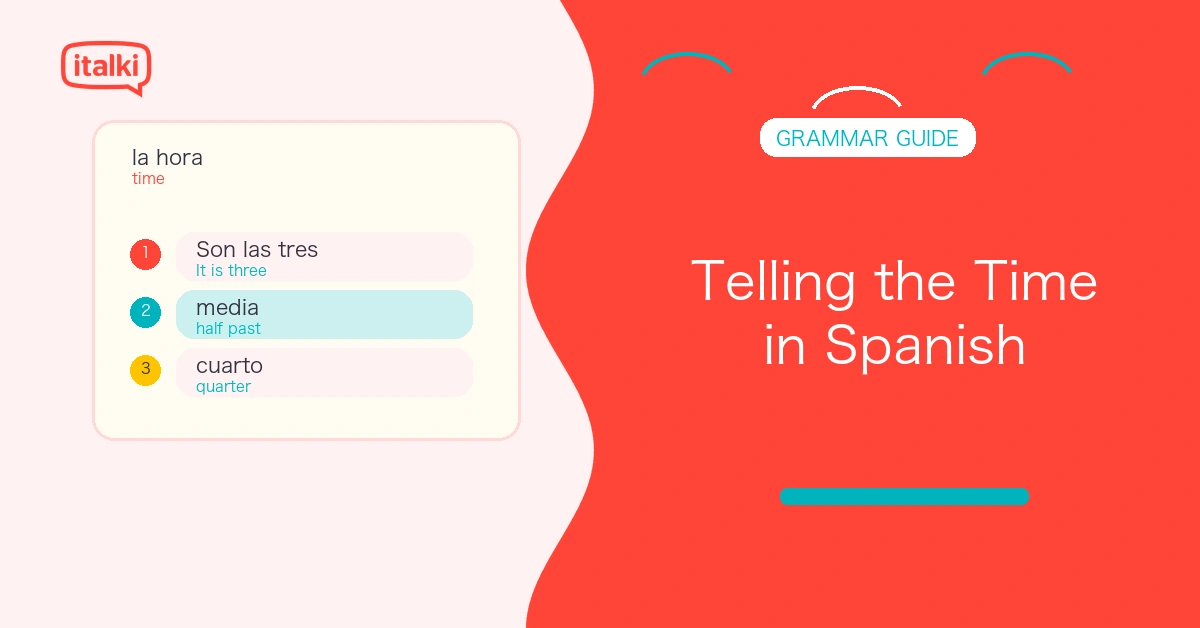
- Spanish uses a quarter-hour system to describe times near the hour: y cuarto (quarter past), y media (half past), and menos cuarto (quarter to). These expressions are used in everyday conversation throughout the Spanish-speaking world.
- To ask what time is it? in Spanish, say ¿Qué hora es? To ask at what time? before an event, say ¿A qué hora?
- Spanish describes the time of day through phrases: de la mañana (morning/AM), de la tarde (afternoon/PM), and de la noche (evening). Spanish also uses a 24-hour clock in formal and written contexts.
Telling time in Spanish is one of the first practical skills that opens up real conversations: scheduling plans, catching a bus, confirming a meeting, or asking when a shop closes. The grammar is straightforward once you see the pattern, but the quarter-hour system and the singular/plural rule for es/son catch many learners by surprise.
The fastest way to internalize time vocabulary is to use it in actual conversations, not just practice with a clock face. italki connects you with Spanish teachers who can run scheduling and appointment conversations with you so time expressions become automatic responses rather than things you have to calculate before saying.
This guide covers how to say the hour in Spanish, the minute and quarter-hour system, AM and PM, how to ask and answer time questions, and the most common time-related expressions used in daily conversation.
A Spanish tutor can practice scheduling dialogues with you, from setting meeting times to discussing daily routines, so time vocabulary is ready for the real conversations where you need it.

Find your perfect teacher
Build real speaking confidence with personalized lessons from a teacher who matches your goals, schedule, and learning style.
Book a trial lesson
How to say the hour in Spanish
The formula for telling time in Spanish is: es/son + las/la + number.
- Use es la for 1:00 only (singular).
- Use son las for all other hours (plural).
| Time | Spanish | Pronunciation guide |
|---|---|---|
| 1:00 | Es la una | ess la OO-na |
| 2:00 | Son las dos | son las dos |
| 3:00 | Son las tres | son las trays |
| 4:00 | Son las cuatro | son las KWAH-troh |
| 5:00 | Son las cinco | son las SEEN-koh |
| 6:00 | Son las seis | son las says |
| 7:00 | Son las siete | son las SYEH-teh |
| 8:00 | Son las ocho | son las OH-choh |
| 9:00 | Son las nueve | son las NWEH-veh |
| 10:00 | Son las diez | son las dyess |
| 11:00 | Son las once | son las ON-seh |
| 12:00 | Son las doce | son las DOH-seh |
Special times:
| Spanish | English |
|---|---|
| Es mediodía | It is noon |
| Es medianoche | It is midnight |
| Son las doce del mediodía | It is 12:00 noon |
| Son las doce de la medianoche | It is 12:00 midnight |
En punto means exactly or on the dot: Son las tres en punto = It is exactly 3:00.
Minutes and the quarter-hour system
For minutes between 1 and 29, add y (and) plus the number of minutes:
| Time | Spanish | Literal meaning |
|---|---|---|
| 3:10 | Son las tres y diez | Three and ten |
| 5:25 | Son las cinco y veinticinco | Five and twenty-five |
| 8:15 | Son las ocho y cuarto | Eight and quarter |
| 2:30 | Son las dos y media | Two and half |
For minutes between 31 and 59, Spanish subtracts from the next hour using menos (minus):
| Time | Spanish | Literal meaning |
|---|---|---|
| 4:45 | Son las cinco menos cuarto | Five minus quarter |
| 7:50 | Son las ocho menos diez | Eight minus ten |
| 11:40 | Son las doce menos veinte | Twelve minus twenty |
The quarter-hour markers:
| Expression | Meaning | Example |
|---|---|---|
| y cuarto | quarter past | Son las dos y cuarto (2:15) |
| y media | half past | Son las dos y media (2:30) |
| menos cuarto | quarter to | Son las tres menos cuarto (2:45) |
Note on regional variation: Latin American Spanish commonly uses the menos system. However, in everyday speech in many regions, people also say the full minutes: Son las dos y cuarenta y cinco (2:45) instead of son las tres menos cuarto. Both are correct and understood everywhere.
Find your perfect teacher
Build real speaking confidence with personalized lessons from a teacher who matches your goals, schedule, and learning style.
Book a trial lesson
Am and pm in Spanish
Spanish does not use AM and PM in the same way as English. Instead, the time of day is specified with a prepositional phrase after the time:
| Expression | Used for | Example |
|---|---|---|
| de la mañana | morning (roughly midnight to noon) | Son las nueve de la mañana (9 AM) |
| del mediodía | around noon | Es la una del mediodía (1 PM / noon area) |
| de la tarde | afternoon (roughly noon to around 8 PM) | Son las cinco de la tarde (5 PM) |
| de la noche | evening/night (roughly 8 PM onward) | Son las diez de la noche (10 PM) |
| de la madrugada | very late night / early morning (midnight to around 6 AM) | Son las tres de la madrugada (3 AM) |
24-hour clock: Formal writing, official schedules, and transport in Spanish-speaking countries typically use the 24-hour format: 17:30 is read as las diecisiete y treinta or simply written in numerals. Train tickets, flight schedules, and official appointments use this system.
Asking and answering what time is it?
| Situation | Spanish | English |
|---|---|---|
| Asking the time | ¿Qué hora es? | What time is it? |
| Polite form | Perdone, ¿qué hora es? / ¿Me podría decir la hora? | Excuse me, what time is it? / Could you tell me the time? |
| Asking when something happens | ¿A qué hora empieza? | At what time does it start? |
| Saying at [time] | A las tres / A la una | At three o’clock / At one o’clock |
| Approximate time | Son las tres y pico / Son casi las cuatro | It is just past three / It is almost four |
| Time has passed | Ya son las cinco | It is already five |
| Early/late | Es temprano / Es tarde | It is early / It is late |
Common answers:
| Spanish | English |
|---|---|
| Son las cuatro de la tarde | It is 4 PM |
| Empieza a las ocho y media | It starts at 8:30 |
| Llego a las nueve menos cuarto | I arrive at 8:45 |
| La reunión es a las dos en punto | The meeting is at exactly 2:00 |
For how time expressions fit into sentence structure in Spanish, including how to use a las, desde las, and hasta las in full sentences, the guide to Spanish sentence structure covers the prepositional and verbal patterns that appear throughout time-related conversation.
Find your perfect teacher
Build real speaking confidence with personalized lessons from a teacher who matches your goals, schedule, and learning style.
Book a trial lesson
Common time expressions
Beyond telling the clock time, Spanish has a full set of expressions for talking about when things happen:
| Spanish | English |
|---|---|
| ahora | now |
| ahora mismo | right now |
| pronto | soon |
| tarde | late |
| temprano | early |
| en seguida | right away |
| de repente | suddenly |
| a tiempo | on time |
| con retraso | late / delayed |
| con anticipación | in advance |
| por la mañana | in the morning |
| por la tarde | in the afternoon |
| por la noche | in the evening |
| a mediodía | at noon |
| a medianoche | at midnight |
Frequency and duration:
| Spanish | English |
|---|---|
| ¿Cuánto tiempo dura? | How long does it last? |
| Dura dos horas | It lasts two hours |
| Hace media hora | Half an hour ago |
| Dentro de una hora | In one hour |
| Cada hora | Every hour |
For the vocabulary used to describe time as temprano (early), tarde (late), rápido (fast), and other descriptive words in context, the guide to Spanish adjectives covers how descriptive vocabulary functions in Spanish sentences.
Practice time conversations with a teacher
Time expressions appear in almost every practical Spanish conversation. Scheduling plans, asking when a restaurant closes, confirming when a class starts: all require the vocabulary in this guide to come out automatically in real-time, not after calculating.
With 30,000+ tutors on italki, there are Spanish teachers who focus on everyday practical fluency including scheduling, appointments, and daily routine descriptions. Book a trial lesson and ask your teacher to run a scheduling conversation: plan your week together in Spanish, discuss your daily schedule, and practice every time expression until the responses come out without thinking.
Find your perfect teacher
Build real speaking confidence with personalized lessons from a teacher who matches your goals, schedule, and learning style.
Book a trial lesson
FAQ
How do you say what time is it? in Spanish?
The standard way is ¿Qué hora es? A more polite version when asking a stranger is Perdone, ¿me podría decir la hora? (Excuse me, could you tell me the time?). In casual contexts with someone you know, ¿Qué hora tienes? (What time do you have?) is also common.
Why does Spanish use es for 1:00 and son for all other times?
Because the verb agrees with the noun. La hora (the hour/time) is singular when referring to one o’clock (la una), so the singular verb es is used. All other hours are plural (las dos, las tres, etc.), so the plural verb son is used. This is the only grammatical rule specific to telling time in Spanish.
How do you say at what time? in Spanish?
Use ¿A qué hora? followed by the verb: ¿A qué hora empieza la película? (At what time does the film start?). The answer follows the same structure: La película empieza a las nueve (The film starts at nine).
Does Spanish use AM and PM?
Not the abbreviations in the same way English does. Instead, Spanish specifies the time of day: de la mañana (morning), de la tarde (afternoon/evening), de la noche (night). In formal written contexts, the 24-hour format is common.
How do you say half past and quarter past in Spanish?
Half past uses y media: Son las tres y media (3:30). Quarter past uses y cuarto: Son las tres y cuarto (3:15). Quarter to uses menos cuarto: Son las cuatro menos cuarto (3:45).
Want to learn a language at italki?
Here are the best resources for you!