Key takeaways
- Compliments in Japanese sound best when they are specific, polite, and suited to the relationship between speakers.
- Start with safe phrases like すごいですね (sugoi desu ne), 似合っています (niatte imasu), and 上手ですね (jōzu desu ne).
- Replies matter as much as the compliment itself. A modest response like ありがとうございます (arigatō gozaimasu) or いえいえ (ie ie) sounds natural.
- Live practice with a Japanese tutor helps you match tone, politeness level, and timing before using compliments in real conversations.
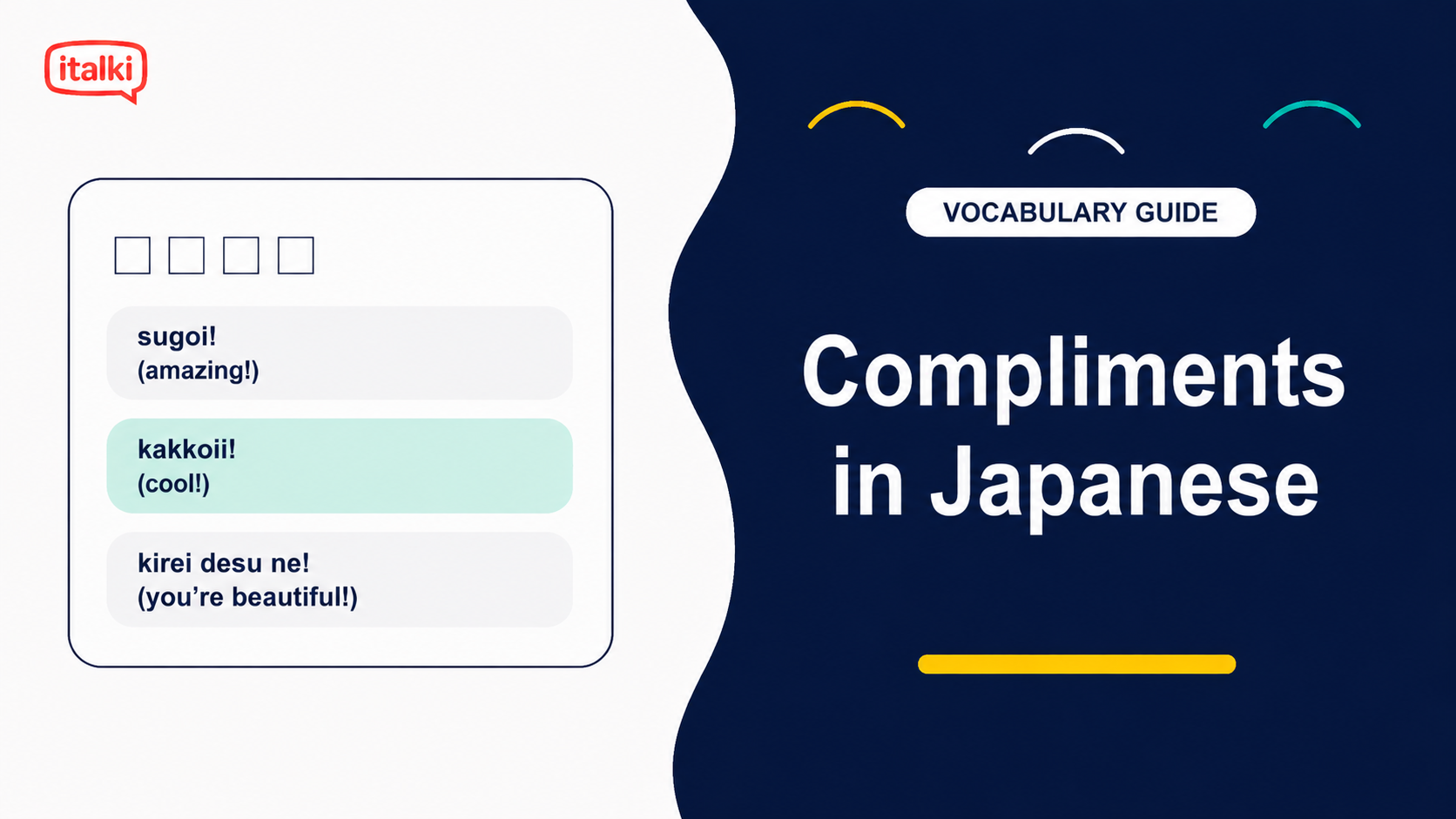
Compliments in Japanese work best when they are specific, modest, and matched to the relationship. Start with すごいですね (sugoi desu ne), 似合っています (niatte imasu), and 上手ですね (jōzu desu ne), then learn when each one feels natural.
The gap between knowing a phrase and saying it with the right softness is where most beginners freeze, which is why live correction from a native speaker matters before any real conversation. italki connects learners with 30,000+ teachers across 150+ languages and has helped over 10 million people get exactly this kind of speaking practice.
Practice compliment tone, sentence endings, and modest replies with a Japanese tutor before using these phrases in daily conversation.

Find Your Perfect Teacher
Practice compliments in japanese with a Japanese tutor who can correct pronunciation, phrasing, listening speed, and natural replies in real time.

What are the most useful compliments in Japanese for beginners?
The most useful compliments in Japanese are short, polite phrases that praise effort, skill, style, or kindness. Beginners should learn fixed expressions first, then change one word at a time. Add ですね (desu ne) at the end to soften the compliment into a friendly “isn’t it” instead of a flat judgment.
| Japanese | Pronunciation | Meaning | Best use |
|---|---|---|---|
| すごいですね | sugoi desu ne | That’s great | Safe praise for effort, news, skill, or results |
| 素敵ですね | suteki desu ne | That’s lovely | Clothes, design, photos, atmosphere |
| 上手ですね | jōzu desu ne | You’re good at that | Skills, hobbies, language, music |
| 似合っています | niatte imasu | It suits you | Clothes, hair, glasses, colors |
| かわいいですね | kawaii desu ne | That’s cute | Pets, accessories, style |
| 優しいですね | yasashii desu ne | You’re kind | Helpful behavior and considerate actions |
A beginner mistake is using すごい for everything. It works often, but Japanese has better choices when you want to praise clothes, kindness, or effort specifically.
Japanese compliments follow politeness patterns rooted in keigo, the honorific speech system that sorts language into polite, humble, and respectful levels. Choosing the wrong level can turn a warm compliment into an awkward overstep.
Opening with a proper greeting before a compliment makes the praise land better instead of feeling sudden, a skill covered in Japanese greetings.
How do you compliment someone’s appearance in Japanese?
Appearance compliments in Japanese sound more natural when they focus on an item, style, or change rather than the person’s body. Compliment the shirt, hairstyle, color, or overall look. The safest beginner structure is noun plus 似合っています (niatte imasu), “it suits you,” which works for clothes, hair, glasses, and accessories.
| Japanese | Pronunciation | Meaning | Natural situation |
|---|---|---|---|
| そのシャツ、似合っています | sono shatsu, niatte imasu | That shirt suits you | Casual but polite |
| 髪型、素敵ですね | kamigata, suteki desu ne | Your hairstyle looks lovely | After a haircut |
| メガネ、似合っていますね | megane, niatte imasu ne | Your glasses suit you | New glasses |
| 今日の服、かっこいいですね | kyō no fuku, kakkoii desu ne | Your outfit today is cool | Friend, classmate, coworker |
For someone you do not know well, avoid personal comments like きれいですね (kirei desu ne), “you’re beautiful.” It often feels too intimate with a coworker or new acquaintance. Aim きれい at an item instead: きれいな写真ですね (kirei na shashin desu ne), “that’s a beautiful photo,” is safer than direct praise of a person.
The pattern その + noun + 似合っていますね (sono + noun + niatte imasu ne) covers most situations. その帽子、似合っていますね (sono bōshi, niatte imasu ne) means “that hat suits you,” and swapping in ジャケット, メガネ, or 髪型 covers jackets, glasses, and hairstyles the same way.
かわいい (kawaii) does not only mean “cute” in a childish way. It often praises a bag, design, pet, or outfit detail, since the word has grown from a narrow adjective into a much broader marker of style and appeal.
Knowing how to direct appearance praise at an item rather than a person is a judgment call that reading alone does not build. An online Japanese teacher gives real-time feedback on whether your phrasing sounds warm or crosses into territory that makes a coworker uncomfortable.
Find Your Perfect Teacher
Practice compliments in japanese with a Japanese tutor who can correct pronunciation, phrasing, listening speed, and natural replies in real time.
How do you compliment skills and work in Japanese?
Skill compliments in Japanese often praise effort and improvement, not only talent. 上手ですね (jōzu desu ne), “skillful,” is the most common praise word for ability, and it sounds more natural paired with a specific noun.
| Japanese | Pronunciation | Meaning | Use it for |
|---|---|---|---|
| 日本語が上手ですね | nihongo ga jōzu desu ne | Your Japanese is good | Language learning |
| 料理が上手ですね | ryōri ga jōzu desu ne | You’re good at cooking | Home meals, cooking talk |
| 説明がとても分かりやすいです | setsumei ga totemo wakariyasui desu | Your explanation is easy to understand | Teacher, coworker, classmate |
| さすがですね | sasuga desu ne | As expected, impressive | Someone with a strong reputation |
| よく頑張りましたね | yoku ganbarimashita ne | You worked hard | Encouraging praise after effort |
Be careful with 日本語が上手ですね. Japanese speakers often say it to learners after a few basic sentences, so it frequently functions as polite encouragement rather than a serious skill assessment.
To sound more specific, praise the exact skill: 発音がきれいですね (hatsuon ga kirei desu ne), “your pronunciation is clear,” or 漢字をたくさん知っていますね (kanji o takusan shitte imasu ne), “you know a lot of kanji.”
When praising work, avoid sounding like a supervisor unless that is your role. 勉強になりました (benkyō ni narimashita), “that was a learning experience for me,” shifts the praise from “you did well” to “you helped me,” which reduces the evaluative weight.
Phrases like 上手な, きれいな, and 分かりやすい follow regular adjective patterns, and Japanese adjective conjugation shows how to shift them into past, negative, or noun-modifying forms.
Getting the nuance right on さすがですね, which sounds admiring toward a senior but patronizing toward a junior, is one of the harder calls in workplace Japanese. A tutor with business experience can flag these misfires before they happen.
How do you compliment personality and kindness in Japanese?
Personality compliments in Japanese feel warm when they point to behavior. Instead of saying “you are a good person,” praise the helpful action you noticed. 優しいですね (yasashii desu ne), “you’re kind,” is one of the safest compliments in any context.
| Japanese | Pronunciation | Meaning | Natural situation |
|---|---|---|---|
| 優しいですね | yasashii desu ne | You’re kind | Someone helps you |
| 親切ですね | shinsetsu desu ne | You’re helpful | More polite than casual praise |
| 気が利きますね | ki ga kikimasu ne | You’re thoughtful | Someone notices needs early |
| 話しやすいです | hanashiyasui desu | You’re easy to talk to | Good for friends or classmates |
| 頼りになります | tayori ni narimasu | You’re dependable | Work, study, group tasks |
気が利く (ki ga kiku) carries an advanced social weight. It praises anticipatory awareness, like bringing extra cups before anyone asks or noticing someone needs help without being told.
A natural example: 手伝ってくれて、ありがとうございます。優しいですね (tetsudatte kurete, arigatō gozaimasu, yasashii desu ne), “thank you for helping me, you’re kind.” For someone easy to talk to, name + さんは話しやすいです (hanashiyasui desu) works well.
Getting さん right alongside the rest of Japanese honorifics keeps compliments from sounding too casual or too distant.
How should you reply to compliments in Japanese?
The most natural reply to a compliment in Japanese is modest thanks. A simple ありがとうございます (arigatō gozaimasu) works well, and adding いえいえ (ie ie) brings in humility. Beginners often reply with only ありがとう, which is fine with friends, but ありがとうございます is safer in polite settings.
| Japanese reply | Pronunciation | Meaning | Tone |
|---|---|---|---|
| ありがとうございます | arigatō gozaimasu | Thank you very much | Polite and safe |
| いえいえ | ie ie | No, no | Modest, soft denial |
| まだまだです | mada mada desu | I still have a long way to go | Humble reply to skill praise |
| そんなことないです | sonna koto nai desu | That’s not true | Modest denial |
| うれしいです | ureshii desu | That is nice to hear | Warm and direct |
A strong beginner reply is ありがとうございます。うれしいです (arigatō gozaimasu, ureshii desu), “thank you, that is nice to hear.” For skill praise, add でも、まだまだです (demo, mada mada desu), “but I still have a long way to go.”
This modest deflection is a well-known feature of Japanese communication. Speakers often respond to compliments with a deflection or a follow-up question rather than a flat thank you, unlike the more direct acceptance common in English. Repeating そんなことないです too often, though, can pressure the other person to keep reassuring you, so a balanced reply still accepts the kindness.
Compliment replies are where tone does most of the work. The difference between a まだまだです that sounds genuinely humble and one that sounds dismissive is in the pitch, pause, and facial expression. A private Japanese teacher can model both versions and correct you in real time, which text alone cannot replicate.
Find Your Perfect Teacher
Practice compliments in japanese with a Japanese tutor who can correct pronunciation, phrasing, listening speed, and natural replies in real time.
What makes a Japanese compliment sound natural instead of awkward?
A natural Japanese compliment has the right target, politeness level, and timing. The safest compliment praises effort, skill, style, or a choice rather than private physical details.
Adding ね (ne) softens a compliment from a verdict into a shared observation. Compare 発音がいいです (hatsuon ga ii desu), a flat judgment, with 発音がいいですね (hatsuon ga ii desu ne), which feels conversational.
Brevity matters too. One clear compliment plus a smile beats a long string of praise. あなたは本当にすごく美しくて完璧です (anata wa hontō ni sugoku utsukushikute kanpeki desu), “you are very beautiful and perfect,” is grammatically fine but too heavy for daily situations. あなた (anata) itself is rarely used face to face, since directly saying “you” already feels pointed, and it’s typically reserved for romantic contexts or formal writing.
Match the register to the relationship. With a close friend, いいね, すごいね, and かわいいね sound natural. With a teacher, coworker, or new acquaintance, switch to いいですね, すごいですね, and 素敵ですね. In the workplace, keep praise focused on clarity and effort, as in 資料が分かりやすかったです (shiryō ga wakariyasukatta desu), “the materials were easy to understand.”
This indirectness runs through Japanese culture more broadly, which is why modest replies carry so much weight in everyday conversation.
How should beginners practice compliments in Japanese?
Beginners should practice compliments as short exchanges, not isolated vocabulary. A good drill includes the compliment, the other person’s reply, and a follow-up.
Scene 1: Complimenting an outfit
A: そのセーター、似合っていますね。 (Sono sētā, niatte imasu ne.) That sweater suits you.
B: ありがとうございます。うれしいです。 (Arigatō gozaimasu. Ureshii desu.) Thank you. That is nice to hear.
A: 色もいいですね。 (Iro mo ii desu ne.) The color is nice too.
Scene 2: Complimenting a skill
A: 日本語の発音がきれいですね。 (Nihongo no hatsuon ga kirei desu ne.) Your Japanese pronunciation is clear.
B: ありがとうございます。でも、まだまだです。 (Arigatō gozaimasu. Demo, mada mada desu.) Thank you. But I still have a long way to go.
Once these feel comfortable, swap in new nouns. Replace セーター with ジャケット, バッグ, or 髪型. Replace 発音 with 説明, 料理, or 歌.
Compliment exchanges are a natural extension of conversational Japanese practice, since both depend on timing and reaction rather than memorized lines. The real challenge is delivery: getting the pitch and softness right on ですね versus です needs a real listener correcting you in the moment.
Start giving compliments in Japanese with better timing
Compliments in Japanese are easier when you learn phrase pairs: what to say, when to say it, and how the other person may reply. Start with すごいですね, 似合っています, 上手ですね, 優しいですね, and ありがとうございます, then build from real situations.
Compliment delivery depends on pitch, pausing, and politeness level, making it one of the hardest things to self-study from a textbook. italki gives beginners access to native Japanese speakers across 150+ languages who specialize in conversation coaching and cultural context. Book a trial lesson to practice appearance, skill, and kindness compliments with guided correction before your next real conversation.
Find Your Perfect Teacher
Practice compliments in japanese with a Japanese tutor who can correct pronunciation, phrasing, listening speed, and natural replies in real time.
FAQ
What is the easiest compliment in Japanese for beginners?
すごいですね (sugoi desu ne) is the easiest all-purpose compliment. It means “That’s great” and works for effort, results, skills, and good news.
How do you say “you look good” in Japanese?
Use 似合っています (niatte imasu), “it suits you.” そのシャツ、似合っています means “That shirt suits you.” This item-focused approach sounds more natural than direct body praise.
Is かわいい a compliment in Japanese?
Yes. かわいい (kawaii) is a common compliment for cute things, style, pets, accessories, and sometimes people. Use it carefully in formal settings, where 素敵 (suteki) may fit better.
How should someone reply to 上手ですね?
A natural reply is ありがとうございます。でも、まだまだです, “Thank you. But I still have a long way to go.” It balances gratitude with expected modesty.
Is it rude to accept a compliment in Japanese?
No. A polite thank-you is perfectly natural. The key is to accept warmly while staying modest. ありがとうございます、うれしいです works well in casual and polite situations alike.
Want to learn a language at italki?
Here are the best resources for you!