Key takeaways
- Difficult words in Spanish follow repeatable patterns: silent h (ahora), shared b/v sounds (vivir), position-based g and j (gente, jirafa), and trilled rr (perro).
- Accent marks are not decoration. They tell you which syllable to stress, and misplacing stress changes what a listener hears (practicó vs. práctica).
- Long words like otorrinolaringólogo and desarrollador become manageable when you break them into syllable blocks and identify the one trap inside each block.
- Practicing these words inside full sentences with a Spanish tutor builds pronunciation habits that isolated word repetition does not.
Difficult words in Spanish usually trip you up because the spelling sends the wrong signal: silent h, identical b and v, g that changes sound depending on the next vowel, trilled rr, and accent marks that shift stress to an unexpected syllable.
If words like refrigerador, vergüenza, izquierda, and otorrinolaringólogo make you hesitate mid-sentence, practice them with a Spanish teacher who can hear the exact sound that breaks down, correct it, and have you try again until the pattern sticks.

Find Your Perfect Teacher
Your Spanish doesn’t have to sound like a textbook. Get personalized lessons from native tutors who’ll help you speak naturally, not just correctly.

What makes difficult words in Spanish hard to pronounce?
Most pronunciation trouble in Spanish comes from four collision points between spelling and sound: letters that stay silent, letters that share a sound, letters that change value based on the vowel after them, and stress that lands on a syllable English speakers would not expect.
Spanish spelling is far more phonetic than English, but it still has specific traps. The letter h carries no sound in standard Spanish. B and v map to the same phoneme. And c before e or i shifts its value entirely. These are not quirky exceptions. They are systematic rules you can learn once and apply to every new word.
Here are the main difficulty types covered in this guide:
| Problem type | Example words | What goes wrong | Fix |
|---|---|---|---|
| Silent letter | ahora, alcohol | Saying the h out loud | Skip h entirely |
| Same sound, different spelling | vaca, barco | Using an English v lip-bite | Use a soft Spanish b for both |
| Position-based sound | gente, guerra | Guessing from English g | Check the vowel after g |
| Rolled r | perro, alrededor | Tensing jaw and throat | Tongue tip near the alveolar ridge, light air bursts |
| Stress | difícil, teléfono | Stressing the wrong syllable | Follow the written accent mark |
If you already handle everyday phrases but freeze on trickier vocabulary, try mixing these words into short exchanges. The guide on basic conversation Spanish gives you simple sentence frames to drop hard words into.
Which difficult words in Spanish have silent letters?
The letter h is the main silent-letter problem in Spanish. You write it, you see it, but you do not pronounce it. In standard modern Spanish, h carries no sound.
Here are common words where h catches learners off guard:
| Word | Pronunciation | Meaning | Learner trap |
|---|---|---|---|
| hola | OH-la | hello | Adding an English H at the start |
| ahora | a-O-ra | now | Breathing out on the h between vowels |
| hablar | a-BLAR | to speak | Starting with “ha” instead of a clean “a” |
| hermano | er-MA-no | brother | Treating it like English “her” |
| zanahoria | sa-na-O-ria | carrot | Pausing at the hidden h |
| almohada | al-mo-A-da | pillow | Saying al-mo-HA-da |
Almohada is a useful self-test. Record yourself saying it. If you hear a breathy push before the final “a-da,” the h is leaking through.
The real challenge with silent h is not the isolated word. It is the flow between vowels inside connected speech. When you say ¿Puedes hablar ahora? (PWE-des a-BLAR a-O-ra, “Can you talk now?”), three silent h’s appear across two words. If you puff air on any of them, the rhythm breaks and you sound like you are pausing to read rather than speaking. Try saying the sentence while tapping the table at each syllable to keep the rhythm steady.
Mi hermano compró zanahorias (mi er-MA-no kom-PRO sa-na-O-rias, “My brother bought carrots”) is a good follow-up drill because the h in hermano sits right after the m in mi, creating a vowel bridge that needs to stay smooth.
If you also struggle to type the accent marks you see in these words during note-taking or chat, how to type Spanish accents covers keyboard shortcuts for every platform.
Why do b and v sound the same in Spanish, and how should you handle them?
Spanish spelling separates b and v, but standard pronunciation does not give them different sounds the way English does. For learning purposes, treat both letters as the same b-like sound rather than using an English v lip-bite.
The practical rule: stop biting your lower lip for v. Use a soft b for both.
| Word | Pronunciation | Meaning | English habit to drop |
|---|---|---|---|
| vaca | BA-ka | cow | English v lip-bite |
| vivir | bi-BIR | to live | Two English v sounds |
| beber | be-BER | to drink | Over-hard b on every syllable |
| vacaciones | ba-ka-SYO-nes | vacation | English v at the start |
| volver | bol-BER | to return | Lip-bite on vol- |
The word that stacks the most problems is vergüenza (ber-GWEN-sa, “shame/embarrassment”). It opens with the b/v trap, then hits the güe cluster in the middle. The dieresis (ü) tells you to pronounce the u. In plain gue (like guerra), the u stays silent and only serves to keep the g hard. The dieresis signals that you voice the u as a separate sound: gwen, not gen.
So vergüenza hits you with three difficulties in five syllables: the soft b start, the güe cluster, and the final -sa where you need to avoid adding a final vowel.
A useful drill for internalizing the b/v merger is to pair words where the spelling alternates but the mouth movement stays identical. Say each pair slowly, then at normal speed, making sure both words start with the same lip position:
- vino / boca (BI-no / BO-ka)
- verde / burro (BER-de / BU-rro)
- Full sentence: Me da vergüenza beber vino en las vacaciones. (“I feel embarrassed drinking wine on vacation.”)
That sentence forces you to produce b/v five times in a row. If your lip catches your teeth on any of them, you have found the exact spot to fix.
An online Spanish teacher can run a listening discrimination test, alternating between vino and bino to show that both should sound identical, then check whether your own production matches.
Find Your Perfect Teacher
Your Spanish doesn’t have to sound like a textbook. Get personalized lessons from native tutors who’ll help you speak naturally, not just correctly.
How do g, j, c, z, and qu change the sound of Spanish words?
These consonants are position-dependent: the vowel that follows them decides which sound comes out of your mouth. Once you internalize the pattern, you can pronounce unfamiliar words on sight without guessing.
| Pattern | Words | Sound |
|---|---|---|
| ga, go, gu | gato, goma, gusto | Hard g (like English “go”) |
| gue, gui | guerra, guitarra | Hard g, u is silent |
| güe, güi | vergüenza, pingüino | Hard g, u is pronounced |
| ge, gi | gente, girar | Rough h from the throat (the voiceless velar fricative) |
| ja, je, ji, jo, ju | jamón, jefe, jirafa, joven, jugo | Rough h from the throat (the voiceless velar fricative) |
| ca, co, cu | casa, cosa, cuchara | k sound |
| que, qui | queso, quince | k sound, u is silent |
| ce, ci, z | cena, cinco, zapato | s in most of Latin America, th-like in much of Spain |
The Spanish j is where English speakers sound most foreign. Do not say jirafa with an English “j” (like “giraffe”). Say hi-RA-fa, with a rougher, more guttural h than you would use in English. The sound is produced at the back of the soft palate, not at the front of the mouth. If you have ever cleared your throat lightly, you are already close to the right placement.
Practice these contrasting sets by reading across each row, feeling the position of your tongue change:
- gato (GA-to, “cat”) then gente (HEN-te, “people”): same letter, different vowel, completely different sound.
- guerra (GE-rra, “war”) then vergüenza (ber-GWEN-sa, “embarrassment”): both have gue, but the dieresis in the second word turns the silent u into a spoken one.
- queso (KE-so, “cheese”) then cena (SE-na, “dinner”): c before a back vowel gives k, c before a front vowel gives s (or th).
The c/z/s variation across regions is worth knowing early. Most Spanish speakers worldwide use an s-like sound for c before e/i and for z. Speakers in much of central and northern Spain use a th-like sound instead, a pattern commonly called distinción. Neither pronunciation is wrong, but you want to be consistent with one model.
Here is a sentence that packs several of these position-dependent sounds together: El jefe quiere queso y gente generosa para la cena. (el HE-fe KYE-re KE-so i HEN-te he-ne-RO-sa PA-ra la SE-na, “The boss wants cheese and generous people for dinner.”) Reading it aloud forces you to switch between hard g, guttural j, silent-u qu, and soft c in quick succession.
Which Spanish words are hard because of r and rr?
Spanish uses two distinct r sounds: a quick single tap (the alveolar tap) and a longer trill (the alveolar trill). Getting this wrong changes meaning outright, not just accent.
| Single r (tap) | Meaning | Double rr (trill) | Meaning |
|---|---|---|---|
| caro (KA-ro) | expensive | carro (KA-rro) | car |
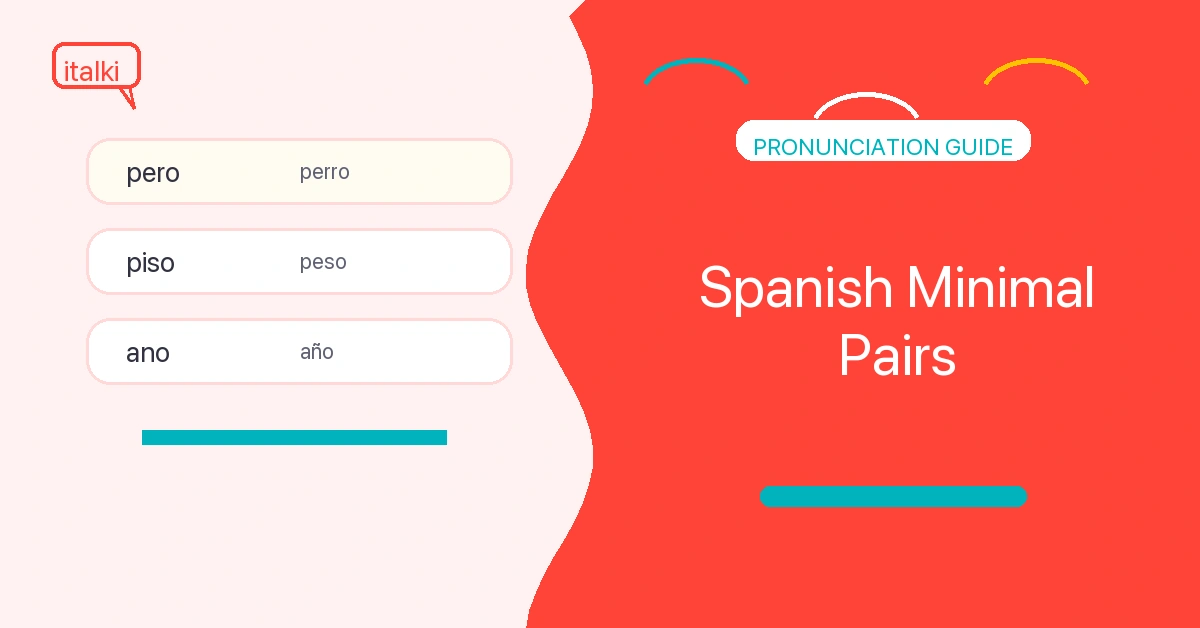
| pero (PE-ro) | but | perro (PE-rro) | dog |
| cero (SE-ro) | zero | cerro (SE-rro) | hill |
These minimal pairs show that the difference between r and rr is not cosmetic. Saying pero when you mean perro changes the entire sentence from “but” to “dog.”
Other tough rr words to drill:
- arroz (a-RROS), “rice”
- rojo (RO-ho), “red” (word-initial r is trilled)
- alrededor (al-re-de-DOR), “around”
- ferrocarril (fe-rro-ka-RRIL), “railway”
A single r at the start of a word or after l, n, or s also gets the trill. So rojo starts with a trill even though it is written with one r. The same applies to alrededor, where the r after l gets the trill.
If your trill will not come, do not clench your jaw. Place the tongue tip lightly against the alveolar ridge (the bumpy area just behind your top front teeth) and push small bursts of air past it. A common mistake is pressing the tongue too hard against the ridge, which locks it in place. The trill requires the tongue to be loose enough to vibrate. Start with just the sound: rrr. Then attach vowels: rra, rre, rri. Then try single words: perro, arroz.
Then a phrase: El perro come arroz. (“The dog eats rice.”)
Ferrocarril is the ultimate rr stress test because it contains two trilled clusters (ferro- and -rril) plus a final consonant cluster. Break it down: fe-rro-ka-RRIL. Drill the two halves separately (ferro, carril), then glue them together.
For extra rr reps built into rhythm and speed, Spanish tongue twisters pairs well with this kind of drill.
When self-practice stalls, the issue is usually tongue position rather than effort. A Spanish tutor online watching your mouth on camera can tell you whether your tongue is too far back, too tense, or angled incorrectly, and that single correction often unblocks the trill within a few sessions.
Find Your Perfect Teacher
Your Spanish doesn’t have to sound like a textbook. Get personalized lessons from native tutors who’ll help you speak naturally, not just correctly.
How do accent marks change difficult Spanish words?
Accent marks (tildes) tell you which syllable gets stress, and misplacing stress distorts the whole word. Spanish has clear default stress patterns: words ending in a vowel, n, or s usually stress the second-to-last syllable; words ending in any other consonant usually stress the last syllable. A written accent mark overrides these defaults.
Here are words learners commonly flatten by stressing the wrong syllable:
| Word | Pronunciation | Meaning | Stress falls on |
|---|---|---|---|
| teléfono | te-LE-fo-no | telephone | second syllable |
| difícil | di-FI-sil | difficult | second syllable |
| rápido | RA-pi-do | fast | first syllable |
| lápiz | LA-pis | pencil | first syllable |
| canción | kan-SYON | song | final syllable |
| país | pa-IS | country | final syllable |
| médico | ME-di-ko | doctor | first syllable |
| miércoles | MYER-ko-les | Wednesday | first syllable |
Accent marks also distinguish words that are otherwise spelled identically. This is where pronunciation and grammar collide, and it is a trap that catches even intermediate learners:
- práctica (PRAK-ti-ka): practice (noun). El equipo necesita más práctica. (“The team needs more practice.”)
- práctico (PRAK-ti-ko): practical (adjective). Es un consejo práctico. (“It is practical advice.”)
- practicó (prak-ti-KO): he/she practiced (past tense verb). Ella practicó toda la semana. (“She practiced all week.”)
A listener hears the stress before the meaning clicks. Saying prak-ti-KO when you mean the noun práctica does not just sound off. It sounds like a past-tense verb, which makes your sentence mean something different from what you intended.
Try reading a paragraph from a news article or a recipe aloud, exaggerating the stress on every accented syllable until the pattern feels natural. Then record yourself and listen back, checking whether your stressed syllable matches the written accent. This self-check catches the most common error: defaulting to English stress patterns and ignoring the tilde altogether.
If you want to reinforce the grammar side of how verb stress shifts across tenses, Spanish grammar practice gives you structured exercises that complement pronunciation work.
Which long Spanish words should you break into syllables?
Long words stop being intimidating when you slice them into small sound blocks, find the one trap in each block, and then read the whole word through.
| Word | Syllable breakdown | Meaning | Main trap |
|---|---|---|---|
| desafortunadamente | des-a-for-tu-na-da-MEN-te | unfortunately | Losing syllables in the middle |
| otorrinolaringólogo | o-to-rri-no-la-rin-GO-lo-go | ENT doctor | rr in block three plus sheer length |
| electrodoméstico | e-lek-tro-do-MES-ti-ko | household appliance | Stress buried in the center |
| responsabilidad | res-pon-sa-bi-li-DAD | responsibility | Final-syllable stress |
| extraordinario | eks-tra-or-di-NA-rio | extraordinary | x at the start plus vowel chain |
| izquierda | is-KYER-da | left | z plus the diphthong ie |
| desarrollador | de-sa-rro-ya-DOR | developer | rr in block three plus final stress |
| refrigerador | re-fri-he-ra-DOR | refrigerator | g before e sounds like rough h |
The letter x adds its own confusion. Between vowels, x typically sounds like [ks] (as in examen, ek-SA-men). Before a consonant, x in casual speech often reduces to [s] (as in explicar, which many speakers say es-pli-KAR rather than eks-pli-KAR). Both pronunciations are considered standard in everyday speech.
That explains why these x-words catch people:
- extranjero (eks-tran-HE-ro or es-tran-HE-ro), “foreigner”
- excelente (ek-se-LEN-te or e-se-LEN-te), “excellent”
- explicación (eks-pli-ka-SYON or es-pli-ka-SYON), “explanation”
Use a three-pass method for any long word:
- Mark the stressed syllable: res-pon-sa-bi-li-DAD.
- Circle the trap letter or cluster: the rr in desarrollador, the g-before-e in refrigerador.
- Say the whole word inside a sentence: Es una gran responsabilidad. (“It is a big responsibility.”)
Here is a sentence that stacks two long words with different traps, so you can practice transitioning between them: El otorrinolaringólogo tiene un refrigerador extraordinario. (“The ENT doctor has an extraordinary refrigerator.”) Nobody says this in real life, but the absurdity makes it memorable, and you are drilling rr, silent-u ge, and x-before-t in a single pass.
How to put all these tricky words into real sentences
Drilling individual words builds accuracy, but pronunciation lives in connected speech. This section gives you sentence-level practice organized not by sound type but by realistic situation, so you train yourself to produce difficult words under the pressure of actually communicating something.
Giving directions:
- Gire a la izquierda y siga alrededor de la plaza.
HI-re a la is-KYER-da i SI-ga al-re-de-DOR de la PLA-sa. “Turn left and continue around the plaza.” Traps: guttural g in gire, z plus diphthong in izquierda, trilled r-after-l in alrededor.
Talking about work:
- Mi hermano es desarrollador y trabaja con electrodomésticos.
mi er-MA-no es de-sa-rro-ya-DOR i tra-BA-ha kon e-lek-tro-do-MES-ti-kos. “My brother is a developer and works with household appliances.” Traps: silent h in hermano, rr in desarrollador, buried stress in electrodomésticos.
Ordering food:
- ¿Tienen arroz con zanahoria? Es difícil encontrar un buen restaurante rápido.
TYE-nen a-RROS kon sa-na-O-ria? es di-FI-sil en-kon-TRAR un bwen res-tau-RAN-te RA-pi-do. “Do you have rice with carrot? It is difficult to find a good fast restaurant.” Traps: trilled rr in arroz, silent h in zanahoria, accent stress in difícil and rápido.
After running these sentences a few times, try recording yourself telling a short story that combines at least five of the difficult words from this guide. Play it back and mark the spots where you stumble or default to English sound patterns.
When you are ready to turn this into real conversation, bring your word list to a session with an online Spanish tutor for adults and ask them to build a role-play around your weak spots, such as giving directions using izquierda and alrededor, ordering food with arroz and zanahoria, or describing a workplace with desarrollador and responsabilidad. That bridges the gap between drills and speech.
Find Your Perfect Teacher
Your Spanish doesn’t have to sound like a textbook. Get personalized lessons from native tutors who’ll help you speak naturally, not just correctly.
Say difficult Spanish words with clearer pronunciation
Difficult words in Spanish stop feeling random once you sort them by their sound pattern: silent h, shared b/v, position-dependent g and j, r vs. rr, x clusters, and accent-driven stress. The fastest way to close the gap between knowing a pattern and producing it naturally is live correction from a teacher who hears exactly where the sound goes wrong.
Learn Spanish faster with personal guidance from 30,000+ qualified online Spanish tutors trusted by over 10 million learners worldwide. Book a trial lesson today.
Find Your Perfect Teacher
Your Spanish doesn’t have to sound like a textbook. Get personalized lessons from native tutors who’ll help you speak naturally, not just correctly.
FAQ
What are the most difficult words in Spanish for English speakers?
Common difficult words include vergüenza, desarrollador, refrigerador, izquierda, extranjero, alrededor, ferrocarril, and otorrinolaringólogo. They combine traps like rr, guttural j, x, güe, silent h, and unexpected stress placement.
How do I pronounce rr in Spanish?
Place the tongue tip near the alveolar ridge (just behind your top front teeth) and push short bursts of air past it. Keep the tongue loose, not pressed hard. Start with the isolated sound, then attach vowels (rra, rre), then full words (perro, carro, arroz).
Is v pronounced like b in Spanish?
Yes. In standard Spanish, b and v represent the same phoneme. Say vaca, vivir, and volver with a soft b-like closure, not an English v lip-bite.
Why is h silent in Spanish words?
In standard Spanish, h carries no sound. Hola is OH-la, hablar starts with a clean “a,” and ahora is a-O-ra with no breath on the h. The h remains in spelling for historical reasons but does not affect pronunciation.
Do accent marks change pronunciation in Spanish?
They change stress, which changes how the entire word sounds and what it means. Práctica (noun), práctico (adjective), and practicó (past tense verb) are spelled almost identically, but the accent mark shifts stress to a different syllable, signaling a different word entirely.
Want to learn a language at italki?
Here are the best resources for you!