Key takeaways:
- French business communication relies on polite, structured phrases.
- Use formal greetings, titles, and “vous” until invited to be informal.
- Prepare phrases for emails, meetings, and client calls to gain confidence.
- Practicing with a tutor can help refine tone, vocabulary, and workplace skills.
- Essential Business French vocabulary and polite expressions
- Useful French phrases for emails and messages
- French for meetings, calls, and presentations
- French for client communication
- Small talk and workplace culture
- Must-know workplace terms in French business
- Common mistakes learners make in business French
- How to learn Business French faster
- FAQ
French for business requires more than basic vocabulary. In professional contexts, the choice of words, level of formality, and tone all matter. This includes situations like interviewing in French, where phrasing, politeness, and cultural awareness are just as important as vocabulary.
A sentence that sounds perfectly natural in casual French can feel abrupt, or even inappropriate, in the workplace.
I teach French to adults who use the language daily at work: expats in France, professionals working with French-speaking clients, and international teams navigating meetings and emails in French. A recurring challenge is not grammar, but confidence. Learners often know what they want to say, yet hesitate because they are unsure how to say it professionally.
This article focuses on practical, ready-to-use phrases for anyone looking to learn business French, organized by workplace situation, to help you communicate clearly and appropriately in professional environments.
If you want to practise these phrases with a professional French tutor, italki connects you with 30,000+ teachers for flexible, one-on-one lessons tailored to your industry and goals.
Find a business French tutor on italki and start speaking with confidence at work.

Find Your Perfect Teacher
Your French doesn’t have to sound like a textbook. Get personalized lessons from native tutors who’ll help you speak naturally, not just correctly.
Book a trial lesson
Essential Business French vocabulary and polite expressions
Professional French relies heavily on politeness and structure. These foundations apply across emails, meetings, and client interactions in any French business environment.
Professionals who need ready-to-use workplace language can pair vocabulary study with a business French conversation cheat sheet for meetings, emails, calls, and polite follow-ups.
Greetings and polite forms
- Bonjour – Hello. Used at the start of any professional interaction in a French office.
- Bonjour Madame / Bonjour Monsieur – A standard, respectful greeting in formal contexts.
- Enchanté(e) – Nice to meet you. Used during first introductions in business settings.
Professional titles and formality
In French business culture, titles and surnames are often preferred, especially early on. First names usually come later, once a relationship is established.
Formal vs informal “you”
This distinction is essential in French business culture
- Vous is formal and professional.
- Tu is informal and personal.
| Formal (vous) | Informal (tu) | When to use |
|---|---|---|
| Pourriez-vous… | Tu peux… | Professional vs. close friends |
| Je vous remercie | Merci | Clients vs. teammates you know well |
| Vous êtes disponible? | T’es dispo? | Formal meetings vs. casual chat |
In my lessons, I advise students to use vous until explicitly invited to switch. Using tu too early is one of the most common mistakes in French for business.
Protip: If someone invites you to use tu by saying “On peut se tutoyer,” respond with “Avec plaisir” to accept gracefully. Until then, always use vous with clients, managers, and new colleagues.
Polite workplace expressions
- Je vous remercie – Thank you (formal)
- Je reste à votre disposition – I remain available
- Avec plaisir – With pleasure
These expressions are widely expected in the French business environment and help employees maintain professionalism.
Learn more about French greetings for every situation to expand your workplace vocabulary
Useful French phrases for emails and messages
Emails are a central part of professional communication, and knowing how to write an email in French helps you communicate clearly with colleagues and clients. French emails follow clear conventions that learners benefit from mastering early.
Subject line vocabulary
- Objet : Réunion de suivi – Follow-up meeting
- Objet : Demande d’informations – Request for information
Email openings
- Madame, Monsieur, – When the recipient is unknown
- Bonjour Madame Dupont, – Professional and appropriate in most situations.
Asking questions and confirming information
- Pourriez-vous me confirmer… – Could you please confirm…
- Auriez-vous des précisions concernant… – Could you provide further details…
- Veuillez trouver ci-joint… – Please find attached…
Closings
- Cordialement,
- Bien cordialement,
- Respectueusement,
Protip: “Cordialement” is the safest closing for most business emails. Save “Respectueusement” for very formal contexts like government correspondence or senior executives.
Example of a professional email
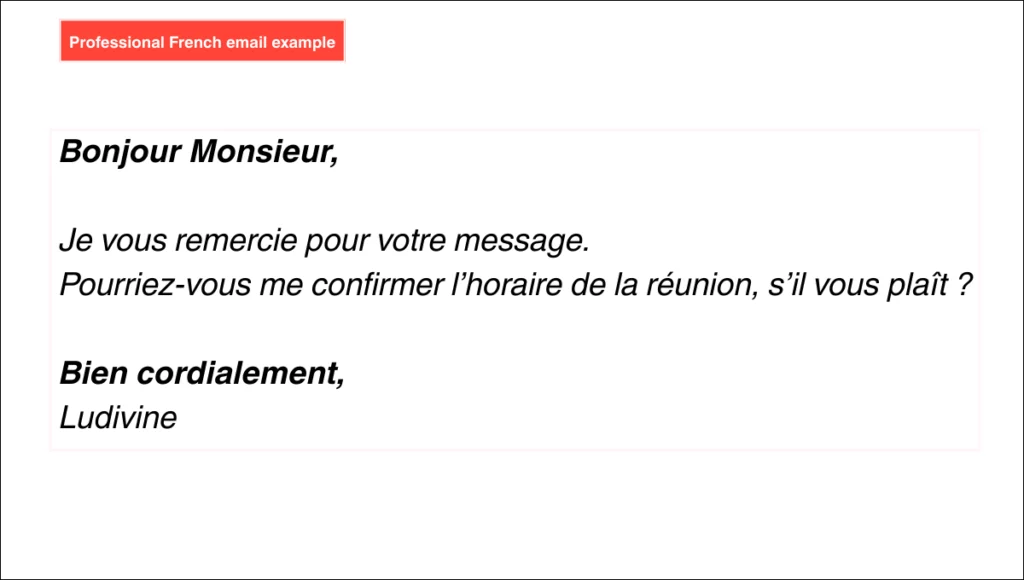
This structure is simple, polite, and widely used in French professional settings.
French for meetings, calls, and presentations
Meetings are often where learners feel the most pressure. Speaking formally, interrupting politely, or expressing disagreement in the francophone business world can be challenging.
Let’s have a look at some of the common phrases you must know:
Participating in meetings
- Pouvons-nous commencer ? – Can we begin?
- Je suis d’accord avec vous – I agree with you
- Je ne suis pas tout à fait d’accord – I do not entirely agree
- Pouvez-vous préciser ? – Could you clarify?
Sharing updates
- Je voulais faire un point sur… – I wanted to give an update on
- Nous avons avancé sur… – We have made progress on…
These phrases are essential when you need to discuss a project, communicate with your team, or present updates to management.
Presenting
- Je vais vous présenter… – I am going to present (for example a new product or business plan etc)
- Je passe maintenant la parole à… – I’ll now hand over to…
- Pour conclure… – To conclude a
Many learners struggle with sounding either too direct or too hesitant. Business French often favours indirect phrasing, which helps maintain a professional tone.
Protip: When you need to disagree in meetings, soften your statement with “Je ne suis pas tout à fait d’accord”rather than a direct “non.” This maintains professional relationships while allowing you to express your perspective.
Ready to practice your meeting confidence? italki’s flexible scheduling allows you to practice real workplace scenarios with expert French tutors who understand your industry and career goals. Book a trial lesson to prepare for your next important presentation or negotiation.
Find Your Business French Tutor today
Find Your Perfect Teacher
Your French doesn’t have to sound like a textbook. Get personalized lessons from native tutors who’ll help you speak naturally, not just correctly.
Book a trial lesson
French for client communication
Client interactions require a particularly careful balance between clarity and politeness.
Service interactions and follow-ups
- Je reviens vers vous concernant…
I’m getting back to you regarding… - Merci pour votre retour.
Thank you for your feedback.
Scheduling and negotiations
- Seriez-vous disponible… ?
Would you be available…? - Nous devons en discuter en interne.
We need to discuss this internally.
Setting boundaries politely
- Nous aurions besoin de plus de détails.
We would need more details. - Cela ne sera pas possible pour le moment.
That won’t be possible for now.
French work culture values structure, punctuality, and respectful distance. Politeness is not optional; it is a marker of professionalism.
Small talk and workplace culture
Although professional, French workplaces do include moments of small talk, often brief but meaningful. Topics often include workload, weekends, food, weather, and current events.
Useful phrases
- Vous avez passé un bon week-end ?
Did you have a good weekend? - Bon courage !
An encouraging phrase frequently used at work when colleagues face challenging tasks or a busy week ahead.
What to avoid
- Asking overly personal questions
- Being too informal too quickly
- Using humor that may not translate culturally
- Discussing sensitive topics like money or politics unless the relationship is well established
Helping learners feel comfortable with these exchanges often improves their overall confidence at work.
Must-know workplace terms in French business
Understanding these terms helps you navigate contracts, HR discussions, and your rights as an employee in France.
Employment contract types
- CDI (Contrat à durée indéterminée) – Permanent contract
The gold standard in France. Offers strong job protection and better benefits.
- CDD (Contrat à durée déterminée) – Fixed-term contract
Temporary contract with a specific end date. Less security but common for project work.
- Période d’essai – Probationary period
Trial period (usually 2-4 months for CDI, up to 8 months possible). Either party can end the contract easily during this time. After this, full employment protections apply.
Leave and time off
- RTT (Réduction du temps de travail) – Compensatory time off
Extra paid days (typically 5-12 per year) for working over 35 hours weekly. Must be used within the year.
- Arrêt maladie – Medical leave certificate
Doctor’s note required for sick leave. Must be sent to employer and Sécurité sociale within 48 hours. Partially paid after 3 days, no annual limit, and you can’t be fired for being sick.
Salary and benefits
- 13ème mois – Thirteenth-month salary
Extra month’s pay (usually in December). Not mandatory everywhere—common in finance, consulting, and large companies. Check your convention collective.
- Solde de tout compte – Final settlement
Final payment when leaving: remaining salary, unused vacation/RTT, and severance if applicable.
- Préavis – Notice period
Required working time after resignation (typically 1-3 months). You must work it unless negotiated otherwise, but you’re paid for the full period either way.
Health and benefits
- Mutuelle – Supplementary health insurance
Covers what public healthcare (Sécurité sociale) doesn’t—glasses, dental, specialists. Employers pay 50%+ of the premium. Coverage quality varies significantly between companies.
- CE/CSE (Comité social et économique) – Social and economic committee
Employee representation in companies with 11+ employees. Provides discount vouchers (cinema, groceries, gym) and company events.
Protip: Always check your “convention collective” (industry labor agreement) referenced in your contract. It outlines additional rights and benefits beyond standard French labor law, including potential eligibility for 13ème mois and other perks.
Common mistakes learners make in business French
From my teaching experience, these issues come up frequently:
- Mixing tu and vous
- Translating directly from English
- Writing emails that are too informal
- Not preparing phrases for recurring tasks
To fix this, I encourage students to prepare reusable phrases for emails, meetings, and calls, and to adapt them slightly rather than improvising each time.
How to learn Business French faster
To progress efficiently in French for work and business, I recommend:
- Keeping a personalised list of professional phrases. Document the French terms and expressions specific to your industry and role.
- Focusing on vocabulary related to your actual role
- Practicing emails and meetings aloud to perfect your writing and French pronunciation skills.
- Listening to French news or business podcasts
Working with a tutor allows you to refine tone and vocabulary for your specific profession. Many learners choose to learn French online or find a French tutor who can adapt lessons to real workplace situations. There are also specialised Business French tutors for targeted professional needs.
Find Your Perfect Teacher
Your French doesn’t have to sound like a textbook. Get personalized lessons from native tutors who’ll help you speak naturally, not just correctly.
Book a trial lesson
Wrapping up
Business French is not about sounding perfect. It is about sounding clear, respectful, and appropriate to the context.
Using French at work requires specific workplace vocabulary, polite expressions, and an understanding of professional conventions. By practising email phrases, meeting language, client communication, and everyday small talk regularly, professionals can feel more confident and better prepared in French-speaking work environments.
Ready to sound more professional in French? Learn faster with personalized guidance from 20,000+ expert French tutors trusted by over 5 million learners worldwide.
Find Your Perfect Teacher
Your French doesn’t have to sound like a textbook. Get personalized lessons from native tutors who’ll help you speak naturally, not just correctly.
Book a trial lesson
FAQ
How do I say “meeting” in a French business context?
The most common term is une réunion. In formal contexts, une réunion professionnelle may also be used.
What are common French business greetings?
Bonjour, Bonjour Madame, and Bonjour Monsieur are standard in professional settings.
How do you address someone professionally in French?
Use Madame or Monsieur followed by the surname, and use vous.
What’s the difference between formal and informal French in business?
Formal French uses vous, polite structures, and indirect phrasing, while informal French uses tu and is reserved for close colleagues.
Do I need a Business French course or can I learn from a regular French course?
You can learn French in a regular course, but a business French course focuses on professional contexts such as formal emails, meetings, negotiations, and workplace culture. If you need French for business, specialized training will prepare you faster for real-life professional situations.
Want to learn a language at italki?
Here are the best resources for you!