Key takeaways
- French kitchen vocabulary divides into four practical areas: equipment (les équipements), cooking verbs (les verbes de cuisine), ingredients (les ingrédients), and recipe phrases (les expressions de recette).
- French cooking verbs have two registers: the infinitive form used in descriptions (faire revenir: to brown) and the imperative form used in recipes (faites revenir: brown the…).
- Many French cooking terms have entered English directly, including sauté, blanch, julienne, and flambé. Knowing these bridges between both languages makes kitchen vocabulary easier to expand.
- Gender matters for kitchen nouns: la casserole (feminine) and le couteau (masculine). Learning the article with the noun from the start is more efficient than memorizing gender rules afterward.
Most French learners can order at a restaurant. The kitchen is where the language gets genuinely useful and genuinely harder. A French recipe says faites revenir les oignons jusqu’à ce qu’ils soient translucides and you need to know what revenir means, which pan, and what translucides looks like when it happens.
italki connects learners with French teachers who can work through recipes, run kitchen vocabulary drills, and practice the cooking conversations that make this vocabulary stick.
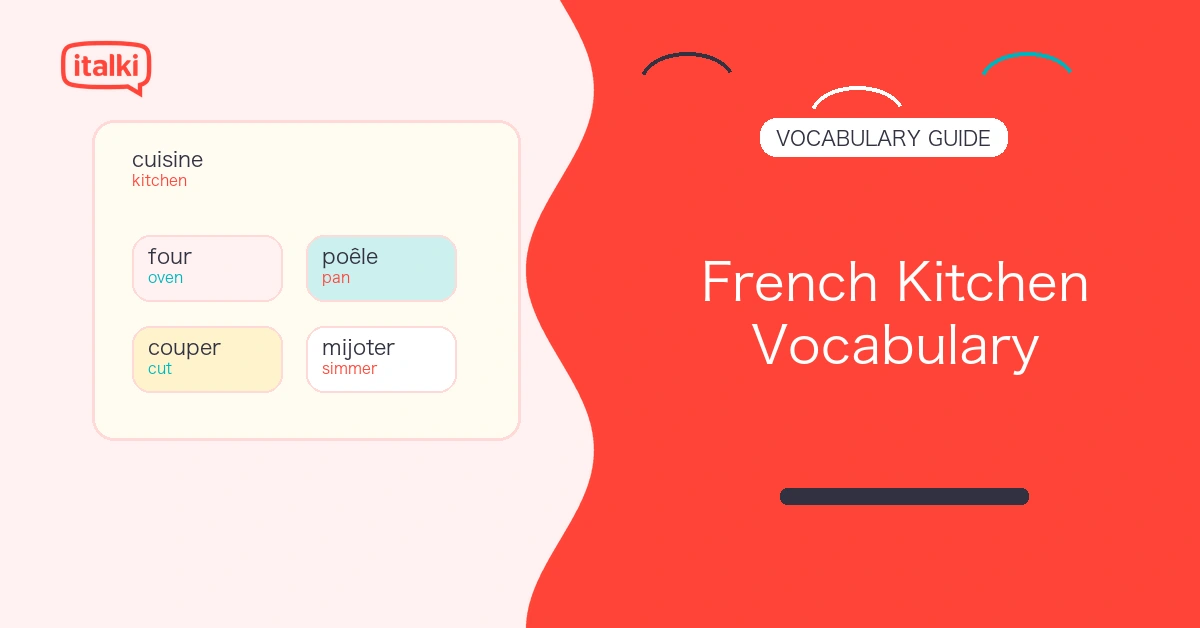
This guide covers 100+ French kitchen vocabulary words organized into appliances, utensils, cooking verbs, ingredients, and recipe instruction phrases.

Find your perfect teacher
Build real French confidence with personalized lessons from a teacher who can help with speaking, exam prep, grammar, and pronunciation.
Book a trial lesson
Kitchen appliances in French
| French | English | Gender |
|---|---|---|
| le four | oven | masculine |
| le micro-ondes | microwave | masculine |
| le réfrigérateur / le frigo | refrigerator / fridge | masculine |
| le congélateur | freezer | masculine |
| le lave-vaisselle | dishwasher | masculine |
| le grille-pain | toaster | masculine |
| le mixeur / le blender | blender | masculine |
| le robot culinaire | food processor | masculine |
| la cafetière | coffee maker | feminine |
| la machine à expresso | espresso machine | feminine |
| la friteuse | deep fryer | feminine |
| la plaque de cuisson | cooktop/hob | feminine |
| la hotte aspirante | range hood | feminine |
| le four à vapeur | steam oven | masculine |
| la bouilloire | kettle | feminine |
Le frigo is the everyday informal word for refrigerator. Le réfrigérateur is the formal term used in recipes, technical writing, and formal speech.
Kitchen utensils and tools in French
| French | English | Gender |
|---|---|---|
| le couteau | knife | masculine |
| la poêle | frying pan | feminine |
| la casserole | saucepan | feminine |
| la marmite | large pot/stockpot | feminine |
| le bol | bowl | masculine |
| la planche à découper | cutting board | feminine |
| la passoire | colander/strainer | feminine |
| la spatule | spatula | feminine |
| le fouet | whisk | masculine |
| la râpe | grater | feminine |
| le moule | baking mold/tin | masculine |
| la plaque de cuisson / la lèchefrite | baking tray | feminine |
| la louche | ladle | feminine |
| les pinces | tongs | feminine plural |
| l’éplucheur (m) | peeler | masculine |
| le tire-bouchon | corkscrew | masculine |
| le rouleau à pâtisserie | rolling pin | masculine |
| l’ouvre-boîte (m) | can opener | masculine |
| le tamis | sieve | masculine |
| la balance de cuisine | kitchen scale | feminine |
A French language tutor can run naming drills for kitchen objects, which fixes article errors (saying le poêle instead of la poêle) before they become habits.
Find your perfect teacher
Build real French confidence with personalized lessons from a teacher who can help with speaking, exam prep, grammar, and pronunciation.
Book a trial lesson
Cooking verbs in French
French cooking verbs are used in two contexts: infinitive in descriptions and imperative in recipe instructions. Both matter for reading French recipes and following French cooking shows.
Heat methods
| Infinitive | Imperative (vous) | English |
|---|---|---|
| faire frire | faites frire | to fry |
| faire sauter / sauter | faites sauter | to sauté |
| rôtir | faites rôtir | to roast |
| cuire au four | faites cuire au four | to bake |
| faire griller | faites griller | to grill/to toast |
| faire dorer | faites dorer | to brown/sear |
| faire bouillir | faites bouillir | to boil |
| mijoter | faites mijoter | to simmer |
| braiser | braisez | to braise |
| pocher | pochez | to poach |
| blanchir | blanchissez | to blanch |
| flamber | flambez | to flambé |
Preparation verbs
| Infinitive | Imperative (vous) | English |
|---|---|---|
| couper | coupez | to cut |
| hacher | hachez | to chop/mince |
| émincer | émincez | to slice thinly |
| râper | râpez | to grate |
| mélanger | mélangez | to mix |
| fouetter | fouettez | to whisk/beat |
| ajouter | ajoutez | to add |
| verser | versez | to pour |
| éplucher / peler | épluchez / pelez | to peel |
| égoutter | égouttez | to drain |
| mariner | marinez | to marinate |
| assaisonner | assaisonnez | to season |
| saupoudrer | saupoudrez | to sprinkle |
| incorporer | incorporez | to fold in/incorporate |
Recipe language also uses avoir-based compound forms, so passé composé in French helps with cooking sentences such as j’ai fait revenir les oignons (I browned the onions).
Ingredients vocabulary in French
Vegetables (les légumes)
| French | English |
|---|---|
| l’oignon (m) | onion |
| l’ail (m) | garlic |
| la tomate | tomato |
| le poivron | bell pepper |
| la carotte | carrot |
| la pomme de terre | potato |
| le champignon | mushroom |
| l’aubergine (f) | eggplant/aubergine |
| la courgette | zucchini/courgette |
| les haricots verts (m) | green beans |
| le poireau | leek |
| l’échalote (f) | shallot |
Grocery shopping in French pairs naturally with kitchen vocabulary because ingredient names and market phrases often appear before the cooking starts.
Proteins and dairy
| French | English |
|---|---|
| la viande | meat |
| le poulet | chicken |
| le boeuf | beef |
| le porc | pork |
| le poisson | fish |
| les fruits de mer (m) | seafood |
| l’oeuf (m) | egg |
| le lait | milk |
| le beurre | butter |
| le fromage | cheese |
| la crème fraîche | crème fraîche / heavy cream |
| le yaourt | yogurt |
Pantry and seasonings
| French | English |
|---|---|
| l’huile (f) | oil |
| le vinaigre | vinegar |
| le sel | salt |
| le poivre | pepper |
| le sucre | sugar |
| la farine | flour |
| le bouillon | broth/stock |
| les herbes aromatiques (f) | fresh herbs |
| les épices (f) | spices |
| la moutarde | mustard |
| le thym | thyme |
| le laurier | bay leaf |
| la cannelle | cinnamon |
Find your perfect teacher
Build real French confidence with personalized lessons from a teacher who can help with speaking, exam prep, grammar, and pronunciation.
Book a trial lesson
Recipe instruction phrases
| French phrase | English meaning |
|---|---|
| Préchauffez le four à 180°C. | Preheat the oven to 180°C. |
| Faites chauffer l’huile à feu moyen. | Heat the oil over medium heat. |
| Ajoutez l’ail et faites revenir deux minutes. | Add the garlic and sauté for two minutes. |
| Versez le bouillon petit à petit. | Pour in the broth little by little. |
| Laissez mijoter à feu doux pendant 20 minutes. | Let it simmer on low heat for 20 minutes. |
| Salez et poivrez selon votre goût. | Season with salt and pepper to taste. |
| Laissez reposer avant de servir. | Let it rest before serving. |
| Saupoudrez de persil frais. | Sprinkle with fresh parsley. |
| Goûtez et rectifiez l’assaisonnement. | Taste and adjust the seasoning. |
| Retirez du feu et servez chaud. | Remove from the heat and serve hot. |
Key measurements and heat levels:
| French | English |
|---|---|
| une pincée | a pinch |
| une cuillère à soupe | a tablespoon |
| une cuillère à café | a teaspoon |
| selon votre goût | to taste |
| à feu vif | on high heat |
| à feu moyen | on medium heat |
| à feu doux | on low heat |
Kitchen conversation phrases
| French | English |
|---|---|
| Tu as une grande casserole? | Do you have a large saucepan? |
| Où est l’ouvre-boîte? | Where is the can opener? |
| Il me faut plus de sel. | I need more salt. |
| Le riz est prêt? | Is the rice ready? |
| L’eau bout déjà. | The water is already boiling. |
| Fais attention, la poêle est très chaude. | Careful, the pan is very hot. |
| Tu peux hacher les oignons? | Can you chop the onions? |
| Je n’ai plus d’huile. | I am out of oil. |
| Il faut laisser mariner la viande. | The meat needs to marinate. |
| Je mets à feu doux. | I will put it on low heat. |
Practice these phrases in a kitchen roleplay with a private French tutor who can correct your pronunciation and article usage on the spot.
Find your perfect teacher
Build real French confidence with personalized lessons from a teacher who can help with speaking, exam prep, grammar, and pronunciation.
Book a trial lesson
Ready to cook in French?
French kitchen vocabulary opens up recipes, cooking shows, and real kitchen conversations in a way that basic food vocabulary cannot. The bridge from recognizing these words to using them naturally in a real cooking situation takes practice with actual speech.
A French tutor can read through a recipe with you, check your article gender on kitchen nouns, and run quick kitchen conversation drills that move vocabulary from recognition into production. italki connects learners with 30,000+ expert tutors trusted by over 10 million learners worldwide, with French tutors who can focus lessons on exactly the cooking vocabulary you need. Book a trial lesson and bring a French recipe you want to cook.
Find your perfect teacher
Build real French confidence with personalized lessons from a teacher who can help with speaking, exam prep, grammar, and pronunciation.
Book a trial lesson
FAQ
Are there French cooking terms that have entered English?
Yes. Many standard English cooking terms come directly from French: sauté, blanch, julienne, flambé, braise, marinate, mousse, purée, and gratin are all French in origin and carry the same meanings in English culinary use. Knowing this makes French recipes more accessible than they initially appear.
Is kitchen vocabulary the same in Quebec French as in European French?
Mostly yes, but some differences exist. Quebec French uses some regional terms: un chaudron for a large pot (versus une marmite in France), and a few appliance names differ. The core vocabulary in this guide is standard French and universally understood, but a Quebec teacher can flag regional variations if you plan to cook or work in a Quebec kitchen context.
What is the best way to practice French kitchen vocabulary before a trip to France?
Cook a French recipe in French. Read through the ingredient list, say the cooking steps aloud, and look up any term you do not recognize. This is more effective than flashcards because it places vocabulary in context: you see, say, and do the action at the same time.
Want to learn a language at italki?
Here are the best resources for you!