Key takeaways
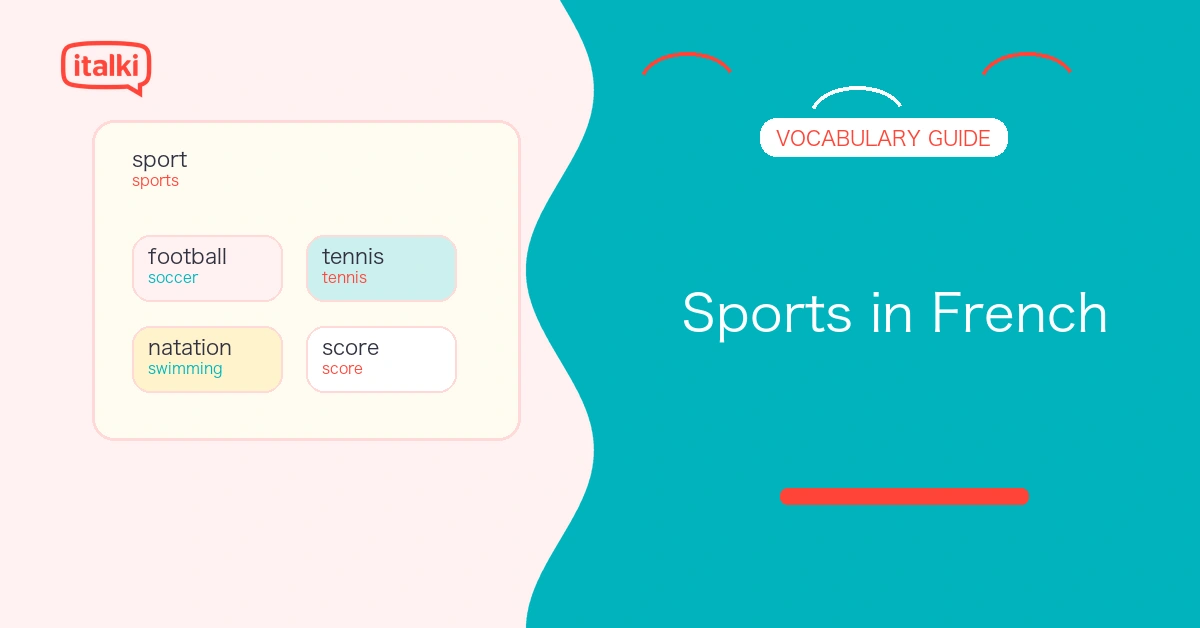
- French uses two different verbs to talk about playing sports: jouer à (jouer au, jouer à la) for sports that involve playing a game against someone, and faire de (faire du, faire de la) for physical activities and disciplines. Using the wrong one is one of the most common errors French learners make.
- The most important distinction: jouer au football (to play soccer), jouer au tennis (to play tennis), but faire du ski (to ski), faire de la natation (to swim), faire de la gym (to work out). The test is whether the activity involves an opponent or a game format.
- French sports vocabulary blends native French words with English loanwords: le football (soccer), le rugby, le basket (basketball), and le ski are all in daily use. Some loanwords are slightly modified in French pronunciation and gender.
- France hosts major international sporting events, and sports vocabulary connects directly to French culture: le Tour de France, Roland-Garros (the French Open), and the Coupe du Monde (World Cup) are all conversation topics where sports vocabulary becomes genuinely useful.
Sports are one of the most natural entry points into French conversation. Whether you are following French sports media, watching a match with French speakers, or just chatting about weekend activities, sports vocabulary gives you practical, high-frequency language immediately.
italki connects learners with French tutors who can help you practice this vocabulary in real conversational contexts and explain the cultural dimensions of French sports culture. This guide covers the jouer/faire distinction, team sports, individual sports, winter and water sports, spectator vocabulary, and useful phrases for talking about sports in French.
Work with a French tutor to practice sports vocabulary in conversation and understand the cultural context of major French sporting events.

Find your perfect teacher
Build real French confidence with personalized lessons from a teacher who can help with speaking, exam prep, grammar, and pronunciation.
Book a trial lesson
Jouer à vs faire de: the essential rule
This is the most important grammar point for talking about sports in French. Two verbs are used depending on the type of activity.
Jouer à (to play): Used for sports that involve a game, competition, or opponent. The à contracts with the definite article: jouer au (à + le), jouer à la, jouer aux (à + les).
- jouer au football (to play soccer)
- jouer au tennis (to play tennis)
- jouer au basket (to play basketball)
- jouer aux échecs (to play chess)
Faire de (to do / to practice): Used for physical disciplines, activities, and sports that are not framed as a game against an opponent. The de contracts: faire du (de + le), faire de la, faire des (de + les).
- faire du ski (to ski)
- faire de la natation (to swim)
- faire de la gym (to work out / do gymnastics)
- faire du vélo (to cycle)
- faire de la course (to run / do running)
The quick test: If the sport involves a score, an opponent, or is inherently a game (football, tennis, cards), use jouer à. If it is a physical activity you practice or pursue as a discipline (swimming, skiing, cycling), use faire de.
Some sports can take either verb depending on context:
- jouer au golf (to play golf, competitive) vs. faire du golf (to practice golf, as an activity)
- jouer au rugby (to play rugby) vs. faire du rugby (to do rugby, participate in the sport generally)
Team sports
| French | English | Verb used |
|---|---|---|
| le football | soccer / football | jouer au football |
| le rugby | rugby | jouer au rugby |
| le basket(-ball) | basketball | jouer au basket |
| le volleyball | volleyball | jouer au volleyball |
| le handball | handball | jouer au handball |
| le hockey | hockey | jouer au hockey |
| le hockey sur glace | ice hockey | jouer au hockey sur glace |
| le football américain | American football | jouer au football américain |
| le baseball | baseball | jouer au baseball |
| le cricket | cricket | jouer au cricket |
Note that in France, football always means soccer. What Americans call football is le football américain. This distinction matters in conversation with French speakers.
Football (soccer) is by far the most popular sport in France. The French national team, les Bleus (the Blues), won the World Cup in 1998 and 2018 and the sport dominates French sports media. For football-specific vocabulary in French, the guide to French soccer vocabulary covers the specialized terms used in match commentary.
Find your perfect teacher
Build real French confidence with personalized lessons from a teacher who can help with speaking, exam prep, grammar, and pronunciation.
Book a trial lesson
Individual sports
| French | English | Verb used |
|---|---|---|
| le tennis | tennis | jouer au tennis |
| le golf | golf | jouer au golf / faire du golf |
| la natation | swimming | faire de la natation |
| le cyclisme | cycling | faire du cyclisme |
| le vélo | cycling / biking | faire du vélo |
| l’athlétisme | track and field / athletics | faire de l’athlétisme |
| la course à pied | running | faire de la course à pied |
| la boxe | boxing | faire de la boxe |
| la lutte | wrestling | faire de la lutte |
| l’équitation | horse riding | faire de l’équitation |
| la gymnastique | gymnastics | faire de la gymnastique |
| le judo | judo | faire du judo |
| le karaté | karate | faire du karaté |
| le yoga | yoga | faire du yoga |
| la danse | dance | faire de la danse |
l’équitation (horse riding) is particularly notable because France has a strong equestrian tradition and the word appears frequently in French culture and media.
Winter sports
Winter sports are very popular in France, which has the Alps and Pyrenees mountains and a strong skiing culture.
| French | English | Verb used |
|---|---|---|
| le ski | skiing | faire du ski |
| le snowboard | snowboarding | faire du snowboard |
| le ski de fond | cross-country skiing | faire du ski de fond |
| le patinage | skating | faire du patinage |
| le patinage artistique | figure skating | faire du patinage artistique |
| le biathlon | biathlon | faire du biathlon |
| la luge | sledding / luge | faire de la luge |
| l’alpinisme | mountaineering | faire de l’alpinisme |
| la randonnée (en montagne) | mountain hiking | faire de la randonnée |
Les stations de ski (ski resorts) such as Chamonix, Courchevel, and Méribel are internationally known, and discussions of ski vacations are common in French social conversations, making winter sports vocabulary particularly useful in real interactions.
Find your perfect teacher
Build real French confidence with personalized lessons from a teacher who can help with speaking, exam prep, grammar, and pronunciation.
Book a trial lesson
Water sports
| French | English | Verb used |
|---|---|---|
| la natation | swimming | faire de la natation |
| le surf | surfing | faire du surf |
| le windsurf | windsurfing | faire du windsurf |
| la voile | sailing | faire de la voile |
| l’aviron | rowing | faire de l’aviron |
| le kayak | kayaking | faire du kayak |
| la plongée | diving / scuba diving | faire de la plongée |
| le water-polo | water polo | jouer au water-polo |
| la planche à voile | windsurfing | faire de la planche à voile |
La voile (sailing) is culturally significant in France. La Route du Rhum, a transatlantic solo sailing race, is one of the most famous events in French sports, and sailing vocabulary appears frequently in French media.
Combat and martial arts
| French | English | Verb used |
|---|---|---|
| le judo | judo | faire du judo |
| le karaté | karate | faire du karaté |
| la boxe | boxing | faire de la boxe |
| la lutte | wrestling | faire de la lutte |
| le taekwondo | taekwondo | faire du taekwondo |
| l’escrime | fencing | faire de l’escrime |
| le jiu-jitsu | jiu-jitsu | faire du jiu-jitsu |
France has produced notable Olympic champions in judo, boxing, and fencing, making these sports part of French national sports culture beyond just vocabulary.
Find your perfect teacher
Build real French confidence with personalized lessons from a teacher who can help with speaking, exam prep, grammar, and pronunciation.
Book a trial lesson
Spectator and match vocabulary
This vocabulary is essential for following French sports broadcasts and discussing matches.
| French | English |
|---|---|
| le match | the match / game |
| l’équipe (f.) | the team |
| le joueur / la joueuse | the player |
| l’arbitre | the referee |
| le stade | the stadium |
| le terrain | the field / pitch |
| marquer un but | to score a goal |
| gagner | to win |
| perdre | to lose |
| faire match nul | to draw / tie |
| le score | the score |
| la mi-temps | half-time |
| la finale | the final |
| le championnat | the championship |
| la coupe | the cup |
| l’entraîneur / l’entraîneuse | the coach |
| le supporter | the fan / supporter |
| le classement | the ranking / standings |
| la saison | the season |
| le transfert | the transfer |
Marquer un but (to score a goal) is the standard phrase in French commentary: le joueur a marqué un but à la dernière minute (the player scored a goal in the last minute).
Asking and talking about sports in French
| French | English |
|---|---|
| Tu fais du sport ? | Do you do sport? |
| Tu joues à quoi ? | What do you play? |
| Quel sport tu pratiques ? | What sport do you do? |
| Je suis fan de… | I’m a fan of… |
| Tu as regardé le match ? | Did you watch the match? |
| Qui a gagné ? | Who won? |
| Quel est le score ? | What’s the score? |
| Mon équipe préférée, c’est… | My favorite team is… |
| Je suis supporter de… | I support… |
| Le match était nul. | The match was a draw. |
| On a perdu 2-1. | We lost 2-1. |
| On a gagné. | We won. |
| Il a marqué un but magnifique. | He scored a wonderful goal. |
Find your perfect teacher
Build real French confidence with personalized lessons from a teacher who can help with speaking, exam prep, grammar, and pronunciation.
Book a trial lesson
Major French sporting events
These events appear constantly in French media and make ideal conversation topics.
Le Tour de France: The world’s most famous cycling race, held annually in July. 21 stages over 23 days, finishing in Paris. The leader wears the maillot jaune (yellow jersey).
Roland-Garros: The French Open tennis tournament, held in Paris each spring on clay courts. One of the four Grand Slam tournaments.
La Coupe du Monde (World Cup): France won in 1998 (at home) and 2018 (in Russia). French national team conversations dominate French life during tournaments.
Les 24 Heures du Mans: The famous endurance car race held annually in Le Mans, Normandy.
La Route du Rhum: A solo transatlantic sailing race from Saint-Malo, France, to Pointe-à-Pitre, Guadeloupe, held every four years.
Practice sports vocabulary with a tutor
Vocabulary lists are a starting point. Real fluency in sports vocabulary means being able to follow a live commentary, discuss a match result naturally, or describe your weekend activities without pausing. A tutor can practice dialogue around sports events, help you understand French broadcast language, and build the conversational agility to discuss sports the way French speakers actually do.
italki’s 30,000+ expert tutors include native French speakers from France, Belgium, Canada, and beyond who bring cultural knowledge of French sports into their lessons. Trusted by over 10 million learners worldwide, the platform lets you find a tutor who matches your interests and level. Book a trial lesson and talk about your favorite sport in French from your very first lesson.
Find your perfect teacher
Build real French confidence with personalized lessons from a teacher who can help with speaking, exam prep, grammar, and pronunciation.
Book a trial lesson
FAQ
Do you use jouer or faire for swimming in French?
Swimming uses faire: faire de la natation (to swim / to do swimming). This is because swimming is treated as a physical discipline rather than a competitive game. You can also say je nage (I swim) using the verb nager directly. Jouer à la natation does not exist in standard French.
Is it le football or le soccer in French?
In French, le football (or informally le foot) always refers to soccer. American football is le football américain. The word soccer is not used in standard French.
How do you say I play tennis in French?
Je joue au tennis. The à contracts with the definite article le to give au: jouer + à + le tennis = jouer au tennis. For a feminine sport noun: je joue à la pétanque. For plural: je joue aux échecs (I play chess).
What is the difference between le sport and les sports in French?
Le sport (uncountable) refers to physical activity or sport in general: je fais du sport (I exercise / I do sport). Les sports refers to specific sports as countable entities: quels sports tu pratiques ? (which sports do you do?). Both are used frequently in everyday conversation.
How do you say to score a goal in French?
The standard phrase is marquer un but: il a marqué un but (he scored a goal). In ice hockey, the word used is un but as well. In rugby, a try is un essai and a goal kick is une transformation.
Want to learn a language at italki?
Here are the best resources for you!