Key takeaways
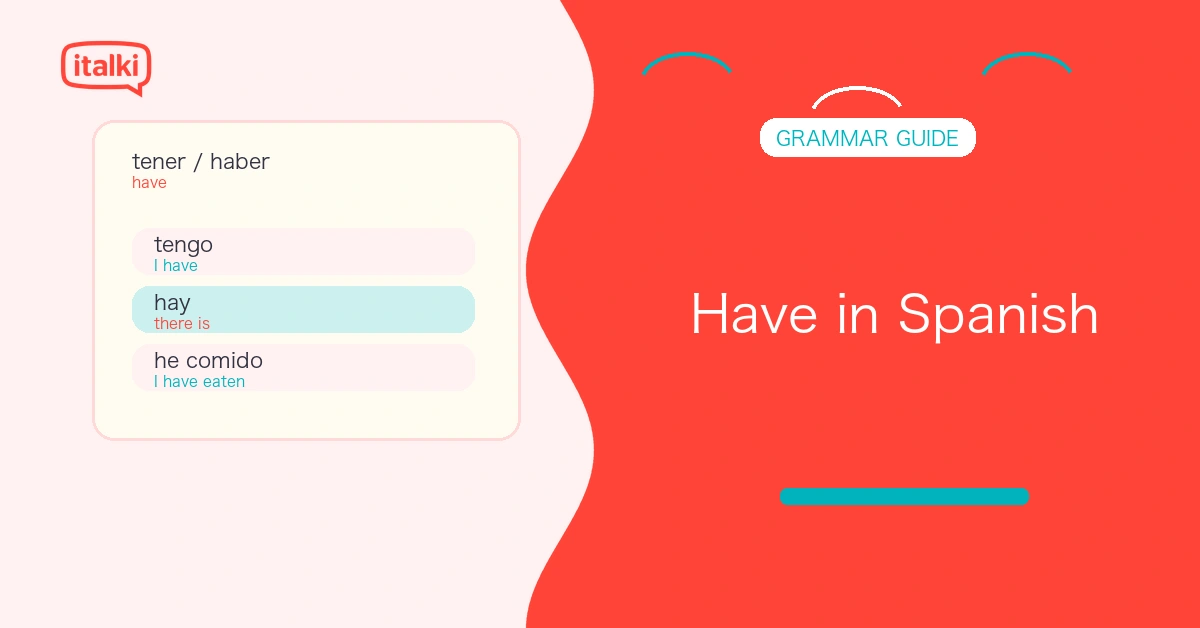
- Tener expresses possession, physical states, and age.
- Haber is the auxiliary verb for compound tenses: he comido (I have eaten).
- Tener never forms compound tenses. Haber never expresses possession.
- Hay (impersonal haber) means there is/there are.
- Many English to be expressions use tener in Spanish: tengo hambre (I am hungry).
This guide covers the full uses of tener and haber, common tener expressions, hay usage, and a direct comparison table for when to use each verb.
Tener and haber are straightforward when you study the rules, but fluency comes from hearing and using them in natural dialogue. italki has 30,000+ tutors across 150+ languages, making it simple to find a Spanish teacher who can help you internalise the tener/haber distinction through real conversation.

Find your perfect teacher
Build real speaking confidence with personalized lessons from a teacher who matches your goals, schedule, and learning style.
Book a trial lesson
Tener conjugation (present tense)
| Person | Form | Example |
|---|---|---|
| yo | tengo | Tengo un libro. |
| tú | tienes | ¿Tienes tiempo? |
| él/ella/usted | tiene | Ella tiene razón. |
| nosotros | tenemos | Tenemos una reunión. |
| vosotros | tenéis | ¿Tenéis hambre? |
| ellos/ustedes | tienen | Tienen tres hijos. |
Tener expressions (English to be constructions)
| Spanish tener | English to be |
|---|---|
| Tener hambre | To be hungry |
| Tener sed | To be thirsty |
| Tener frío | To be cold |
| Tener calor | To be hot |
| Tener miedo | To be afraid |
| Tener razón | To be right |
| Tener sueño | To be sleepy |
| Tener prisa | To be in a hurry |
| Tener suerte | To be lucky |
| Tener vergüenza | To be embarrassed |
| Tener éxito | To be successful |
| Tener cuidado | To be careful |
Internalise these tener expressions through conversation with a Spanish tutor by using them in natural dialogue until they feel instinctive.
Find your perfect teacher
Build real speaking confidence with personalized lessons from a teacher who matches your goals, schedule, and learning style.
Book a trial lesson
Haber as auxiliary verb (present tense)
| Person | Form | Example |
|---|---|---|
| yo | he | He comido. |
| tú | has | ¿Has visto esa película? |
| él/ella/usted | ha | Ella ha llegado tarde. |
| nosotros | hemos | Hemos vivido aquí tres años. |
| vosotros | habéis | ¿Habéis terminado? |
| ellos/ustedes | han | Han viajado mucho. |
Hay (impersonal haber)
| Spanish | English |
|---|---|
| Hay un problema. | There is a problem. |
| Hay muchas personas aquí. | There are many people here. |
| No hay tiempo. | There is no time. |
| Había un error. | There was an error. |
Find your perfect teacher
Build real speaking confidence with personalized lessons from a teacher who matches your goals, schedule, and learning style.
Book a trial lesson
Tener vs. haber: direct comparison
| Situation | Tener (use this) | Haber (not used here) |
|---|---|---|
| Possession | Tengo un coche. | – |
| Physical state | Tengo hambre. | – |
| Age | Tengo 30 años. | – |
| Obligation (have to) | Tengo que salir. | – |
| Perfect tenses | – | He salido. |
| There is/are | – | Hay mucho trabajo. |
The tener/haber distinction is simple as a rule but slips away in real conversation. A Spanish tutor can help you practice tener and haber in natural dialogue until you choose the right verb automatically. Book a trial lesson on italki and spend the session on conversation using these expressions.
Find your perfect teacher
Build real speaking confidence with personalized lessons from a teacher who matches your goals, schedule, and learning style.
Book a trial lesson
FAQ
Why do Spanish speakers say tengo 30 años instead of soy 30 años?
Spanish treats age as something you accumulate and have, not a permanent state. The same logic applies to hunger, thirst, and physical states.
Can haber mean possession?
No. In modern Spanish, haber in the sense of possession is archaic. Always use tener for possession.
What is the difference between hay que and tener que?
Hay que is impersonal (hay que trabajar: one must work). Tener que is personal (tengo que trabajar: I have to work).
Want to learn a language at italki?
Here are the best resources for you!