Key takeaways
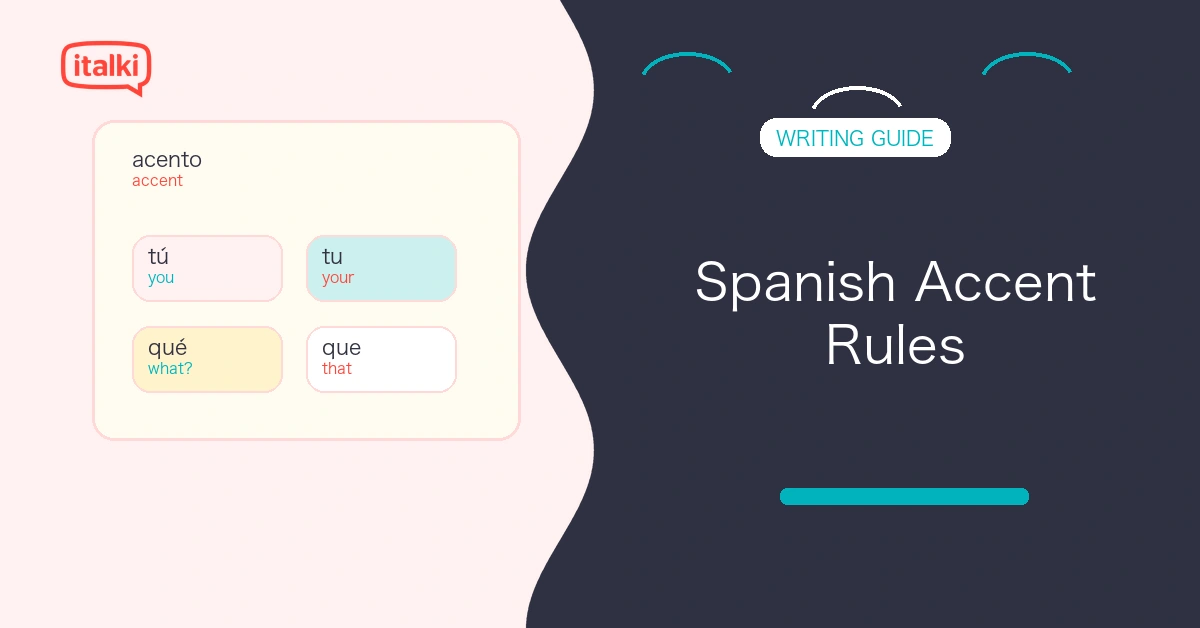
- Accent marks show which syllable to stress and can change the meaning of short words like tu and tú.
- Most Spanish words follow predictable stress patterns, so accent marks usually appear only when a word breaks the normal pattern.
- Monosyllabic words normally carry no accent, but several monosyllabic pairs (tú/tu, él/el, sé/se, sí/si) use the accent to separate two different words with the same spelling
- Interrogative and exclamatory words (qué, cómo, cuándo, dónde, quién) always carry a written accent regardless of where they appear in the sentence
Spanish learners often treat accent marks as optional decoration or assume they appear at random. In practice, accent marks follow a logical system that connects directly to how Spanish syllables are stressed when spoken aloud.
Once you understand the default stress rules, the written accent becomes predictable: it appears precisely when a word breaks from those defaults. italki connects learners with Spanish teachers who can demonstrate these patterns in real speech so the written and spoken systems reinforce each other.
This guide covers the three default stress rules, the four word stress categories (aguda, llana, esdrújula, sobreesdrújula), disambiguation accents for monosyllabic pairs, interrogative and exclamatory words, and the hiatus accent.

Find your perfect teacher
Build real speaking confidence with personalized lessons from a teacher who matches your goals, schedule, and learning style.

What the accent mark does
The written accent mark in Spanish (´) does two distinct things:
Stress marking: Spanish stress is predictable by rule for most words, but when a word breaks the default pattern, the written accent tells you which syllable receives the stress. Without it, a reader would apply the wrong stress automatically.
Meaning disambiguation: Some words that sound identical (or would be spelled identically) are distinguished purely by the presence or absence of an accent: tú (you) vs tu (your), él (he) vs el (the). The accent here does not change pronunciation; it separates two different words.
Understanding which function applies in each case makes the accent system logical rather than arbitrary.
The three default stress rules
Spanish readers apply these three rules automatically when no accent is written:
Rule 1: Words ending in a vowel (a, e, i, o, u), the letter n, or the letter s are stressed on the second-to-last syllable.
- casa (CA-sa), hablan (HA-blan), comes (CO-mes)
Rule 2: Words ending in any consonant other than n or s are stressed on the last syllable.
- reloj (re-LOJ), papel (pa-PEL), ciudad (ciu-DAD)
Rule 3: Words that break either rule carry a written accent on the stressed syllable to override the default.
These three rules are the foundation. The written accent exists only to mark exceptions to rules 1 and 2.
Find your perfect teacher
Build real speaking confidence with personalized lessons from a teacher who matches your goals, schedule, and learning style.
Agudas: stress on the last syllable
Agudas are words stressed on the last syllable. They follow Rule 2 naturally when they end in a consonant other than n or s. When an aguda ends in a vowel, n, or s, it breaks Rule 1, so it needs a written accent.
| Word | Stress | Written accent? | Reason |
|---|---|---|---|
| papel | pa-PEL | No | Ends in consonant (not n/s): Rule 2 applies |
| reloj | re-LOJ | No | Ends in consonant (not n/s): Rule 2 applies |
| café | ca-FÉ | Yes | Ends in vowel; Rule 1 would give CA-fe |
| camión | ca-MIÓN | Yes | Ends in n; Rule 1 would give CA-mion |
| adiós | a-DIÓS | Yes | Ends in s; Rule 1 would give A-dios |
| canté | can-TÉ | Yes | Ends in vowel; Rule 1 would give CAN-te |
Llanas: stress on the second-to-last syllable
Llanas (also called graves or paroxytones) are words stressed on the second-to-last syllable. They follow Rule 1 naturally when they end in a vowel, n, or s. When a llana ends in any other consonant, it breaks Rule 2, so it needs a written accent.
| Word | Stress | Written accent? | Reason |
|---|---|---|---|
| casa | CA-sa | No | Ends in vowel: Rule 1 applies |
| libro | LI-bro | No | Ends in vowel: Rule 1 applies |
| árbol | ÁR-bol | Yes | Ends in l (not n/s); Rule 2 would give ar-BOL |
| lápiz | LÁ-piz | Yes | Ends in z; Rule 2 would give la-PIZ |
| fácil | FÁ-cil | Yes | Ends in l; Rule 2 would give fa-CIL |
| útil | Ú-til | Yes | Ends in l; Rule 2 would give u-TIL |
Find your perfect teacher
Build real speaking confidence with personalized lessons from a teacher who matches your goals, schedule, and learning style.
Esdrújulas and sobreesdrújulas: always written
Esdrújulas are words stressed on the third-to-last syllable. They always break Rule 1, so they always carry a written accent. There are no exceptions.
- médico (MÉ-di-co), música (MÚ-si-ca), rápido (RÁ-pi-do)
- número (NÚ-me-ro), página (PÁ-gi-na), público (PÚ-bli-co)
Sobreesdrújulas are stressed even further back (fourth-to-last or beyond). These occur mostly with verb forms that have object pronouns attached:
- dígamelo (DÍ-ga-me-lo: tell it to me), tráiganoslo (TRÁIGAN-os-lo)
If you see a word with three or more syllables before the stress, it will always have a written accent.
A Spanish teacher can practice these stress categories with you through pronunciation drills that connect what you see on the page with what you hear and produce in speech.
Monosyllabic disambiguation pairs
Single-syllable words in Spanish normally carry no accent because there is no stress ambiguity in a one-syllable word. However, some monosyllabic pairs are spelled identically and need an accent to distinguish between two different words with different grammatical roles.
| With accent | Meaning | Without accent | Meaning |
|---|---|---|---|
| tú | you (subject pronoun) | tu | your (possessive) |
| él | he (subject pronoun) | el | the (definite article) |
| sé | I know / be! (imperative) | se | reflexive pronoun |
| sí | yes / oneself | si | if (conjunction) |
| mí | me (after prepositions) | mi | my (possessive) |
| té | tea | te | you (object pronoun) |
| más | more | mas | but (literary conjunction) |
| dé | give (subjunctive) | de | of / from (preposition) |
| aún | still / yet | aun | even (even when) |
These pairs must be memorized because the accent does not change pronunciation: tú and tu are pronounced identically. The distinction is purely orthographic.
Find your perfect teacher
Build real speaking confidence with personalized lessons from a teacher who matches your goals, schedule, and learning style.
Interrogative and exclamatory words
Question words and exclamatory words always carry an accent in Spanish, regardless of whether they appear in a direct or indirect question, or in an exclamation.
| Word | Meaning | Example |
|---|---|---|
| qué | what / how (exclamatory) | ¿Qué quieres? / ¡Qué bonito! |
| cómo | how | ¿Cómo estás? / No sé cómo llegó. |
| cuándo | when | ¿Cuándo llega? / Dime cuándo llegas. |
| dónde | where | ¿Dónde vives? / No sé dónde está. |
| quién | who | ¿Quién es? / No sé quién llamó. |
| cuál | which | ¿Cuál prefieres? |
| cuánto | how much | ¿Cuánto cuesta? |
| cuántos | how many | ¿Cuántos años tienes? |
| por qué | why | ¿Por qué tardaste? |
Compare with the same words when they are not interrogative or exclamatory:
- que (that, conjunction): Creo que es tarde.
- como (as / like / how in non-question contexts): Come como un rey.
- cuando (when, non-question): Cuando llegues, llámame.
The accent marks the interrogative or exclamatory function, while Spanish question marks show the punctuation pattern that surrounds full questions.
The hiatus accent
A hiatus occurs when two vowels appear next to each other but belong to different syllables, meaning each vowel is pronounced separately. In Spanish, when a weak vowel (i or u) is stressed and appears next to a strong vowel (a, e, o), an accent is written to signal that they form two syllables, not one diphthong.
| Word | Syllable break | Without accent it would be… |
|---|---|---|
| día | dí-a | dia (one syllable, diphthong) |
| María | Ma-rí-a | Maria (diphthong on ia) |
| continúa | con-ti-nú-a | continua (diphthong) |
| país | pa-ís | pais (diphthong ai) |
| maíz | ma-íz | maiz (diphthong ai) |
| reúne | re-ú-ne | reune (diphthong eu) |
This accent overrides the normal stress rules: its job is not to mark unusual stress but to break a diphthong and signal two separate syllables.
Find your perfect teacher
Build real speaking confidence with personalized lessons from a teacher who matches your goals, schedule, and learning style.
Common mistakes and how to avoid them
- Omitting accents on esdrújulas: all words stressed on the third-to-last syllable always carry the accent. If you see a three-plus-syllable word with no accent, assume the stress falls on the second-to-last syllable.
- Confusing tú and tu, él and el: these are among the most common written errors. The subject pronouns (tú, él) take accents; the article el and the possessive tu do not.
- Forgetting accents on interrogative words in indirect questions: ¿Sabes dónde está? (do you know where it is?) uses dónde with an accent even though it is an indirect question embedded in a statement.
- Adding accents to monosyllables that do not form a disambiguation pair: words like fe (faith), fui (I went), fue (he/she went), vio (he/she saw), and dio (he/she gave) have no written accent in modern Spanish orthography.
- Applying the accent to adjectives/verbs to mark importance: the accent in Spanish marks stress or disambiguation only, not emphasis.
Practice Spanish accents with a tutor
Understanding the accent system intellectually and applying it automatically when writing are different skills. The fastest path between them is practice with feedback. italki has 30,000+ expert tutors trusted by over 10 million learners worldwide, including Spanish tutors who can give you writing tasks, check your accent placement, and connect the written system to the spoken stress you produce. Book a trial lesson and start applying these rules with confidence.
Find your perfect teacher
Build real speaking confidence with personalized lessons from a teacher who matches your goals, schedule, and learning style.
FAQ
Do I need to write accent marks when typing in Spanish?
Yes. In formal written Spanish (emails, essays, professional communication, and any published text), accent marks are required and their omission is considered an error. In informal text messages, many native speakers omit them for speed, but this is a stylistic shortcut, not a rule. For learners, the best habit is to always write accents correctly so the association between spelling and pronunciation is consistent.
Does the accent change the pronunciation of a vowel?
No. The Spanish accent mark is a stress marker, not a vowel quality marker. The vowel é in café is pronounced the same way as the e in every other Spanish word: a pure, consistent vowel. The accent only tells you which syllable to stress, and in the case of disambiguation pairs, it distinguishes two words. Compare this with languages like French where the accent can change the vowel sound (é vs è vs e).
What is the difference between a tilde and an accent mark in Spanish?
In everyday usage, many Spanish speakers use tilde to refer to the written accent mark (´). Technically, the tilde is a separate mark: the wavy line over the ñ (as in España or mañana). The accent mark is the acute accent (´) used on vowels. However, in informal conversation, calling the acute accent a tilde is understood and common in much of the Spanish-speaking world.
Want to learn a language at italki?
Here are the best resources for you!