Key takeaways
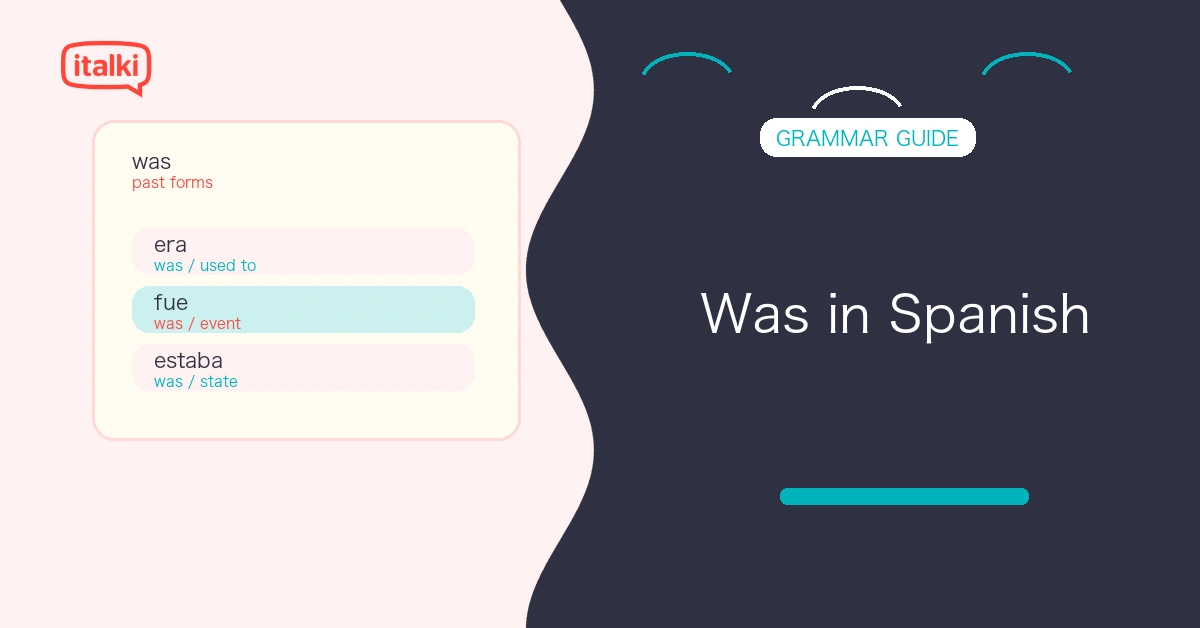
- Spanish has four common past tense forms that translate as “was”: era, fue, estaba, and estuvo.
- Era (imperfect of ser) describes past states, characteristics, and ongoing situations.
- Fue (preterite of ser) describes completed past events, historical facts, and single occurrences.
- Estaba (imperfect of estar) describes temporary past states and ongoing conditions.
- Estuvo (preterite of estar) describes temporary past events that are now complete.
Spanish has two separate verbs for “to be” in the present: ser and estar. In the past, each has two possible tenses: the preterite (a completed past action) and the imperfect (an ongoing or descriptive past state). That gives you four ways to say “was,” and English has only one.
This is why Spanish past tense is one of the most consistent sources of confusion for English learners, even at intermediate level.
With 30,000+ tutors trusted by 10 million learners, italki connects you with Spanish tutors who help you hear and apply this distinction in real conversation, because the ser/estar and preterite/imperfect decisions have to become automatic to be useful in natural speech.

Find Your Perfect Teacher
Build real speaking confidence with personalized lessons from a teacher who matches your goals, schedule, and learning style.
Book a trial lesson
The two verbs and two tenses
Before choosing the right word for “was,” establish two things:
- Is this a ser situation (permanent, identity, classification) or an estar situation (temporary, condition, location)?
- Was it a completed event (preterite) or an ongoing background state (imperfect)?
| Verb | Tense | Form | When to use |
|---|---|---|---|
| Ser | Imperfect | Era | Ongoing past characteristics, descriptions, identity |
| Ser | Preterite | Fue | Completed past events, historical facts, single occurrences |
| Estar | Imperfect | Estaba | Ongoing past conditions, temporary states |
| Estar | Preterite | Estuvo | Completed temporary events, locations at a specific moment |
Era: ser in the imperfect
Use era for ongoing descriptions, background states, and characteristics in the past:
| Spanish | English |
|---|---|
| Era muy difícil | It was very difficult (ongoing state) |
| Era médico | He was a doctor (profession, identity) |
| La ciudad era pequeña | The city was small (description) |
| Era mi mejor amigo | He was my best friend (relationship) |
| Era tarde cuando llegamos | It was late when we arrived (time description) |
Era describes what something was like over a period of time, as a defining characteristic, or as background context for other events. Think of it as the “setting the scene” form. Grasp this distinction with a Spanish online tutor through personalized examples from your own life.
Find Your Perfect Teacher
Build real speaking confidence with personalized lessons from a teacher who matches your goals, schedule, and learning style.
Book a trial lesson
Fue: ser in the preterite
Use fue for completed past events, singular occurrences, and facts about events:
| Spanish | English |
|---|---|
| Fue un error | It was a mistake (single event now in the past) |
| La boda fue en junio | The wedding was in June (completed event) |
| Fue el primer vuelo | It was the first flight (historical fact) |
| ¿Dónde fue la reunión? | Where was the meeting? (completed event) |
| Fue una noche increíble | It was an incredible night (completed experience) |
Fue marks events that happened, are now over, and are being recorded as facts. If you can put a specific date or time on it, fue is usually the right choice. Notice that both era and fue translate as “was” in English. The distinction is about the type of being described, not the time of the event. Practice the era/fue distinction with a Spanish tutor on italki through personalized storytelling exercises.
Estaba: estar in the imperfect
Use estaba for ongoing past conditions, temporary states, and locations described as background:
| Spanish | English |
|---|---|
| Estaba cansado | I was tired (ongoing state at that time) |
| Estaba en Madrid | I was in Madrid (ongoing location) |
| Estaba enferma | She was sick (temporary ongoing condition) |
| El café estaba caliente | The coffee was hot (temporary condition) |
| Estaba esperando cuando llegaste | I was waiting when you arrived (background action) |
Estaba describes conditions that were in progress or continuing at a point in the past. It sets the background against which other actions happen.
Find Your Perfect Teacher
Build real speaking confidence with personalized lessons from a teacher who matches your goals, schedule, and learning style.
Book a trial lesson
Estuvo: estar in the preterite
Use estuvo for temporary states or locations that are now complete:
| Spanish | English |
|---|---|
| Estuvo en París tres días | He was in Paris for three days (completed stay) |
| Estuvo enferma toda la semana | She was sick all week (completed period of illness) |
| Estuvo muy nervioso durante el examen | He was very nervous during the exam (completed state) |
| La reunión estuvo bien | The meeting was good (completed event, temporary assessment) |
The key signal for estuvo is often a specific duration or a contained period: “for three days,” “all week,” “during the exam.” Once that period ends, the state is complete, and estuvo is the right choice. Solidify the estuvo concept with online Spanish lessons by narrating personal experiences in the past.
Choosing between them: a quick decision guide
When you need “was” in Spanish, ask: Step 1: Ser or estar?
- Identity, classification, origin, profession, characteristics: ser (era or fue)
- Condition, location, temporary state, how something felt: estar (estaba or estuvo)
Step 2: Imperfect or preterite?
- Ongoing, background, descriptive, no clear endpoint: imperfect (era or estaba)
- Completed, specific, event-based, with a defined duration or single occurrence: preterite (fue or estuvo)
| Question | Yes | No |
|---|---|---|
| Is this a permanent/defining characteristic? | Ser (era or fue) | Estar (estaba or estuvo) |
| Was it ongoing/descriptive at the time? | Imperfect (era or estaba) | Preterite (fue or estuvo) |
Find Your Perfect Teacher
Build real speaking confidence with personalized lessons from a teacher who matches your goals, schedule, and learning style.
Book a trial lesson
Common errors
Using fue for background descriptions.“La película fue larga” (the film was long) implies the film’s length was a completed fact, which sounds slightly odd. “La película era larga” describes it as a characteristic. Both are understandable, but for descriptions of what things were like, the imperfect is more natural. Using estaba for completed events.“Estaba en París el fin de semana” (I was in Paris the weekend) with the imperfect implies you were in the middle of being there. If the trip is now over, “Estuve en París el fin de semana” is more precise. Confusing fue as an event vs. era as a state.“Fue mi profesor” (he was my teacher – one year, then it ended) vs. “Era mi profesor” (he was my teacher – during that period of his life) carry different implications about completeness. The ser/estar distinction is one of the features of Spanish that English speakers take the longest to internalize, and the past tense layer compounds it. Reading the rules helps you understand the logic. The real fluency comes from exposure to the forms in context until they feel natural rather than calculated. With 30,000+ expert tutors across 150+ languages on italki, find a Spanish tutor and practice past tense storytelling.Book a trial lesson today.
Find Your Perfect Teacher
Build real speaking confidence with personalized lessons from a teacher who matches your goals, schedule, and learning style.
Book a trial lesson
FAQ
Why does Spanish have two verbs for “to be”?
Historically, ser and estar developed from two different Latin verbs: esse (to exist, to be) and stare (to stand, to be in a position). Over time, their meanings specialized: ser for permanent essence and classification, estar for position, condition, and temporary state. The distinction is deeply embedded in Spanish and does not map onto any English equivalent, which is why English speakers find it challenging. With practice, the division becomes intuitive rather than analytical. Can fue and era ever be interchangeable? In a few specific contexts, native speakers use them interchangeably without a meaningful difference. “Fue un placer” and “era un placer” (it was a pleasure) are both used naturally. More typically, though, choosing the wrong one does affect meaning or naturalness. “Fue médico” (he was a doctor – he retired or died) vs. “Era médico” (he was a doctor – during that period of his life) carry different implications about completeness. What about “había” and “hubo” (there was)? Había and hubo are the imperfect and preterite of haber and translate as “there was” or “there were.” Había describes ongoing presence (había mucha gente: there were a lot of people), while hubo marks a completed occurrence (hubo un accidente: there was an accident). They follow the same imperfect/preterite logic as era/fue and estaba/estuvo.
Want to learn a language at italki?
Here are the best resources for you!