Key takeaways
- Spanish uses a default SVO (subject-verb-object) word order, but the subject is often omitted because the verb ending already identifies who is performing the action
- Spanish verbs change their ending based on the subject, tense, and mood. A single verb form encodes the subject, making subject pronouns optional and frequently dropped in natural speech
- Adjectives in Spanish usually follow the noun they describe and must agree with it in both gender and number: el libro rojo, la mesa roja, los libros rojos, las mesas rojas
- Negation in Spanish requires placing no directly before the verb; double negatives are grammatically mandatory, not errors: no tengo nada (I don’t have anything) is the correct form
Writing sentences in Spanish is not simply a matter of translating word by word from English. The subject pronoun can disappear, the adjective moves after the noun, the verb changes for every pronoun, and negation works by adding no in front of the verb and using negative words throughout the sentence.
Each of these features is systematic once understood. italki connects learners with Spanish teachers who can work through these patterns in real sentences and correct your production before errors become habits.
This guide covers Spanish word order, subject pronouns and when to drop them, verb agreement, gender and number agreement, adjective placement, negation, question formation, connecting sentences, and relative clauses.

Find your perfect teacher
Build real speaking confidence with personalized lessons from a teacher who matches your goals, schedule, and learning style.
Book a trial lesson
Basic word order: SVO in Spanish
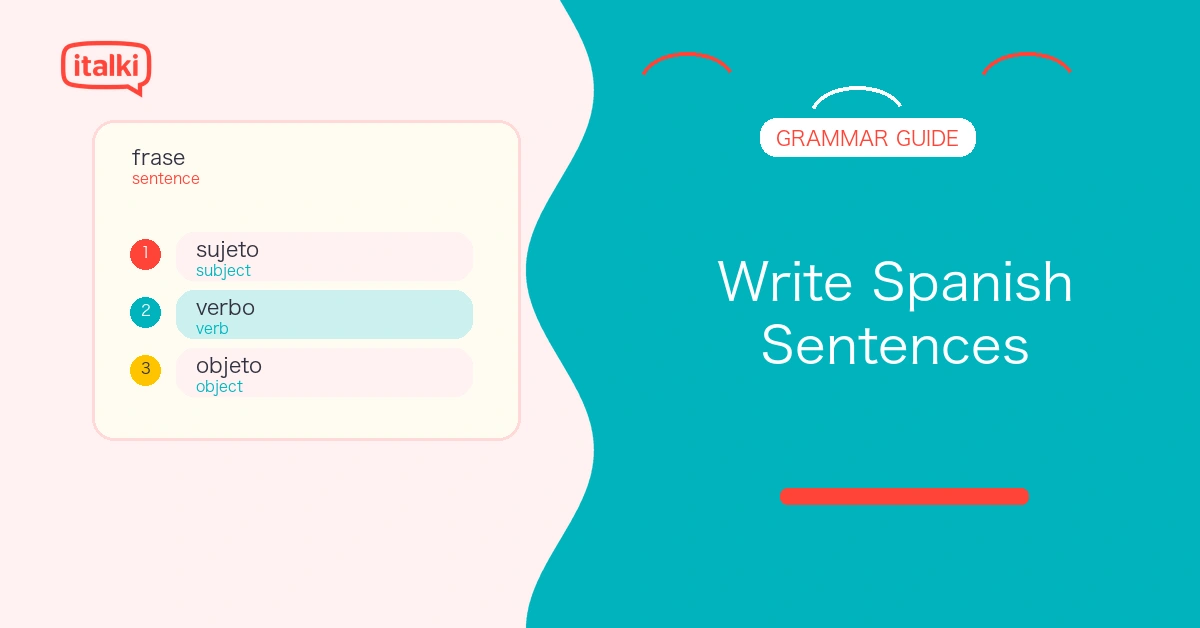
Spanish defaults to subject-verb-object (SVO) order, the same as English:
- Juan come una manzana. (Juan eats an apple.)
- La profesora explica la lección. (The teacher explains the lesson.)
Unlike English, Spanish allows flexible word order to shift emphasis. Moving an element to the front of the sentence places emphasis on it:
- Una manzana come Juan. (It is an apple that Juan eats, with emphasis on what he eats)
- La lección, la explica bien. (The lesson, she explains it well, with emphasis on what she explains)
This flexibility does not mean word order is arbitrary. The default SVO is the neutral, informationless order, and deviations carry pragmatic meaning. For standard writing and early learners, stick to SVO until you can feel the difference.
Spanish sentence structure explains the broader word-order patterns behind agreement, negation, and question formation.
Subject pronouns and pro-drop
Spanish is a pro-drop language: the subject pronoun (yo, tú, él, ella, usted, nosotros, vosotros, ellos, ustedes) is often omitted because the verb ending already identifies the subject.
- Hablo español. (I speak Spanish: yo is implied by the -o ending)
- Comes mucho. (You eat a lot: tú is implied by the -es ending)
- Vivimos aquí. (We live here: nosotros is implied by the -imos ending)
When to include the subject pronoun:
- For clarification when two subjects share the same verb form: Ella estudia, él trabaja. (She studies, he works.)
- For contrast or emphasis: Yo quiero el café, tú quieres el té. (I want coffee, you want tea.)
- After a topic change or when the subject has not appeared for several sentences
In everyday Spanish, subject pronouns appear far less often than in English. Overusing them sounds slightly formal or emphatic to native speakers.
Find your perfect teacher
Build real speaking confidence with personalized lessons from a teacher who matches your goals, schedule, and learning style.
Book a trial lesson
Verb agreement: ending encodes the subject
Spanish verbs conjugate for person (1st/2nd/3rd), number (singular/plural), tense, and mood. The present tense of a regular -ar verb (hablar: to speak) illustrates the pattern:
| Pronoun | Conjugation | English |
|---|---|---|
| yo | hablo | I speak |
| tú | hablas | you speak |
| él/ella/usted | habla | he/she speaks / you (formal) speak |
| nosotros | hablamos | we speak |
| vosotros | habláis | you all speak (Spain) |
| ellos/ustedes | hablan | they speak / you all speak |
Each ending is unique except that the él/ella/usted form shares the third-person singular. Because of this, Spanish writers and speakers rely on context or an explicit pronoun to distinguish he speaks from she speaks only when necessary.
For -er and -ir verbs, the endings differ. Essential Spanish verbs give the broader pattern for the most common verb groups.
Gender and number agreement
Spanish nouns are either masculine or feminine, singular or plural. Every article, adjective, and pronoun connected to that noun must match in gender and number. This is called agreement (concordancia).
Adjective agreement:
| Noun gender/number | Adjective form | Example |
|---|---|---|
| Masculine singular | -o | el libro rojo (the red book) |
| Feminine singular | -a | la mesa roja (the red table) |
| Masculine plural | -os | los libros rojos (the red books) |
| Feminine plural | -as | las mesas rojas (the red tables) |
Some adjectives have a single form for masculine and feminine (ending in -e or a consonant) and only change for number:
- el examen difícil / la tarea difícil / los exámenes difíciles / las tareas difíciles
When an adjective describes a mixed-gender group, the masculine plural form is used: Juan y María son altos (Juan and María are tall).
Find your perfect teacher
Build real speaking confidence with personalized lessons from a teacher who matches your goals, schedule, and learning style.
Book a trial lesson
Adjective placement
Most descriptive adjectives in Spanish follow the noun:
- un coche rojo (a red car)
- una ciudad grande (a large city)
- una persona inteligente (an intelligent person)
A smaller set of adjectives precede the noun. These include quantifiers and evaluative adjectives that are more closely tied to the noun than to describing it:
- mucho/poco/bastante (much/little/enough): mucha gente
- bueno/malo (good/bad): un buen libro (note: bueno shortens to buen before a masculine singular noun)
- gran (great): un gran hombre
- primero/último/mismo (first/last/same): el primer día, la última vez
Several adjectives change meaning depending on whether they precede or follow the noun:
- un hombre grande (a large man, referring to size) vs un gran hombre (a great man, referring to importance)
- un amigo viejo (an old friend, referring to age) vs un viejo amigo (a long-standing friend)
Negation
Spanish negation is formed by placing no directly before the verb. No modifier comes between no and the verb:
- Hablo español. (I speak Spanish.)
- No hablo español. (I do not speak Spanish.)
- Tengo dinero. (I have money.)
- No tengo dinero. (I do not have money.)
Double negatives are required in Spanish. When a negative word (nada, nadie, nunca, jamás, ninguno) appears after the verb, no must also appear before the verb:
- No tengo nada. (I don’t have anything / I have nothing.)
- No veo a nadie. (I don’t see anyone / I see nobody.)
- No vengo nunca. (I never come / I don’t ever come.)
- No hay ningún problema. (There is no problem / There isn’t any problem.)
If the negative word precedes the verb, no is omitted:
- Nada tengo. (Nothing do I have: emphatic word order)
- Nadie vino. (Nobody came.)
- Nunca llego tarde. (I never arrive late.)
Using nunca alongside no before the verb (no nunca llego tarde) is a common learner error. The correct form when nunca follows the verb is no llego nunca tarde.
Find your perfect teacher
Build real speaking confidence with personalized lessons from a teacher who matches your goals, schedule, and learning style.
Book a trial lesson
Forming questions
Spanish questions require the inverted question mark ¿ at the start and the standard ? at the end. There are three main ways to form a question:
Yes/no questions by intonation: The word order stays the same as a statement; the rise in voice pitch marks it as a question in speech, and the ¿ marks it in writing.
- ¿Hablas español? (Do you speak Spanish?)
- ¿Tienes tiempo? (Do you have time?)
Yes/no questions with inversion: The subject moves after the verb (optional in casual speech, more common in formal writing):
- ¿Habla usted inglés? (Do you speak English? Formal form.)
Information questions with interrogative words: Always accented; always begin with the question word.
- ¿Qué quieres? (What do you want?)
- ¿Dónde vives? (Where do you live?)
- ¿Cuándo llegas? (When do you arrive?)
Tag questions: ¿verdad? (right?), ¿no? (right?), and ¿sí? are added to the end of statements to seek confirmation:
- Hablas español, ¿verdad? (You speak Spanish, right?)
- Es tarde, ¿no? (It is late, isn’t it?)
Connecting sentences: conjunctions
Coordinating conjunctions join clauses of equal weight:
| Conjunction | Meaning | Example |
|---|---|---|
| y (e before i/hi-) | and | Hablo y escucho. |
| o (u before o/ho-) | or | ¿Café o té? |
| pero | but | Es tarde pero no tengo sueño. |
| sino | but rather (after negative) | No es tarde, sino temprano. |
| ni | nor / neither | No tengo tiempo ni dinero. |
Subordinating conjunctions introduce dependent clauses:
| Conjunction | Meaning | Example |
|---|---|---|
| que | that | Creo que es correcto. |
| porque | because | No vine porque estaba cansado. |
| aunque | although / even if | Iré aunque llueva. |
| cuando | when | Te llamo cuando llegue. |
| si | if | Si tienes tiempo, ven. |
| para que | so that | Te lo explico para que entiendas. |
Note that cuando and para que are followed by the subjunctive mood (llegue, entiendas) when referring to future or hypothetical events. This is a pattern that requires careful study.
Find your perfect teacher
Build real speaking confidence with personalized lessons from a teacher who matches your goals, schedule, and learning style.
Book a trial lesson
Relative clauses
Relative clauses add information about a noun using a relative pronoun:
Que is the most common: it refers to both people and things.
- El libro que compré es interesante. (The book that I bought is interesting.)
- La persona que llamó dejó un mensaje. (The person who called left a message.)
Quien/quienes refers only to people and is used after prepositions or in non-restrictive clauses:
- La profesora con quien hablo es experta. (The teacher I am speaking with is an expert.)
Cuyo/cuya/cuyos/cuyas expresses possession (whose) and agrees with the noun that follows:
- El autor cuyo libro leí es famoso. (The author whose book I read is famous.)
Common sentence starters
| Spanish | English |
|---|---|
| Hay que… | One must… / It is necessary to… |
| Es importante… | It is important… |
| Me parece que… | I think that… / It seems to me that… |
| Según… | According to… |
| A pesar de… | Despite… |
| Sin embargo… | However… |
| Por lo tanto… | Therefore… |
| Además… | Furthermore… / Also… |
| En cuanto a… | Regarding… / As for… |
| Cabe destacar que… | It is worth noting that… |
These starters work in both spoken and written Spanish and signal sophisticated language use. Incorporating them into your writing raises the register and makes sentences flow more naturally.
Find your perfect teacher
Build real speaking confidence with personalized lessons from a teacher who matches your goals, schedule, and learning style.
Book a trial lesson
Practice writing Spanish sentences with a tutor
Understanding sentence structure in Spanish and applying it without thinking are two different skills. The distance between them closes through writing practice with targeted feedback on your actual errors. italki has 30,000+ expert tutors trusted by over 10 million learners worldwide, including Spanish tutors who can assign writing tasks, correct your sentences, and explain the grammar behind every correction in real time. Book a trial lesson and start building correct Spanish sentence habits from the start.
Find your perfect teacher
Build real speaking confidence with personalized lessons from a teacher who matches your goals, schedule, and learning style.
Book a trial lesson
FAQ
Is Spanish word order as flexible as people say?
Spanish is more flexible than English, but flexibility is not the same as freedom. The default SVO order is the neutral form, and deviations carry specific pragmatic meanings (emphasis, contrast, topic shift). Moving elements around without understanding those meanings produces sentences that are technically grammatical but sound unnatural or convey the wrong emphasis. For practical communication, SVO is reliable and safe until you are at a level where you can feel when a shift sounds natural.
Why does no appear twice in sentences like no tengo nada?
Spanish uses what linguists call negative concord: all parts of a negative sentence must agree in being negative. In English, double negatives cancel out (I don’t have nothing means I have something). In Spanish, they reinforce each other. No tengo nada means I have nothing, with no before the verb and nada after both marking the negative. This is the grammatically required form in Spanish and should be learned as the standard pattern, not a mistake.
Do I need to use usted or tú when speaking to someone I don’t know?
The choice between tú (informal) and usted (formal) depends on the country, the context, and the relative age or status of the speakers. In Spain, tú is used very broadly and strangers often address each other informally. In Colombia and parts of Latin America, usted is the safer default with strangers and people older than you. When in doubt, start with usted and follow the other person’s lead. A Spanish tutor from a specific region can advise on the norms where the language variety you are learning is spoken.
Want to learn a language at italki?
Here are the best resources for you!