Key takeaways
- Every Japanese business greeting has a specific form and a specific moment it belongs to. Using the wrong one, or skipping it, is immediately noticeable to colleagues.
- おはようございます (ohayou gozaimasu: good morning) applies to the first interaction with each colleague until midday, even if you have been in the office for hours. It resets with every person.
- When leaving before colleagues, お先に失礼します (osaki ni shitsurei shimasu: excuse me for leaving ahead of you) is expected. Not saying it is a noticeable omission.
- Phone greetings follow a fixed formula for both inbound and outbound calls. It moves fast and differs from general conversation, and is worth practicing as its own skill.
Here is a mistake many learners make: they study the translation of a Japanese business phrase and assume that is enough. But phrases like おつかれさまです (Otsukaresama desu) have no clean English equivalent, are used at moments English speakers would not expect, and carry social meaning that the translation does not capture.
italki connects you with Japanese business language teachers who can walk you through not just the phrase but the moment it belongs in, so you use it the way a Japanese professional would.
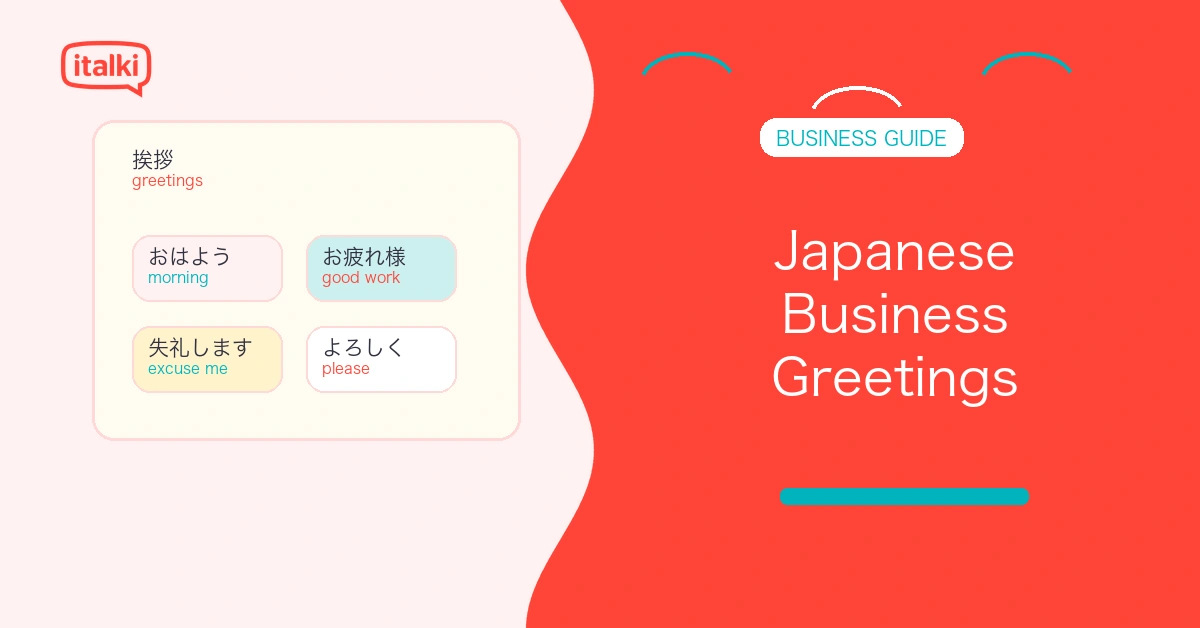
This guide covers the essential Japanese business greetings for every workplace situation: morning arrivals, welcoming visitors, meeting openers and closers, phone calls, end-of-day expressions, and the phrases used when someone is absent or returning.

Find your perfect teacher
Build real speaking confidence with personalized lessons from a teacher who matches your goals, schedule, and learning style.

Morning and arrival greetings
The first thing you say when you arrive at a Japanese workplace matters. These are not casual hellos: they signal that you are present, respectful, and aware of the social dynamics around you.
| Japanese | Romaji | English | Notes |
|---|---|---|---|
| おはようございます | Ohayou gozaimasu | Good morning (formal) | Used until around midday; say to each colleague individually on first contact |
| おはよう | Ohayou | Good morning (casual) | Between close colleagues of similar rank only |
| よろしくお願いします | Yoroshiku onegaishimasu | I look forward to working with you today | Said at the start of a shift or new work period |
| 本日もよろしくお願いいたします | Honjitsu mo yoroshiku onegaiitashimasu | I look forward to another day working with you | More formal version; used in formal workplaces |
The おはようございます rule: Even if you have been at your desk since 7am and a colleague arrives at 9am, you still say おはようございます to them when you first speak. It marks the first interaction with each person, not the time of day. Using こんにちは (Konnichiwa) in the morning in a workplace setting sounds like you forgot where you are.
Work with a Japanese business language tutor to practice these arrivals with real dialogue, including the timing and bow depth that accompany each phrase.
Welcoming visitors and guests
When a client, partner, or external visitor arrives, specific phrases are used depending on whether you are the receptionist, the meeting host, or a colleague passing in the hallway.
| Japanese | Romaji | English | Who says it |
|---|---|---|---|
| いらっしゃいませ | Irasshaimase | Welcome (to someone arriving) | Reception, host |
| ようこそお越しくださいました | Youkoso okoshi kudasaimashita | Welcome, thank you for coming | Meeting host (formal) |
| お待ちしておりました | Omachi shite orimashita | We have been expecting you | Meeting host |
| こちらへどうぞ | Kochira e douzo | Please, this way | Guiding a guest |
| お掛けください | Okake kudasai | Please have a seat | Inviting someone to sit |
| ただいま担当者を呼んでまいります | Tadaima tantousha o yonde mairimasu | I will call the person in charge right away | Receptionist |
Note the verb いらっしゃいます (irasshaimasu): this is the sonkeigo (respectful) form of いる (to be), います (to exist), and 来る (to come). It elevates the visitor’s presence. Using います instead of いらっしゃいます for a client sounds casual in a way that will register immediately.
Find your perfect teacher
Build real speaking confidence with personalized lessons from a teacher who matches your goals, schedule, and learning style.
Meeting openers and closers
Meetings in Japanese workplaces open and close with standard phrases that frame the entire interaction. Knowing these makes you sound like you belong in the room.
Opening a meeting:
| Japanese | Romaji | English |
|---|---|---|
| 本日はお忙しい中お越しいただきありがとうございます | Honjitsu wa oisogashii naka okoshi itadaki arigatou gozaimasu | Thank you for coming despite your busy schedule |
| それでは始めさせていただきます | Soredewa hajimesasete itadakimasu | Let us now begin |
| どうぞよろしくお願いいたします | Douzo yoroshiku onegaiitashimasu | I look forward to our meeting |
| 早速ですが、本題に入らせていただきます | Sassoku desu ga, hondai ni hairasasete itadakimasu | If I may, let us get to the main topic |
Closing a meeting:
| Japanese | Romaji | English |
|---|---|---|
| 本日はありがとうございました | Honjitsu wa arigatou gozaimashita | Thank you for today |
| 引き続きよろしくお願いいたします | Hikitsuzuki yoroshiku onegaiitashimasu | I look forward to our continued work together |
| またご連絡させていただきます | Mata gorenraku sasete itadakimasu | I will be in touch again |
| お気をつけてお帰りください | Okiwotsukete okaeri kudasai | Please take care on your way back |
The phrase 本日はお忙しい中お越しいただきありがとうございます is long, but it is a near-fixed formula at the opening of a business meeting. You do not need to compose it from scratch each time: it is a unit to memorize and deploy.
During the workday: phrases for ongoing interactions
These are the phrases woven into a Japanese workday that have no direct English equivalent but are missed if absent.
| Japanese | Romaji | English equivalent | When used |
|---|---|---|---|
| おつかれさまです | Otsukaresama desu | Good work / Thanks for your effort | Acknowledging a colleague throughout the day; also an all-purpose workday greeting after morning |
| おつかれさまでした | Otsukaresama deshita | Past tense version | At the end of the day, or after someone finishes a task |
| ご苦労様でした | Gokurousama deshita | Good work (for effort under difficulty) | Used by superiors to subordinates only; wrong if used upward |
| 少々お待ちください | Shoushou omachi kudasai | Please wait a moment | When putting someone on hold or pausing |
| 承知しました | Shouchi shimashita | Understood / I will do it | Confirming you understood an instruction |
| かしこまりました | Kashikomarimashita | Certainly (very formal) | More deferential than 承知しました; used with clients and superiors |
The ご苦労様 trap: Non-native speakers sometimes use ご苦労様でした to thank a senior colleague, not realizing it runs downward (from senior to junior) in the hierarchy. Saying it to your manager is a visible error. Use おつかれさまでした with everyone safely.
A private Japanese business language tutor can clarify which of these run upward, downward, or both, and give you practice in realistic workplace exchanges until the right phrase comes automatically.
Find your perfect teacher
Build real speaking confidence with personalized lessons from a teacher who matches your goals, schedule, and learning style.
End-of-day and departure phrases
Leaving the office in Japan involves specific phrases depending on whether you are leaving before your colleagues or staying as others leave.
| Japanese | Romaji | English | Who says it |
|---|---|---|---|
| お先に失礼します | Osaki ni shitsurei shimasu | Excuse me for leaving before you | Person leaving early |
| おつかれさまでした | Otsukaresama deshita | Good work today | Colleagues responding to someone leaving |
| 気をつけて | Kiwotsukte | Take care | Casual response to a colleague leaving |
| また明日 | Mata ashita | See you tomorrow | Casual, between close colleagues |
| 本日はありがとうございました | Honjitsu wa arigatou gozaimashita | Thank you for today | End of a client interaction or formal workday |
| ごちそうさまでした | Gochisousama deshita | Thank you for the meal | After a business lunch or dinner paid for by a host |
お先に失礼します literally means I am being rude by leaving before you. It acknowledges that leaving while seniors are still at the desk is technically a breach of seniority etiquette. The phrase manages this breach politely. Not saying it when leaving is noticed.
Phone greeting formulas
Japanese business phone calls open and close with fixed formulas. These are rehearsed sequences, not improvised conversation. Learning them as complete units rather than word by word is the right approach.
Answering an incoming call:
| Step | Japanese | Romaji | English |
|---|---|---|---|
| 1 | はい、〇〇会社でございます | Hai, ~ kaisha de gozaimasu | Yes, this is ~ company |
| 2 | いつもお世話になっております | Itsumo osewa ni natte orimasu | Thank you for your continued support |
| 3 | 少々お待ちください | Shoushou omachi kudasai | One moment please (if transferring) |
Making an outgoing call:
| Step | Japanese | Romaji | English |
|---|---|---|---|
| 1 | 〇〇会社の〇〇と申します | ~ kaisha no ~ to moushimasu | This is ~ from ~ company |
| 2 | いつもお世話になっております | Itsumo osewa ni natte orimasu | Thank you for your continued support |
| 3 | 〇〇様はいらっしゃいますでしょうか | ~ sama wa irasshaimasu deshou ka | May I speak with ~? |
Ending the call:
| Japanese | Romaji | English |
|---|---|---|
| それでは失礼いたします | Soredewa shitsurei itashimasu | Excuse me, goodbye |
| よろしくお願いいたします | Yoroshiku onegaiitashimasu | Thank you / I look forward to it |
The opening sequence on both sides is almost entirely fixed. Both parties say おつかれさまでございます or いつもお世話になっております regardless of whether they have actually worked together before: it is the ritual acknowledgment of a professional relationship.
For the broader cultural context behind why these formulas exist and how they connect to Japanese professional values, the guide to Japanese business culture covers hierarchy, tatemae and honne, and the logic of indirect communication in the workplace.
Find your perfect teacher
Build real speaking confidence with personalized lessons from a teacher who matches your goals, schedule, and learning style.
When someone is absent or returning
| Situation | Japanese | Romaji | English |
|---|---|---|---|
| Someone is out | ただいま外出しております | Tadaima gaishutsu shite orimasu | They are currently out of the office |
| Someone is in a meeting | ただいま会議中でございます | Tadaima kaigichuu de gozaimasu | They are currently in a meeting |
| Taking a message | 伝言をお預かりしましょうか | Dengon o oazukari shimashou ka | May I take a message? |
| Someone returns | おかえりなさい | Okaeri nasai | Welcome back (casual) |
| Returning yourself | ただいま戻りました | Tadaima modorimashita | I have returned (formal) |
| After a business trip | 行ってきました | Itte kimashita | I am back (after going somewhere) |
おかえりなさい is normally a home greeting (welcome back), but it is used between close colleagues when someone returns from a business trip or long outing. The formal equivalent in an office is お帰りになりましたか or simply acknowledging with おつかれさまでした.
Get confident with a Japanese business teacher
Reading these phrases is different from using them at the right moment, in the right form, without pausing to think. That kind of automaticity only comes from speaking practice, and specifically from someone who can tell you in real time when a phrase landed correctly and when something was off.
One session focused on phone greeting drills, another on meeting openers, and a third on the daily phrases that mark a professional in a Japanese office: that kind of targeted practice closes the gap faster than any flashcard deck. italki has 30,000+ expert tutors trusted by over 10 million learners worldwide. Book a trial lesson and work through the exact workplace scenarios you will actually face.
Find your perfect teacher
Build real speaking confidence with personalized lessons from a teacher who matches your goals, schedule, and learning style.
FAQ
What is the difference between 承知しました and かしこまりました?
Both mean understood or certainly, but かしこまりました is more deferential. It is used primarily with clients and in formal service contexts. 承知しました is appropriate with colleagues and managers. Using かしこまりました with a close colleague every day sounds overly formal; using 承知しました with an important client sounds slightly casual.
When do I stop using おはようございます and switch to こんにちは?
In a workplace setting, keep using おはようございます for the first interaction with each colleague regardless of the time, as long as it is broadly morning. In practice, many Japanese offices use おはようございます until noon. After that, おつかれさまです takes over as the general all-purpose acknowledgment phrase and is safer than こんにちは in a workplace context.
Is it necessary to bow while saying these phrases?
Yes, in person. The phrase and the bow are paired. The depth of the bow matches the formality: a casual おはよう gets a small nod, while ありがとうございました to a client gets a proper 30-degree bow. On a phone call, Japanese people often bow even though the other person cannot see them: it is that habitual.
What do I say if I do not know the standard phrase in a Japanese business situation?
失礼いたしました (Shitsurei itashimashita), meaning I apologize for the rudeness, is a safe recovery phrase for many social missteps. Saying it sincerely when you realize you used the wrong form is far better than attempting to cover the mistake. Most Japanese colleagues will be understanding of genuine effort.
Want to learn a language at italki?
Here are the best resources for you!