Key takeaways
- Business card exchange (meishi koukan) follows precise rules: present your card with both hands, printed side facing the recipient, receive cards with both hands, and never write on or fold a received card.
- Bowing depth signals formality. A 15-degree bow is casual, a 30-degree bow is the standard business greeting, and a 45-degree bow signals deep respect or apology. Maintain the bow until the other person rises.
- Group consensus shapes Japanese business decisions through a process called nemawashi (informal pre-consultation) and ringi (formal approval circulation). Major decisions are rarely finalized in meetings; meetings confirm agreements already reached in advance.
- Business emails in Japanese use keigo (formal honorific language). The opening formula, body phrases, and closing are standardized and expected. Using casual language in a business email signals a lack of professional awareness.
Japanese business culture has a clear internal logic, but it operates on assumptions that are largely invisible to outsiders.
Understanding why a meeting proceeds the way it does, why a yes does not always mean agreement, and why the business card matters as much as it does makes the difference between a professional who navigates Japanese business settings comfortably and one who creates friction without knowing why.
italki connects you with Japanese business language teachers who work in these environments and can close the gap between textbook knowledge and real professional fluency.
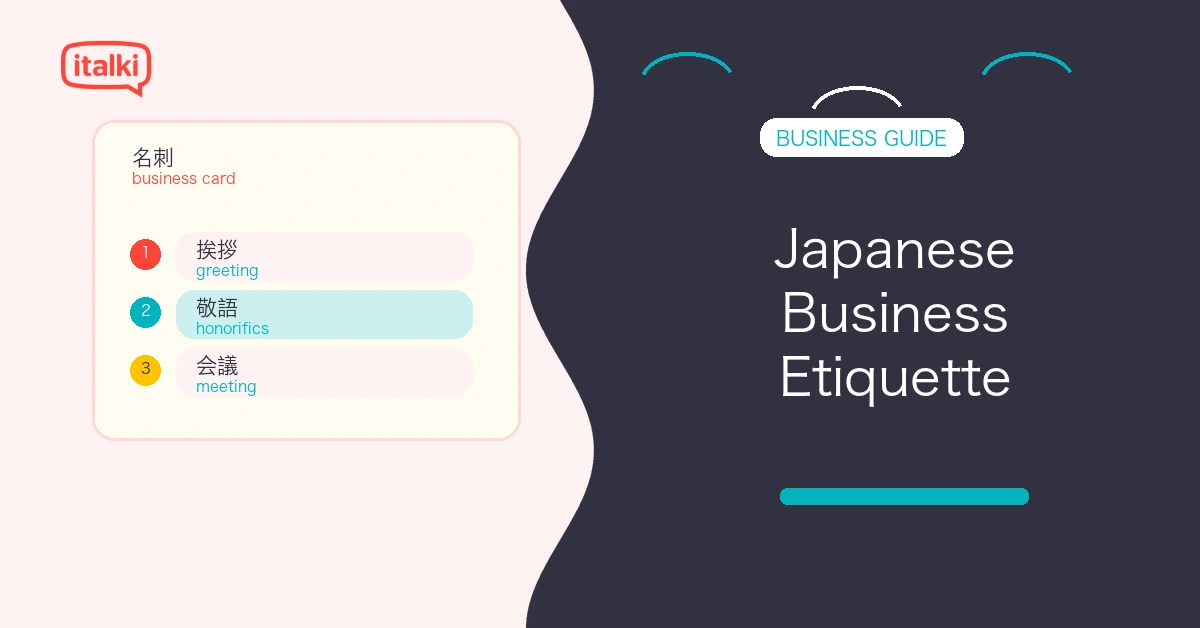
This guide covers business card exchange, greetings and bowing, meeting and decision-making culture, business email phrases, workplace hierarchy, and gift-giving in Japanese professional contexts.

Find your perfect teacher
Build real speaking confidence with personalized lessons from a teacher who matches your goals, schedule, and learning style.

Business card exchange: meishi koukan
The exchange of business cards (名刺交換 / meishi koukan) in Japan is a formal ritual, not a casual information transfer. It represents the introduction of your professional identity.
Rules for presenting your card:
- Hold the card with both hands, thumbs and forefingers at the bottom corners.
- Text faces the recipient so they can read it immediately.
- Present with a slight bow.
- Say your name and company: ABC Corporation no [name] to moushimasu.
Rules for receiving a card:
- Receive with both hands.
- Look at the card carefully for a moment. Read the name and title. This shows respect.
- If at a meeting, place received cards on the table in front of you in the order of seniority. Never put them directly into your pocket or bag.
- Never write on a received card in the presence of the giver.
- Never fold, bend, or put a received card under something heavy.
The wrong moves to avoid:
| What to avoid | Why it matters |
|---|---|
| Receiving with one hand | Signals indifference or disrespect |
| Writing on a card in front of the giver | Treating the card (and identity) as a scrap of paper |
| Putting the card in your back pocket | Suggests you will sit on it |
| Running out of cards at a meeting | Signals poor preparation |
| Presenting a damaged or creased card | Poor presentation reflects on your company |
Card logistics: Japanese business cards are typically presented at the beginning of a meeting, after initial greetings. The most senior person in each delegation presents first. Have your cards ready before the meeting, not loose at the bottom of a bag.
Work with a Japanese business tutor to practice the meishi exchange and the accompanying phrases until the ritual becomes instinctive rather than deliberate.
Greetings and bowing
Bowing (おじぎ / ojigi) replaces handshakes in most Japanese professional settings, though a handshake may be offered when meeting a foreigner as an accommodation.
Bow angles and their meanings:
| Bow depth | Context | Japanese |
|---|---|---|
| 15 degrees | Casual acknowledgment, passing a colleague | 会釈 / eshaku |
| 30 degrees | Standard business greeting, thank you | 敬礼 / keirei |
| 45 degrees | Deep respect, formal apology, senior person | 最敬礼 / saikeirei |
Rules for bowing:
- Maintain the bow until the other person rises. If both people hold the bow, a minor bowing cycle can follow. Let the senior person determine the end.
- Eye contact is typically avoided at the deepest point of a bow.
- In formal contexts, do not break a bow to speak.
Key business greeting phrases:
| Japanese | Romaji | English |
|---|---|---|
| よろしくお願いします | Yoroshiku onegaishimasu | I look forward to working with you / Please be good to me |
| お世話になっております | Osewa ni natte orimasu | Thank you for your continued support (business greeting) |
| はじめまして | Hajimemashite | Nice to meet you (first meeting) |
| ご無沙汰しております | Gobusata shite orimasu | It has been a while (formal, reacquainting) |
| どうぞよろしくお願いいたします | Douzo yoroshiku onegaiitashimasu | I sincerely look forward to working with you (formal) |
Osewa ni natte orimasu (お世話になっております) is one of the most important phrases in Japanese professional communication. It appears at the beginning of business emails and calls and signals that you acknowledge the existing relationship and its value. There is no direct English equivalent. Translating it literally as thank you for all your help gets the spirit across but misses the ritualized function it serves.
Find your perfect teacher
Build real speaking confidence with personalized lessons from a teacher who matches your goals, schedule, and learning style.
Meetings and decision-making culture
Meetings in Japan often confirm decisions already made, not make them.
The process of consensus-building before a meeting is called nemawashi (根回し), literally going around the roots. Before a formal proposal is presented in a meeting, the proposer typically consults informally with relevant stakeholders one-on-one to gauge their views, address objections, and build support. By the time the meeting happens, the outcome is often already clear.
The ringi system (稟議) is the formal version: a proposal document (ringi-sho) is circulated through the appropriate levels of the organization for written approval before a decision is finalized. This bottom-up approval process means decisions take longer to make but are implemented smoothly because buy-in is already established.
What yes means in a meeting: Japanese meeting culture often uses affirmative-sounding responses that do not indicate agreement:
| Japanese | Romaji | What it actually means |
|---|---|---|
| そうですね | Sou desu ne | I hear you / I am following (not necessarily agreeing) |
| なるほど | Naruhodo | I see, I understand |
| 検討します | Kentou shimasu | We will consider it (often means probably not) |
| 難しいですね | Muzukashii desu ne | That is difficult (polite no) |
| 少し考えさせてください | Sukoshi kangaesasete kudasai | Let me think about it a little (often means it will not happen) |
Reading these signals correctly requires time and experience. A Business Japanese tutor can help you practice reading and using these indirect communication patterns, which are among the most difficult aspects of Japanese professional communication for outsiders.
Meeting behavior:
- Silence is not uncomfortable in Japanese meetings. Thinking time is respected.
- Interrupting a speaker is rare and considered impolite.
- The most senior person in the room typically speaks last, not first.
- Mobile phones are silenced or switched off during meetings.
Business email phrases in Japanese
Japanese business emails follow a predictable structure with specific formulas at each stage. Deviating from these formulas can make an email feel unprofessional or confusing to Japanese recipients.
Standard email opening:
| Japanese | Romaji | English |
|---|---|---|
| お世話になっております | Osewa ni natte orimasu | Thank you for your continued support |
| いつもお世話になっております | Itsumo osewa ni natte orimasu | Thank you for your ongoing support |
| 突然のご連絡、失礼いたします | Totsuzen no gorenkaku, shitsurei itashimasu | I apologize for contacting you out of the blue (cold outreach) |
| ご連絡いただき、ありがとうございます | Gorenkaku itadaki, arigatou gozaimasu | Thank you for contacting me |
Standard subject lines:
| Japanese | Romaji | English |
|---|---|---|
| 〇〇についてのお問い合わせ | ~ ni tsuite no otoiawase | Inquiry regarding ~ |
| 〇〇のご確認 | ~ no gokakunin | Confirmation of ~ |
| 〇〇の件について | ~ no ken ni tsuite | Regarding the matter of ~ |
| 打ち合わせのお願い | Uchiawase no onegai | Request for a meeting |
| ご報告 | Gohoukoku | Report |
Requesting or proposing something:
| Japanese | Romaji | English |
|---|---|---|
| ご確認いただけますでしょうか | Gokakunin itadakemasu deshou ka | Could you please confirm? |
| ご検討いただければ幸いです | Gokentou itadakereba saiwai desu | I would be grateful if you would consider this |
| ぜひ一度お会いできればと思います | Zehi ichido oai dekireba to omoimasu | I hope we can meet once |
| よろしければ〜はいかがでしょうか | Yoroshikereba ~ wa ikaga deshou ka | If you are willing, how about ~? |
Standard email closing:
| Japanese | Romaji | English |
|---|---|---|
| お手数ですがよろしくお願いいたします | Otesuu desu ga yoroshiku onegaiitashimasu | I apologize for the inconvenience and thank you |
| ご不明な点がございましたら、お気軽にお申し付けください | Gofumei na ten ga gozaimashitara, okigaru ni omoushitsuke kudasai | Please feel free to contact me with any questions |
| 引き続きよろしくお願いいたします | Hikitsuzuki yoroshiku onegaiitashimasu | I look forward to our continued relationship |
| 取り急ぎご連絡まで | Toriisogi gorenkaku made | A quick message to let you know |
For broader context on Japanese language structure and levels, the guide to Japanese language levels covers the JLPT framework and what each level means for real-world business use.
Find your perfect teacher
Build real speaking confidence with personalized lessons from a teacher who matches your goals, schedule, and learning style.
Workplace hierarchy and communication
Japanese workplaces are organized around clear seniority structures. Seniority is based on years at the company, not just title.
Hierarchy markers in language: Japanese uses different verb forms and vocabulary depending on the relative status of speaker and listener. This is the keigo (敬語 / honorific language) system:
| Level | Japanese | Usage |
|---|---|---|
| Teineigo (polite) | 丁寧語 | Standard polite speech, everyday business |
| Sonkeigo (respectful) | 尊敬語 | Raising the status of the other person’s actions |
| Kenjougo (humble) | 謙譲語 | Lowering your own actions to honor the other person |
In business communication, teineigo is the baseline. When speaking about a client’s or senior colleague’s actions, you use sonkeigo. When speaking about your own actions to someone above you, you use kenjougo.
Example: Yamada-san is coming vs. I am going:
- Yamada-san irasshai masu. (sonkeigo, elevating Yamada’s action)
- Watashi ga mairiimasu. (kenjougo, humbling your own action)
Addressing colleagues: Use san (さん) after surnames in nearly all professional contexts. Using first names in a business setting is unusual unless explicitly invited. The title -kun is used for male subordinates or those of significantly lower rank; using it for peers or seniors is presumptuous.
Communication norms:
- Disagreement is rarely expressed directly. If a senior colleague’s idea has problems, a junior employee signals concern indirectly rather than saying that won’t work.
- Asking a clarifying question is acceptable. Challenging a decision publicly is not.
- Staying late when senior colleagues are still working is common. Leaving before your manager can be seen as lack of dedication, regardless of whether your work is finished.
Gift-giving in business contexts
Gift-giving (贈り物 / okurimono) in Japanese business settings follows clear conventions.
When to give gifts:
- When visiting a company for the first time (especially from abroad)
- When returning from a business trip abroad (omiyage, souvenirs)
- At the end of a significant project or business relationship milestone
- During the summer gift-giving season (ochūgen, mid-July) and year-end season (oseibo, December)
What to give:
- Food items from your home region or country (local specialties, sweets, regional products)
- High-quality sweets or confectionery (easy to share within the team)
- Items associated with your city or country (distinctive, but practical)
How to give:
- Present with both hands and a slight bow.
- Wrap the gift neatly. Presentation matters.
- Say something modest: Tsumaranai mono desu ga (It is a humble item, but…) is a traditional phrase used when presenting a gift, even if the gift is expensive.
- In Japan, gifts are typically not opened immediately in front of the giver.
What to avoid:
- Sets of four items: the number four (shi) sounds like the word for death in Japanese.
- White flowers: associated with funerals.
- Very personal items (clothing, perfume) for someone you do not know well.
Find your perfect teacher
Build real speaking confidence with personalized lessons from a teacher who matches your goals, schedule, and learning style.
Build Japanese business language fluency with a tutor
Business Japanese is a distinct skill from conversational Japanese. The honorific system, the indirect communication patterns, and the email formulas are all areas where learners need practice with real correction, not just rules.
italki’s 30,000+ expert tutors trusted by over 10 million learners worldwide include native Japanese speakers who work in business environments. A tutor experienced with business Japanese can run role-plays for meetings, practice business email writing, and explain the cultural logic behind the language so the rules make sense instead of just being memorized. Book a trial lesson and start building the professional Japanese communication skills that make a real difference in business settings.
Find your perfect teacher
Build real speaking confidence with personalized lessons from a teacher who matches your goals, schedule, and learning style.
FAQ
Do I need to bow if I am a foreigner in Japan?
Attempting a bow is appreciated and signals respect for Japanese customs. You do not need to execute it perfectly. A sincere effort at approximately 30 degrees for a business context is well-received. Japanese colleagues meeting international visitors often accommodate with a handshake as well. Following the other person’s lead is always the right approach.
What does yoroshiku onegaishimasu actually mean?
There is no single English equivalent. Depending on context, it functions as nice to meet you, I look forward to working with you, please take care of this for me, or thank you in advance. Its core meaning is a request for goodwill and cooperation from the other person, and it is used at the end of introductions, email closings, and requests. Learning when and how to use it naturally is one of the most useful things a Japanese business learner can do.
How long does it take to learn business Japanese to a functional level?
For someone starting from zero, reaching functional business Japanese (able to write emails, conduct meetings, and navigate social situations comfortably) typically takes two to three years of serious study. Learners who already speak conversational Japanese at N3-N4 level can focus specifically on keigo and business vocabulary and develop professional fluency in six to twelve months of targeted practice.
Is it acceptable to conduct business in Japan entirely in English?
Possible at major international corporations and in some industries (technology, finance). Not reliable in mid-sized Japanese companies, government institutions, or traditional industries where meetings and communications are conducted primarily in Japanese. Having at least basic Japanese greetings, business card exchange phrases, and meeting phrases is valuable regardless of whether the meeting itself is in English.
Want to learn a language at italki?
Here are the best resources for you!