What are Japanese prefixes?
Japanese prefixes are elements added to the beginning of a word to change its meaning, level of politeness, or intensity. Some are native Japanese in origin, some come from Chinese, and some are used specifically in honorific speech.
Knowing the most common prefixes allows learners to decode unfamiliar vocabulary and build new words from patterns rather than memorizing each word individually.
Key takeaways
- Japanese prefixes come from two main sources: native Japanese words (和語, wago) and Sino-Japanese words (漢語, kango), and each tends to attach to the same type of word it originated from.
- The honorific prefixes お (o-) and ご (go-) are among the most visible in daily Japanese and are required in formal and polite speech.
- Negative prefixes like 不 (fu-), 無 (mu-), and 未 (mi-) each carry a different shade of negation, and choosing the wrong one produces unnatural Japanese.
- Recognizing prefix patterns significantly speeds up vocabulary acquisition because one prefix can unlock the meaning of dozens of unfamiliar words.
A learner reading a Japanese newspaper or product label encounters dozens of prefix-formed words on every page. Being able to identify 不 as a negation prefix or 再 as meaning “re-” transforms unknown words into guessable ones. This is one of the most practical vocabulary strategies available to intermediate Japanese learners.
italki connects learners with Japanese teachers who teach vocabulary in patterns, not as isolated lists.
Book a trial lesson and ask the teacher to walk through prefix patterns using words from a current reading text.

Find Your Perfect Teacher
Build real speaking confidence with personalized lessons from a teacher who matches your goals, schedule, and learning style.

Honorific prefixes: お (o-) and ご (go-)
The prefixes お (o-) and ご (go-) add politeness or respect to a noun. Both are forms of the same honorific prefix but attach to different word types.
お (o-) attaches primarily to words of Japanese origin (和語, wago).
| Word | With お- | Reading | Meaning |
|---|---|---|---|
| 水 (water) | お水 | おみず (omizu) | water (polite) |
| 名前 (name) | お名前 | おなまえ (onamae) | name (polite) |
| 願い (request) | お願い | おねがい (onegai) | request / please |
| 土産 (souvenir) | お土産 | おみやげ (omiyage) | souvenir / gift |
| 金 (money) | お金 | おかね (okane) | money (polite) |
| 茶 (tea) | お茶 | おちゃ (ocha) | tea (polite/standard) |
ご (go-) attaches primarily to words of Chinese origin (漢語, kango).
| Word | With ご- | Reading | Meaning |
|---|---|---|---|
| 連絡 (contact) | ご連絡 | ごれんらく (go-renraku) | contact (respectful) |
| 確認 (confirmation) | ご確認 | ごかくにん (go-kakunin) | confirmation (respectful) |
| 家族 (family) | ご家族 | ごかぞく (go-kazoku) | family (respectful) |
| 注文 (order) | ご注文 | ごちゅうもん (go-chūmon) | order (polite, customer use) |
| 予約 (reservation) | ご予約 | ごよやく (go-yoyaku) | reservation (polite) |
Some words break this pattern. お電話 (o-denwa, phone call) uses お even though 電話 is a Sino-Japanese word. These exceptions are best learned through reading and listening exposure.
Removing お or ご from polite speech does not make Japanese incorrect in casual settings, but in formal contexts, using plain nouns without the prefix can sound abrupt or overly familiar.
Find Your Perfect Teacher
Build real speaking confidence with personalized lessons from a teacher who matches your goals, schedule, and learning style.
Negative prefixes
Japanese has several negative prefixes, each with a slightly different meaning. Using the wrong one produces unnatural Japanese even when the intended meaning is clear.
| Prefix | Kanji | Reading | Core meaning | Example |
|---|---|---|---|---|
| 不 | ふ | fu- | Not, un- (general negation) | 不可能 (fukanō) – impossible |
| 無 | む | mu- | Without, -less | 無料 (muryō) – free (no charge) |
| 非 | ひ | hi- | Non-, outside of | 非公式 (hikōshiki) – unofficial |
| 未 | み | mi- | Not yet, un- (incomplete) | 未来 (mirai) – future; 未確認 (mikakunin) – unconfirmed |
| 反 | はん | han- | Anti-, opposing | 反対 (hantai) – opposition |
不 (fu-): general negation
- 不満 (fuman) – dissatisfaction, discontent
- 不思議 (fushigi) – mysterious, strange
- 不安 (fuan) – anxiety, unease
- 不便 (fuben) – inconvenient
無 (mu-): without or lacking
- 無料 (muryō) – free (without charge)
- 無理 (muri) – impossible / unreasonable; can’t be done
- 無意識 (muishiki) – unconscious (without consciousness)
- 無限 (mugen) – infinite (without limit)
非 (hi-): non-category or outside a norm
- 非常 (hijō) – extraordinary / emergency
- 非公式 (hikōshiki) – unofficial
- 非常識 (hijōshiki) – lacking common sense
未 (mi-): incomplete or not yet done
- 未来 (mirai) – future
- 未確認 (mikakunin) – unconfirmed
- 未成年 (miseinen) – minor (not yet adult)
- 未満 (miman) – less than / below (a number)
Find Your Perfect Teacher
Build real speaking confidence with personalized lessons from a teacher who matches your goals, schedule, and learning style.
Magnitude prefixes
These prefixes intensify, diminish, or categorize by scale.
| Prefix | Kanji | Reading | Meaning | Example |
|---|---|---|---|---|
| 大 | だい/おお | dai-/ō- | Big, great | 大成功 (daiseikō) – great success |
| 小 | しょう/こ | shō-/ko- | Small, lesser | 小学校 (shōgakkō) – elementary school |
| 超 | ちょう | chō- | Ultra, super | 超特急 (chōtokkyū) – super express train |
| 高 | こう | kō- | High, elevated | 高品質 (kōhinshitsu) – high quality |
| 低 | てい | tei- | Low | 低価格 (teikaкaku) – low price |
大 (dai-/ō-) in practice:
- 大学 (daigaku) – university
- 大都市 (daitoshi) – large city
- 大雪 (ōyuki) – heavy snow
- 大成功 (daiseikō) – great success
Note on lexicalized 大 words: Some common words that contain 大 are fixed vocabulary items, not productive prefix combinations. 大丈夫 (daijōbu, OK / fine), 大変 (taihen, difficult / very), and 大好き (daisuki, to really like something) should be learned as whole words. Learners cannot freely apply the same pattern to form new combinations the way 大都市 or 大雪 can be understood compositionally.
超 (chō-) is also used in casual speech as an intensifier equivalent to “super” or “really”:
- 超楽しい (chō tanoshii) – super fun
- 超むずい (chō muzui) – super difficult (casual/slang)
Find Your Perfect Teacher
Build real speaking confidence with personalized lessons from a teacher who matches your goals, schedule, and learning style.
Repetition and return: 再 (sai-)
再 (sai-) corresponds to “re-” in English and attaches to verbs and nouns to indicate doing something again.
| Word | Reading | Meaning |
|---|---|---|
| 再確認 | さいかくにん (saikakunin) | reconfirm |
| 再利用 | さいりよう (saiрiyō) | reuse |
| 再開 | さいかい (saikai) | resume / reopen |
| 再生 | さいせい (saisei) | playback / regeneration |
| 再入国 | さいにゅうこく (sainyūkoku) | re-entry (into a country) |
再 is common in formal and written Japanese. In everyday speech, learners may also hear もう一度 (mō ichido, one more time) used informally to express the same idea as 再.
Find Your Perfect Teacher
Build real speaking confidence with personalized lessons from a teacher who matches your goals, schedule, and learning style.
How to choose the right prefix
The most common question is whether to use 不 or 無 when negating a word. A rough guide:
- Use 不 when something is imperfect, not functioning as expected, or emotionally negative: 不満, 不安, 不便.
- Use 無 when something is literally absent or zero: 無料 (zero charge), 無限 (zero limit), 無意識 (zero consciousness).
- Use 未 when something has not happened yet or is below a threshold: 未来 (not yet arrived), 未成年 (not yet adult age).
When uncertain, checking a dictionary for the specific word is more reliable than applying the prefix rule, since many common words have fixed forms that do not follow the general pattern.
Find Your Perfect Teacher
Build real speaking confidence with personalized lessons from a teacher who matches your goals, schedule, and learning style.
Common mistakes with Japanese prefixes
Mistake 1: Using お with all nouns Not all nouns take お. Adding お to words that do not normally take it (like お時間 for “time” in formal speech, which is acceptable) versus words that never take it (like お電脳, which is not a standard term) is something learners discover through reading and listening exposure.
Mistake 2: Confusing 不 and 無 不可能 (fukanō, impossible) is standard, but 無可能 does not exist. 無料 (muryō, free) is standard, but 不料 does not exist. These combinations are fixed. Using the wrong prefix with a given root produces unrecognized words.
Mistake 3: Overusing 超 in formal contexts 超 as an intensifier is conversational and casual. Using 超 in a business email or formal essay is inappropriate and reads as unprofessional.
Find Your Perfect Teacher
Build real speaking confidence with personalized lessons from a teacher who matches your goals, schedule, and learning style.
Practice tasks
- Take 10 words from a recent Japanese text or lesson. Identify which ones contain a prefix. What does removing the prefix do to the meaning?
- Generate the 不, 無, and 未 versions of three base words and check a dictionary to see which combinations actually exist.
- Write five sentences using ご with Sino-Japanese nouns. Try them with a Japanese tutor online who can confirm whether the honorific use sounds natural in each context.
- Find five product labels, menus, or news headlines in Japanese. Circle all prefixes and write their meanings.
Find Your Perfect Teacher
Build real speaking confidence with personalized lessons from a teacher who matches your goals, schedule, and learning style.
Where do learners go from here?
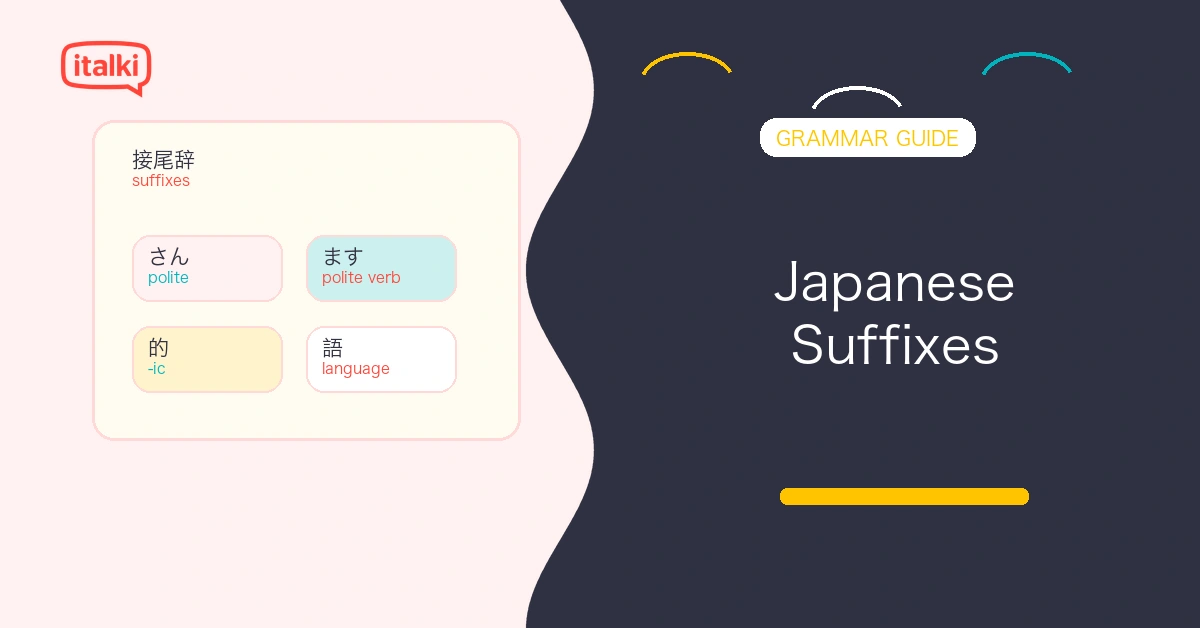
Prefixes are one component of a larger pattern system in Japanese that also includes suffixes (like 的, -teki, meaning “-like” or “-ish”) and compound words. Learners who can identify these elements read and listen faster because unfamiliar words become partially decodable rather than completely opaque.
italki has connected learners with Japanese teachers since 2007. A Japanese tutor can introduce new vocabulary in prefix families, test comprehension through reading exercises, and correct errors in real writing.
Book a trial lesson and bring a text with unfamiliar words to decode together.
Find Your Perfect Teacher
Build real speaking confidence with personalized lessons from a teacher who matches your goals, schedule, and learning style.
FAQ
What is the difference between お and ご as honorific prefixes?
お attaches mainly to Japanese-origin words (おみず, omizu, water), and ご attaches mainly to Sino-Japanese words (ご連絡, go-renraku, contact). Exceptions exist and are best learned through repeated exposure.
Is it rude to omit お or ご in polite speech?
In very formal contexts, like customer service or business, omitting them from fixed phrases can sound abrupt. In casual conversation among friends, they are generally optional or even dropped for naturalness.
Do all nouns take the honorific prefix?
No. Many words do not take お or ご, and adding the prefix to them sounds unnatural. There is no simple rule for which nouns accept the prefix and which do not; this is learned through exposure.
What does 非常 mean and why does 非 not mean “not normal”?
非常 (hijō) means “extraordinary” or “emergency” in set phrases like 非常口 (hijōguchi, emergency exit) and 非常事態 (hijō jitai, state of emergency). 非 signals that something falls outside the usual category, which in emergency contexts means outside normal operating conditions. The prefix itself means “non-” or “outside of,” not simply “not.”
How is 未来 (mirai) structured?
未 (not yet) + 来 (come/arrive) = mirai, the time that has not yet arrived. The same 未 appears in 未成年 (not yet adult) and 未確認 (not yet confirmed), showing the consistent “not yet / incomplete” meaning of the prefix.
Want to learn a language at italki?
Here are the best resources for you!