Key takeaways
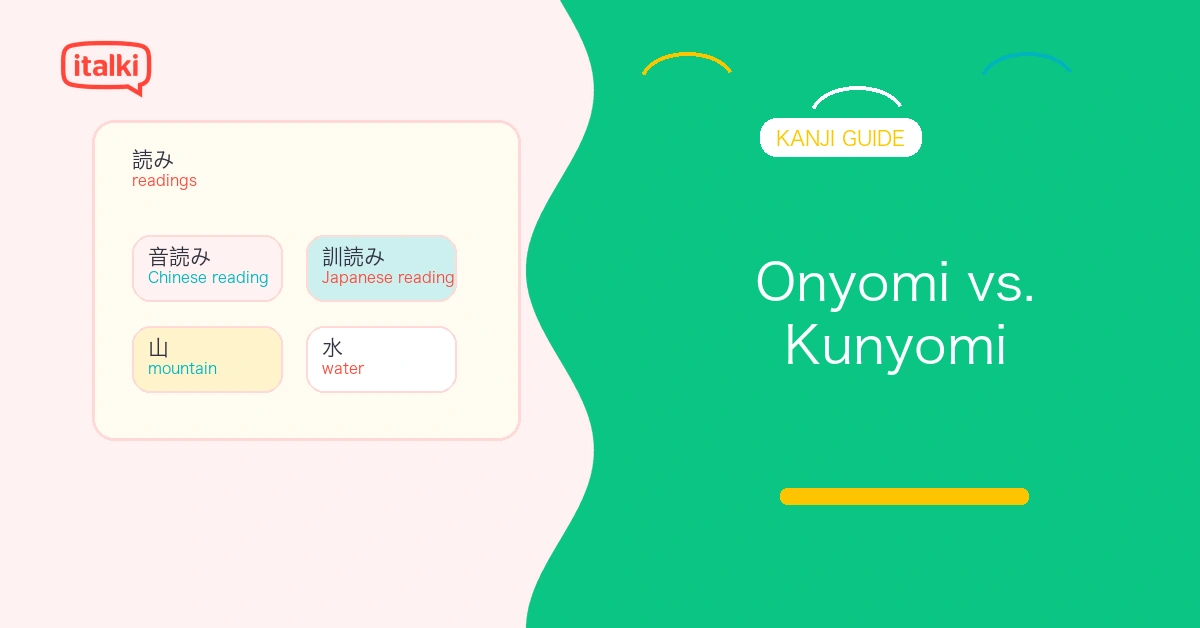
- Onyomi (音読み, on’yomi) are the Chinese-derived readings of a kanji, imported alongside the characters from China. Kunyomi (訓読み, kun’yomi) are the native Japanese readings assigned to the same characters. Most kanji have both, and you use different ones depending on context.
- The most reliable general rule: when two or more kanji appear together as a compound word, use onyomi. When a single kanji appears alone or followed by hiragana, use kunyomi.
- Japanese dictionaries and textbooks list onyomi in katakana (to signal the Chinese origin) and kunyomi in hiragana. Recognizing this convention helps you read vocabulary lists and dictionary entries immediately.
- Some kanji have only onyomi, some have only kunyomi, and some have multiple readings in each category because Japanese borrowed from Chinese at different historical periods, resulting in several layers of onyomi for the same character.
One of the most consistent questions Japanese learners hit in the first months of studying kanji is: Why does this character have so many different ways to read it? The answer is the onyomi / kunyomi split. Understanding why it exists and how to use it makes kanji learning significantly less random.
italki connects learners with Japanese tutors who can help you practice reading kanji in real sentences, identify patterns, and develop the instinct to choose the right reading without looking it up.
This guide covers the history of each reading type, how to identify which to use, clear examples with well-known kanji, and the special cases that break the general rules.
Work with a Japanese tutor online to practice kanji readings in context and develop the pattern recognition that makes Japanese text easier to process over time.

Find your perfect teacher
Build real speaking confidence with personalized lessons from a teacher who matches your goals, schedule, and learning style.
Book a trial lesson
What is onyomi?
音読み (on’yomi, literally sound reading) is the Japanese rendering of the original Chinese pronunciation of a kanji. When Japan adopted Chinese writing over a period from roughly the 5th to the 9th centuries CE, the characters came with their Chinese sounds. These sounds were adapted into Japanese phonology and preserved as the onyomi.
Onyomi is typically used in:
- Compound words (熟語 jukugo) made of two or more kanji: 学校 (gakkō, school), 電話 (denwa, telephone), 音楽 (ongaku, music)
- Sino-Japanese vocabulary, which tends to be more formal and often corresponds to academic, technical, or written language
- Many words you will encounter in news, textbooks, and formal writing
In dictionaries and study materials, onyomi readings are listed in katakana (キ, ガク, サン) to visually mark their foreign origin.
What is kunyomi?
訓読み (kun’yomi, literally meaning reading) is the native Japanese word that was assigned to a kanji when Japan first adopted the Chinese writing system. When the Japanese saw the character 山 (meaning mountain), they applied their existing Japanese word for mountain, やま (yama), to that character. That native assignment is the kunyomi.
Kunyomi is typically used when:
- A single kanji stands alone: 山 (yama, mountain), 水 (mizu, water), 木 (ki, tree)
- A kanji appears with hiragana attached (okurigana): 食べる (taberu, to eat), 書く (kaku, to write), 高い (takai, expensive/tall)
- Japanese native vocabulary, which tends to be more conversational and everyday in register
In dictionaries, kunyomi readings are listed in hiragana (やま, みず, き).
Find your perfect teacher
Build real speaking confidence with personalized lessons from a teacher who matches your goals, schedule, and learning style.
Book a trial lesson
The general rule for choosing a reading
No rule is universal in Japanese, but this one works most of the time:
Compound word (two or more kanji together) = onyomi Single kanji (alone or with hiragana) = kunyomi
| Situation | Reading type | Example |
|---|---|---|
| Kanji + kanji | onyomi | 山頂 (さんちょう, sanchō, mountain summit) |
| Kanji alone | kunyomi | 山 (やま, yama, mountain) |
| Kanji + hiragana | kunyomi | 高い (たかい, takai, expensive) |
| Kanji + kanji + hiragana | usually onyomi for kanji, hiragana is okurigana | 勉強する (べんきょうする, benkyō suru, to study) |
Exceptions exist, but this rule handles the majority of the kanji you will encounter as a learner.
Examples with common Kanji
These are frequently studied kanji that show the onyomi / kunyomi contrast clearly.
山 (mountain)
- Kunyomi: やま (yama) – 山 (yama, mountain)
- Onyomi: サン (san) – 富士山 (ふじさん, Fujisan, Mount Fuji), 登山 (とざん, tozan, mountain climbing)
水 (water)
- Kunyomi: みず (mizu) – 水 (mizu, water), 水色 (みずいろ, mizuiro, light blue)
- Onyomi: スイ (sui) – 水泳 (すいえい, suiei, swimming), 水曜日 (すいようび, suiyōbi, Wednesday)
日 (sun / day)
- Kunyomi: ひ (hi), か (ka) – 今日 (きょう, kyō, today), 三日 (みっか, mikka, 3rd day)
- Onyomi: ニチ (nichi), ジツ (jitsu) – 日曜日 (にちようび, nichiyōbi, Sunday), 日本 (にほん/にっぽん, Nihon/Nippon, Japan)
人 (person)
- Kunyomi: ひと (hito) – 人 (hito, person), 人々 (ひとびと, hitobito, people)
- Onyomi: ジン (jin), ニン (nin) – 外国人 (がいこくじん, gaikokujin, foreigner), 一人 (ひとり, hitori, one person, which actually uses kunyomi despite the number compound)
食 (eat / food)
- Kunyomi: た (ta-) – 食べる (たべる, taberu, to eat), 食べ物 (たべもの, tabemono, food)
- Onyomi: ショク (shoku) – 食事 (しょくじ, shokuji, meal), 食堂 (しょくどう, shokudō, cafeteria)
Find your perfect teacher
Build real speaking confidence with personalized lessons from a teacher who matches your goals, schedule, and learning style.
Book a trial lesson
Multiple onyomi readings
Some kanji have more than one onyomi because Japan borrowed from China at different historical periods, bringing in different regional Chinese pronunciations. The main categories are:
Go-on (呉音, goon): An early layer of borrowing, associated with Buddhism and classical learning. Often gives the more archaic-sounding reading.
Kan-on (漢音, kan’on): A later, more systematic borrowing from Tang Dynasty Chinese. This became the standard for most academic and compound vocabulary.
Tō-on (唐音, tōon): A third layer from the Song/Ming Dynasty period, mainly affecting vocabulary related to Zen Buddhism, Chinese-style cooking, and certain arts.
Example with 明 (bright / clear):
- Go-on: みょう (myō) – 明日 (みょうにち, myōnichi, tomorrow, formal)
- Kan-on: めい (mei) – 明確 (めいかく, meikaku, clear / definite)
- Kunyomi: あ (a-) – 明るい (あかるい, akarui, bright)
For most learners, the distinction between Go-on and Kan-on matters less than simply learning which reading a given word uses. Textbooks and vocabulary lists will teach you the reading used in each specific word, and pattern recognition builds naturally through exposure.
Kanji with only onyomi or only kunyomi
Not every kanji has both reading types. Some have only onyomi (usually characters for abstract concepts with no native Japanese equivalent) and some have only kunyomi (characters created in Japan, called 国字 kokuji, with no Chinese-derived reading).
Kanji with only onyomi (no standard kunyomi):
- 絵 (e, painting/picture): always read え in compounds too
- 図 (zu/to, diagram): 地図 (ちず, chizu, map)
- 完 (kan, completion): 完全 (かんぜん, kanzen, complete)
Kanji with only kunyomi (国字 kokuji, created in Japan):
- 畑 (はたけ, hatake, field/farm): no onyomi exists because this character was invented in Japan
- 峠 (とうげ, tōge, mountain pass): invented in Japan, kunyomi only
- 働 (はたら-, hatara-, to work): 働く (はたらく, hataraku, to work). Technically this character was created in Japan based on Chinese components, and while it has an onyomi ドウ (dō) in compounds like 労働 (rōdō, labor), it is predominantly used with its kunyomi
Find your perfect teacher
Build real speaking confidence with personalized lessons from a teacher who matches your goals, schedule, and learning style.
Book a trial lesson
Special cases: jukujikun and nanori
Two categories break the general rules entirely.
Jukujikun (熟字訓, ateji-style readings): These are compound words where the reading of the whole word bears no relationship to the individual kanji readings. They are read as a single unit.
| Kanji | Jukujikun reading | Meaning |
|---|---|---|
| 今日 | きょう (kyō) | today (not kin + nichi) |
| 明日 | あした (ashita) | tomorrow |
| 大人 | おとな (otona) | adult |
| 七夕 | たなばた (Tanabata) | Star Festival |
| 時雨 | しぐれ (shigure) | autumn rain |
These must be memorized as vocabulary items rather than decoded from the component readings.
Nanori (名乗り): Japanese names use a completely separate set of readings called nanori that do not follow either the standard onyomi or kunyomi. The character 大 is ダイ (dai) in onyomi and おお (ō) in kunyomi, but in the name 大輔 it may be読まれる daijō, だいすけ (daisuke) or other readings. Name readings require learning the name directly.
For more on how Japanese scripts work together, the guide to Japanese alphabets covers hiragana, katakana, and kanji alongside each other.
How this looks in a Japanese dictionary
When you look up a kanji in a Japanese dictionary or app such as Jisho or KanjiAlive, you will see:
- Onyomi listed in katakana: for 山 you see サン (SAN)
- Kunyomi listed in hiragana: for 山 you see やま (yama)
- Example compounds showing onyomi in action
- Example standalone uses showing kunyomi in action
The katakana-for-onyomi / hiragana-for-kunyomi convention is consistent across all standard Japanese reference materials and is itself a useful reading signal.
Find your perfect teacher
Build real speaking confidence with personalized lessons from a teacher who matches your goals, schedule, and learning style.
Book a trial lesson
Practical tips for learners
Tip 1: Learn readings through words, not in isolation. Rather than memorizing that 山 has onyomi サン and kunyomi やま as abstract facts, learn 山 (yama, mountain) and 登山 (tozan, mountain climbing) as vocabulary. The reading is absorbed through the word, and patterns emerge naturally.
Tip 2: Use the two-kanji rule as your default. When you see two kanji together and are unsure how to read them, guess onyomi. You will be right most of the time.
Tip 3: When you see hiragana attached to kanji, expect kunyomi. The hiragana suffix (okurigana) is a strong signal: 食べ (tabe-), 書き (kaki-), 高い (takai) all use kunyomi for the kanji portion.
Tip 4: Pay attention to register. Onyomi compounds tend to be more formal and written. Kunyomi words tend to be more conversational. Building awareness of this register difference helps you choose vocabulary appropriate to the context you are in.
Practice Kanji readings with a tutor
The rules for onyomi and kunyomi make the system feel manageable, but internalizing them takes practice with real text. A Japanese tutor can walk you through vocabulary in context, help you decode unfamiliar kanji, and build the reading fluency that comes from guided exposure to authentic Japanese.
italki’s 30,000+ expert tutors include native Japanese speakers who specialize in kanji instruction for learners at every level. Trusted by over 10 million learners worldwide, the platform lets you find a tutor who can tailor kanji lessons to your current reading level and learning goals. Book a trial lesson and start reading real Japanese text with confident kanji recognition.
Find your perfect teacher
Build real speaking confidence with personalized lessons from a teacher who matches your goals, schedule, and learning style.
Book a trial lesson
FAQ
What is the difference between onyomi and kunyomi?
Onyomi (音読み) is the Chinese-derived pronunciation of a kanji, used primarily in compound words (two or more kanji together). Kunyomi (訓読み) is the native Japanese word assigned to the kanji, used when the kanji appears alone or with a hiragana suffix. Most kanji have both, and context determines which reading applies.
How do you know whether to use onyomi or kunyomi?
The most reliable guideline: two or more kanji together as a compound word = onyomi. A single kanji alone or followed by hiragana = kunyomi. Exceptions exist, but this rule covers the majority of cases. Over time, reading practice builds the instinct to choose correctly without consciously applying the rule.
Why does one kanji sometimes have multiple onyomi?
Multiple onyomi exist because Japan borrowed from China at different historical periods (5th to 14th centuries), each time importing a different regional Chinese pronunciation. The oldest layer (Go-on) came through Korea and early Buddhist texts; the main layer (Kan-on) came from Tang Dynasty official Chinese. A single kanji may carry both because different vocabulary items were borrowed at different times.
What is jukujikun?
Jukujikun (熟字訓) are compound words where the reading does not come from the individual kanji readings at all. 今日 (きょう, today), 明日 (あした, tomorrow), and 大人 (おとな, adult) are examples. These are read as complete units and must be memorized as vocabulary rather than decoded from the component characters.
What are 国字 (kokuji)?
Kokuji are kanji invented in Japan, without a Chinese origin. They typically have kunyomi only because there is no Chinese pronunciation to borrow. 畑 (はたけ, hatake, cultivated field) and 峠 (とうげ, tōge, mountain pass) are both kokuji, created to describe Japanese-specific landscapes and concepts that had no equivalent Chinese character.
Want to learn a language at italki?
Here are the best resources for you!