Key takeaways
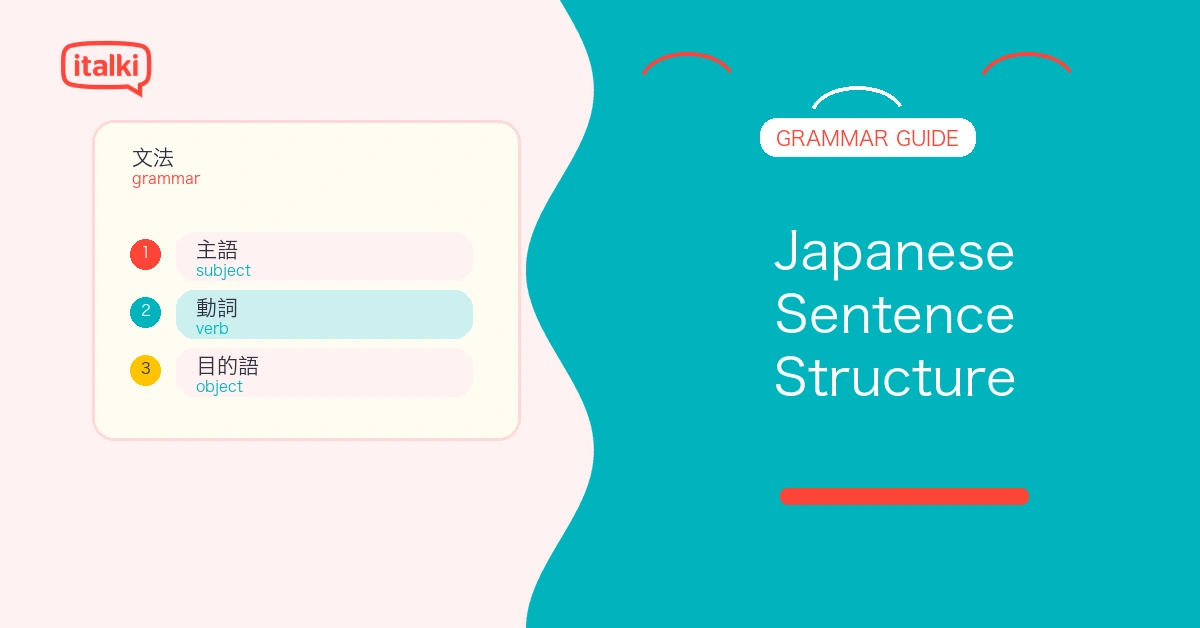
- Japanese follows Subject-Object-Verb (SOV) word order. The verb always comes at the end of the sentence. This is the single most important structural difference from English, which follows Subject-Verb-Object (SVO) order.
- Japanese uses grammatical particles (助詞, joshi): small words that follow nouns and indicate their role in the sentence. は (wa) marks the topic, が (ga) marks the subject, を (wo) marks the object, に (ni) marks direction or location, で (de) marks location of action or means.
- The topic marker は (wa) and the subject marker が (ga) are one of the most discussed distinctions in Japanese grammar. Briefly: は introduces what the sentence is about; が identifies who performs the action, often with emphasis or new information.
- Japanese forms questions by adding か (ka) to the end of a statement without changing word order. No subject-verb inversion is needed. Rising intonation alone also works in casual speech.
Japanese sentence structure is systematic once the core logic is clear, but it requires rebuilding the way you think about sentence construction from the bottom up. The verb-at-the-end rule means you must hold the meaning of a sentence until the final word, which takes adjustment for English speakers who process meaning as they hear each verb.
Practicing sentence construction in real conversations, not just exercises, is what makes the structure automatic. italki connects you with Japanese teachers who can correct your sentence structure in real time, show you where your instincts from English are leading you wrong, and build the habit of constructing Japanese sentences naturally.
This guide covers the basic SOV structure, the Japanese particle system, the は vs. が distinction, how to form negative sentences, how to ask questions, and how to build more complex sentences.
A Japanese tutor can give you sentence construction drills, correct particle errors immediately in conversation, and show you how complex Japanese sentences are layered from their core structure outward.

Find your perfect teacher
Build real speaking confidence with personalized lessons from a teacher who matches your goals, schedule, and learning style.
Book a trial lesson
The sov word order
English: Subject + Verb + Object
She eats sushi.
Japanese: Subject + Object + Verb
彼女は寿司を食べます。
*Kanojo wa sushi wo tabemasu.*
(She / sushi / eats.)
The verb always comes at the end. This applies to any length of sentence:
| English | Japanese | Romaji |
|---|---|---|
| I drink water. | 私は水を飲みます。 | Watashi wa mizu wo nomimasu. |
| He reads a book. | 彼は本を読みます。 | Kare wa hon wo yomimasu. |
| She studies Japanese. | 彼女は日本語を勉強します。 | Kanojo wa nihongo wo benkyou shimasu. |
| We eat pizza on Fridays. | 私たちは金曜日にピザを食べます。 | Watashitachi wa kin’youbi ni piza wo tabemasu. |
What can move: In Japanese, the subject and topic can often be dropped if they are clear from context. Time expressions (kin’youbi ni, on Friday) can appear at different positions in the sentence. What cannot move is the verb: it always comes last.
Japanese grammatical particles
Particles follow the noun they mark and tell you the noun’s grammatical function in the sentence.
| Particle | Romaji | Function | Example |
|---|---|---|---|
| は | wa | Topic marker: what the sentence is about | 私は学生です。 (I [topic] am a student.) |
| が | ga | Subject marker: who performs the action | 猫が好きです。 (I like cats. [Cats are what I like.]) |
| を | wo (o) | Object marker: what receives the action | 本を読みます。 (I read a book.) |
| に | ni | Direction, time, target, location of existence | 学校に行きます。 (I go to school.) |
| で | de | Location of action, means, reason | 図書館で勉強します。 (I study at the library.) |
| の | no | Possessive, noun connector | 私の本。 (My book.) |
| と | to | And (connecting nouns), with | りんごとみかん。 (Apples and oranges.) |
| へ | e | Direction (toward, less specific than に) | 東京へ行きます。 (I go toward Tokyo.) |
| から | kara | From (starting point), because | 東京から来ました。 (I came from Tokyo.) |
| まで | made | Until, up to | 5時まで働きます。 (I work until 5 o’clock.) |
| も | mo | Also, too | 私も行きます。 (I am going too.) |
| か | ka | Question marker | 行きますか? (Are you going?) |
| ね | ne | Seeking agreement (right? / isn’t it?) | いい天気ですね。 (Nice weather, isn’t it?) |
| よ | yo | Asserting information (you know) | これは美味しいよ。 (This is delicious, you know.) |
For how pronouns work with these particles in natural Japanese sentences, the guide to Japanese pronouns covers when to include 私は (watashi wa) or drop the pronoun entirely, and how names replace pronouns in real conversation.
Find your perfect teacher
Build real speaking confidence with personalized lessons from a teacher who matches your goals, schedule, and learning style.
Book a trial lesson
Topic marker は vs. subject marker が
This distinction is one of the most debated points in Japanese grammar. A simplified explanation:
は (wa): topic marker:
- Introduces what the sentence is talking about.
- Often translates as As for [topic]… or [Topic]…
- Can mark things that are NOT the grammatical subject.
- Shows contrast when used in the middle of a sentence.
が (ga): subject marker:
- Marks the grammatical subject: who or what performs the action.
- Used when identifying who does something (often with new information).
- Required after question words: 誰が来ましたか? (Who came?)
- Used in adjective sentences describing a property: 猫が好きです。 (I like cats. Literally: cats are liked [by me].)
Comparison:
| Japanese | Romaji | Nuance |
|---|---|---|
| 私は学生です。 | Watashi wa gakusei desu. | As for me, I am a student. (Introducing topic.) |
| 私が学生です。 | Watashi ga gakusei desu. | I am the one who is a student. (Emphasis: me, not you.) |
| 猫は好きです。 | Neko wa sukidesu. | As for cats, I like them. (Cats as topic; possibly implying contrast with another animal.) |
| 猫が好きです。 | Neko ga sukidesu. | I like cats. (Natural expression of preference; cats identified as what you like.) |
Practical rule for beginners: Use は when introducing a topic or making a general statement. Use が when answering a who or which question, or when the sentence contains a stative verb like aru (exist), iru (exist for living things), or suki (like) and kirai (dislike).
Building negative sentences
Japanese negation changes the verb form, not the word order. The verb remains at the end of the sentence.
Polite present:
| Affirmative | Negative | English |
|---|---|---|
| 食べます (tabemasu) | 食べません (tabemasen) | eat / do not eat |
| 飲みます (nomimasu) | 飲みません (nomimasen) | drink / do not drink |
| 行きます (ikimasu) | 行きません (ikimasen) | go / do not go |
| 見ます (mimasu) | 見ません (mimasen) | see / do not see |
| します (shimasu) | しません (shimasen) | do / do not do |
| です (desu) | じゃありません (ja arimasen) | is / is not |
Polite past:
| Affirmative | Negative | English |
|---|---|---|
| 食べました (tabemashita) | 食べませんでした (tabemasen deshita) | ate / did not eat |
| 行きました (ikimashita) | 行きませんでした (ikimasen deshita) | went / did not go |
| でした (deshita) | じゃありませんでした (ja arimasen deshita) | was / was not |
Casual negative (dictionary form):
| Verb | Casual negative | English |
|---|---|---|
| 食べる (taberu) | 食べない (tabenai) | not eat |
| 行く (iku) | 行かない (ikanai) | not go |
| 飲む (nomu) | 飲まない (nomanai) | not drink |
For how Japanese nouns appear in negative sentences alongside these verb forms, including common patterns for I do not have and there is no, the guide to Japanese nouns covers the noun patterns that appear throughout Japanese sentence construction.
Find your perfect teacher
Build real speaking confidence with personalized lessons from a teacher who matches your goals, schedule, and learning style.
Book a trial lesson
Forming questions in Japanese
Japanese questions are formed by adding か (ka) at the end of a statement. No word order change is needed.
| Statement | Question | English |
|---|---|---|
| 本を読みます。 | 本を読みますか? | You read a book. / Do you read a book? |
| これは日本語です。 | これは日本語ですか? | This is Japanese. / Is this Japanese? |
| 彼女は学生です。 | 彼女は学生ですか? | She is a student. / Is she a student? |
Question words:
| Japanese | Romaji | English |
|---|---|---|
| 何 | nani / nan | what |
| 誰 | dare | who |
| どこ | doko | where |
| いつ | itsu | when |
| なぜ / どうして | naze / doushite | why |
| どう / どのように | dou / dono you ni | how |
| いくら | ikura | how much |
| いくつ | ikutsu | how many |
Examples:
| Japanese | Romaji | English |
|---|---|---|
| これは何ですか? | Kore wa nan desu ka? | What is this? |
| どこに行きますか? | Doko ni ikimasu ka? | Where are you going? |
| いつ来ますか? | Itsu kimasu ka? | When are you coming? |
| 誰が来ましたか? | Dare ga kimashita ka? | Who came? |
Casual questions: In casual speech, the か is often dropped and replaced by rising intonation: 行く? (iku?: Going?) instead of 行きますか? (ikimasu ka?: Are you going?).
More complex sentence patterns
Connecting clauses: Japanese uses て-form (te-form) to connect sequential actions: 朝ごはんを食べて、学校に行きました。 (Asagohan wo tabete, gakkou ni ikimashita.: I ate breakfast and went to school.)
Expressing reason: Use ので (node) or から (kara) to give reasons: 雨が降っているので、家にいます。 (Ame ga futte iru node, ie ni imasu.: Because it is raining, I am at home.)
Before and after: 前に (mae ni, before) and 後で (ato de, after): 寝る前に歯を磨きます。 (Neru mae ni ha wo migakimasu.: I brush my teeth before sleeping.)
Conditional: Use たら (tara) or と (to): 雨が降ったら、傘を持ちます。 (Ame ga futtara, kasa wo mochimasu.: If it rains, I will bring an umbrella.)
Find your perfect teacher
Build real speaking confidence with personalized lessons from a teacher who matches your goals, schedule, and learning style.
Book a trial lesson
Practice Japanese sentence structure with a teacher
Japanese sentence structure requires rebuilding fundamental instincts about how language works. The verb-at-the-end rule, the particle system, and the topic/subject distinction all take time to internalize, and the most reliable way to build that intuition is to construct and correct sentences in real conversation.
With 30,000+ tutors on italki, there are Japanese teachers who work specifically on grammar through conversation: they let you speak, track your structural errors, and correct them in context so the feedback is immediate and memorable. Book a trial lesson and ask your teacher to focus on sentence building: describe your day in Japanese while the teacher guides your word order, particles, and verb forms until they are coming out correctly by reflex.
Find your perfect teacher
Build real speaking confidence with personalized lessons from a teacher who matches your goals, schedule, and learning style.
Book a trial lesson
FAQ
What is the basic word order in Japanese?
Japanese follows Subject-Object-Verb (SOV) order. The verb always comes at the end of the sentence. This is the opposite of English Subject-Verb-Object (SVO) order. Time expressions and other elements can appear in different positions, but the verb position never changes.
What are Japanese particles?
Particles (助詞, joshi) are small grammatical words that follow nouns and tell you how that noun functions in the sentence. は (wa) marks the topic, が (ga) marks the subject, を (wo) marks the object, に (ni) marks direction or time, and で (de) marks the location of action. They have no direct equivalent in English grammar.
What is the difference between は (wa) and が (ga)?
は (wa) marks the topic: what the sentence is generally about. が (ga) marks the grammatical subject: who or what performs the action, often with emphasis or new information. In practice: use は for general statements and は when you have been talking about something for a while. Use が after question words, in adjective sentences with suki/kirai, and when identifying who does something.
How do you make a negative sentence in Japanese?
Change the verb form rather than adding a separate negative word. The polite negative of 食べます (tabemasu, eat) is 食べません (tabemasen, do not eat). The past negative is 食べませんでした (tabemasen deshita, did not eat). The verb remains at the end of the sentence.
How do you form a question in Japanese?
Add か (ka) to the end of any statement without changing word order: 本を読みますか? (Hon wo yomimasu ka?: Do you read a book? / Are you reading a book?). In casual speech, questions can use rising intonation without か.
Want to learn a language at italki?
Here are the best resources for you!