Key takeaways
- Japanese sentence structure is verb-final: the action always comes last, regardless of how long the sentence is. Until that pattern becomes automatic, longer sentences will keep breaking down mid-production.
- Particles are the biggest source of persistent errors at intermediate level: short enough to overlook in reading, hard to deploy automatically without deliberate drilling.
- Knowing a grammar pattern in hiragana does not mean you will recognize it in mixed kanji text. Writing system fluency and grammar fluency need to develop in parallel.
- Japanese has two registers (plain form and polite form), and nearly every grammar pattern has both versions. A textbook teaches you the rule; only a native speaker can tell you which version belongs in a given moment.
You can understand a Japanese grammar point in a textbook and still stumble the moment you try to use it in real speech. That is the normal gap between recognition and production.
italki connects you with Japanese teachers who can give you real-time corrections and tell you not just what is wrong but what sounds natural versus stiff, which is the feedback that actually moves your grammar forward.
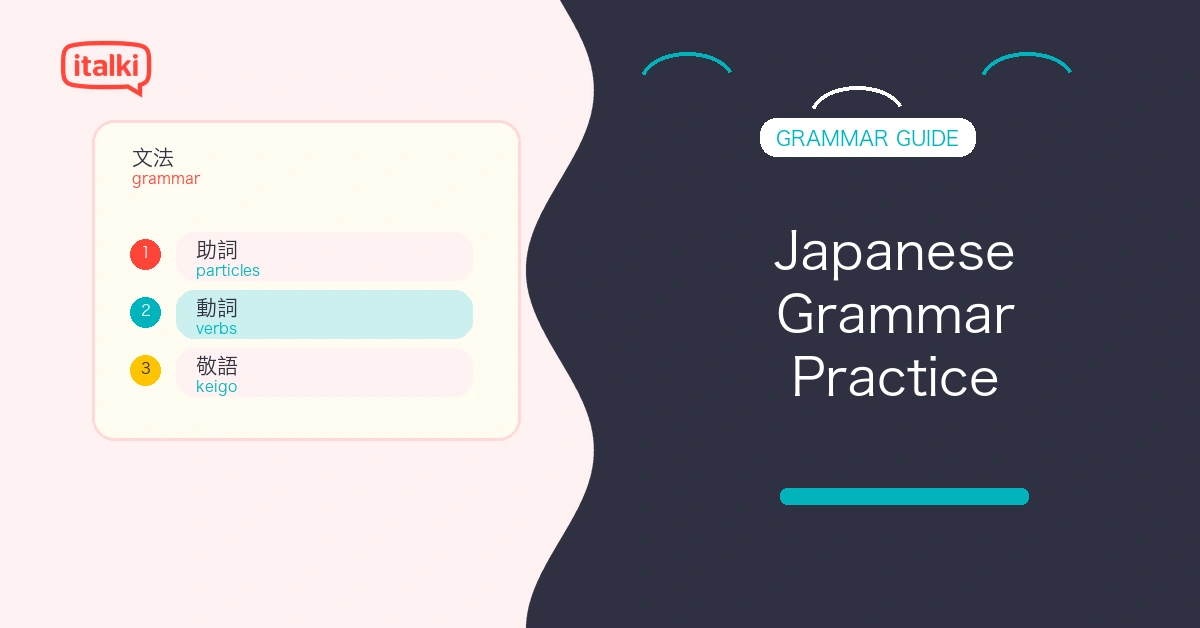
This guide covers practical grammar exercises for beginners, intermediate, and advanced learners; particle drills; verb conjugation practice strategies; sentence-building techniques; and how to study Japanese grammar in a way that builds actual speaking and writing ability.

Find your perfect teacher
Build real speaking confidence with personalized lessons from a teacher who matches your goals, schedule, and learning style.
Book a trial lesson
Why grammar practice needs to be active, not passive
Reading grammar explanations and doing grammar exercises are not the same thing. Most learners spend too much time in the first category and not enough in the second.
Active grammar practice means you produce sentences, not just check them. It means:
- Writing 10 sentences using a new grammar point without looking at the model
- Saying a sentence aloud and noticing where you hesitate
- Translating a paragraph from English to Japanese using only grammar you have recently studied
- Reading a dialogue and then writing your own version using the same structures
Passive grammar study (reading notes, reviewing rules, watching explanations) has its place. But the production gap – the freezing, the searching, the falling back on easier structures – only closes through active practice.
Work with a Japanese language tutor to build active practice sessions into your routine: a tutor can create exercises targeting exactly the grammar points you underuse or consistently get wrong.
Beginner grammar exercises
At beginner level, the goal is basic sentence construction: subject, verb, object, and a few core particles.
Exercise 1: Basic sentence building Construct 5 sentences using [noun] は [noun/adjective] です:
- 私は学生です。(I am a student.)
- この本は面白いです。(This book is interesting.)
- 東京は大きい都市です。(Tokyo is a big city.)
Then flip them to negatives: ではありません or じゃないです.
Exercise 2: Particle substitution Take the sentence 私は学校に行きます (I go to school) and swap the destination:
- 私は図書館に行きます。(I go to the library.)
- 私は公園に行きます。(I go to the park.)
- 私はスーパーに行きます。(I go to the supermarket.)
Now substitute the verb: 行きます (go) – 来ます (come) – 帰ります (return). Notice how the particle stays the same but the sentence direction shifts.
Exercise 3: Question and answer Write 5 questions using か and answer each:
- どこに行きますか。Answer: 図書館に行きます。
- 何を食べますか。Answer: ラーメンを食べます。
- 何時に起きますか。Answer: 7時に起きます。
For a foundation in hiragana, katakana, and kanji that makes grammar practice readable, the guide to Japanese alphabets covers all three writing systems and how they work together.
Find your perfect teacher
Build real speaking confidence with personalized lessons from a teacher who matches your goals, schedule, and learning style.
Book a trial lesson
Particle practice: the core intermediate challenge
Particles are the most consistently difficult part of Japanese grammar for non-native speakers. They are small enough to overlook in reading but essential in production.
The core particles and their primary functions:
| Particle | Primary function | Example |
|---|---|---|
| は | Topic marker | 私は日本語を勉強します (I study Japanese) |
| が | Subject marker / emphasis | 猫がいます (There is a cat) |
| を | Direct object marker | 本を読む (Read a book) |
| に | Direction / time / location (static) | 学校に行く / 3時に / 部屋にいる |
| で | Location of action / means | 公園で遊ぶ / 電車で行く |
| へ | Direction (less specific than に) | 東京へ行く |
| と | With (accompanying) / quotation | 友達と行く / 「おはよう」と言った |
| から | From / because | 東京から来た / 雨だから |
| まで | Until / as far as | 6時まで / 東京まで |
| の | Possessive / noun modifier | 私の本 / 日本語の先生 |
は vs. が is the particle pair that causes the most confusion at intermediate level. A simple rule to practice with: は marks what you are talking about (topic); が marks who or what does something when you are emphasizing or contrasting it. Practice by writing the same sentence with each and noticing the shift in nuance:
- 私は行きます。(As for me, I’ll go.): general statement
- 私が行きます。(I’m the one who’ll go.): emphasis or contrast
Particle drill: Fill in the particle for each blank:
- 私___ 東京___ 住んでいます。(I live in Tokyo.)
- バス___ 学校___ 行きます。(I go to school by bus.)
- 図書館___ 本___ 読みます。(I read books at the library.)
- 友達___ 映画___ 見ました。(I watched a film with a friend.)
- 月曜日___ 木曜日___ 働きます。(I work from Monday to Thursday.)
Answers: 1. は / に 2. で / に 3. で / を 4. と / を 5. から / まで
Verb conjugation exercises
Japanese verbs conjugate into distinct groups, and production errors in conjugation are very common.
Group 1 (U-verbs) vs. Group 2 (RU-verbs) vs. Irregular verbs:
| Verb type | Dictionary form | Masu form | Te-form | Past (ta) |
|---|---|---|---|---|
| U-verb | 書く (kaku) | 書きます | 書いて | 書いた |
| U-verb | 話す (hanasu) | 話します | 話して | 話した |
| RU-verb | 食べる (taberu) | 食べます | 食べて | 食べた |
| RU-verb | 見る (miru) | 見ます | 見て | 見た |
| Irregular | する (suru) | します | して | した |
| Irregular | 来る (kuru) | 来ます | 来て | 来た |
Exercise: conjugation table drill Take 5 verbs from a text you are reading and conjugate each one through: dictionary, masu, te-form, plain past, negative present, negative past, conditional (ば/たら). Do not look up the answers first. Then check.
Exercise: te-form chains The te-form connects verb sequences. Write 5 sentence chains:
- 起きて、シャワーを浴びて、朝ごはんを食べました。
- 図書館に行って、本を借りて、家に帰りました。
For verb conjugation practice with keigo forms (the polite forms used in formal and business contexts), the guide to Japanese conjugation practice covers both plain and polite conjugation patterns with exercises.
Find your perfect teacher
Build real speaking confidence with personalized lessons from a teacher who matches your goals, schedule, and learning style.
Book a trial lesson
Intermediate grammar exercises
At intermediate level, the goal is complex sentences, conditionals, relative clauses, and expressing nuance.
Grammar patterns to practice at N4-N3 level:
| Pattern | Meaning | Example |
|---|---|---|
| 〜ことができる | Can / be able to | 日本語を話すことができます |
| 〜たことがある | Have done before | 京都に行ったことがあります |
| 〜てもいい | May / it’s okay to | ここで写真を撮ってもいいですか |
| 〜てはいけない | Must not | ここで食べてはいけません |
| 〜なければならない | Must / have to | 宿題をしなければならない |
| 〜と思う | I think that | 彼は来ないと思います |
| 〜かもしれない | Might / maybe | 明日は雨かもしれない |
| 〜ために | In order to / for the purpose of | 日本語を学ぶために毎日練習する |
Exercise: sentence transformation Take a simple sentence and add a grammar pattern to express possibility, obligation, or purpose:
- 行きます – 行かなければなりません (I must go)
- 食べます – 食べたことがありません (I have never eaten it)
- 勉強します – 勉強するために図書館に行きます (I go to the library to study)
Exercise: relative clause practice Japanese relative clauses come before the noun they modify (the reverse of English). Practice converting two sentences into one:
- 本を買いました。本はとても面白いです。
- – 買った本はとても面白いです。(The book I bought is very interesting.)
A private Japanese tutor can generate transformation drills targeting exactly the grammar patterns where you make consistent errors, and correct your output in real time.
Advanced grammar and keigo practice
At advanced level (N2-N1), grammar practice shifts toward register, nuance, and keigo.
Grammar patterns at N2-N1 level:
| Pattern | Meaning | Register |
|---|---|---|
| 〜にもかかわらず | Despite / in spite of | Formal/written |
| 〜に基づいて | Based on | Formal |
| 〜をもって | By means of / from (a date) | Very formal |
| 〜に際して | On the occasion of | Formal |
| 〜に応じて | According to / in response to | Formal/written |
| 〜かねない | Might (negative consequence) | Formal |
| 〜いかんにかかわらず | Regardless of | Very formal |
Keigo production practice: Take a casual sentence and elevate it through all three keigo levels:
- Casual: 田中さんは来る? (Is Tanaka coming?)
- Teineigo: 田中さんは来ますか。
- Sonkeigo: 田中様はいらっしゃいますか。
Take a statement about your own action and humble it:
- Plain: 私は行きます。
- Teineigo: 私は参ります。
- Kenjougo: 私がまいります。
Advanced keigo production is where most learners, even those who passed N2, still have significant gaps. The only way to close them is through conversation practice with correction.
Find your perfect teacher
Build real speaking confidence with personalized lessons from a teacher who matches your goals, schedule, and learning style.
Book a trial lesson
Study strategies that actually work
1. Write output every day, however short. Even five sentences in Japanese daily adds up. Write about what happened, what you plan to do, or what you are thinking about. Use grammar you recently studied, not just grammar you know comfortably.
2. Shadow native speech for rhythm and grammar patterns. Shadowing (repeating audio immediately as you hear it) builds the internalized sense of what grammar patterns sound like at natural speed. Use podcasts, drama clips, or YouTube content with transcripts at your level.
3. Anki for grammar patterns, not just vocabulary. Create cards where the front shows an English concept (obligation + verb) and the back shows the Japanese grammar form with an example sentence. Testing grammar patterns in production forces active recall.
4. Find your error patterns. Keep a list of the grammar errors you make repeatedly. After each conversation or writing session, log any corrections. If the same error appears three times, it needs dedicated drilling.
5. Use conversations to test what you studied. After studying a grammar pattern, try to use it in your next conversation practice session. If you cannot produce it naturally in conversation yet, that is useful information about what needs more practice.
Build grammar fluency with a Japanese teacher
Grammar rules become grammatical instinct only through production with feedback. The point where you stop thinking which particle goes here? and just say the right one is a product of volume and correction, not more rules.
italki has 30,000+ expert tutors worldwide, including Japanese teachers who specialize in grammar-focused lessons at every level from beginner hiragana through N1 preparation. Pick a lesson format that targets your gap: particle drills, keigo production, JLPT preparation, or free conversation with correction. Book a trial lesson and find out which grammar patterns are actually holding your Japanese back.
Find your perfect teacher
Build real speaking confidence with personalized lessons from a teacher who matches your goals, schedule, and learning style.
Book a trial lesson
FAQ
Should I learn grammar from a textbook or through immersion?
Both, at different stages. A textbook (Genki, Minna no Nihongo, or Tobira depending on your level) gives you a systematic framework. Immersion exposes you to how grammar is actually used in natural speech. The combination works best: study a pattern systematically, then find it in real Japanese content, then produce it in conversation.
What JLPT level focuses the most on grammar?
All JLPT levels test grammar, but N3 and N2 have the heaviest grammar-per-question ratio. N2 in particular introduces a large number of formal written patterns (〜にもかかわらず, 〜に基づいて, etc.) that rarely appear in conversational Japanese, making them harder to pick up through immersion alone.
Is it worth memorizing all the grammar patterns or should I focus on the common ones first?
Focus on frequency first. The core sentence patterns (て-form connections, conditionals with と and たら, ために for purpose, と思う for reported thought) appear constantly and will do more for your daily communication than rare formal patterns. Rare patterns matter most if you are targeting JLPT, academic reading, or business formal writing.
How do I know if my Japanese grammar is improving?
Compare older and newer writing samples: longer sentences, fewer hesitations in self-correction, wider range of grammar patterns used spontaneously, and a shrinking list of particles you second-guess. If you are getting corrections from a tutor, a decreasing number of corrections per session is the clearest signal.
Want to learn a language at italki?
Here are the best resources for you!