Key takeaways
- Japanese proverbs, called ことわざ (kotowaza), help you sound more natural when giving advice, reacting to setbacks, or talking about effort.
- The best proverbs for conversation are short, image-rich, and easy to place after a real situation rather than dropped in at random.
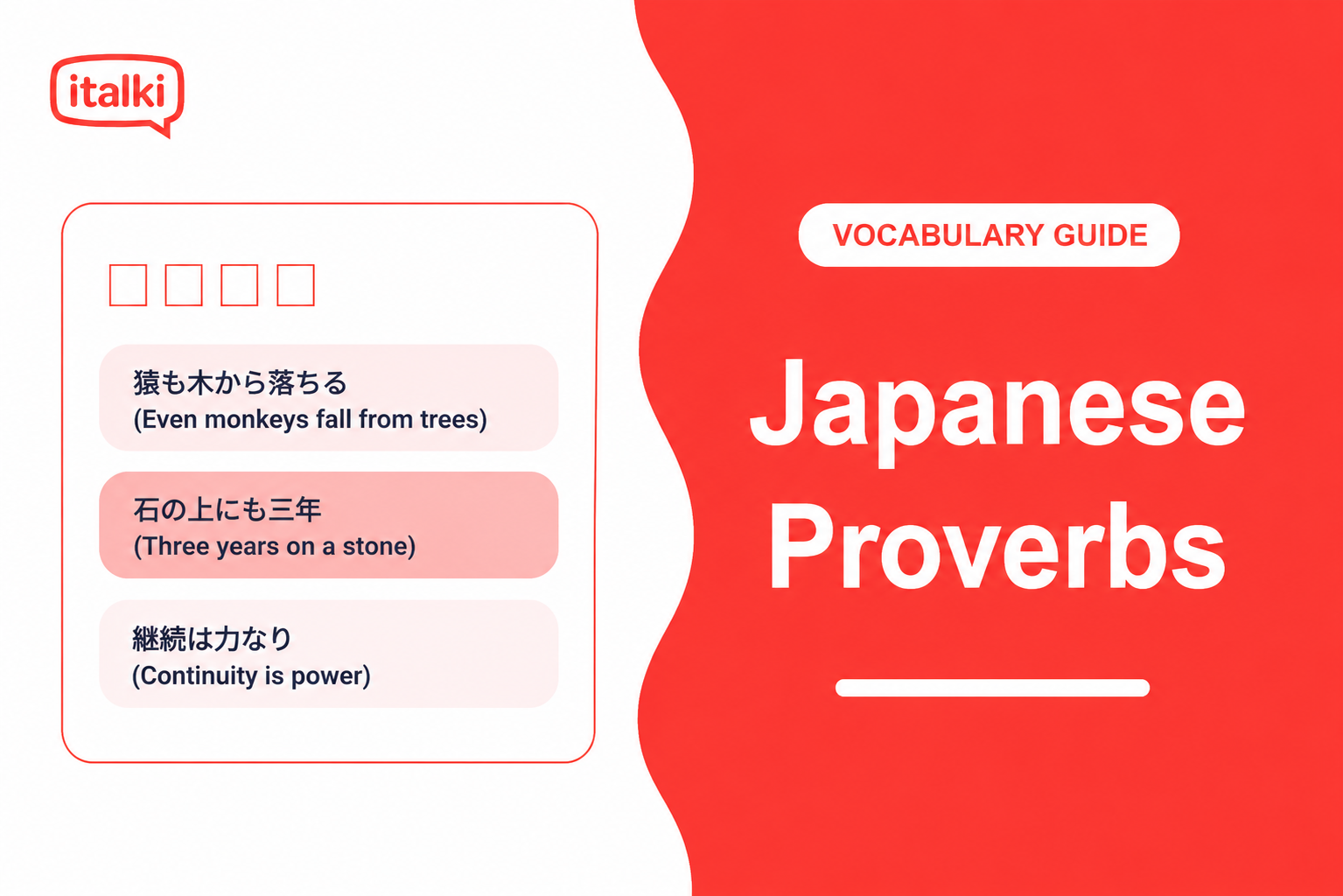
- Start with phrases like 七転び八起き (nanakorobi yaoki), 猿も木から落ちる (saru mo ki kara ochiru), and 継続は力なり (keizoku wa chikara nari).
- Practicing proverb timing with a tutor matters because a good phrase in the wrong tone or context sounds stiff or overly dramatic.
Japanese proverbs add personality to conversation when plain sentences feel too direct, but knowing the right one is only half the job: getting the tone and timing wrong makes a good proverb sound stiff or unintentionally dramatic. Start with 20 practical ことわざ (kotowaza), learn what each means, then use them in moments like encouragement, mistakes, decisions, and effort.
italki connects learners with 30,000+ teachers across 150+ languages and has helped over 10 million people build speaking confidence with native speakers for exactly this kind of live correction.
Practice these proverbs in short dialogues, not as isolated quotes, with a Japanese tutor.

Find Your Perfect Teacher
Practice japanese proverbs with a Japanese tutor who can correct pronunciation, phrasing, listening speed, and natural replies in real time.

What are Japanese proverbs, and when should you use them?
Japanese proverbs are short traditional sayings that express advice, warning, humor, or life experience. In Japanese, they are called ことわざ (kotowaza), and they often draw images from animals, nature, work, or daily life, distinct from four-character compounds (四字熟語) and literary quotations.
Use them after the situation is clear, since a proverb works best as a reaction, not as a random line dropped into conversation. For example, if a friend fails a test after studying hard, 七転び八起き (nanakorobi yaoki), “fall seven times, rise eight,” sounds encouraging. If someone makes a surprising mistake, 猿も木から落ちる (saru mo ki kara ochiru), “even monkeys fall from trees,” softens the moment with humor.
Proverbs build on the polite phrases covered in Japanese greetings, adding warmth, humor, or perspective to a conversation instead of repeating そうですね (sou desu ne), “that’s true.” A good proverb needs the situation to fit, the tone to match the relationship, and the surrounding sentence to sound natural. Do not rush to use rare proverbs: a short familiar one used at the right time sounds better than a dramatic proverb that stops the conversation.
Choosing the right proverb for the moment is the hardest part, since reading social context takes practice flashcards alone cannot provide. An online Japanese teacher can role-play these situations and tell you when your tone or timing feels off.
Which Japanese proverbs work best in everyday conversation?
The best Japanese proverbs for conversation are short, memorable, and easy to connect to daily life. The 20 below give you phrases for effort, mistakes, timing, learning, caution, teamwork, and decisions.
Romaji is included to help with reading, but practice the rhythm from the Japanese script as early as possible.
| Japanese proverb | Romaji | Meaning | Use it when… |
|---|---|---|---|
| 七転び八起き | nanakorobi yaoki | Keep getting back up | Someone needs encouragement after failure |
| 猿も木から落ちる | saru mo ki kara ochiru | Everyone makes mistakes | A skilled person slips up |
| 継続は力なり | keizoku wa chikara nari | Consistency builds ability | Talking about study, fitness, or work habits |
| 石の上にも三年 | ishi no ue ni mo sannen | Patience brings results | Someone feels impatient with slow progress |
| 失敗は成功のもと | shippai wa seikou no moto | Mistakes lead to growth | A mistake teaches something useful |
| 口は災いの元 | kuchi wa wazawai no moto | Careless words cause trouble | Someone speaks without thinking |
| 知らぬが仏 | shiranu ga hotoke | Ignorance brings peace | Knowing the truth would only upset someone |
| 花より団子 | hana yori dango | Practical things beat pretty things | Someone chooses comfort or food over beauty |
| 二兎を追う者は一兎をも得ず | nito o ou mono wa itto o mo ezu | Do not chase too many goals | Someone splits attention too much |
| 案ずるより産むが易し | anzuru yori umu ga yasushi | Doing is less scary than worrying | Someone overthinks a task |
| 雨降って地固まる | ame futte ji katamaru | Trouble strengthens things | A conflict leads to a better relationship |
| 馬の耳に念仏 | uma no mimi ni nenbutsu | Advice gets ignored | Someone refuses to listen |
| 井の中の蛙大海を知らず | i no naka no kawazu taikai o shirazu | Limited experience gives a narrow view | Someone lacks perspective |
| 出る杭は打たれる | deru kui wa utareru | Standing out invites criticism | Talking about group pressure |
| 能ある鷹は爪を隠す | nou aru taka wa tsume o kakusu | Truly capable people stay modest | Someone talented stays quiet |
| 縁の下の力持ち | en no shita no chikara mochi | An unseen supporter | Praising behind-the-scenes help |
| 住めば都 | sumeba miyako | Any place feels like home with time | Someone adjusts to a new place |
| 塵も積もれば山となる | chiri mo tsumoreba yama to naru | Small efforts add up | Talking about savings, study, or practice |
| 急がば回れ | isogaba maware | The safer route saves time | Someone wants a shortcut |
| 好きこそ物の上手なれ | suki koso mono no jouzu nare | Passion improves skill | Someone learns faster through interest |
A proverb becomes useful when you attach it to a sentence. Instead of saying only 継続は力なり, say 日本語の勉強は、継続は力なりですね (Nihongo no benkyou wa, keizoku wa chikara nari desu ne), “With Japanese study, consistency is strength,” the same sentence rhythm, particles, and polite endings covered in best way to learn conversational Japanese.
Find Your Perfect Teacher
Practice japanese proverbs with a Japanese tutor who can correct pronunciation, phrasing, listening speed, and natural replies in real time.
How do these proverbs sound in short conversations?
Japanese proverbs sound most natural when they answer a situation in one short line, feeling like a reaction rather than a speech. When a friend says 試験、だめだった (shiken, dame datta), “the exam did not go well,” answering でも、七転び八起きだよ。次があるよ (demo, nanakorobi yaoki da yo, tsugi ga aru yo), “but fall seven times, rise eight, there is another chance,” sounds encouraging. Use だよ with friends and ですね with classmates, coworkers, or people you do not know well.
For softening a mistake, 先生でも漢字を間違えるんですね (sensei demo kanji o machigaerun desu ne), “even teachers make kanji mistakes,” pairs with 猿も木から落ちる、ですね (saru mo ki kara ochiru, desu ne), “even monkeys fall from trees, right.” This is friendly when the mood is light, but avoid it after a serious mistake at work.
For praising someone modestly, 田中さん、プレゼンすごかったね (Tanaka-san, purezen sugokatta ne), “Tanaka’s presentation was great,” pairs with 能ある鷹は爪を隠す、だね (nou aru taka wa tsume o kakusu, da ne), “a skilled hawk hides its claws.”
Japanese proverbs connect closely with behavior and social distance, and the cultural logic behind phrases becomes clearer when paired with Japanese culture, especially for sayings about modesty and group harmony.
Find Your Perfect Teacher
Practice japanese proverbs with a Japanese tutor who can correct pronunciation, phrasing, listening speed, and natural replies in real time.
Which Japanese proverbs should beginners use first?
Beginners should start with five proverbs that work in many situations, need little grammar around them, and are easier to pronounce, remember, and use safely in tone: 七転び八起き for encouragement after failure, 猿も木から落ちる for small mistakes by skilled people, 継続は力なり for language learning, exercise, or work habits, 花より団子 when someone chooses food, comfort, or practical value over appearances, and 急がば回れ when a shortcut looks risky. They cover daily topics learners often talk about, study goals, mistakes, motivation, food, and planning, without sounding too formal.
For beginners, the safest sentence frames are まさに、七転び八起きですね (masani, nanakorobi yaoki desu ne), “that is exactly fall seven times, rise eight,” and 私は花より団子タイプです (watashi wa hana yori dango taipu desu), “food over flowers describes this type of person.” The second example is casual and useful because it turns the proverb into a self-description, which sounds more conversational than reciting the proverb alone.
Proverbs often stay fixed, but the sentence around them changes with the relationship, and Japanese honorifics covers the endings that match the person in front of you. Hearing a native speaker say each proverb at natural speed, then getting coached on pitch accent, helps beginners most. A Japanese language tutor can slow the phrase down and confirm whether your version sounds encouraging, funny, or accidentally preachy.
What mistakes make Japanese proverbs sound unnatural?
Japanese proverbs sound unnatural when they are too formal for the moment, too rare for the listener, or used without context, even when the phrase itself is correct. Five mistakes show up most often:
- translating English proverbs word for word, since “better late than never” has natural Japanese equivalents but a direct translation sounds odd
- using a proverb as a lecture, since 二兎を追う者は一兎をも得ず sounds harsh said to someone who only shared an idea unless softened with かもね or かもしれません;
- using dramatic proverbs for tiny problems, since 雨降って地固まる fits a real disagreement but feels too heavy for a lunch-plan mix-up;
- ignoring the listener, since だよ and だね sound warm with friends while ですね sounds safer with coworkers;
- overusing proverbs, since one good kotowaza is memorable while three in a row sounds like a performance.
A quick fix: 雨降って地固まる on its own sounds blunt, but 今回は大変だったけど、雨降って地固まるものですね (“this time was rough, but trouble strengthens things, doesn’t it”) connects the proverb to the situation naturally, since attaching ですね directly to a dictionary-form verb like 固まる is grammatically awkward, while ものですね or って言いますよね (“as they say”) keeps it intact.
These nuances are hard to self-correct because the grammatical structure looks fine on paper but sounds wrong to a native ear, which is exactly the kind of real-time feedback a private Japanese teacher provides.
How should you practice Japanese proverbs out loud?
Practice Japanese proverbs in short scenes, not from a long memorized list: pick three proverbs from one theme, write one daily situation for each, say the situation in Japanese, then add the proverb with ですね, だね, or かもしれません.
For example, with the theme of effort: 毎日十分だけでも、継続は力なりですね (mainichi juppun dake demo, keizoku wa chikara nari desu ne), “even just ten minutes every day, consistency becomes strength,” and 単語を五つずつ覚えれば、塵も積もれば山となるものですね (tango o itsutsu zutsu oboereba, chiri mo tsumoreba yama to naru mono desu ne), “learning five words at a time adds up.” The second example uses ものですね after 山となる, which keeps a proverb ending in a dictionary-form verb grammatically smooth.
Proverbs are shared sayings used in everyday speech, while Japanese quotes are often tied to a specific speaker or text, a distinction worth keeping clear. Guided role-play across study, work, friendship, and travel situations with Japanese lessons online reveals timing gaps that solo memorization misses.
How do kotowaza differ from other Japanese sayings?
Japanese has several categories of set phrases, and mixing them up is a common learner error. Knowing where kotowaza fit helps you use them at the right moment.
ことわざ (kotowaza) are folk proverbs passed down through generations, anonymous and usually one sentence long, such as 猿も木から落ちる and 花より団子. 四字熟語 (yojijukugo) are four-kanji compounds adapted from classical Chinese that carry a compressed meaning and appear in formal writing and speeches, such as 一期一会 (ichigo ichie), “one time, one meeting,” meaning every encounter is unique; these sound more literary than conversational. 慣用句 (kanyouku) are idiomatic phrases that function as parts of sentences rather than standalone sayings, such as 腕を磨く (ude o migaku), literally “polish one’s arm,” meaning to improve a skill.
In conversation, kotowaza are the most versatile because they sound like a friendly comment rather than a formal speech. Mixing a yojijukugo into casual chat can sound overly intellectual, and using a kanyouku as a standalone reaction the way you would use a proverb breaks the grammar, so keeping the categories straight helps you choose the right tool for each moment.
Ready to use Japanese proverbs in real conversations?
Japanese proverbs become useful when you connect them to real situations: failed tests, delayed results, awkward mistakes, group pressure, or quiet support. Memorizing the list is only step one, since timing, tone, and follow-up sentences make the proverb sound natural. Choose five proverbs from this article and practice them in three forms: casual, polite, and softened advice, for usable lines instead of memorized trivia.
The hardest part of using kotowaza is not vocabulary but judgment, knowing whether the moment calls for humor, encouragement, or silence. A tutor who speaks Japanese natively catches those misfires in real time, which a flashcard app cannot do. With 30,000+ teachers across 150+ languages, italki makes it straightforward to find a teacher whose conversational style matches the Japanese you want to speak.
Book a trial lesson and practice using 七転び八起き, 継続は力なり, and 猿も木から落ちる in conversations that sound like real life.
Find Your Perfect Teacher
Practice japanese proverbs with a Japanese tutor who can correct pronunciation, phrasing, listening speed, and natural replies in real time.
FAQ
What is the Japanese word for proverb?
The Japanese word for proverb is ことわざ (kotowaza), a short traditional saying that gives advice, warning, humor, or shared wisdom, distinct from four-character compounds (四字熟語) and idiomatic verb phrases (慣用句).
What is the easiest Japanese proverb for beginners?
七転び八起き (nanakorobi yaoki), “fall seven times, rise eight,” works well for encouragement after setbacks. The rhythm is memorable and the meaning is clear without much explanation.
Are Japanese proverbs used in daily conversation?
Yes, familiar proverbs appear in conversation, writing, speeches, and media. In casual speech, people often use only the key phrase with a natural ending like だね or ですね rather than citing the full saying.
Should Japanese proverbs be polite or casual?
The proverb itself usually stays fixed, but the sentence ending changes: だね with friends, ですね in polite conversation, and かもしれません to soften advice to someone senior or less familiar.
How many Japanese proverbs should a learner memorize first?
Start with five useful proverbs and practice them in real situations, since timing and tone decide how natural the phrase sounds more than quantity does. Once those five feel comfortable, add two or three more from a new theme.
Want to learn a language at italki?
Here are the best resources for you!