Key takeaways
- Spanish heteronyms are word pairs that share the same spelling but carry different meanings, distinguished in writing by an accent mark (tilde).
- The most common pairs involve function words: el/él, tu/tú, mi/mí, te/té, si/sí.
- In speech, some pairs carry a slight stress difference; for most, context carries the full meaning load.
- Ignoring accent marks in written Spanish creates genuine ambiguity – a sentence like “Tu sabes que tu gato come” means something different from “Tú sabes que tu gato come.”
In English, heteronyms like read/read or lead/lead are distinguished by completely different pronunciations. In Spanish, the distinction is subtler: a single written accent mark (tilde) separates two different words that look identical on paper.
On italki, 10M+ learners have found support from teachers since 2007, and the platform now includes 30,000+ teachers across 150+ languages. For this topic, that support is especially useful because accent mark errors go beyond typos – they change what a sentence says.
Practice spotting and producing these pairs with an online Spanish teacher who can catch them in real-time writing and dictation.

Find Your Perfect Teacher
Build real speaking confidence with personalized lessons from a teacher who matches your goals, schedule, and learning style.
Book a trial lesson
What Spanish heteronyms are, and how they differ from English ones
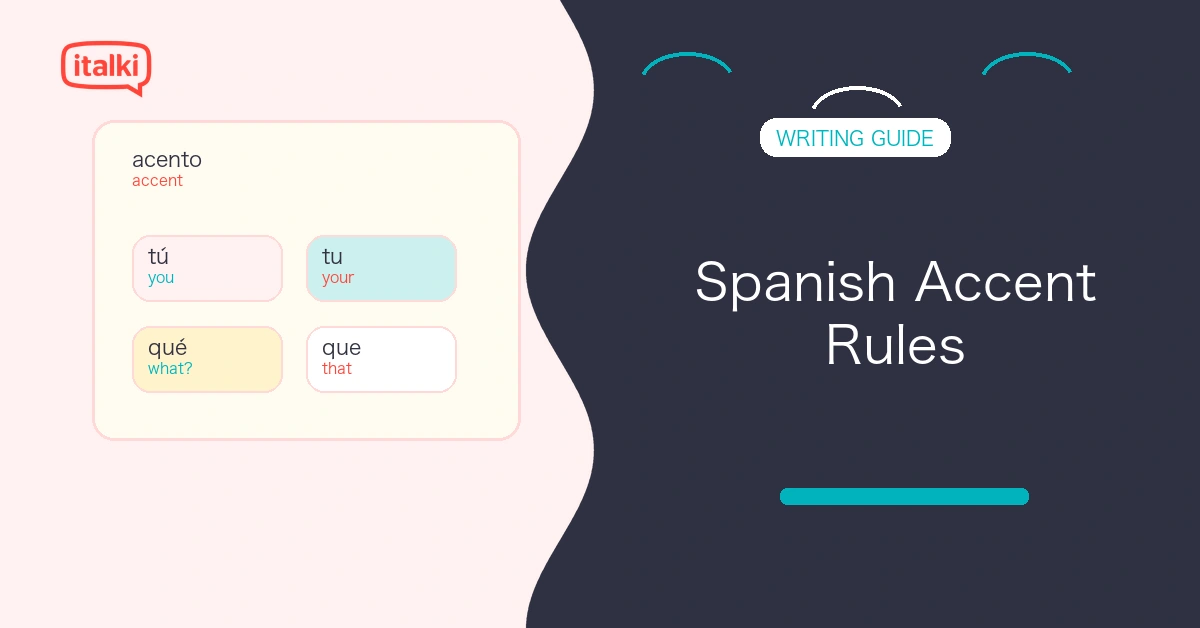
Spanish heteronyms are word pairs that share identical spelling but differ in grammatical function and meaning. The distinction is marked in writing by the presence or absence of a tilde (the written accent mark: á, é, í, ó, ú). For the broader spelling system behind these marks, see this guide to Spanish accent marks.
In English, heteronyms like lead (the metal) and lead (to guide) are pronounced differently – the word sounds tell them apart. In Spanish, many heteronym pairs sound identical or nearly identical in everyday speech. The tilde in written Spanish carries the disambiguation that pronunciation handles in English.
| Without tilde | Grammatical function | With tilde | Grammatical function |
|---|---|---|---|
| el | masculine definite article (the) | él | third person subject pronoun (he) |
| tu | second person possessive (your) | tú | second person subject pronoun (you) |
| mi | first person possessive (my) | mí | first person pronoun after prepositions (me) |
| te | second person object pronoun (you/to you) | té | noun (tea) |
| si | conjunction (if) | sí | affirmation (yes) / reflexive pronoun |
| mas | conjunction (but, archaic/literary) | más | comparative adverb (more) |
| se | reflexive pronoun | sé | first person of saber (I know) / imperative of ser (be) |
| de | preposition (of, from) | dé | present subjunctive of dar (give) |
| como | verb (I eat) / conjunction (as, like) | cómo | interrogative/exclamatory (how) |
| aun | adverb (even) | aún | adverb (still, yet) |
Function word pairs: el/él, tu/tú, mi/mí, te/té
These four pairs cause the most written errors because they involve the highest-frequency words in the language.
el vs. él
El (no tilde) is the masculine definite article. Él (tilde) is the third person singular subject pronoun.
- El gato duerme. (The cat sleeps.)
- Él duerme en el sofá. (He sleeps on the sofa.)
In many sentences, context makes the difference obvious. “El trabaja mucho” is an error – el before a verb produces a grammatically impossible sequence in standard Spanish. The correct form is “Él trabaja mucho” (He works a lot).
tu vs. tú
Tu (no tilde) is the second person possessive determiner. Tú (tilde) is the second person subject pronoun.
- Tu libro está aquí. (Your book is here.)
- Tú sabes la respuesta. (You know the answer.)
The sentence “Tu sabes que tu gato está bien” reads as “Your knows that your cat is fine” – grammatically broken. The correct version is “Tú sabes que tu gato está bien” (You know that your cat is fine).
mi vs. mí
Mi (no tilde) is the first person possessive. Mí (tilde) is the first person pronoun used after prepositions.
- Mi café está frío. (My coffee is cold.)
- Este café es para mí. (This coffee is for me.)
Mí appears only after prepositions: para mí, sin mí, a mí, por mí. It never appears before a noun as a possessive.
te vs. té
Te (no tilde) is the second person indirect or reflexive object pronoun. Té (tilde) is the noun for tea.
- Te llamo mañana. (I’ll call you tomorrow.)
- ¿Quieres un té? (Do you want a tea?)
This pair causes fewer errors in context because a verb following the word signals the pronoun, and a noun article or direct object context signals the drink.
Find Your Perfect Teacher
Build real speaking confidence with personalized lessons from a teacher who matches your goals, schedule, and learning style.
Book a trial lesson
Conjunction and adverb pairs: si/sí, mas/más, aun/aún
si vs. sí
Si (no tilde) is the conditional conjunction meaning “if.” Sí (tilde) means “yes” and also functions as the emphatic reflexive pronoun.
- Si vienes, te espero. (If you come, I’ll wait for you.)
- Sí, voy a ir. (Yes, I’m going to go.)
- Lo hizo por sí mismo. (He did it by himself – sí as reflexive)
The sí emphatic reflexive appears in phrases like “por sí mismo” (by himself/itself), “a sí mismo” (himself), and “en sí” (in itself). These are fixed expressions worth memorizing as units.
mas vs. más
Mas (no tilde) is a literary or archaic conjunction equivalent to “but” or “however.” It appears in formal poetry and older texts and is rarely used in everyday modern Spanish. Más (tilde) is the comparative adverb meaning “more.”
- Quería ir, mas no pudo. (He wanted to go, but he couldn’t – literary register)
- Quiero más café. (I want more coffee.)
In everyday writing, the conjunction mas has been almost entirely replaced by pero. Learners are unlikely to need to produce mas, but they will encounter it in literature.
aun vs. aún
Aun (no tilde) means “even” (equivalently: hasta, incluso). Aún (tilde) means “still” or “yet.”
- Aun así, decidió quedarse. (Even so, he decided to stay.)
- Aún no ha llegado. (He hasn’t arrived yet.)
- ¿Aún estás aquí? (Are you still here?)
A reliable test: if the word can be replaced by todavía (still, yet), the tilde is needed. If it can be replaced by incluso or hasta, no tilde is needed.
Verb form pairs: se/sé, de/dé, como/cómo
se vs. sé
Se (no tilde) is the third person reflexive pronoun and the impersonal or passive “se.” Sé (tilde) is either the first person singular present of saber (to know) or the second person singular imperative of ser (to be).
- Se lava las manos. (He washes his hands / reflexive.)
- Sé que tienes razón. (I know you’re right – saber, first person.)
- Sé honesto. (Be honest – ser, imperative.)
de vs. dé
De (no tilde) is the preposition “of” or “from.” Dé (tilde) is the third person singular present subjunctive of dar (to give), used in commands and subjunctive clauses.
- Vengo de Madrid. (I come from Madrid.)
- Espero que me dé una respuesta hoy. (I hope he gives me an answer today.)
- Dé una vuelta. (Take a walk – formal imperative of dar.)
como vs. cómo
Como (no tilde) has three functions: the first person singular present of comer (I eat), the comparative conjunction “as/like,” and the causal connector “how/since.” Cómo (tilde) is the interrogative and exclamatory “how.”
- Como arroz todos los días. (I eat rice every day.)
- Canta como un profesional. (She sings like a professional.)
- ¿Cómo te llamas? (What is your name? – literally “how are you called?”)
- No sé cómo llegó. (I don’t know how he arrived.)
Find Your Perfect Teacher
Build real speaking confidence with personalized lessons from a teacher who matches your goals, schedule, and learning style.
Book a trial lesson
How accent marks work as meaning signals in writing
The Real Academia Española (RAE) governs Spanish orthography and classifies the tildes in these pairs as tildes diacríticas – diacritical accents whose sole purpose is to distinguish two otherwise identical written words, not to indicate irregular stress.
Most Spanish accent marks follow predictable stress rules. The diacritical accent is different: it does not follow stress rules. El and él are typically stressed identically in most speech contexts. The tilde on él is purely a semantic and grammatical marker.
This is why spellcheckers and autocorrect tools often miss heteronym errors. A spellchecker sees tu and confirms it is a valid Spanish word – which it is. It has no way to know that the intended word in context was tú.
Typed Spanish on phones with autocorrect off, and handwritten Spanish, are the contexts where heteronym errors appear most frequently. The habit of adding the tilde needs to be deliberate and practiced.
Stress and context in spoken Spanish
In speech, most heteronym pairs are disambiguated entirely by context, not by stress. A native speaker listening to “El gato comió” versus “Él comió” hears the noun gato in the first sentence, which makes the article reading automatic. In the second sentence, the verb immediately after él confirms the pronoun reading.
For some pairs – particularly te/té – there is a slight stress difference audible in careful speech. Té as a noun tends to carry full lexical stress when it is the main content word of a phrase (“un té, por favor”). Te as a clitic pronoun tends to be unstressed.
For learners, the practical implication is clear: spoken Spanish gives context signals that written Spanish strips away. Dictation practice – writing what a teacher says aloud – is one of the most efficient ways to internalize which word requires the tilde. A Spanish tutor can run targeted dictation sessions on exactly these pairs.
Find Your Perfect Teacher
Build real speaking confidence with personalized lessons from a teacher who matches your goals, schedule, and learning style.
Book a trial lesson
Stopping the most common heteronym mistakes
The three highest-frequency errors are tu/tú, el/él, and si/sí. All three involve distinguishing a function word from a pronoun or affirmation.
A practical habit for each:
- Before writing tu, ask: does a noun follow it? If no noun follows and the word is the subject of a verb, it should be tú.
- Before writing el, ask: does an adjective or noun follow it? If the word is followed directly by a verb, it is likely él.
- Before writing si, ask: does it mean “if”? If it means “yes” or appears in a phrase like “sí mismo,” the tilde is required.
The deeper fix is writing practice with immediate feedback. Recognizing heteronyms in reading is relatively easy – context provides the signal. Producing them correctly in writing is harder, because the writer must make the choice consciously each time.
Mastering the details that make Spanish writing precise
The tilde on Spanish heteronyms is one of the smallest marks in the language and one of the most meaningful. Missing it in a text message reads as informal; missing it in a business email reads as careless; missing it in an academic document reads as a grammatical error. Getting it right consistently is a matter of habit built through practice.
italki can turn this from a proofreading problem into a practice routine: write a short paragraph, read it aloud, then have a teacher check every tilde choice with you. Book a trial lesson and make heteronym accuracy part of your next writing session.
Find Your Perfect Teacher
Build real speaking confidence with personalized lessons from a teacher who matches your goals, schedule, and learning style.
Book a trial lesson
FAQ
What is a Spanish heteronym?
A Spanish heteronym is a word pair that shares identical spelling but has different meanings and grammatical functions. In Spanish, the pairs are distinguished in writing by a diacritical accent mark (tilde). Examples: el (the) vs. él (he), tu (your) vs. tú (you).
Why does Spanish use accent marks to distinguish heteronyms?
Spanish orthography uses diacritical accent marks (tildes diacríticas) to separate words that would otherwise look identical in writing. Unlike most Spanish accent marks, these do not indicate irregular stress – they exist solely to prevent written ambiguity.
Do Spanish heteronyms sound different when spoken?
Most do not. Speakers rely on grammatical context to distinguish them in speech. Some pairs carry a subtle stress difference (te vs. té in careful speech), but for most pairs, the spoken context – surrounding words, sentence structure – makes the meaning clear without stress variation.
What is the difference between si and sí?
Si (no tilde) means “if” and introduces conditional clauses: “si vienes, te llamo.” Sí (tilde) means “yes” and also appears as a reflexive pronoun in set phrases like “por sí mismo” (by himself) and “a sí mismo” (to himself).
What is the difference between aun and aún?
Aun (no tilde) means “even” and can be replaced by incluso or hasta: “aun así, fue” (even so, he went). Aún (tilde) means “still” or “yet” and can be replaced by todavía: “aún no ha llegado” (he hasn’t arrived yet).
Want to learn a language at italki?
Here are the best resources for you!