Key takeaways
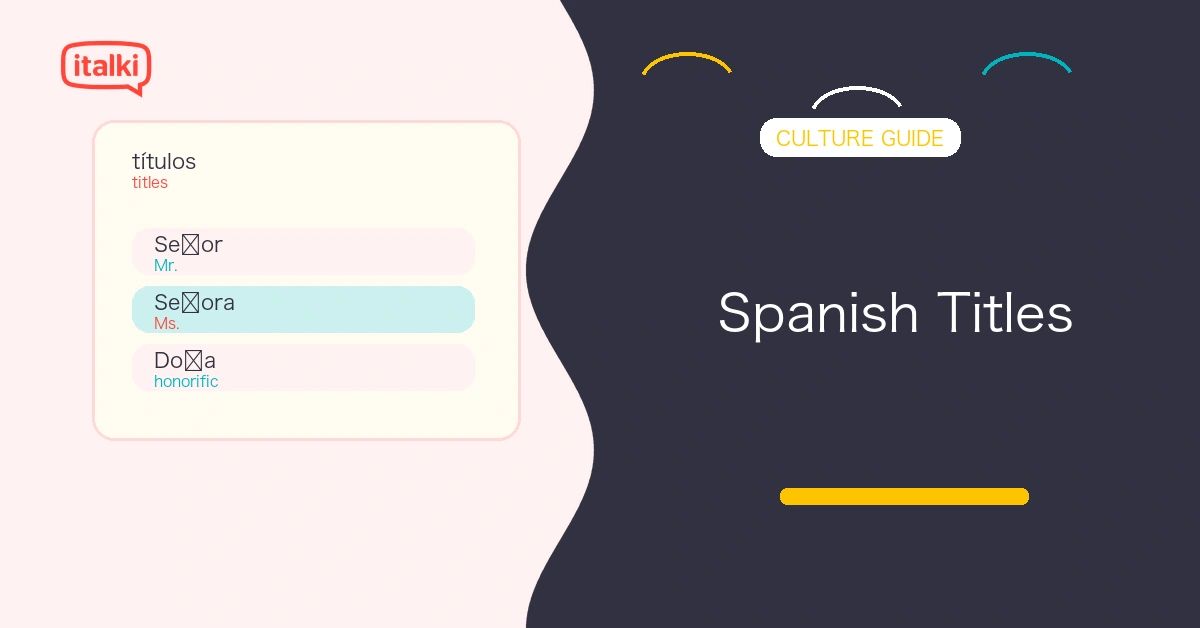
- Señor (Sr.), Señora (Sra.), and Señorita (Srta.) are the three standard Spanish address titles, and Señora is the safe default for adult women in professional contexts everywhere.
- Don and Doña are honorifics used before first names only (not last names), and signal respect for someone’s age, status, or standing across Latin America.
- Professional titles like Doctor/Doctora, Licenciado/Licenciada, and Ingeniero/Ingeniera are used as direct forms of address in many Spanish-speaking countries, especially in Mexico and Central America.
- Usage varies by country: what sounds polite in Mexico City may feel overly formal in Buenos Aires, so knowing the regional norms matters as much as knowing the titles themselves.
Addressing someone correctly in Spanish is more involved than choosing between Mr. and Ms. Spanish has separate titles for gender, marital status, profession, and social standing, and the expectations shift between Spain and Latin America. The wrong title in a business email or at a reception desk signals unfamiliarity with local norms before the conversation even starts.
The challenge is not just learning the titles but knowing when each applies, how to abbreviate them in writing, and where a professional title replaces the standard one entirely. italki connects Spanish learners with native-speaking tutors who navigate these conventions daily and can help you practice the right form for your specific situation.
This guide covers Señor, Señora, and Señorita; Don and Doña; professional titles including Doctor, Licenciado, and Ingeniero; how titles work in writing and speech; regional differences; and the most common mistakes.
Work with a Spanish tutor to practice the address forms that fit your professional or social situation in a Spanish-speaking context.

Find your perfect teacher
Build real speaking confidence with personalized lessons from a teacher who matches your goals, schedule, and learning style.
Book a trial lesson
The three standard address titles
Señor, Señora, and Señorita are the Spanish equivalents of Mr., Mrs./Ms., and Miss. The table below shows each title with its standard abbreviation and when to use it.
| Title | Abbreviation | Used for | Formal safety |
|---|---|---|---|
| Señor | Sr. | Adult men | Always safe |
| Señora | Sra. | Adult women (all) | Always safe |
| Señorita | Srta. | Unmarried women or girls | Declining in professional use |
Señor (Sr.): Used for all adult men regardless of age or marital status. Pronunciation: seh-NYOR. The plural is Señores (Sres.), used for a group of men or a mixed-gender group.
Señora (Sra.): The correct default for adult women in formal, professional, and official contexts, regardless of marital status. Pronunciation: seh-NYO-rah. The plural is Señoras (Sras.).
Señorita (Srta.): Traditionally addressed unmarried women, parallel to Miss in English. In professional contexts in Spain and increasingly across Mexico, Señora is preferred for all adult women to avoid the implication that marital status is relevant. Señorita remains common in some Latin American countries in commercial speech and with younger women, but using Señora avoids any awkwardness.
Don and doña: honorifics for first names
Don and Doña serve a different function from Señor and Señora. They signal respect for someone’s age, social standing, or personal reputation rather than simply marking gender or formality.
The most important rule: Don and Doña always precede the first name, never the last name.
| Correct | Incorrect |
|---|---|
| Don Carlos | Don García |
| Doña María | Doña Martínez |
| Buenos días, Don Roberto. | Buenos días, Don López. |
Don and Doña appear across Latin America in everyday respectful address, especially for older community members, authority figures, or anyone whose standing warrants acknowledgment. In Spain, they are less commonly used in daily speech but appear in formal and historical contexts.
They can also carry warmth. A shopkeeper addressing an elderly regular customer as Don Antonio communicates familiarity and affection, not stiff formality.
What Don and Doña are not: They are not formal equivalents of Señor or Señora. You would not use Don in a business email opening the way you would use Señor. They belong in direct spoken address and in respectful reference to a named individual.
Find your perfect teacher
Build real speaking confidence with personalized lessons from a teacher who matches your goals, schedule, and learning style.
Book a trial lesson
Professional titles in Spanish
In many Spanish-speaking countries, professional titles are used as direct forms of address when speaking to or about someone in their professional role. This practice is more widespread in Latin America than in Spain.
| Title | Abbreviated form | Used for |
|---|---|---|
| Doctor / Doctora | Dr. / Dra. | Physicians; some PhD holders in written contexts |
| Licenciado / Licenciada | Lic. | University graduates (very common in Mexico and Central America) |
| Ingeniero / Ingeniera | Ing. | Engineers |
| Arquitecto / Arquitecta | Arq. | Architects |
| Maestro / Maestra | Mtro. / Mtra. | Teachers at any level; musicians; skilled craftspeople |
| Profesor / Profesora | Prof. | University professors |
Licenciado/a is particularly important in Mexico and Central America, where it is routinely used as a spoken address title for anyone holding a university degree, regardless of their specific field. Buenos días, Licenciado Ramírez is a normal business greeting in a Mexican office.
Doctor/Doctora in spoken address almost always refers to a medical doctor across Latin America. In Spain, the distinction between practicing physician and academic PhD holder is clearer, and Doctor as a spoken address is more narrowly applied.
Maestro/Maestra carries genuine warmth. It is the respectful way to address a teacher, a music instructor, a chef, or a skilled artisan. Using it correctly signals that you recognize someone’s expertise and mastery.
Work with a Spanish language tutor if you are preparing for a specific professional context: a job interview, a client meeting, or correspondence in a particular Spanish-speaking country.
Using titles in writing and speech
In a formal letter or email:
Open with the abbreviated title and last name:
- Estimado Sr. García: or Estimada Dra. Martínez:
- If you do not know the person’s gender: Estimado/a Sr./Sra.: covers both.
In Spanish formal business emails, the opening title and name are followed by a colon, not a comma. The body of the email begins on the next line. If you are practicing titles out loud before a meeting, the guide to Spanish conversation practice gives you scenarios for turning address forms into real dialogue.
Close with Reciba un cordial saludo (formal, meaning: Please accept my warm regards) or Atentamente (formal, meaning: Sincerely). If the relationship is established and warm, Saludos works for semi-formal correspondence.
In spoken address:
At a reception desk, shop counter, or phone call, Señor or Señora alone is a perfectly polite form of address when you do not know the person’s name: Disculpe, Señora, ¿me puede ayudar? (Excuse me, ma’am, can you help me?)
Adding the last name is more formal and signals recognition: Buenos días, Señor Rodríguez.
With professional titles in speech: Doctora, ¿tiene un momento? (Doctor, do you have a moment?) or Buenos días, Ingeniero Torres.
Find your perfect teacher
Build real speaking confidence with personalized lessons from a teacher who matches your goals, schedule, and learning style.
Book a trial lesson
Regional differences across Spanish-speaking countries
Because title usage changes from country to country, learners benefit from treating these forms as part of broader Spanish-speaking countries etiquette rather than memorizing one universal rule.
| Country / region | Señorita in professional contexts | Licenciado/a as address | Don/Doña everyday use |
|---|---|---|---|
| Spain | Declining; Señora preferred | Rare | Less common |
| Mexico | Still heard in commercial speech | Very common | Common and warm |
| Argentina | Señorita used for younger women | Less common | Moderate |
| Colombia | Commonly heard | Moderate | Common in respectful address |
| Central America | Very common | Very common | Very common |
| Chile | Señorita used for younger contexts | Uncommon | Less common |
The safest default in any Spanish-speaking context: Señor for all men, Señora for all women. Observe what those around you use and adjust from there.
Common mistakes and how to avoid them
Mistake 1: Using Señorita as the default for any woman who looks young In professional settings, Señora is the correct choice for adult women regardless of age. Defaulting to Señorita based on appearance implies you are guessing at marital status, which can feel intrusive.
Mistake 2: Putting Don or Doña before the last name Don + last name is not correct Spanish. Don belongs before the first name: Don Carlos, not Don García. Using it before a last name signals unfamiliarity with the convention.
Mistake 3: Assuming professional titles work the same in every country Licenciado/a as a spoken address title is widespread in Mexico and Central America but would sound unusual in Argentina or Chile. Doctor as a spoken title for a medical physician is near-universal, but for an academic PhD holder, it varies by country.
Mistake 4: Abbreviating inconsistently In Latin American style, abbreviations use a period: Sr., Sra., Dr., Dra., Lic. In Spain, the period is sometimes omitted in modern usage. Match the convention of the country you are writing to or from.
Find your perfect teacher
Build real speaking confidence with personalized lessons from a teacher who matches your goals, schedule, and learning style.
Book a trial lesson
Practice Spanish titles in real conversation
Spanish titles carry more social information than the words alone suggest. Using the right one communicates your understanding of the relationship, the level of formality, and the local norms of the country you are in. That social fluency is difficult to build from a reference table alone.
italki’s 30,000+ expert tutors include Spanish native speakers from Mexico, Spain, Colombia, and Argentina who understand these regional differences firsthand. Trusted by over 10 million learners worldwide, the platform lets you find a tutor who can simulate the specific professional or social context you are preparing for. Book a trial lesson and practice the address forms your situation actually requires, whether that is a job application, a client meeting, or a formal introduction.
Find your perfect teacher
Build real speaking confidence with personalized lessons from a teacher who matches your goals, schedule, and learning style.
Book a trial lesson
FAQ
What is the difference between Señora and Señorita?
Señora is the standard title for adult women in formal and professional contexts, regardless of marital status. Señorita traditionally addressed unmarried women, similar to Miss in English. In professional settings across most of the Spanish-speaking world, Señora is now the preferred choice for all adult women. When in doubt, Señora is always safe.
Is Don the same as Señor?
No. Señor is used with the last name in formal address (Señor García). Don is used before the first name as a sign of respect for the person’s standing (Don Carlos). They serve different social functions and are not interchangeable.
Do all Spanish-speaking countries use titles the same way?
The titles are the same, but how often and when they are used varies considerably. Licenciado/a as a spoken form of address is very common in Mexico and Central America but unusual in Argentina or Spain. Don/Doña is more consistently used across Latin America. When in doubt, observe local conventions.
How do I address a woman whose name I do not know?
Use Señora in formal or professional contexts. In service or commercial settings, Señora alone works perfectly: Disculpe, Señora, ¿me puede ayudar? (Excuse me, ma’am, can you help me?)
Is it rude to call a woman Señorita in a professional context?
Not rude, but it can feel out of place in a formal professional setting because it implies you are making a judgment about her marital status. Using Señora avoids that entirely. If someone introduces herself as Señorita and you know she prefers it, follow her preference.
Want to learn a language at italki?
Here are the best resources for you!