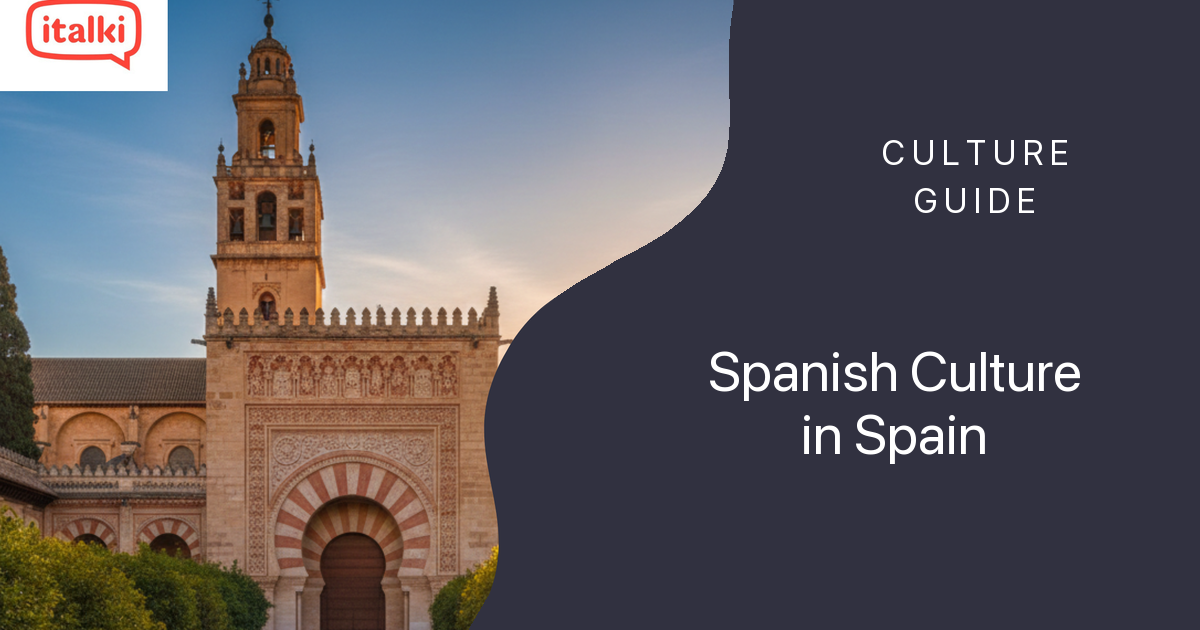
Spanish culture in Spain is not one single way of living. It changes from region to region, from breakfast habits to greeting styles to how people plan their time. If you are an adult learner, that matters because cultural context makes your Spanish more natural, helps you avoid misunderstandings, and gives you better listening comprehension in real conversations.
In this guide, you will learn the practical side of culture in Spain: everyday etiquette, regional differences, food and mealtimes, festivals, and the language patterns that often appear in real life. If you want feedback from a Spanish tutors who can explain the cultural meaning behind expressions, italki connects learners with 10M+ learners, 30,000+ teachers, and 150+ languages, so you can practice Spanish in the situations that matter to you.

Find Your Perfect Teacher
Your Spanish doesn’t have to sound like a textbook. Get personalized lessons from native tutors who’ll help you speak naturally, not just correctly.
Book a trial lesson
Key takeaways
- Spanish culture in Spain is regional, so the best approach is to learn common patterns first and then adjust for local habits in places like Madrid, Andalusia, Catalonia, and the Basque Country.
- Adult learners benefit most from culture plus language together: greetings, directness, meal timing, and social etiquette all affect how fluent your Spanish sounds.
- Working with a Spanish tutor on italki helps you practice culture-specific situations such as introductions, tapas ordering, small talk, and correcting register for formal versus casual settings.
- If you are planning travel, relocation, or exams, italki supports flexible practice with live correction, role-play, pronunciation feedback, and tutor matching for your goals.
What Spanish culture in Spain means
If you are searching for Spanish culture in Spain, you probably want more than tourist facts. You want to understand how people live, speak, and relate to each other so your Spanish feels appropriate in real situations.
At its core, Spanish culture combines strong social life, family connections, regional identity, food-centered routines, and a mix of informality and respect. The national picture is important, but Spain is also shaped by local customs that can change from one city to the next.
Cultural learning matters because Spanish is not only vocabulary. If you know what to say, when to say it, and how direct or warm to sound, your Spanish becomes more useful in real conversations.
Spanish from Spain also travels through film, food, literature, tourism, and family history. That influence is useful for learners because one phrase can carry social meaning, not just dictionary meaning.
Daily life, etiquette, and conversation
Spanish etiquette in Spain is often friendly, social, and relatively direct. That does not mean rude. It usually means people value clarity and warmth over excessive formality.
Common first-contact habits include a greeting, eye contact, and a short exchange before getting to the main point. In many settings, especially among adults, small talk matters. A simple comment about the day, the location, or the situation can make a conversation feel more natural.
In everyday speech, you will also hear differences in formality. In Spain, tú is widely used in daily life, while usted still appears in professional, age-based, or respectful contexts. Knowing when to switch matters as much as knowing the words.
| Situation | Natural behavior in Spain | What to say in Spanish |
|---|---|---|
| Meeting someone for the first time | Greet first, then add a short friendly comment | Hola, encantado de conocerte |
| Asking for help | Be direct, but polite | Perdona, ¿me puedes ayudar? |
| Speaking to a service worker | Use clear requests and brief thanks | Quería pedir… / Muchas gracias |
| Texting a new contact | Start with context, not only the request | Hola, soy Ana. Te escribo por… |
One practical tip: Spanish conversations often feel quicker than learners expect. People may overlap slightly, respond with short backchannels, or use humor early. Listening practice helps, but guided speaking practice is even better when you need to react in real time.
That is where live conversation matters. with online Spanish tutors, you can practice these everyday interactions with teachers who correct not just grammar, but tone, pacing, and cultural fit.
Regional differences you should know
Spain is not culturally identical from north to south. Regional identity is a big part of life, and adult learners should expect accents, vocabulary, schedules, and social habits to vary.
Madrid often feels fast-paced and practical. Andalusia may feel more relaxed and expressive. Catalonia has a strong local identity and its own linguistic context. The Basque Country, Galicia, and Valencia also bring distinct histories and everyday habits.
The most important lesson is not memorizing every regional feature. It is recognizing that Spanish culture in Spain is layered. You can be polite and successful with standard Spanish, then adapt as you learn more local nuance.
| Region | Common cultural note | Learner tip |
|---|---|---|
| Madrid | Busy pace, straightforward communication | Keep your requests clear and concise |
| Andalusia | Warm, social, often more relaxed timing | Listen for informal phrasing and rhythm |
| Catalonia | Strong regional identity and bilingual context | Be aware that local language context may appear around you |
| Basque Country | Distinct traditions and local pride | Show interest and avoid assuming one national stereotype fits all |
For a travel or relocation plan, regional differences are where adult learners often get stuck. A phrase that works in one place may sound too blunt or too casual in another. A tutor can help you adjust before you arrive.
Food, mealtimes, and social life
Food is one of the fastest ways to understand culture in Spain because it connects schedules, family life, and social habits. Meals are often social events, not just fuel.
Spain is known for tapas culture, long lunches, and late dinners in many places. A typical day can feel shifted later than in some other countries, especially in urban and social settings. You may also notice that people plan around mealtimes, especially lunch.
Spain.info presents food, festivals, and regional destinations as part of how visitors experience Spain, which supports a practical point for learners: culture is not trivia. It shapes mealtimes, greetings, plans, and small talk.
Food language can also be tricky. For example, ordering in a bar, asking for the bill, or reacting to a recommendation all involve natural phrasing. If you know the vocabulary but not the social pattern, you can still feel lost.
Festivals and traditions
Spain is famous for festivals, but the important point for learners is that traditions are not only performances. They are part of local identity and community memory.
UNESCO intangible cultural heritage includes traditions connected to Spain, which reinforces why festivals are best understood locally. A celebration can be national in visibility but still deeply regional in meaning.
Events like Semana Santa, Las Fallas, San Fermín, and local patron saint festivals each have their own vocabulary and emotional tone. Some are solemn, some are festive, and some are both.
For adult learners, festivals are excellent listening opportunities because you hear repeated cultural references in context. If you learn phrases tied to specific celebrations, you understand not just the words but the social meaning behind them.
Useful examples include:
- ¡Feliz fiesta! for a general festive greeting
- ¿Vas a la verbena? when asking about a local party or fair
- Es una tradición muy arraigada to describe a deeply rooted custom
Useful Spanish expressions for cultural situations
Learning a few culturally useful expressions can make you sound more natural immediately. These phrases are especially helpful in Spain because they fit real interactions in shops, restaurants, messages, and first meetings.
Here is a practical reference for adult learners:
| Situation | Natural expression | Why it helps |
|---|---|---|
| Greeting someone | Hola, ¿qué tal? | Friendly and common in Spain |
| Making a polite request | ¿Me puedes ayudar, por favor? | Direct but respectful |
| Asking for time to think | Déjame pensarlo | Useful in social and work settings |
| Ending a conversation | Bueno, nos vemos | Natural and casual |
| Reacting politely | ¡Qué bien! | Simple positive response |
You can also improve your pronunciation and rhythm by listening for how natives connect words. If you want a stronger spoken model, Spanish pronunciation practice with a teacher can help you sound clearer in everyday interactions.
For learners who are still building confidence, listening and speaking should go together. The best progress usually comes from hearing a phrase, using it in a real context, and then getting corrected right away.
How italki helps you learn culture through conversation
Culture is easier to learn when someone can answer your questions in context. That is why italki is useful for adult learners who want practical Spanish, not just textbook explanations.
You can match with teachers based on your goals, schedule, and level. If you are preparing for travel, work, exams, or daily life in Spain, a lesson can be shaped around your exact scenario.
Here is what makes live lessons especially effective for culture:
- Live correction: you learn which phrases sound natural in Spain and which ones sound too formal, too direct, or too translated.
- Role-play: you can practice café orders, introductions, apartment visits, or social invitations before using them in real life.
- Pronunciation feedback: your teacher can help with rhythm, stress, and the sounds that affect clarity.
- Accountability: regular sessions help you stay consistent instead of studying culture only when you remember.
- Flexible scheduling: you can fit learning around work, family, and travel.
If you want a stronger speaking routine, pairing lessons with Spanish listening practice gives you the best of both worlds: exposure plus correction.
And if you want to know how the platform works before choosing a teacher, start with what is italki. It is designed for learners who want human feedback, not just passive content.
Make Spanish culture usable in real conversation
Understanding Spanish culture in Spain is not about memorizing stereotypes. It is about learning how people speak, greet, eat, joke, and build relationships in context. That is what helps adult learners feel confident faster.
If you want your Spanish to sound natural in Spain, the next step is guided practice with someone who can correct you in the moment and explain the why behind the words.
Book a trial lesson with a Spanish teacher and practice culture, pronunciation, and real-life scenarios with feedback that fits your goals.
With Spanish culture in Spain, italki helps you practice greetings, mealtimes, schedules, festivals, and local etiquette before real conversations. The platform supports 10M+ learners and has 30,000+ teachers across 150+ languages, so you can Book a trial lesson with a Spanish tutor and practice the situations you actually want to handle.
Find Your Perfect Teacher
Your Spanish doesn’t have to sound like a textbook. Get personalized lessons from native tutors who’ll help you speak naturally, not just correctly.
Book a trial lesson
FAQ
Is Spanish culture in Spain the same everywhere?
No. There are shared national habits, but region, city size, and local identity all matter. A conversation in Madrid can feel different from one in Seville, Bilbao, or Barcelona.
What is the biggest culture shock for learners?
Often it is timing and style. Meals can happen later, conversations can be more direct, and people may switch quickly from small talk to the main point.
How can I learn culture and language together?
Use real conversations, not only reading. A teacher can explain expressions, tone, and etiquette while correcting your Spanish in the same lesson.
Why does a Spanish tutor help with this topic?
A tutor can show you how Spanish culture changes speech in real life. For example, they can help you choose the right greeting, handle informal conversation, and sound natural in restaurants or social settings.
Should I focus on one region first?
Yes, if you are traveling or moving to a specific place. Learn standard Spanish first, then add regional vocabulary and habits for the area that matters most to you.
Want to learn a language at italki?
Here are the best resources for you!