Key takeaways
- Pinyin is the official romanization system for Mandarin Chinese. It was developed in the 1950s and adopted as an international standard (ISO 7098) in 1982. Pinyin represents pronunciation, not meaning, and is the system used to input Chinese characters on keyboards and phones worldwide.
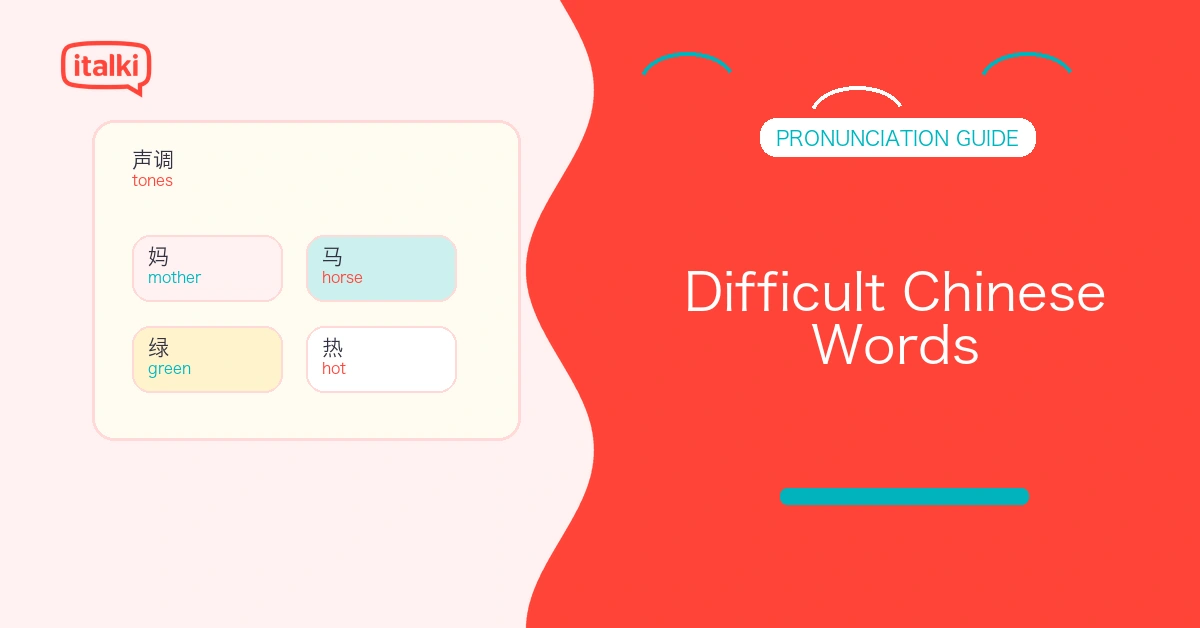
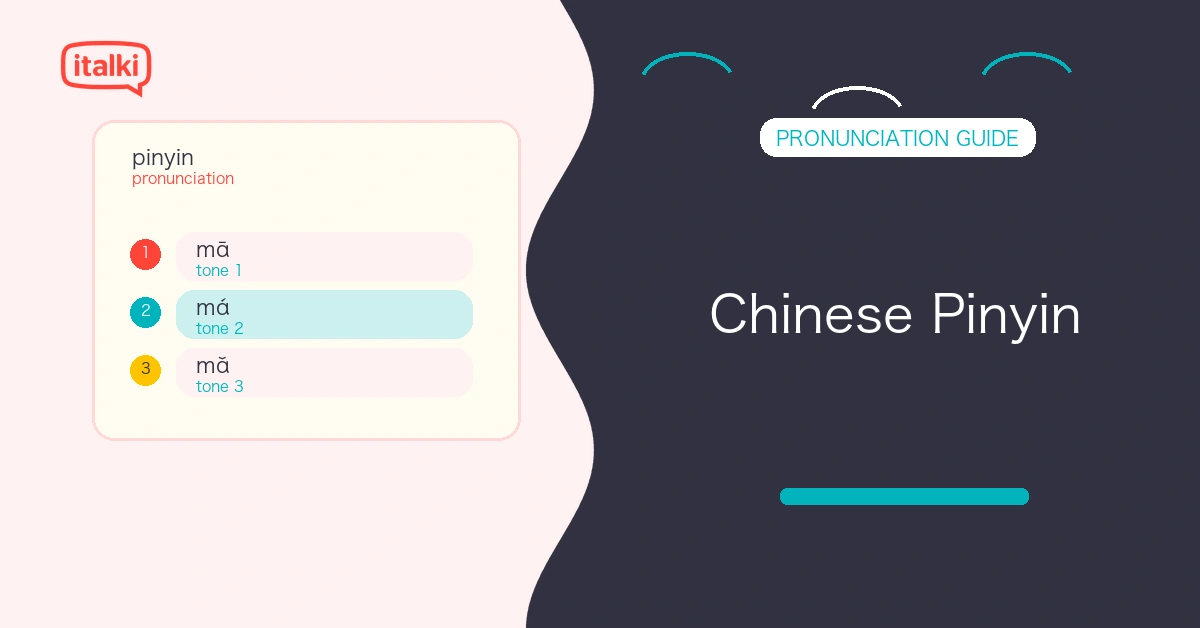
- Mandarin Chinese has four tones plus a neutral (fifth) tone. The same syllable pronounced in different tones has completely different meanings: mā (mother), má (hemp), mǎ (horse), and mà (to scold) are four entirely different words. Correct tones are as essential as correct pronunciation of the syllables themselves.
- Pinyin consists of 21 initials (consonants that begin syllables) and a set of finals (vowels and vowel combinations that follow the initial). Some sounds in pinyin look familiar but are pronounced differently from their English equivalents: x, q, z, c, zh, ch are among the most commonly mispronounced.
- Pinyin has special spelling rules that do not reflect pronunciation directly: ü is written as u after j, q, x, and y; standalone i becomes yi, standalone u becomes wu, and standalone ü becomes yu. These rules must be memorized to read and write pinyin correctly.
Pinyin is the gateway to reading, typing, and learning Mandarin Chinese. Without it, you cannot look up a character you do not know, input text in Chinese, or study pronunciation systematically.
italki connects learners with Chinese tutors who can help you practice pinyin pronunciation in real time and correct the tonal and phonetic errors that are impossible to catch from a written guide alone.
This guide covers all four tones with examples, the complete initial and final system, the most important special spelling rules, the most common pronunciation mistakes for English speakers, and practical tips for building accurate pinyin pronunciation.
Work with a Chinese tutor online to practice pinyin pronunciation with immediate feedback and build the accurate tonal instinct that makes Chinese communication work.

Find your perfect teacher
Build real speaking confidence with personalized lessons from a teacher who matches your goals, schedule, and learning style.
Book a trial lesson
What is pinyin?
Pinyin (拼音, pīnyīn, literally spelling sound) is the official system for romanizing Mandarin Chinese. It was created by a Chinese government commission in the 1950s, adopted in mainland China as the standard, and recognized internationally in 1982.
Pinyin serves several practical purposes:
- It represents the pronunciation of Chinese characters in a readable form
- It is the standard method for inputting Chinese on phones and computers (you type pinyin, and the device suggests characters)
- It is used in dictionaries to show how characters are pronounced
- It is used in language learning materials worldwide as the entry point to Mandarin pronunciation
Pinyin is not a separate writing system: it exists to represent the sounds of characters, not to replace them. Native Chinese speakers do not use pinyin to write, but all learners of Mandarin rely on it to learn and look up words.
The four tones (and neutral tone)
Mandarin Chinese is a tonal language: the pitch contour of a syllable determines its meaning. There are four main tones plus a neutral (fifth) tone used in certain grammatical particles and unstressed syllables.
The classic example uses the syllable ma:
| Tone | Tone mark | Contour | Character | Meaning |
|---|---|---|---|---|
| Tone 1 | ā | High and flat | 妈 | mother |
| Tone 2 | á | Rising | 麻 | hemp / numb |
| Tone 3 | ǎ | Dipping (fall then rise) | 马 | horse |
| Tone 4 | à | Falling sharply | 骂 | to scold |
| Neutral | a (no mark) | Short and unstressed | 吗 | question particle |
How to produce each tone:
Tone 1 (High level): Start at the top of your pitch range and hold it flat. Think of singing a single held note at the top of your range: 妈 (mā).
Tone 2 (Rising): Start in the middle of your range and rise sharply, like the intonation of a question in English: 麻 (má).
Tone 3 (Dipping): Start mid, drop to low, then rise again. In isolation, the full dip-and-rise is pronounced; before another syllable it often becomes a low fall only. This is the most distinctive tone: 马 (mǎ).
Tone 4 (Falling): Start high and fall sharply and decisively, like a firm command: 骂 (mà).
Neutral tone: Short, light, and unstressed. Its actual pitch depends on the preceding tone. Does not carry a tone mark: 吗 (ma, question particle), 的 (de, possessive particle), 了 (le, completion marker).
Tone marks in pinyin: Tone marks are placed over the main vowel of the syllable. When there are multiple vowels, the rule is: a and e always take the mark; ou takes the mark on o; in other cases, the mark goes on the last vowel.
Find your perfect teacher
Build real speaking confidence with personalized lessons from a teacher who matches your goals, schedule, and learning style.
Book a trial lesson
Tone sandhi: the tone 3 rule
When two Tone 3 syllables appear in sequence, the first changes to Tone 2 in pronunciation (but is still written as Tone 3).
你好 (nǐ hǎo, hello): written as two Tone 3 syllables, but pronounced ní hǎo (the first syllable rises to Tone 2).
This is called tone sandhi. It applies automatically in natural speech and is one of the first pronunciation rules every learner should learn, since 你好 is typically the first phrase anyone practices.
The 21 initials (consonants)
Initials are the consonants that begin a syllable. There are 21 initials in Mandarin. They are grouped by where in the mouth they are produced.
Bilabials and labiodentals (lips):
| Initial | Pronunciation note | Example |
|---|---|---|
| b | Unaspirated b (closer to English p in spot) | 爸 (bà, father) |
| p | Aspirated p (strong puff of air) | 怕 (pà, afraid) |
| m | Same as English m | 妈 (mā, mother) |
| f | Same as English f | 飞 (fēi, to fly) |
Alveolars (tongue tip to upper gum ridge):
| Initial | Pronunciation note | Example |
|---|---|---|
| d | Unaspirated d (closer to t in stop) | 大 (dà, big) |
| t | Aspirated t (strong puff of air) | 他 (tā, he) |
| n | Same as English n | 你 (nǐ, you) |
| l | Same as English l | 来 (lái, to come) |
Velars (back of tongue to soft palate):
| Initial | Pronunciation note | Example |
|---|---|---|
| g | Unaspirated g | 哥 (gē, older brother) |
| k | Aspirated k (strong puff of air) | 可 (kě, can) |
| h | Like English h but with slight friction | 好 (hǎo, good) |
Palatals (tongue to hard palate, only before i and ü sounds):
| Initial | Pronunciation note | Example |
|---|---|---|
| j | Like j in jeep but further forward in the mouth | 家 (jiā, home) |
| q | Like ch in cheap but further forward; always aspirated | 去 (qù, to go) |
| x | Like sh in sheep but further forward; no direct English equivalent | 学 (xué, to study) |
Retroflexes (tongue curled back):
| Initial | Pronunciation note | Example |
|---|---|---|
| zh | Like j in jungle with tongue curled back | 中 (zhōng, middle) |
| ch | Like ch in church with tongue curled back; aspirated | 吃 (chī, to eat) |
| sh | Like sh in shop with tongue curled back | 是 (shì, is) |
| r | Like English r merged with the s in measure; unique to Chinese | 人 (rén, person) |
Sibilants (tongue tip near teeth):
| Initial | Pronunciation note | Example |
|---|---|---|
| z | Like ds in beds | 在 (zài, at) |
| c | Like ts in bits; aspirated | 才 (cái, only then) |
| s | Same as English s | 四 (sì, four) |
Zero initial: Some syllables begin with a vowel and have no initial: 安 (ān, safe), 我 (wǒ, I).
Find your perfect teacher
Build real speaking confidence with personalized lessons from a teacher who matches your goals, schedule, and learning style.
Book a trial lesson
Finals (vowels and vowel combinations)
Finals are the vowel sounds and vowel combinations that follow the initial. They include simple vowels, diphthongs, and syllables ending in -n or -ng.
Simple finals:
| Final | Sound | Example |
|---|---|---|
| a | Open ah | 大 (dà, big) |
| o | Rounded oh | 我 (wǒ, I) |
| e | Unrounded mid-back vowel; nothing like English e | 喝 (hē, to drink) |
| i | ee after most initials; unvowelized after zh, ch, sh, r, z, c, s | 你 (nǐ, you) |
| u | oo as in food | 书 (shū, book) |
| ü | Pursed lips ee (like French u or German ü) | 鱼 (yú, fish) |
Compound finals (diphthongs):
| Final | Sound | Example |
|---|---|---|
| ai | eye | 爱 (ài, love) |
| ei | ay | 谁 (shéi, who) |
| ao | ow (as in cow) | 好 (hǎo, good) |
| ou | oh | 走 (zǒu, to walk) |
| ia | ya | 家 (jiā, home) |
| ie | ye | 写 (xiě, to write) |
| ua | wa | 花 (huā, flower) |
| uo | wo | 说 (shuō, to speak) |
| üe | yue with pursed lips | 月 (yuè, moon) |
| iao | yow | 小 (xiǎo, small) |
| iou (iu) | yo + oo | 六 (liù, six) |
| uai | wy | 怀 (huái, embrace) |
| uei (ui) | way | 对 (duì, correct) |
Nasal finals (-n and -ng):
| Final | Sound | Example |
|---|---|---|
| an | ahn | 三 (sān, three) |
| en | uh-n | 人 (rén, person) |
| in | een | 心 (xīn, heart) |
| un | wen | 春 (chūn, spring) |
| ün | yü-n with pursed lips | 军 (jūn, army) |
| ang | ahng | 上 (shàng, above) |
| eng | ung as in rung | 冷 (lěng, cold) |
| ing | eeng | 京 (jīng, capital) |
| ong | oong | 红 (hóng, red) |
| ian | yen | 年 (nián, year) |
| uan | wan | 完 (wán, finished) |
| üan | yüen with pursed lips | 远 (yuǎn, far) |
| iang | yang | 两 (liǎng, two/both) |
| uang | wang | 王 (wáng, king) |
| iong | yoong | 用 (yòng, to use) |
Special spelling rules
Pinyin has several spelling conventions that differ from what the pronunciation rules would suggest.
Rule 1: ü loses its dots after j, q, x, and y The sounds j, q, x, and y in Mandarin only ever appear before the ü vowel sound, not before u. So when you see ju, qu, xu, yu, these are actually pronounced jü, qü, xü, yü. The dots are dropped because there is no ambiguity.
Correct: 去 (qù), 学 (xué), 鱼 (yú) ü keeps its dots after l and n: 旅 (lǚ, to travel), 女 (nǚ, woman)
Rule 2: Standalone vowels add a consonant When i, u, or ü begins a syllable with no initial consonant:
- i – y: in – yin, ia – ya, ie – ye, iao – yao, iou – you, ian – yan, iang – yang, ing – ying, iong – yong
- u – w: u – wu, ua – wa, uo – wo, uai – wai, uei – wei, uan – wan, ueng – weng
- ü – yu: ü – yu, üe – yue, üan – yuan, ün – yun
Rule 3: iou and uei are written as iu and ui after an initial When iou follows an initial, only iu is written: liu, niu, qiu (not liou, niou, qiou). When uei follows an initial, only ui is written: dui, gui, shui (not duei, guei, shuei). The actual pronunciation remains iou and uei; the middle vowel is reduced in writing but still present in speech.
Rule 4: The syllable e changes sound after i and ü In the final -ie, the e sounds like e in bet. In the final -üe, the e sounds the same. But standalone e has a different, more central sound.
Find your perfect teacher
Build real speaking confidence with personalized lessons from a teacher who matches your goals, schedule, and learning style.
Book a trial lesson
The most common pronunciation mistakes
Mistake 1: Treating x like ks or z X in pinyin sounds like sh in English but with the tongue flat and forward (closer to the teeth). Not like the x in box. Practice: xī (west), xiǎo (small), xuésheng (student).
Mistake 2: Treating zh, ch, sh as single sounds Each is a distinct initial. Zh is like j in jungle with the tongue curled back. Ch is like ch in church with the tongue curled back. Sh is like sh in shop with the tongue curled back. The tongue position (retroflex) is the defining feature.
Mistake 3: Confusing j/q/x with zh/ch/sh j, q, x appear only before i or ü sounds. zh, ch, sh appear before a, o, e, u sounds. They are never interchangeable.
Mistake 4: Flattening Tone 3 The dipping shape of Tone 3 (mid-low-rising) is often simplified to a low tone by learners. In connected speech, Tone 3 before another tone often surfaces as just a low tone, but in careful speech the full dip-and-rise is important.
Mistake 5: Skipping tones on unstressed syllables Chinese particles and verb complements that carry neutral tone (like 吗, 的, 了, 呢) should be genuinely short and toneless, not assigned a random tone. Giving them a full tone makes speech sound unnatural.
Mistake 6: Reading q as kw Q in pinyin sounds like ch in cheap but with the tongue flat and forward. Not at all like qu in English queen. Practice: 去 (qù), 请 (qǐng), 钱 (qián).
How to type in pinyin
Pinyin input is the standard method for typing Chinese on all major platforms.
On phones: Go to Settings – Keyboard – Add Chinese (Simplified or Traditional) – Pinyin. Type the pinyin of a character and select the correct character from the suggestion bar.
On computers (Windows): Install Microsoft Pinyin IME (included in Windows), switch to Chinese input with Windows key + Spacebar or Alt+Shift, then type pinyin and press numbers to select characters.
On Mac: Go to System Settings – Keyboard – Input Sources – Add Chinese (Simplified or Traditional) Pinyin. Switch with the input menu or keyboard shortcut.
Tone marks in typing: Standard pinyin input for typing Chinese does NOT require tone marks. You type ni hao and the system suggests 你好. Tone marks are only needed when writing pinyin in academic contexts or learning materials.
For a foundation in the numbers you will use constantly in Mandarin, the guide to Chinese numbers covers the number system alongside pronunciation and practical uses.
Find your perfect teacher
Build real speaking confidence with personalized lessons from a teacher who matches your goals, schedule, and learning style.
Book a trial lesson
Practice tips
Tip 1: Learn tones before vocabulary Spend the first week solely on the four tones using the classic examples (mā má mǎ mà). Getting the pitch contours right from the start prevents months of bad habits. Record yourself and compare to a native speaker.
Tip 2: Practice initials in pairs Learn b and p together (unaspirated vs aspirated), d and t together, g and k together, j and q together, zh and ch together. The aspiration contrast is the key feature in each pair.
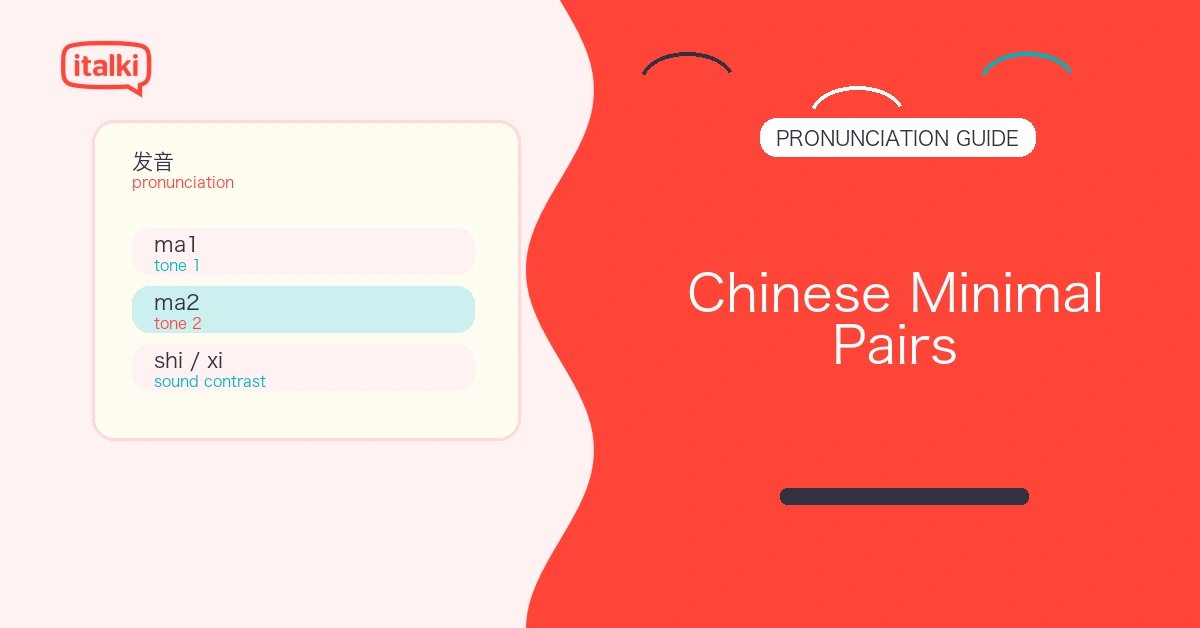
Tip 3: Use minimal pairs Practice pairs that differ in only one element: mā vs má, shī vs xī, zhī vs jī. Producing and recognizing these differences trains both your articulation and your ear.
Tip 4: Record and listen back Your perception of your own speech is unreliable when learning a new phonological system. Recording and listening back, or having a tutor listen, is the only reliable way to know whether your tones and sounds are accurate.
Tip 5: Type in pinyin from day one Typing Chinese in pinyin forces you to know the correct pinyin spelling of every word you look up, reinforcing both spelling and pronunciation simultaneously.
Practice pinyin with a tutor
Pinyin can be learned from a chart and rules, but correct pronunciation requires auditory feedback from a native speaker. Tones in particular are extremely difficult to self-correct because learners often cannot perceive the difference between their own pronunciation and the target. A Chinese tutor can identify your specific tonal and phonetic errors, drill the sounds you consistently get wrong, and guide you from careful pronunciation to natural speech rhythm.
italki’s 30,000+ expert tutors include native Mandarin speakers who specialize in pronunciation training for learners at every starting level. Trusted by over 10 million learners worldwide, the platform lets you find a tutor who can build pinyin correction into every lesson. Book a trial lesson and start building accurate Chinese pronunciation from the first session.
Find your perfect teacher
Build real speaking confidence with personalized lessons from a teacher who matches your goals, schedule, and learning style.
Book a trial lesson
FAQ
What is pinyin used for?
Pinyin is used to represent the pronunciation of Chinese characters in Roman letters. It is the standard system for typing Chinese on phones and computers (you type pinyin, and the device suggests characters), for showing pronunciation in dictionaries, and for learning Mandarin as a foreign language. It is not a separate writing system: it exists alongside Chinese characters, not instead of them.
How many tones does Chinese have?
Mandarin Chinese has four main tones plus a neutral (fifth) tone. Tone 1 is high and flat, Tone 2 rises, Tone 3 dips and rises, Tone 4 falls sharply, and the neutral tone is short and unstressed. Other Chinese varieties have different tone systems: Cantonese has six tones, some Min dialects have seven or eight.
Is pinyin the same as Chinese?
No. Pinyin is a romanization system that represents the sounds of Mandarin Chinese. It is not a separate language or writing system. A text written in pinyin conveys pronunciation but not the characters, which carry the full meaning. Most written Chinese uses characters; pinyin appears in dictionaries, textbooks, children’s materials, and as a keyboard input method.
How do you write tones in pinyin?
Each tone is marked with a diacritic over the main vowel of the syllable: ā (Tone 1, macron), á (Tone 2, acute accent), ǎ (Tone 3, caron), à (Tone 4, grave accent). The neutral tone carries no mark. In everyday typing for input purposes, tone marks are not needed; you type plain pinyin and select the correct character from the suggestions.
What is the hardest part of pinyin for English speakers?
The tones are generally the most challenging, particularly Tone 3 (the dipping tone) and distinguishing Tones 2 and 3 in listening. For consonants, x, q, zh, ch, sh, r, and the distinction between the j/q/x group and the zh/ch/sh group are the most common trouble spots. The sound of ü (pursed lips ee) also has no direct English equivalent.
Want to learn a language at italki?
Here are the best resources for you!