Key takeaways
- Choose is the present tense form: use it to talk about current habits, general truths, or decisions happening now or in the future. Chose is the simple past tense: use it for a specific completed decision in the past. Chosen is the past participle: use it with have/has/had for perfect tenses.
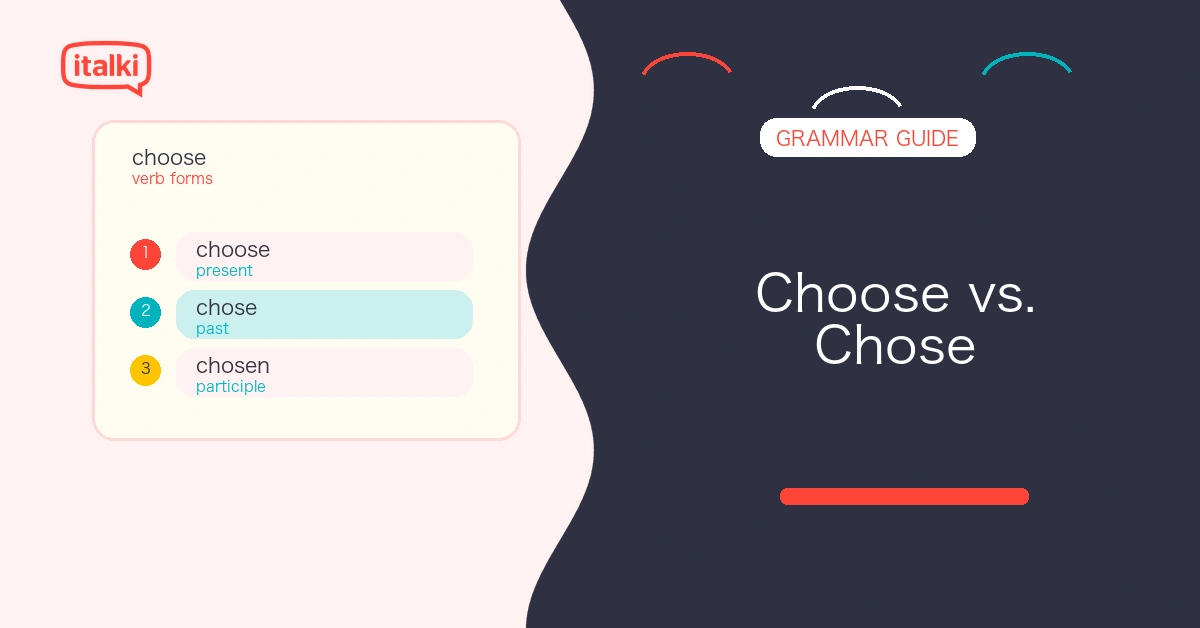
- The three forms of the verb are: choose (present), chose (past), chosen (past participle). Choosing is the present participle, used for progressive tenses and as a gerund.
- Pronunciation helps: choose rhymes with shoes (/tʃuːz/); chose rhymes with goes (/tʃoʊz/). The vowel sound changes between the two forms, and hearing the difference makes it easier to use the correct spelling.
- Choose follows the same irregular pattern as several other common English verbs: lose/lost, freeze/froze, speak/spoke. Understanding these patterns reduces the burden of memorizing each verb separately.
The mistake I chose to go there every week (using past tense for a repeated present habit) and I choose to go there yesterday (using present tense for a completed past event) are common in learner English and they signal incorrect tense usage.
Getting choose and chose right is a matter of understanding which tense fits the situation. italki connects learners with English tutors who can help you practice irregular verb forms in real sentences and develop accurate tense instinct.
This guide covers the complete forms of choose, when each form is used, the pronunciation difference, example sentences for each form, and a look at similar irregular verb patterns.
Work with an English tutor online to practice using choose, chose, and chosen correctly in real conversation and writing.

Find your perfect teacher
Build real English confidence with personalized lessons from a teacher who matches your goals, schedule, and learning style.
Book a trial lesson
Choose vs. chose at a glance
| Form | When to use | Example |
|---|---|---|
| choose | Present tense: habits, facts, decisions now or in future | I choose to walk every morning. |
| chooses | Third person singular present | She chooses carefully. |
| chose | Simple past: a specific completed decision | He chose the blue one. |
| chosen | Past participle: with have/has/had/be | They have chosen a name. |
| choosing | Present participle: progressive tenses and gerunds | She is choosing a career. |
When to use choose (present tense)
Choose is the base form and simple present tense. Use it for:
Habitual or repeated actions:
- I always choose the window seat.
- We choose to cook at home on weekends.
- She chooses quality over quantity.
General truths or preferences:
- People choose based on what feels right to them.
- Most learners choose one language to focus on at a time.
Decisions happening now or very soon:
- I think I’ll choose the second option.
- Right now I’m deciding, but I choose to wait.
Third person singular (add -s):
- He chooses the same restaurant every time.
- She never chooses the easy path.
- It chooses comfort over style.
Infinitive and base form (after modals and other verbs):
- You can choose whatever you want.
- I want to choose carefully.
- They should choose soon.
Find your perfect teacher
Build real English confidence with personalized lessons from a teacher who matches your goals, schedule, and learning style.
Book a trial lesson
When to use chose (past tense)
Chose is the simple past tense. Use it for a specific completed decision at a definite point in the past.
Specific past decisions:
- Yesterday, she chose the red dress.
- He chose economics as his major three years ago.
- We chose to leave early because of the traffic.
- They chose a name for the company before the launch.
Past habits or repeated past actions (use chose or used to choose):
- When I was young, I always chose the aisle seat.
- She chose the same café every Friday.
Note: for past habits that no longer occur, used to choose is often more natural: She used to choose the same café every Friday.
Choose – Chose: no predictable pattern Unlike regular verbs (walk – walked), chose does not add -ed. It is an irregular past form that must be memorized. The vowel in the stem changes: choo-se becomes cho-se.
How to use chosen (past participle)
Chosen is the past participle form. It is used in:
Perfect tenses (with have/has/had):
- I have chosen my courses for next semester.
- She has already chosen a university.
- We had chosen the venue before the budget was cut.
Passive voice (with am/is/are/was/were/been):
- The winner was chosen by the panel.
- The candidates have been chosen.
- A new leader will be chosen next month.
As a participle adjective (describing a noun):
- the chosen candidate
- a carefully chosen gift
- the chosen path
The guide to participle adjectives covers how past participle forms like chosen function as adjectives in English, along with many other common participle adjective pairs.
Find your perfect teacher
Build real English confidence with personalized lessons from a teacher who matches your goals, schedule, and learning style.
Book a trial lesson
The present participle: choosing
Choosing is used in:
Progressive (continuous) tenses:
- She is choosing between two options right now.
- They were choosing a color when I arrived.
- I have been choosing carefully.
As a gerund (noun form of the verb):
- Choosing the right words takes practice.
- The difficulty is in choosing.
- Choosing wisely matters more than choosing quickly.
After prepositions:
- She is thinking about choosing a new career.
- He is known for choosing unusual approaches.
Pronunciation: choose vs. chose
The vowel sound is the key difference.
Choose /tʃuːz/
- The vowel is the long oo sound, as in shoe, food, blue, and cruise.
- Rhymes with: shoes, news, blues, cruise, whose, use (verb).
Chose /tʃoʊz/
- The vowel is the oh sound, as in go, road, home, and phone.
- Rhymes with: goes, hose, nose, those, rose, dose.
Chosen /ˈtʃoʊzən/
- First syllable has the same oh vowel as chose.
- Second syllable is a reduced -en: /zən/.
Practicing the pronunciation helps anchor the correct spelling. If you hear the oo sound, you are using the present tense (choose). If you hear the oh sound, you are using the past tense (chose) or past participle (chosen).
Find your perfect teacher
Build real English confidence with personalized lessons from a teacher who matches your goals, schedule, and learning style.
Book a trial lesson
Example sentences for all forms
Choose (present):
- Every morning I choose between taking the bus or cycling.
- You choose what to have for breakfast.
- She chooses to read rather than watch television.
- They always choose the longer route through the park.
Chose (past):
- Last night, I chose the pasta.
- He chose Spanish as his elective in school.
- We chose to stay an extra day.
- She chose not to respond to the message.
Chosen (past participle):
- I have chosen to focus on one project at a time.
- The design has been chosen.
- They had chosen a name before the baby was born.
- He was chosen as team captain.
Choosing (present participle / gerund):
- She is still choosing between the two offers.
- Choosing the right moment is important.
- I find choosing difficult when the options are too similar.
Similar irregular verb patterns
Choose/chose/chosen follows a vowel-change pattern found in several other common English verbs. Recognizing the pattern helps you handle a whole group of verbs at once.
| Base form | Past tense | Past participle |
|---|---|---|
| choose | chose | chosen |
| freeze | froze | frozen |
| speak | spoke | spoken |
| steal | stole | stolen |
| break | broke | broken |
| wake | woke | woken |
| weave | wove | woven |
A separate but related pattern (lose/lost):
| Base form | Past tense | Past participle |
|---|---|---|
| lose | lost | lost |
| shoot | shot | shot |
And verbs where all three forms are the same:
| Base form | Past tense | Past participle |
|---|---|---|
| cut | cut | cut |
| put | put | put |
| set | set | set |
| let | let | let |
Learning choose as part of the freeze/spoke/broken group reduces the memory burden since the vowel shift pattern is the same across all of them.
Find your perfect teacher
Build real English confidence with personalized lessons from a teacher who matches your goals, schedule, and learning style.
Book a trial lesson
Common mistakes
Mistake 1: Using chose for a present or future action Incorrect: Every morning, she chose the healthy option. Correct: Every morning, she chooses the healthy option. (Present habit = present tense chooses.)
Mistake 2: Using choose for a completed past action Incorrect: Yesterday he choose the second option. Correct: Yesterday he chose the second option. (Specific past event = simple past chose.)
Mistake 3: Using chose instead of chosen after have/has/had Incorrect: I have chose the wrong path. Correct: I have chosen the wrong path. (Perfect tense requires the past participle chosen.)
Mistake 4: Spelling chose with a double-o Incorrect: He choosed / He chose correctly but then also choosed. The past tense is always chose (no -d ending, no double-o).
Mistake 5: Pronouncing choose and chose the same way Both have the same consonants, but the vowel is different. Choose has /uː/ (long oo). Chose has /oʊ/ (oh sound). Keeping the pronunciation distinct helps prevent the spelling confusion.
Practice choose, chose, and chosen with a tutor
Irregular verbs become automatic through practice in real sentences, not from memorizing tables. A tutor can give you prompts that require you to use different tenses of choose in context, catch any errors immediately, and help you internalize the verb forms so they come naturally under conversation speed.
italki’s 30,000+ expert tutors include native English speakers who specialize in grammar instruction and conversational fluency. Trusted by over 10 million learners worldwide, the platform lets you find a tutor who can build verb practice into every conversation. Book a trial lesson and start using choose, chose, and chosen correctly in real English.
Find your perfect teacher
Build real English confidence with personalized lessons from a teacher who matches your goals, schedule, and learning style.
Book a trial lesson
FAQ
What is the difference between choose and chose?
Choose is the present tense: I choose, you choose, she chooses. Use it for habits, general truths, and decisions happening now or in the future. Chose is the simple past tense: I chose, he chose, they chose. Use it for a specific completed decision in the past. They are forms of the same irregular verb.
Is it I have chose or I have chosen?
I have chosen is correct. After have, has, or had, use the past participle form, which is chosen. I have chose is incorrect. The same rule applies to passive voice: It was chosen (not It was chose).
How do you pronounce choose and chose?
Choose is pronounced /tʃuːz/ and rhymes with shoes, news, and blues. Chose is pronounced /tʃoʊz/ and rhymes with goes, nose, and those. The difference is the vowel: a long oo in choose and an oh sound in chose.
What is the past participle of choose?
The past participle of choose is chosen. It is used in perfect tenses (I have chosen, she has chosen, they had chosen) and passive constructions (the winner was chosen). It can also function as a participle adjective: the chosen team, a carefully chosen approach.
Is choose a regular or irregular verb?
Choose is an irregular verb. Regular verbs form the past tense by adding -ed (walk – walked, talk – talked). Irregular verbs change their form in unpredictable ways. For choose, the past tense is chose (vowel change, no -ed ending) and the past participle is chosen. The same vowel-change pattern applies to freeze/froze/frozen, speak/spoke/spoken, and several other common irregular verbs.
Want to learn a language at italki?
Here are the best resources for you!