Key takeaways
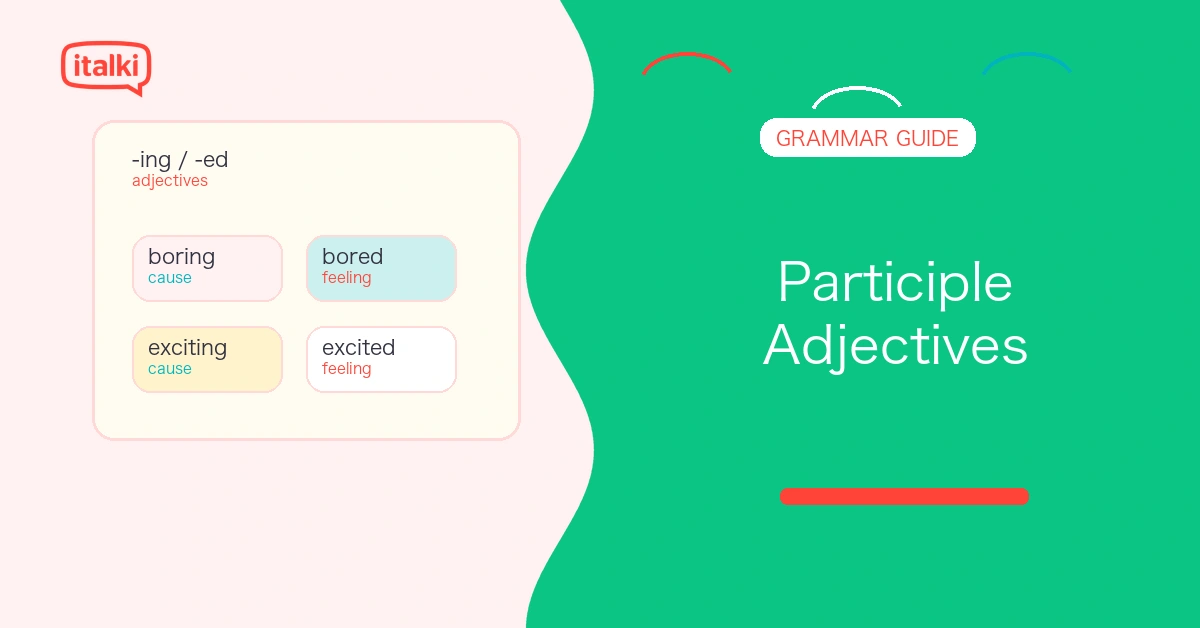
- Participle adjectives are adjectives formed from verbs. Present participle adjectives end in -ing and describe a quality of a thing or situation: a boring meeting, an interesting idea, an exhausting journey. Past participle adjectives end in -ed and describe the emotional state of a person: a bored student, an interested reader, an exhausted traveler.
- The core rule: -ing adjectives describe the cause of a feeling; -ed adjectives describe the person experiencing that feeling. A frightening film causes fear in the viewer, who feels frightened. An interesting book causes interest, so the reader feels interested.
- The most commonly confused pairs are boring/bored, interesting/interested, exciting/excited, tiring/tired, surprising/surprised, annoying/annoyed, frightening/frightened, disappointing/disappointed, and confusing/confused.
- Past participle adjectives from irregular verbs work exactly the same way but use irregular forms: broken (a broken promise), written (a written agreement), frozen (a frozen lake), hidden (a hidden door), spoken (a spoken language).
One of the most reliable signals that someone is still learning English is saying I am boring when they mean I am bored. Participle adjectives follow a precise and consistent logic, but that logic must be learned explicitly because it differs from how most other languages handle this.
italki connects learners with English tutors who can help you practice these forms in real sentences until the correct version sounds natural and the incorrect one sounds wrong. This guide covers what participle adjectives are, how to form them, the -ing vs -ed distinction, irregular forms, placement rules, and the most common mistakes.
Work with an English tutor online to practice participle adjectives in real conversation and build the instinct for natural English usage.

Find your perfect teacher
Build real English confidence with personalized lessons from a teacher who matches your goals, schedule, and learning style.
Book a trial lesson
What are participle adjectives?
Adjectives describe nouns. Participle adjectives are adjectives formed from verbs, using either the present participle (-ing) or past participle (-ed/-en) form. They appear throughout everyday English: a relaxing holiday, a relaxed attitude, an inspiring speech, an inspired performance.
The term simply means: a word that looks like a verb participle but functions as an adjective. Because many common English adjectives come directly from verbs, this category is large and essential for fluent usage.
Present participle adjectives (-ing)
Present participle adjectives are formed from the present participle of a verb. They describe a quality of a person, thing, or situation, specifically what effect it has or what quality it possesses.
Formation: verb + -ing, used as an adjective.
| Verb | Present participle adjective | Example |
|---|---|---|
| bore | boring | a boring lecture |
| interest | interesting | an interesting book |
| excite | exciting | an exciting match |
| tire | tiring | a tiring journey |
| amaze | amazing | an amazing view |
| confuse | confusing | a confusing explanation |
| shock | shocking | shocking news |
| charm | charming | a charming village |
| relax | relaxing | a relaxing afternoon |
| inspire | inspiring | an inspiring teacher |
Present participle adjectives describe the thing or situation that causes a feeling, not the person who experiences it. The boring lecture causes boredom in the listener. The interesting book causes interest in the reader.
Find your perfect teacher
Build real English confidence with personalized lessons from a teacher who matches your goals, schedule, and learning style.
Book a trial lesson
Past participle adjectives (-ed)
Past participle adjectives are formed from the past participle of a verb (typically the -ed form for regular verbs). They describe the emotional state or condition of a person who has been affected by something.
Formation: past participle (verb + -ed for regular verbs), used as an adjective.
| Verb | Past participle adjective | Example |
|---|---|---|
| bore | bored | a bored student |
| interest | interested | an interested audience |
| excite | excited | an excited child |
| tire | tired | a tired traveler |
| amaze | amazed | an amazed crowd |
| confuse | confused | a confused expression |
| shock | shocked | a shocked silence |
| charm | charmed | charmed by the city |
| relax | relaxed | a relaxed atmosphere |
| inspire | inspired | an inspired decision |
Past participle adjectives describe the person who has been caused to feel something by an external force.
The key distinction: -ing vs -ed
This is the most important rule for using participle adjectives correctly.
-ing = describes what causes the feeling (the source) -ed = describes who experiences the feeling (the person)
| -ing (cause) | -ed (person experiencing) |
|---|---|
| The film is boring. | The viewer is bored. |
| The news is shocking. | She is shocked. |
| The game is exciting. | The fans are excited. |
| The explanation is confusing. | The student is confused. |
| The journey is exhausting. | The traveler is exhausted. |
A useful test: ask What is it like? for -ing, and How do they feel? for -ed.
- What is the lecture like? It’s boring.
- How does the student feel? She’s bored.
The -ing adjective cannot be used to describe a student unless that student is literally causing boredom in others, meaning the student is a boring person (a very different meaning).
Find your perfect teacher
Build real English confidence with personalized lessons from a teacher who matches your goals, schedule, and learning style.
Book a trial lesson
Common participle adjective pairs
These are the pairs most frequently confused by learners. The left column describes the source; the right column describes the person.
| Verb | -ing (source) | -ed (person) |
|---|---|---|
| bore | boring | bored |
| interest | interesting | interested |
| excite | exciting | excited |
| tire | tiring | tired |
| surprise | surprising | surprised |
| annoy | annoying | annoyed |
| frighten | frightening | frightened |
| disappoint | disappointing | disappointed |
| confuse | confusing | confused |
| exhaust | exhausting | exhausted |
| amaze | amazing | amazed |
| fascinate | fascinating | fascinated |
| embarrass | embarrassing | embarrassed |
| satisfy | satisfying | satisfied |
| frustrate | frustrating | frustrated |
| overwhelm | overwhelming | overwhelmed |
| motivate | motivating | motivated |
| entertain | entertaining | entertained |
| worry | worrying | worried |
| depress | depressing | depressed |
Example sentences showing pairs in use:
- The results were disappointing. The team was disappointed but determined to improve.
- The new software update was confusing. Most users were confused for the first few days.
- Learning a language is challenging but not discouraging. Learners who feel discouraged often stop too soon.
Irregular past participle adjectives
Many common past participle adjectives in English come from irregular verbs and do not end in -ed, but they function exactly the same way as regular -ed adjectives.
| Verb | Irregular past participle adjective | Example |
|---|---|---|
| break | broken | a broken window, a broken promise |
| write | written | a written agreement, written instructions |
| freeze | frozen | frozen food, a frozen lake |
| hide | hidden | a hidden door, hidden costs |
| speak | spoken | spoken English, a spoken language |
| steal | stolen | stolen property, a stolen car |
| wear | worn | worn shoes, a worn expression |
| lose | lost | a lost wallet, lost time |
| choose | chosen | the chosen candidate |
| make | made | a handmade gift |
| know | known | a well-known author |
| tear | torn | a torn document |
| fall | fallen | fallen leaves |
| see | seen | a never-before-seen performance |
These forms work especially well in noun phrases before a noun: a broken relationship, a well-known restaurant, a frozen landscape.
For more on how adverbs and adjectives interact in English grammar, the guide to adverbs of manner covers a closely related area of English word modification.
Find your perfect teacher
Build real English confidence with personalized lessons from a teacher who matches your goals, schedule, and learning style.
Book a trial lesson
Placement: attributive and predicative
Participle adjectives can appear in two positions in a sentence.
Attributive position (before the noun):
- An interesting documentary
- A confused expression
- A broken window
- A relaxing holiday
Predicative position (after a linking verb such as be, seem, become, feel, look, sound, appear):
- The documentary was interesting.
- He looked confused.
- The window is broken.
- The holiday felt relaxing.
Both -ing and -ed adjectives work in both positions and the meaning does not change based on position.
Some participle adjectives are more commonly used predicatively: She was overwhelmed is more natural than an overwhelmed person. Others work equally well in both positions: a satisfied customer and the customer was satisfied are both standard.
Common mistakes
Mistake 1: Using -ing when -ed is needed The most frequent error is saying I am boring when I am bored is intended.
Incorrect: I’m so boring today. Correct: I’m so bored today.
I’m boring means other people find you dull. I’m bored means you are experiencing boredom caused by a lack of stimulation.
Mistake 2: Using -ed when -ing is needed Incorrect: The film was very frightened. Correct: The film was very frightening. The film causes fear; therefore it is frightening.
Mistake 3: Confusing interested and interesting Incorrect: She is very interesting in learning French. Correct: She is very interested in learning French. She is the person experiencing interest. An interesting person is someone who causes interest in others.
Mistake 4: Forgetting irregular past participles Incorrect: a broke promise, a froze lake Correct: a broken promise, a frozen lake
Find your perfect teacher
Build real English confidence with personalized lessons from a teacher who matches your goals, schedule, and learning style.
Book a trial lesson
Practice participle adjectives with a tutor
The -ing vs -ed distinction becomes automatic through exposure to real English in conversation, reading, and listening. A tutor can help you notice when you use the wrong form, provide immediate corrections, and give you practice producing both forms in context until the correct version sounds instinctively right.
italki’s 30,000+ expert tutors include native English speakers who specialize in grammar instruction and conversational fluency. Trusted by over 10 million learners worldwide, the platform lets you find a tutor who can design grammar practice around your specific problem areas. Book a trial lesson and start using participle adjectives accurately in real conversation.
Find your perfect teacher
Build real English confidence with personalized lessons from a teacher who matches your goals, schedule, and learning style.
Book a trial lesson
FAQ
What is a participle adjective?
A participle adjective is an adjective formed from a verb using either the present participle (-ing) or past participle (-ed/-en) form. Present participle adjectives (boring, interesting, frightening) describe what quality a thing or situation has. Past participle adjectives (bored, interested, frightened) describe the emotional state of a person affected by something.
What is the difference between -ing and -ed adjectives?
The -ing form describes the cause of a feeling: a boring film causes boredom. The -ed form describes the person who experiences the feeling: a bored viewer is experiencing boredom. To use the forms correctly, ask whether you are describing the source of the feeling (-ing) or the person experiencing it (-ed).
Why is I am boring incorrect if you mean you feel unstimulated?
I am boring means that other people find you dull: you are the cause of their boredom. To describe your own internal state of feeling unstimulated, the correct form is I am bored, meaning you are experiencing boredom caused by something external.
Do all English adjectives ending in -ed come from verbs?
Most -ed adjectives that describe emotional states do come from verbs. However, some common adjectives ending in -ed are not derived from verbs: talented, wicked, naked, sacred, and crooked. These happen to end in -ed but do not follow the participle adjective pattern.
Can irregular past participles be used as adjectives?
Yes. Many of the most common English adjectives come from irregular past participles: broken, frozen, hidden, written, worn, lost, chosen, and spoken are all frequently used as adjectives. They follow the same rules as regular -ed adjectives and can appear both before nouns (a broken window) and after linking verbs (the window was broken).
Want to learn a language at italki?
Here are the best resources for you!