Key takeaways
- Dental terms in Japanese help you explain pain, name teeth, and understand treatment instructions.
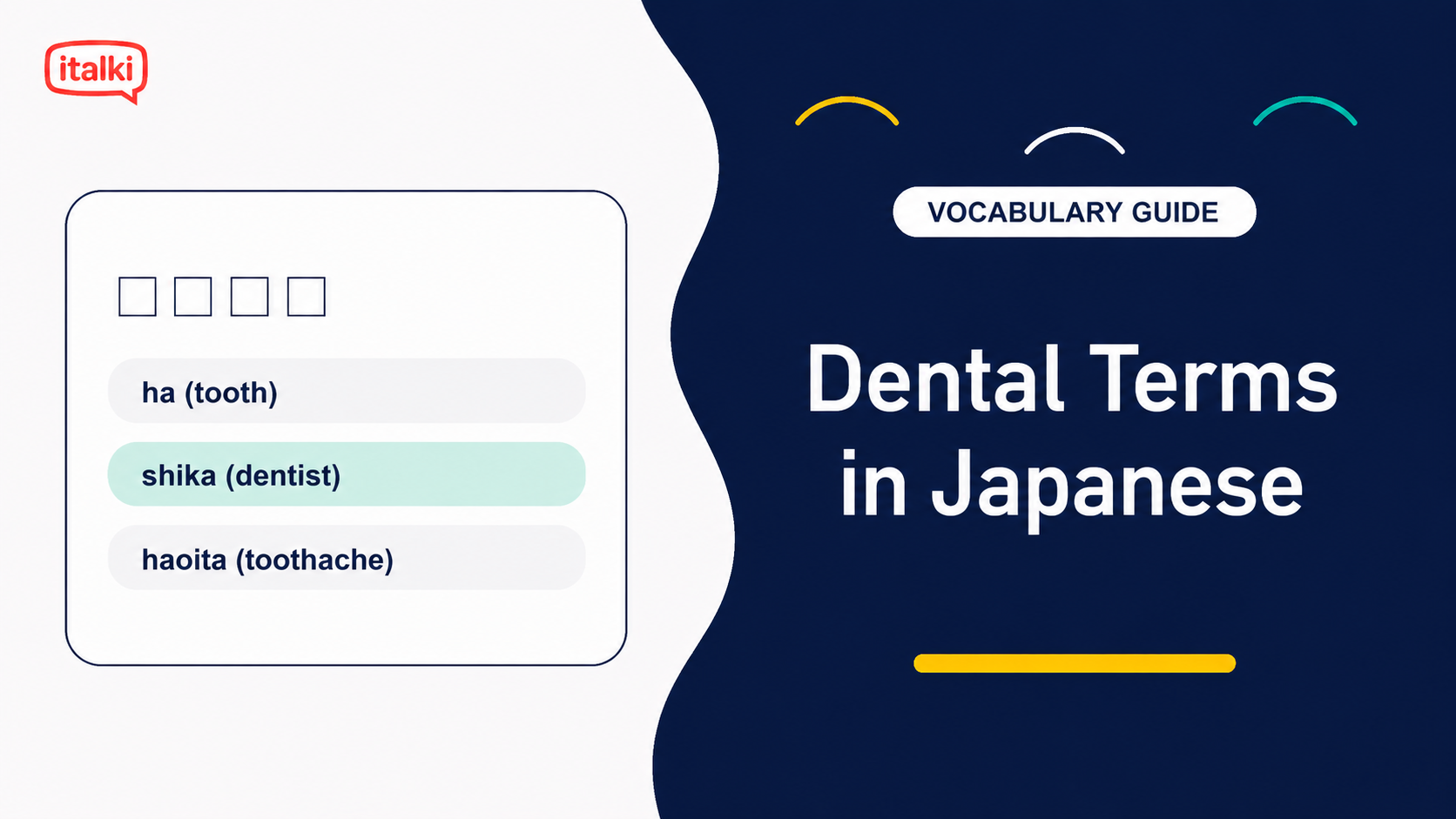
- Start with 歯 (ha), tooth, 歯医者 (haisha), dentist, 痛いです (itai desu), it hurts, and 予約 (yoyaku), appointment.
- Pain words matter most: ズキズキする (zukizuki suru), throbbing, and しみる (shimiru), sensitive.
- Rehearse role-plays with a Japanese tutor before a real appointment so your symptom sentence stays clear under pressure.
Dental terms in Japanese make a dentist visit less stressful because you know how to say where it hurts, how long it has hurt, and what treatment you agree to, and a mistranslated symptom can lead to the wrong treatment entirely. Start with 歯 (ha), tooth, 歯医者 (haisha), dentist, and ここが痛いです (koko ga itai desu, “this part hurts”).
italki connects learners with 30,000+ teachers across 150+ languages and has helped over 10 million people get exactly this kind of practical speaking practice before high-stakes appointments.
Before your appointment, rehearse check-in, pain descriptions, and treatment consent with a online Japanese teacher who can correct your pronunciation of tricky terms like 麻酔 (masui), anesthesia.

Find Your Perfect Teacher
Practice dental terms in japanese with a Japanese tutor who can correct pronunciation, phrasing, listening speed, and natural replies in real time.

What dental terms in Japanese should you know first?
The first dental terms in Japanese to learn are the words for dentist, tooth, pain, appointment, and insurance card, since these appear from the first phone call through to payment at the counter.
| Japanese | Pronunciation | English | Use it when |
|---|---|---|---|
| 歯 | ha | tooth | Naming the problem area |
| 歯医者 | haisha | dentist | Talking about the person or clinic |
| 歯科医院 | shika iin | dental clinic | Calling or finding the clinic |
| 虫歯 | mushiba | cavity | Explaining suspected decay |
| 奥歯 | okuba | back tooth, molar | Pointing to a rear tooth |
| 前歯 | maeba | front tooth | Pointing to a front tooth |
| 予約 | yoyaku | appointment | Booking or confirming a visit |
| 保険証 | hokenshō | insurance card | Reception and payment |
| 痛い | itai | painful, hurts | Main pain word |
Use です (desu) after short phrases to sound polite: 歯が痛いです (ha ga itai desu) means “the tooth hurts.”
Visits often open with the same Japanese greetings you would use anywhere else, including おはようございます (ohayō gozaimasu, “good morning”) and よろしくお願いします (yoroshiku onegai shimasu), a polite phrase used when placing yourself in someone’s care.
Practice the first thirty seconds of your visit with a native Japanese tutor until the opening exchange feels automatic.
How do you describe tooth pain in Japanese?
To describe tooth pain in Japanese, name the place first, then the feeling, then the timing, following the pattern ここが + pain word + です, “this part is…”
| Japanese phrase | Pronunciation | English |
|---|---|---|
| ここが痛いです。 | koko ga itai desu | This part hurts. |
| 右上の奥歯が痛いです。 | migi ue no okuba ga itai desu | The upper right back tooth hurts. |
| 左下の歯ぐきが腫れています。 | hidari shita no haguki ga harete imasu | The lower left gums are swollen. |
| 冷たいものがしみます。 | tsumetai mono ga shimimasu | Cold things sting the tooth. |
| 熱いものがしみます。 | atsui mono ga shimimasu | Hot things sting the tooth. |
| 噛むと痛いです。 | kamu to itai desu | It hurts when biting down. |
| 何もしなくても痛いです。 | nani mo shinakute mo itai desu | It hurts even without doing anything. |
| ズキズキします。 | zukizuki shimasu | It throbs. |
| チクチクします。 | chikuchiku shimasu | It stings or prickles. |
| 出血しています。 | shukketsu shite imasu | It is bleeding. |
Japanese uses onomatopoeia for pain in a way English does not. ズキズキ suggests a deep throbbing pulse, while チクチク suggests a sharp, needle-like sting.
Add time with から (kara), “since”: 昨日から痛いです (kinō kara itai desu) means “it has hurt since yesterday.”
Use these location words when the dentist asks どこが痛いですか (doko ga itai desu ka, “where does it hurt?”): 右 (migi, right), 左 (hidari, left), 上 (ue, upper), 下 (shita, lower), and 奥 (oku, back, deep inside).
Clinic forms and scheduling lean on the counting patterns covered in Japanese numbers, useful for dates and times.
A common mistake is mixing up the location order. In English you say “upper right molar,” but in Japanese the order is 右上の奥歯, “right-upper’s back tooth.” Getting this wrong confuses the dentist, so it’s worth rehearsing a few combinations until the order feels automatic.
Find Your Perfect Teacher
Practice dental terms in japanese with a Japanese tutor who can correct pronunciation, phrasing, listening speed, and natural replies in real time.
What phrases help at reception and during booking?
Clinic staff ask set questions in a predictable order, so memorizing the answer pattern helps more than memorizing single words.
| Situation | Japanese | Pronunciation | English |
|---|---|---|---|
| Entering the clinic | 予約があります。 | yoyaku ga arimasu | There is an appointment. |
| First visit | 初めてです。 | hajimete desu | It is the first time here. |
| No appointment | 予約していません。 | yoyaku shite imasen | There is no appointment. |
| Asking for a time | 何時が空いていますか。 | nanji ga aite imasu ka | What time is available? |
| Giving insurance card | 保険証です。 | hokenshō desu | Here is the insurance card. |
| Stating the problem | 歯が痛いです。 | ha ga itai desu | The tooth hurts. |
Staff might ask 保険証はありますか (hokenshō wa arimasu ka), “Do you have your insurance card?” They might also hand you a clipboard and say 問診票を書いてください (monshin hyō o kaite kudasai), “Please fill out the medical questionnaire,” which usually asks about allergies, current medication, and the main symptom.
For a phone call, keep the request simple: 予約をお願いします (yoyaku o onegai shimasu), “an appointment, please,” followed by 歯が痛いので、診てもらいたいです (ha ga itai node, mite moraitai desu), “the tooth hurts, so a visit is needed.” If you need English support, ask 英語を話せる方はいますか (eigo o hanaseru kata wa imasu ka), “is there someone who speaks English?”
Phone calls are harder than face-to-face conversations because there are no gestures or pointing, and the receptionist speaks at normal speed. Rehearsing the exact call script with a private Japanese teacher until the booking question and symptom sentence feel automatic makes the real call far less stressful.
What treatment words will a Japanese dentist use?
Dentists typically explain the problem, name the treatment, then ask for agreement.
| Japanese | Pronunciation | English |
|---|---|---|
| 診察 | shinsatsu | examination |
| レントゲン | rentogen | X-ray |
| 麻酔 | masui | anesthesia |
| クリーニング | kurīningu | cleaning |
| 詰め物 | tsumemono | filling |
| 抜歯 | basshi | tooth extraction |
| 神経 | shinkei | nerve |
| 根管治療 | konkan chiryō | root canal treatment |
| 治療 | chiryō | treatment |
A dentist might say 虫歯があります (mushiba ga arimasu, “there is a cavity”) or 麻酔をします (masui o shimasu, “anesthesia will be used”).
The word 神経 (shinkei), nerve, comes up when pain is deep: 神経までいっています (shinkei made itte imasu) means the decay has reached the nerve, usually signaling a root canal or extraction next.
Useful consent and clarification phrases include どんな治療ですか (donna chiryō desu ka, “what kind of treatment is it?”), 麻酔をしますか (masui o shimasu ka, “will you use anesthesia?”), 費用はいくらぐらいですか (hiyō wa ikura gurai desu ka, “about how much will it cost?”), and 少し考えてもいいですか (sukoshi kangaete mo ii desu ka, “is it okay to think about it?”).
Asking for time to think is perfectly acceptable, and わかりません (wakarimasen, “I do not understand”) is better than nodding through an explanation you did not follow. Practicing these consent phrases with a Japanese conversation tutor beforehand makes a measurable difference in how confidently you respond.
How do you understand dentist instructions in Japanese?
Dentist instructions often use てください (te kudasai), “please do,” so listening for the verb before ください tells you the action.
| Japanese instruction | Pronunciation | English |
|---|---|---|
| 口を開けてください。 | kuchi o akete kudasai | Please open your mouth. |
| 楽にしてください。 | raku ni shite kudasai | Please relax. |
| うがいをしてください。 | ugai o shite kudasai | Please rinse your mouth. |
| 痛かったら手を上げてください。 | itakattara te o agete kudasai | Raise your hand if it hurts. |
| 動かないでください。 | ugokanaide kudasai | Please do not move. |
The phrase 痛かったら (itakattara), “if it hurts,” is worth knowing before any treatment starts, since you might hear 痛かったら教えてください (itakattara oshiete kudasai), “tell me if it hurts.” Knowing just this one conditional phrase tells you the dentist wants you to signal during the procedure.
After treatment, instructions often involve food or medicine, following the same negative pattern ないでください (naide kudasai), “please do not”: 今日は硬いものを食べないでください (kyō wa katai mono o tabenaide kudasai, “please do not eat hard foods today”), 強くうがいしないでください (tsuyoku ugai shinaide kudasai, “please do not rinse strongly”), and 薬を飲んでください (kusuri o nonde kudasai, “please take the medicine”). Recognizing the ないでください pattern lets you understand an instruction even if you miss the verb.
Knowing Japanese food names for rice, soup, and other soft foods makes it easier to follow post-treatment eating instructions.
Find Your Perfect Teacher
Practice dental terms in japanese with a Japanese tutor who can correct pronunciation, phrasing, listening speed, and natural replies in real time.
What should you say about medicine, allergies, and insurance?
Before treatment, tell the clinic about allergies, medicine, pregnancy, and insurance status, since accuracy matters more here than in any other part of the visit.
| Japanese | Pronunciation | English |
|---|---|---|
| アレルギーがあります。 | arerugī ga arimasu | There is an allergy. |
| 薬を飲んでいます。 | kusuri o nonde imasu | Medicine is being taken. |
| 妊娠しています。 | ninshin shite imasu | Pregnant. |
| 持病があります。 | jibyō ga arimasu | There is a chronic condition. |
| 自費ですか。 | jihi desu ka | Is this private pay? |
If you take blood thinners, dentists need to know before any procedure that causes bleeding: 血液をサラサラにする薬を飲んでいます (ketsueki o sarasara ni suru kusuri o nonde imasu), “blood-thinning medicine is being taken.”
If you use Japanese public health insurance, reception might ask for 保険証 (hokenshō), insurance card. Under Japan’s medical insurance system, people from the start of compulsory education through age 69 have a 30% copayment for covered medical care, including dental procedures.
Cost questions are normal: 保険は使えますか (hoken wa tsukaemasu ka), “does insurance apply?” A mispronounced word in an allergy sentence creates real confusion, so it’s worth practicing アレルギー (arerugī) with a Japanese instructor until it’s clinic-clear.
How should you practice dental Japanese before the appointment?
Practice dental Japanese by building one short script for reception, one for the dentist, and one for payment, then speak it out loud until the symptom sentence stays clear under pressure.
Use this three-part script: for reception, 予約があります。山田です。保険証です (yoyaku ga arimasu, Yamada desu, hokenshō desu), “there is an appointment, the name is Yamada, here is the insurance card”; for the symptom, 右下の奥歯が三日前からズキズキ痛いです (migi shita no okuba ga mikka mae kara zukizuki itai desu), “the lower right back tooth has had throbbing pain for three days”; and for clarification, すみません、もう一度ゆっくりお願いします (sumimasen, mō ichido yukkuri onegai shimasu), “sorry, please say that again slowly.”
Then train answers to the questions you are likely to hear: どこが痛いですか (doko ga itai desu ka, “where does it hurt?”) answered with 右上の奥歯です (migi ue no okuba desu); いつから痛いですか (itsu kara itai desu ka, “since when has it hurt?”) answered with 昨日からです (kinō kara desu); and 薬のアレルギーはありますか (kusuri no arerugī wa arimasu ka, “any medicine allergies?”) answered with いいえ、ありません (iie, arimasen).
Pronunciation matters most in small words that change meaning. 歯 (ha), tooth, uses the sound “ha,” not “wa.” 麻酔 (masui), anesthesia, has three clear beats, ma-su-i, not two.
Japanese politeness also matters in clinics: ください (kudasai), お願いします (onegai shimasu), and すみません (sumimasen) keep requests clear and respectful. Japanese honorifics adds context for polite clinic speech, including お大事に (odaiji ni), “take care.”
For a realistic rehearsal, ask a Japanese pronunciation tutor to play receptionist, dentist, and cashier in one lesson. Running through the entire visit flow in a single session builds the muscle memory that keeps your sentences steady when real nerves kick in.
Ready to speak clearly at a Japanese dentist?
Dental Japanese is not about sounding perfect. It is about saying the symptom, pointing to the tooth, understanding instructions, and asking for clarification before treatment starts. Bring a written note if speaking feels hard: a simple line like 右下の奥歯が三日前から痛いです (the lower right back tooth has hurt for three days) gives the dentist a clear starting point.
With 30,000+ teachers across 150+ languages, italki makes it straightforward to find a Japanese tutor for guided practice before a real visit. Book a trial lesson and rehearse the appointment script and pain descriptions with a tutor who can correct your dental vocabulary in real time.
Find Your Perfect Teacher
Practice dental terms in japanese with a Japanese tutor who can correct pronunciation, phrasing, listening speed, and natural replies in real time.
FAQ
What is dentist in Japanese?
Dentist is 歯医者 (haisha). A dental clinic is 歯科医院 (shika iin), and the field of dentistry is 歯科 (shika). Clinic signs usually display 歯科.
How do you say “the tooth hurts” in Japanese?
Say 歯が痛いです (ha ga itai desu). For more detail, add the location: 右上の奥歯が痛いです (migi ue no okuba ga itai desu) means “the upper right back tooth hurts.”
How do you say cavity in Japanese?
Cavity is 虫歯 (mushiba), literally “bug tooth.” 虫歯があります (mushiba ga arimasu) means “there is a cavity.”
What should you say if you do not understand the dentist?
Say すみません、もう一度ゆっくりお願いします (sumimasen, mō ichido yukkuri onegai shimasu). It means “sorry, please say that again slowly.” You can also say わかりません (wakarimasen), “I do not understand.”
How do you ask about cost at a Japanese dental clinic?
Say 費用はいくらぐらいですか (hiyō wa ikura gurai desu ka), meaning “about how much will it cost?” For insurance coverage, ask 保険は使えますか (hoken wa tsukaemasu ka), “Does insurance apply?”
Want to learn a language at italki?
Here are the best resources for you!