Key takeaways
- English has three articles: a (indefinite, before consonant sounds), an (indefinite, before vowel sounds), and the (definite). A fourth option, no article at all, is called the zero article.
- The choice between a/an and the depends on whether the speaker and listener share the same reference: a dog means any dog; the dog means a specific dog both parties already know about.
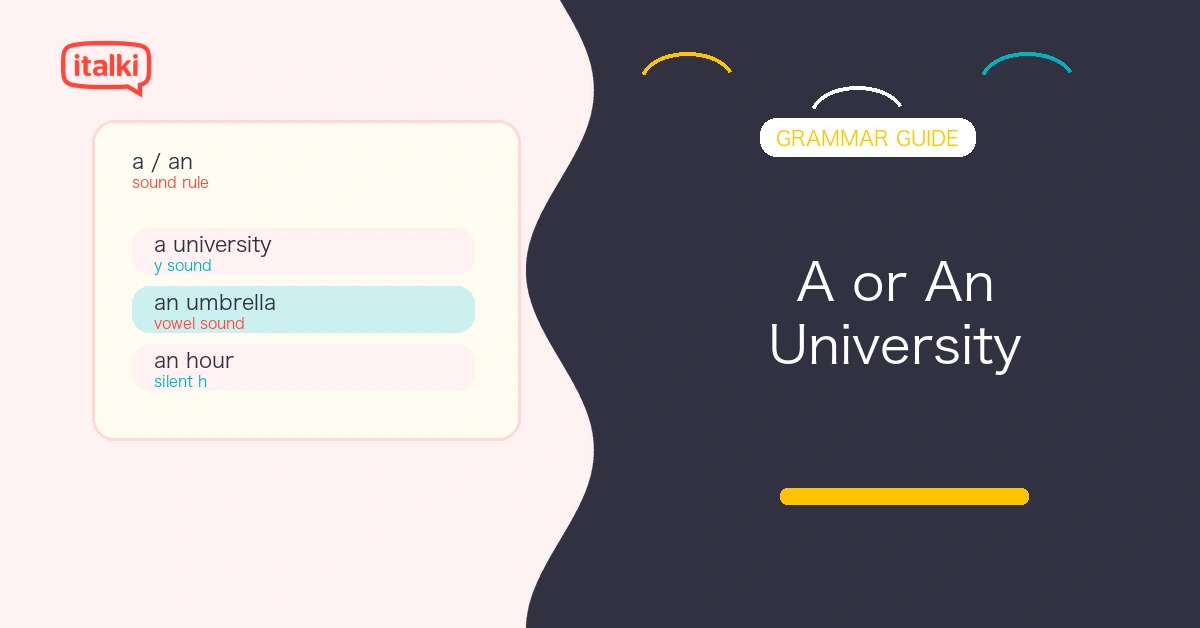
- A vs an depends on the sound of the following word, not the spelling. An hour uses an because hour begins with a vowel sound (the h is silent). A university uses a because it begins with a “y” sound.
- Speakers of languages without articles, including Chinese, Japanese, Korean, Russian, Arabic, and Turkish, consistently rank article use among the most difficult English grammar points.
Native English speakers produce a, an, and the automatically, without ever consciously deciding which one to use. For learners whose first language has no articles, including Chinese, Japanese, Korean, Russian, Arabic, and Turkish, every noun in every sentence requires an active choice that proficient speakers never need to make.
This guide covers all four article options: the sound rule for a vs an, when to use the, when no article is needed at all, how generic statements work, how articles behave with proper nouns and place names, and the specific errors most common for learners of particular language backgrounds.
italki, operating since 2007 with 10M+ learners, connects English learners with teachers who can identify article patterns in a learner’s speech and target the errors that come from their specific first language. Find an English tutor and practice in real conversation: article use only becomes automatic through enough corrected exposure.

Find your perfect teacher
Build real English confidence with personalized lessons from a teacher who matches your goals, schedule, and learning style.
Book a trial lesson
What articles do in English
Articles signal whether a noun refers to something specific and identifiable, or to something general and unidentified.
| Article | Type | Use | Example |
|---|---|---|---|
| a | Indefinite | One of many; listener doesn’t know which one | I saw a film last night. |
| an | Indefinite | Same as a, before vowel sounds | She ate an orange. |
| the | Definite | A specific one; listener knows which | The film was excellent. |
| (none) | Zero article | General, uncountable, or plural generics | I love music. / Dogs are loyal. |
The clearest way to see the definite/indefinite contrast in a single exchange:
“I bought a book yesterday.“, introducing the book for the first time; the listener doesn’t know which one. “The book is on the table.“, both speaker and listener now know which book is meant.
Once a noun has been introduced with a/an, it switches to the for every reference after the first. This is the entry-mention rule, and it explains most definite article use in spoken and written narrative.
A vs. an: the sound rule
A and an are the same word. The form changes based on the sound that follows, not the letter.
Use an before vowel sounds (a, e, i, o, u sounds):
| Word | Sound | Article |
|---|---|---|
| apple | /æ/ vowel sound | an apple |
| elephant | /ɛ/ vowel sound | an elephant |
| hour | /aʊ/ vowel sound (h is silent) | an hour |
| umbrella | /ʌ/ vowel sound | an umbrella |
| honest | /ɒ/ vowel sound (h is silent) | an honest person |
Use a before consonant sounds:
| Word | Sound | Article |
|---|---|---|
| car | /k/ consonant | a car |
| university | /juː/ (y-sound) | a university |
| European | /juː/ (y-sound) | a European country |
| one-way | /wʌn/ (w-sound) | a one-way street |
| useful | /juːs/ (y-sound) | a useful tip |
The words university, European, one-way, useful, and unique all begin with consonant sounds despite starting with vowel letters. A university is correct because the word begins with a “y” sound (/juː/), not a vowel sound.
Conversely, an hour, an honest, and an heir begin with a silent h, the first sound is a vowel, so an applies.
With abbreviations: Read the first letter’s pronunciation, not the letter itself. An MBA (em-bee-ay, begins with vowel sound “em”). A PhD (pee-aitch-dee, begins with consonant sound “p”). An NGO. A URL in American English (because “you-are-el” starts with a y-sound).
Find your perfect teacher
Build real English confidence with personalized lessons from a teacher who matches your goals, schedule, and learning style.
Book a trial lesson
When to use “the”
The marks a noun as specific and identifiable. Several situations create this shared reference.
1. Second mention, re-referring to something already introduced
I ordered a coffee and a sandwich. The coffee was cold. (Second reference to the coffee, now both speaker and listener know which one.)
2. Unique reference, only one exists
The sun rises in the east. (Only one sun.) The president will speak at noon. (One president in context.) Please close the door. (In a room with one door, or the relevant one.)
3. Superlatives, always use “the”
She is the best student in the class. It was the most interesting lecture.
4. Ordinals in sequence, usually “the”
The first chapter is the easiest. The second is harder.
5. Specific groups or systems
the internet, the economy, the government, the environment
These noun phrases refer to systems that are understood to exist, the economy means the economic system of a given country or the world, already known in context.
6. Geographic names with “the“
the United States, the Amazon, the Pacific Ocean, the Netherlands, the Alps
Recognizing when “the” is required is something that develops through extensive reading and listening. If article errors are appearing in writing or drawing feedback from readers, structured practice with an English tutor, who can identify patterns in a learner’s specific errors, is significantly more efficient than reviewing rules in isolation.
When to use no article (zero article)
No article appears before:
1. Plural and uncountable nouns in general statements
Dogs are loyal. (Not “the dogs are loyal”, that would mean specific known dogs.) Water is essential for life. Music makes people happy.
2. Most proper nouns (see exceptions below)
London is the capital of England. Maria studies at Harvard.
3. Languages, academic subjects, and sports
She speaks French. He studies mathematics. They play basketball.
4. Meals, when used generally
Breakfast is at seven. (But: The breakfast at that hotel was excellent., specific meal.) She skipped lunch.
5. Transportation and communication by mode
I travel by train. (Not “by the train.”) She sent it by email. We go by car.
6. Titles before names
President Lincoln. (But: The president announced…) Doctor Kim. (But: The doctor examined her.)
The zero article trips learners because the absence of a word is hard to notice or remember. An error like “the music makes me happy” or “I go to the school every day” sounds wrong to a native speaker but invisible to a learner who expects article omission to be marked somehow.
Find your perfect teacher
Build real English confidence with personalized lessons from a teacher who matches your goals, schedule, and learning style.
Book a trial lesson
Generic statements: A, the, or nothing?
English has three ways to make a general statement about a category of things, and all three are grammatically correct, with slightly different nuances.
| Generic type | Example | Notes |
|---|---|---|
| Zero article + plural | Cats are independent. | Most common in everyday speech |
| The + singular | The cat is an independent animal. | More formal; common in scientific writing |
| A + singular | A cat is an independent animal. | Refers to any one cat as representative of the type |
For most practical purposes, the zero article plural (Cats are independent) is the default in spoken English. The cat is independent and a cat is independent are both correct but sound slightly more formal or academic.
Articles with proper nouns
Most proper nouns take no article. The exceptions follow patterns.
No article:
- Most countries: France, Japan, Brazil, Spain
- Most cities: Paris, Tokyo, Cairo
- Continents: Europe, Asia, Africa
- Most names: Maria, James, Professor Chen
- Single mountains: Mount Everest, Mount Fuji
- Individual lakes: Lake Superior, Lake Titicaca
“The“
- Countries that are plural or contain “republic/kingdom/states”: the United States, the United Kingdom, the Philippines, the Netherlands, the Czech Republic
- Rivers: the Thames, the Nile, the Amazon, the Mississippi
- Oceans and seas: the Pacific Ocean, the Mediterranean
- Mountain ranges: the Alps, the Himalayas, the Andes
- Island chains: the Maldives, the Canary Islands
- Specific well-known buildings or institutions: the Louvre, the White House, the Vatican
- Newspapers: the Guardian, the New York Times
The pattern for countries: countries named as a single word usually take no article (Japan, Brazil, Mexico), while countries named as a political union or containing a noun of political structure usually take the (the United States = a union of states; the United Kingdom = a kingdom; the Netherlands = a plural of “lowlands”).
Find your perfect teacher
Build real English confidence with personalized lessons from a teacher who matches your goals, schedule, and learning style.
Book a trial lesson
Common mistakes by first language
Different language backgrounds produce predictably different article errors.
Speakers of Chinese, Japanese, Korean (no articles in these languages):
- Adding “the” to generic plurals: “The dogs are loyal” when making a general statement
- Missing “the” with unique references: “Sun is hot” instead of “The sun is hot”
- Omitting a when introducing a new singular noun: “She is teacher” instead of “She is a teacher”
Speakers of Russian, Polish, Arabic (no articles):
- Similar overuse and underuse as above
- Additional challenge: Russian and Arabic are highly inflected, and article-encoded specificity information is carried by other grammatical tools that do not transfer to English
Speakers of Spanish, French, Italian (have articles):
- Generally better with the concept, but specific differences remain
- Using article with abstract nouns or mass nouns where English omits it: “The life is short” instead of “Life is short”
- Spanish uses articles with languages (el español) where English does not (Spanish)
Understanding where your specific article errors come from, based on your first language, helps target practice. An English teacher online who has experience with your language background can identify the error patterns that are predictable for speakers of your language and address them directly, rather than working through every article rule regardless of what is actually causing problems.
Making article use automatic
The rules in this guide explain a, an, the, and the zero article clearly enough for a learner to apply them deliberately. But in real conversation, deliberate is not fast enough. Article use only becomes reliable when it is automatic, and that only happens through enough corrected speaking practice.
italki, operating since 2007 with 10M+ learners, connects English learners with teachers who can listen for article errors during normal conversation and correct them in context, which is where the habit actually changes. Book a trial lesson and ask your teacher to flag every article error during a five-minute conversation about your day, the pattern will be clear within minutes.
Find your perfect teacher
Build real English confidence with personalized lessons from a teacher who matches your goals, schedule, and learning style.
Book a trial lesson
FAQ
What is the difference between “a” and “an”?
A and an are the same article, the form depends on the sound that follows. Use an before vowel sounds: an apple, an hour, an MBA. Use a before consonant sounds: a car, a university, a PhD. The deciding factor is the sound, not the spelling.
When do you use “the” in English?
Use the when both the speaker and listener know which specific thing is meant: after a noun has already been introduced (I have a dog. The dog is friendly.), for things that are unique (the sun, the president), and for superlatives (the best, the most interesting).
Is it correct to say “I play the piano” but “I play basketball”?
Yes. Musical instruments use the (the piano, the guitar, the violin). Sports and games do not (basketball, football, chess). This is a fixed rule that must be memorized, there is no logical reason for the difference.
Why do some country names use “the” and others do not?
Countries named as political unions or with words like “republic,” “kingdom,” “states,” or “lands” typically use the: the United States, the United Kingdom, the Netherlands. Countries named as single proper words typically do not: France, Japan, Brazil.
How do you know when to use no article at all?
No article appears before plural nouns in general statements (Dogs are mammals), uncountable nouns used generally (Water is essential), most proper nouns (She lives in Tokyo), languages and academic subjects (She studies biology), and transportation by mode (I travel by bus).
Want to learn a language at italki?
Here are the best resources for you!