Key takeaways
- Most writing problems in English (run-ons, fragments, awkward sentences) are clause errors in disguise. Understanding clause structure is what lets you diagnose and fix your own writing.
- An independent clause stands alone as a sentence. A dependent clause cannot. Does this make sense on its own? is the fastest test.
- English has three types of dependent clauses: noun clauses, relative clauses, and adverbial clauses. Each answers a different grammatical question.
- The most common clause errors (comma splices, fragments, and misplaced relative clauses) each have a straightforward fix once you identify the clause type involved.
Most people use clauses correctly in everyday English without ever thinking about them. But the moment you want to write more complex sentences, understand grammar feedback, or fix errors in your own writing, knowing what a clause is and how it works becomes genuinely useful.
italki connects you with English teachers who can explain clause structure in the context of your own writing, which is far more effective than learning it in the abstract.
This guide covers the definition of a clause, the difference between independent and dependent clauses, the three main dependent clause types with examples, how clauses connect, and the most common mistakes learners make.

Find your perfect teacher
Build real English confidence with personalized lessons from a teacher who matches your goals, schedule, and learning style.
Book a trial lesson
What is a clause?
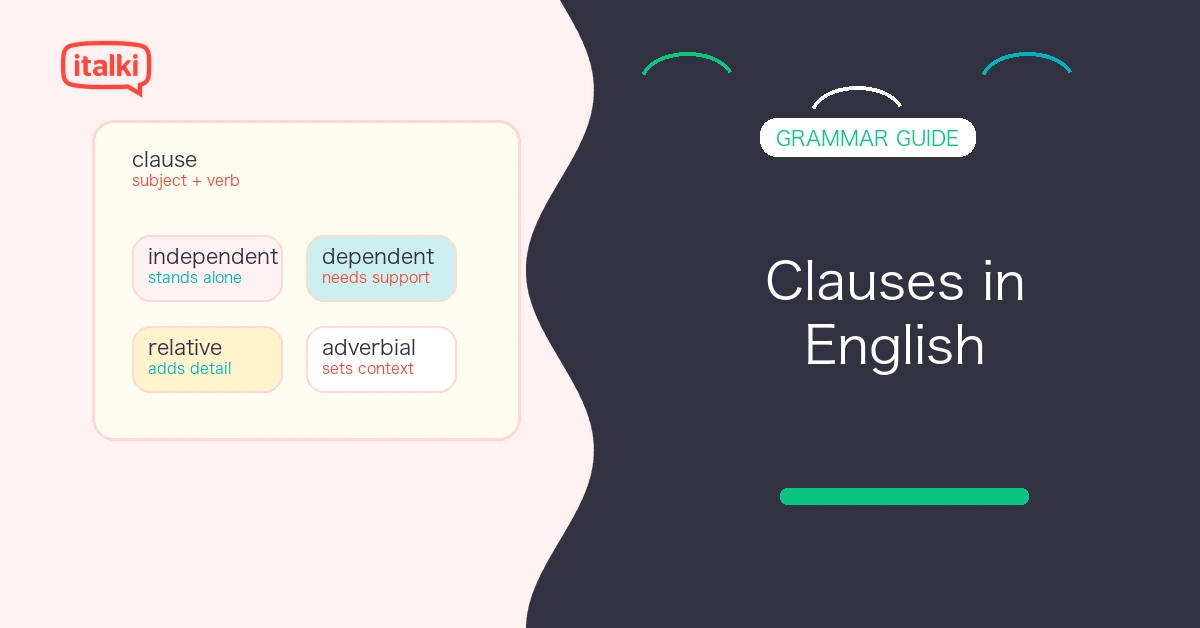
A clause is a group of words that contains a subject and a verb.
- She reads.: One clause. Subject: she. Verb: reads.
- She reads every night before bed.: Still one clause. The extra words are modifiers, not a second clause.
- She reads, and her sister watches television.: Two clauses. Each has its own subject and verb.
A clause is not the same as a phrase. A phrase is a group of words without a subject-verb combination: in the morning, the tall man, quickly and quietly. These are phrases. They can be part of a clause, but they are not clauses on their own.
The key test: does it have both a subject and a verb? If yes, it is a clause. If it is missing either one, it is a phrase.
Independent clauses
An independent clause can stand alone as a complete sentence. It expresses a complete thought.
| Independent clause | Complete sentence? |
|---|---|
| She finished the report. | Yes |
| The train was late. | Yes |
| We need to reschedule the meeting. | Yes |
| Although it was raining. | No: dependent (see below) |
| What she said in the meeting. | No: dependent |
Every sentence must contain at least one independent clause. A sentence that is only a dependent clause is a fragment (a common error covered in the mistakes section).
Two independent clauses can join in three ways:
- With a coordinating conjunction (and, but, or, so, yet, for, nor): She finished the report, and she sent it to the client.
- With a semicolon: She finished the report; she sent it to the client.
- By making one clause dependent: After she finished the report, she sent it to the client.
Work with an English teacher online to review how your own sentences are structured: most writing problems (run-ons, fragments, awkward sentences) trace back to clause connection issues.
Find your perfect teacher
Build real English confidence with personalized lessons from a teacher who matches your goals, schedule, and learning style.
Book a trial lesson
Dependent clauses
A dependent clause has a subject and a verb but cannot stand alone as a sentence. It depends on an independent clause to complete its meaning.
| Dependent clause | Why it cannot stand alone |
|---|---|
| Although she was tired | Does not tell us what happened |
| Because the meeting ran late | Does not tell us the result |
| What he said surprised everyone | This one actually can: it functions as a subject (see noun clauses) |
| Which was built in 1920 | Does not tell us what was built in 1920 |
Dependent clauses are introduced by subordinating conjunctions (although, because, if, when, while, after, before, unless, until, since) or relative pronouns (who, which, that, whose, whom).
Noun clauses
A noun clause functions as a noun in the sentence. It can be the subject, object, or complement.
| Function | Example |
|---|---|
| Subject | What she said surprised everyone. |
| Object | I did not understand what he meant. |
| Complement | The problem is that nobody told us. |
| Object of preposition | She worried about what might happen. |
Common noun clause introductory words: that, what, who, whoever, whatever, whether, if, how, why, when, where.
Examples in context:
- That she resigned was unexpected. (subject clause)
- Do you know whether the meeting has been confirmed? (object clause: note: whether is preferred over if in formal writing for embedded questions)
- The issue is that we missed the deadline. (complement clause)
A common error with noun clauses: maintaining question word order inside a noun clause.
| Incorrect | Correct |
|---|---|
| I don’t know where is he. | I don’t know where he is. |
| She asked what did I mean. | She asked what I meant. |
| Can you tell me when does it start? | Can you tell me when it starts? |
Inside a noun clause, use statement word order (subject before verb), not question word order.
Find your perfect teacher
Build real English confidence with personalized lessons from a teacher who matches your goals, schedule, and learning style.
Book a trial lesson
Relative clauses
A relative clause modifies a noun. It tells us more about which person or thing is being discussed.
Defining relative clauses (no commas) identify which person or thing is meant:
- The woman who called this morning wants a callback.
- The report that was submitted late needs to be revised.
Remove a defining relative clause and the sentence loses essential meaning. You do not know which woman, which report.
Non-defining relative clauses (with commas) add extra information about a noun already clearly identified:
- My manager, who started last month, has already changed three policies.
- The conference, which runs for three days, covers topics from all departments.
Remove a non-defining relative clause and the core meaning survives. The commas signal that the information is additional, not essential.
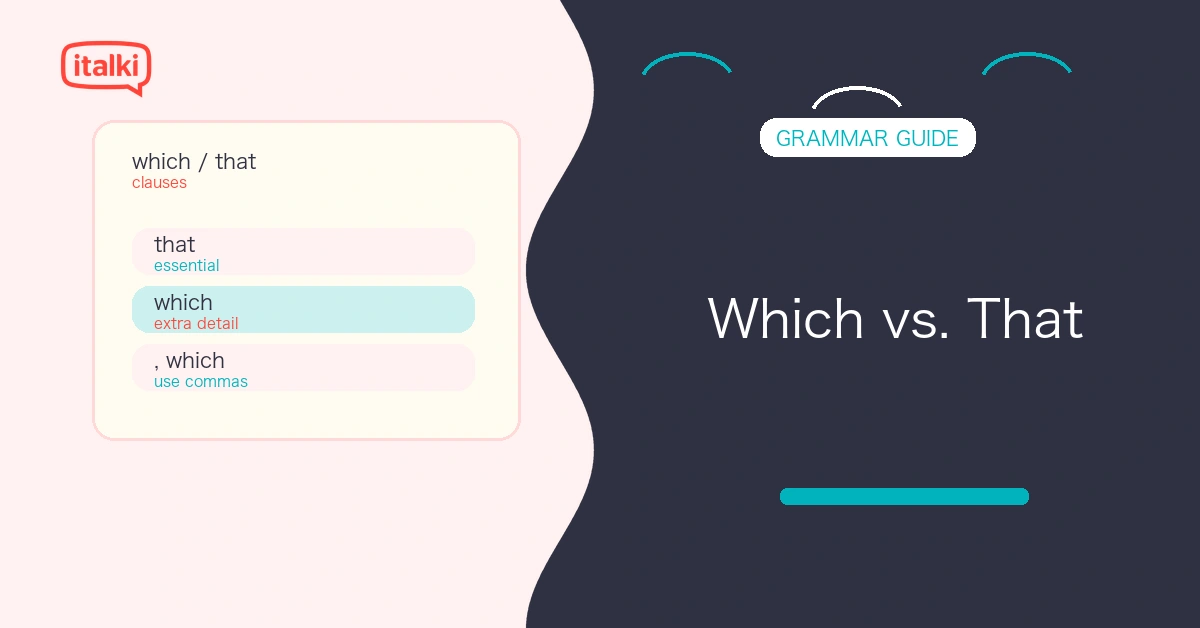
Which vs. that: That is used in defining relative clauses. Which is used in non-defining relative clauses. In formal writing, this distinction matters.
- Defining: The file that you need is on the server. (not which)
- Non-defining: The file, which contains all the data, is on the server. (not that)
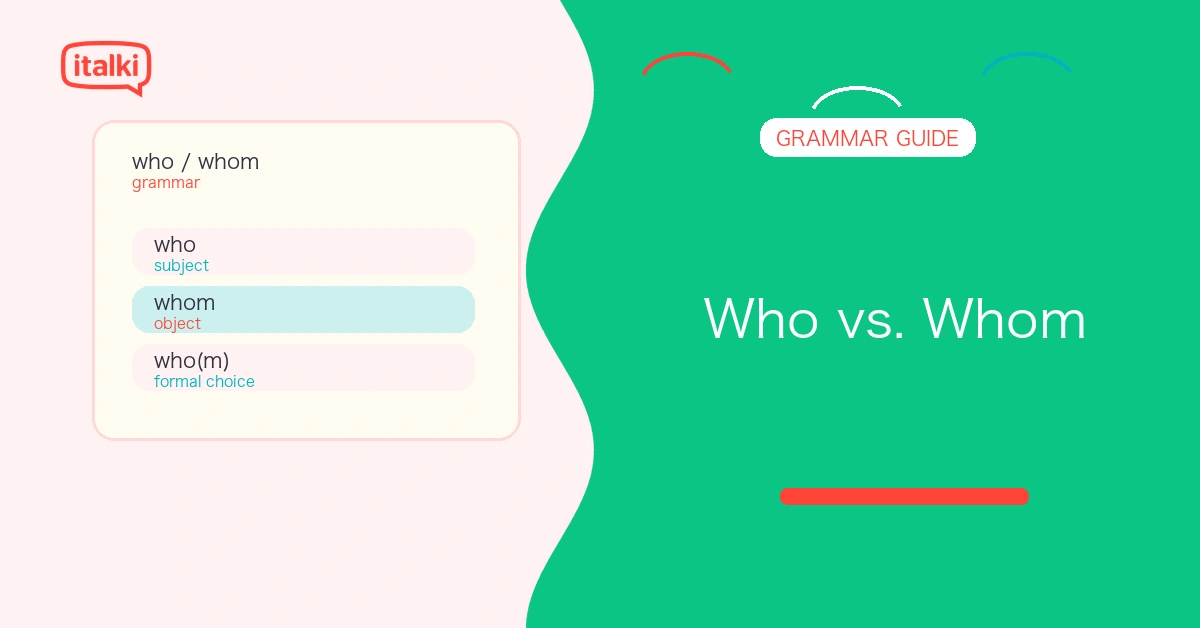
Who vs. whom: Who is the subject. Whom is the object.
- The colleague who helped me (who is the subject doing the helping)
- The colleague whom I thanked (whom is the object of my thanking)
Adverbs often sit inside clauses, so adverbs of manner can help with placement. Participle adjectives are also relevant because they often behave like shortened clause structures.
Adverbial clauses
An adverbial clause modifies a verb, an adjective, or an entire independent clause. It answers questions like when, where, why, how, under what condition, or to what extent.
Types of adverbial clauses:
| Type | Introduced by | Example |
|---|---|---|
| Time | when, while, after, before, as soon as, until | Call me when you arrive. |
| Reason | because, since, as | She left early because she had a flight. |
| Condition | if, unless, provided that, as long as | I’ll come unless it rains. |
| Concession | although, even though, while | Although he practised, he still struggled. |
| Purpose | so that, in order that | She spoke slowly so that everyone could follow. |
| Result | so…that, such…that | It was so cold that we went inside. |
| Comparison | as…as, than | She runs faster than I expected. |
| Place | where, wherever | Put it wherever there is space. |
Comma placement: When the adverbial clause comes before the main clause, use a comma: Because she was tired, she went home early. When it comes after, no comma is usually needed: She went home early because she was tired.
A private English tutor can review your own writing and identify which clause types you underuse or misuse, then create exercises targeting exactly those patterns.
Find your perfect teacher
Build real English confidence with personalized lessons from a teacher who matches your goals, schedule, and learning style.
Book a trial lesson
How clauses connect: conjunctions and punctuation
Understanding clause connection prevents two of the most common writing errors: comma splices and run-on sentences.
Coordinating conjunctions (FANBOYS: for, and, nor, but, or, yet, so): Join two independent clauses with a comma before the conjunction:
- She worked late, but she finished the report.
- Do NOT use a comma without a conjunction: She worked late, she finished the report.: this is a comma splice.
Subordinating conjunctions: Introduce dependent clauses. When the dependent clause comes first, use a comma after it:
- Although she was tired, she stayed until the end. (comma after dependent clause)
- She stayed until the end although she was tired. (no comma when dependent clause is second)
Semicolons: Join two closely related independent clauses without a conjunction:
- The meeting ran late; several people missed their trains.
- Never use a semicolon before a subordinating conjunction: She left; because she was tired.: wrong.
Common clause mistakes and how to fix them
1. Comma splice Using only a comma to join two independent clauses.
- Wrong: She finished the work, she sent it immediately.
- Fix: She finished the work, and she sent it immediately. / She finished the work; she sent it immediately. / After finishing the work, she sent it immediately.
2. Fragment A dependent clause treated as a complete sentence.
- Wrong: Although she studied all night. (No main clause)
- Fix: Although she studied all night, she did not pass. / She studied all night, although she still did not pass.
3. Run-on sentence Two independent clauses with no punctuation or conjunction between them.
- Wrong: The report was late nobody had been told about the deadline.
- Fix: The report was late because nobody had been told about the deadline. / The report was late. Nobody had been told about the deadline.
4. Misplaced relative clause A relative clause too far from the noun it modifies.
- Wrong: I saw a man in the park who was wearing a red hat walking his dog.
- Fix: I saw a man who was wearing a red hat walking his dog in the park. / In the park, I saw a man wearing a red hat and walking his dog.
5. Wrong relative pronoun Using that in a non-defining clause or which in a defining clause.
- Wrong: My colleague, that helped me with the project, is leaving next week.
- Fix: My colleague, who helped me with the project, is leaving next week.
Find your perfect teacher
Build real English confidence with personalized lessons from a teacher who matches your goals, schedule, and learning style.
Book a trial lesson
Improve your sentence structure with a teacher
Clauses are the building blocks of every sentence you write in English. Once you can identify them and connect them correctly, longer and more complex sentences become much less intimidating: and your writing becomes clearer and more professional.
The fastest way to improve is to have someone look at your actual writing, spot the recurring clause errors, and explain the fix in terms of your own sentences. Reading grammar rules is useful; applying them to your own work is where the improvement actually happens. italki has 30,000+ expert tutors trusted by over 10 million learners worldwide, including teachers who specialise in writing and grammar development. Book a trial lesson and bring a piece of your writing: that is the most efficient place to start.
Find your perfect teacher
Build real English confidence with personalized lessons from a teacher who matches your goals, schedule, and learning style.
Book a trial lesson
FAQ
What is the difference between a clause and a sentence?
A sentence is a complete unit of written language that begins with a capital letter and ends with a full stop. A sentence must contain at least one independent clause. A clause is the grammatical unit that contains a subject and a verb. One sentence can contain multiple clauses, and not all clauses can stand alone as sentences.
Can a clause be one word?
Technically, a clause needs both a subject and a verb. In certain contexts, the subject is implied: Go! is a one-word imperative sentence where you is the understood subject. Sit. Listen. These are complete clauses with an implied subject. Otherwise, a single noun or verb is a word, not a clause.
What is the difference between who and that in relative clauses?
Both can introduce relative clauses, but who is used for people and that is used for things (or informally for people in defining clauses). In formal writing, The person who called is preferred over The person that called. For non-defining clauses (with commas), who for people and which for things: My colleague, who joined last year… / The building, which was built in 1890…
Why do some sentences use commas before relative clauses and some do not?
The comma signals whether the clause is defining or non-defining. Defining clauses (no comma) identify which specific noun is meant. Non-defining clauses (with commas) add extra information about a noun already identified. The report that was submitted late (defining: which report?) vs. The report, which was submitted last week, has been approved (non-defining: we already know which report).
Want to learn a language at italki?
Here are the best resources for you!