Key takeaways
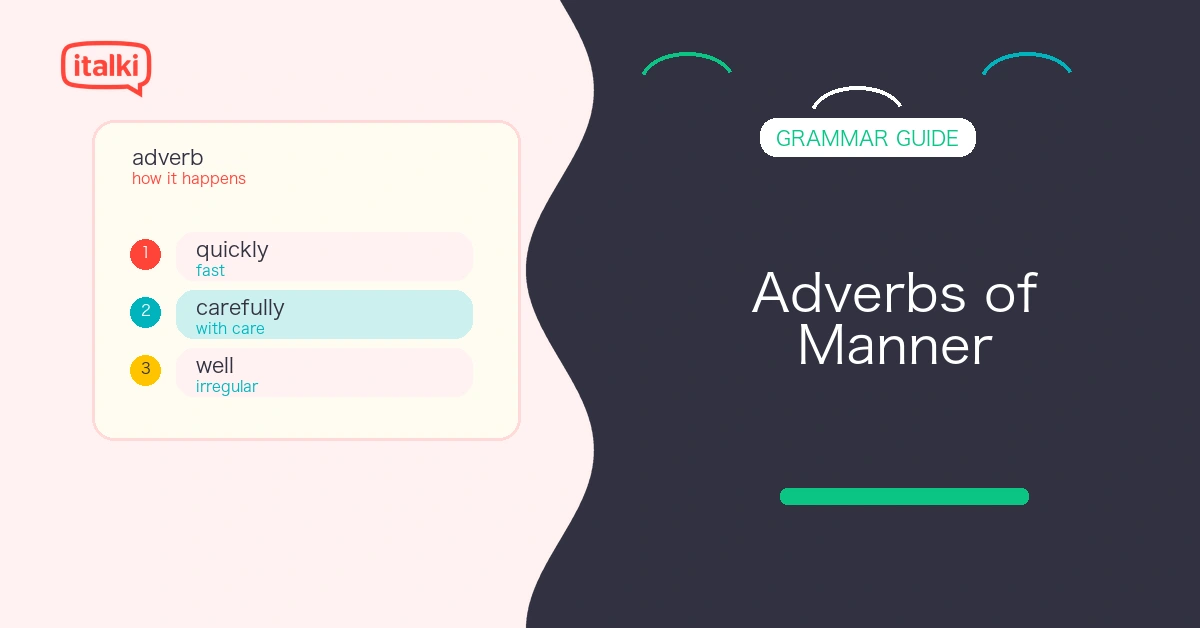
- Adverbs of manner describe how an action is performed. Most are formed by adding -ly to an adjective: quick – quickly, careful – carefully, quiet – quietly. They answer the question How? about a verb.
- Several common adverbs of manner are irregular: some have the same form as their adjective (fast, hard, early, late, straight), and good uses the completely different word well. Using good where well is needed is one of the most consistent grammar errors in English.
- Spelling changes apply when adding -ly to certain adjective endings: adjectives ending in -y change to -ily (happy – happily), adjectives ending in -le change to -ly by dropping the -e (gentle – gently), and adjectives ending in -ic add -ally (basic – basically).
- Adverbs of manner are typically placed after the main verb or after the object when one is present. They should not be placed between the verb and its object. They can appear at the beginning of a sentence for emphasis.
He played good vs He played well is the difference between a learner and a native speaker in a single word. Adverbs of manner are among the most frequently used grammatical structures in English, and using them correctly requires understanding both the formation rules and the placement conventions.
italki connects learners with English tutors who can help you use adverbs of manner naturally in real speech. This guide covers how adverbs of manner are formed, the spelling rules for -ly, irregular forms, placement rules, a full categorized list, and the most common mistakes to avoid.
Work with an English tutor online to practice adverbs of manner in real conversation and develop the natural feel for English sentence rhythm.

Find your perfect teacher
Build real English confidence with personalized lessons from a teacher who matches your goals, schedule, and learning style.
Book a trial lesson
What are adverbs of manner?
Adverbs of manner describe how an action is done. They modify verbs and answer the question How?
- She spoke quietly. (How did she speak? Quietly.)
- He worked hard. (How did he work? Hard.)
- The children sang beautifully. (How did they sing? Beautifully.)
- She finished the test quickly. (How did she finish? Quickly.)
Adverbs of manner are distinct from adverbs of frequency (always, never, sometimes), adverbs of time (yesterday, soon, already), and adverbs of place (here, there, somewhere). Adverbs of manner specifically address the quality or character of the action itself.
How to form adverbs of manner
The standard method is to add -ly to an adjective.
| Adjective | Adverb of manner |
|---|---|
| careful | carefully |
| quick | quickly |
| quiet | quietly |
| slow | slowly |
| loud | loudly |
| brave | bravely |
| calm | calmly |
| clear | clearly |
| eager | eagerly |
| fair | fairly |
| firm | firmly |
| free | freely |
| kind | kindly |
| neat | neatly |
| patient | patiently |
| polite | politely |
| proud | proudly |
| safe | safely |
| sharp | sharply |
| soft | softly |
| strong | strongly |
| warm | warmly |
| weak | weakly |
Most regular adjectives take -ly with no spelling change.
Find your perfect teacher
Build real English confidence with personalized lessons from a teacher who matches your goals, schedule, and learning style.
Book a trial lesson
Spelling rules when adding -ly
Some adjectives require a spelling change.
Adjectives ending in -y: change -y to -ily
| Adjective | Adverb |
|---|---|
| happy | happily |
| easy | easily |
| heavy | heavily |
| lazy | lazily |
| noisy | noisily |
| angry | angrily |
| busy | busily |
| greedy | greedily |
| lucky | luckily |
| merry | merrily |
Adjectives ending in -le: drop -e and add -y
| Adjective | Adverb |
|---|---|
| gentle | gently |
| simple | simply |
| possible | possibly |
| terrible | terribly |
| comfortable | comfortably |
| flexible | flexibly |
| reasonable | reasonably |
| reliable | reliably |
| sensible | sensibly |
Adjectives ending in -ic: add -ally
| Adjective | Adverb |
|---|---|
| basic | basically |
| dramatic | dramatically |
| automatic | automatically |
| fantastic | fantastically |
| realistic | realistically |
| scientific | scientifically |
| specific | specifically |
| tragic | tragically |
| enthusiastic | enthusiastically |
Exception: public – publicly (not publically).
Adjectives ending in -ll: add -y only
| Adjective | Adverb |
|---|---|
| full | fully |
| dull | dully |
Irregular adverbs of manner
Good – well The most important irregular adverb. Good is an adjective; well is the adverb of manner.
- She is a good writer. (adjective, describing the noun writer)
- She writes well. (adverb, describing how she writes)
Incorrect: She sings good. Correct: She sings well.
Note: Well can also function as an adjective meaning healthy: I am well today. Context makes the distinction clear.
Find your perfect teacher
Build real English confidence with personalized lessons from a teacher who matches your goals, schedule, and learning style.
Book a trial lesson
Adverbs of manner that share form with adjectives
Several very common adverbs of manner have exactly the same form as the corresponding adjective. The same word functions as either a noun modifier (adjective) or a verb modifier (adverb) depending on position.
| Word | As adjective | As adverb of manner |
|---|---|---|
| fast | a fast car | She runs fast. |
| hard | hard work | He studies hard. |
| early | an early start | She arrived early. |
| late | a late bus | He stayed late. |
| high | a high shelf | The bird flew high. |
| low | a low voice | Speak low. |
| straight | a straight road | Go straight ahead. |
| long | a long wait | He waited long. |
| right | the right answer | Turn right here. |
| wrong | the wrong answer | She got it wrong. |
Warning about hardly and lately: Adding -ly to some of these words creates forms with completely different meanings.
- Hardly means barely or scarcely: I can hardly hear you. It is not a variant of hard.
- Lately means recently: I haven’t seen her lately. It is not a variant of late.
These -ly forms are separate words, not adverbs of manner derived from the adjectives.
Common adverbs of manner by category
Speed and physical effort: quickly, slowly, rapidly, gradually, swiftly, suddenly, steadily, forcefully, energetically, smoothly, gently, roughly, cautiously, recklessly
Voice and communication: loudly, quietly, softly, clearly, fluently, vaguely, directly, honestly, briefly, bluntly, diplomatically, politely, rudely, formally, informally
Emotional quality: happily, sadly, angrily, anxiously, calmly, nervously, eagerly, enthusiastically, patiently, impatiently, confidently, shyly, bravely, fearfully, miserably, cheerfully
Physical movement: gracefully, awkwardly, carefully, heavily, lightly, swiftly, firmly, loosely, tightly, steadily
Thought and skill: cleverly, wisely, foolishly, deliberately, accidentally, instinctively, creatively, logically, precisely, accurately, skillfully, expertly, naturally
General manner: well, badly, perfectly, wonderfully, terribly, surprisingly, apparently, obviously, certainly, definitely, deeply, fully, partly, mainly, largely
Find your perfect teacher
Build real English confidence with personalized lessons from a teacher who matches your goals, schedule, and learning style.
Book a trial lesson
Placement in sentences
After the main verb (when there is no object):
- She dances gracefully.
- He spoke quietly.
- The children played noisily.
After the object (when one is present):
- She finished the test quickly.
- He explained the problem clearly.
- They completed the project efficiently.
Never between the verb and the object: Incorrect: She finished quickly the test. Correct: She finished the test quickly.
Incorrect: He explained clearly the problem. Correct: He explained the problem clearly. OR He clearly explained the problem.
At the beginning of the sentence (for emphasis):
- Slowly, she opened the door.
- Carefully, he lifted the box.
- Suddenly, the phone rang.
Front placement adds emphasis and is more common in formal or literary writing than in everyday speech.
Before a past participle in passive sentences:
- The package was carefully wrapped.
- The letter was hastily written.
- The rules were clearly explained.
Adverbs of manner modifying adjectives and other adverbs
Adverbs of manner can also modify adjectives and other adverbs, not just verbs. In these uses, the adverb appears immediately before the word it modifies.
- She is incredibly talented. (adverb modifying adjective)
- He drove dangerously fast. (adverb modifying adverb)
- The explanation was surprisingly clear. (adverb modifying adjective)
- She worked unbelievably hard. (adverb modifying adverb)
Common intensifying adverbs used this way: extremely, incredibly, surprisingly, remarkably, terribly, awfully, wonderfully, slightly, barely.
The guide to participle adjectives covers how adverbs like surprisingly and deeply interact with -ed and -ing adjectives in English.
Find your perfect teacher
Build real English confidence with personalized lessons from a teacher who matches your goals, schedule, and learning style.
Book a trial lesson
Common mistakes
Mistake 1: Using an adjective instead of an adverb Incorrect: She speaks English very good. Correct: She speaks English very well. The verb speaks needs an adverb, not an adjective. Well is the adverb form of good.
Mistake 2: Placing the adverb between the verb and its object Incorrect: She reads quickly books. Correct: She reads books quickly. OR She quickly reads books.
Mistake 3: Using fastly, hardly (to mean in a hard way), or lately (to mean in a late manner) Fastly does not exist. Use fast. He works hardly means he barely works. Use He works hard. She arrived lately sounds odd and does not mean in a late way. Use She arrived late.
Mistake 4: Applying -ly to flat adverbs unnecessarily Incorrect: She runs fastly. He came lately (when meaning in a late way). Correct: She runs fast. He came late.
Mistake 5: Forgetting the -y/-ily spelling change Incorrect: She answered the question angrily… wait this is correct. Let me give a different example: Incorrect: She spoke angrly. (wrong spelling) Correct: She spoke angrily. (angry – angrily)
Practice adverbs of manner with a tutor
The rules for forming adverbs of manner are learnable from a guide, but using them naturally in spoken English takes practice with real conversation. A tutor can catch adverb placement errors in real time, drill the irregular forms until they feel natural, and help you develop the rhythm of spoken English where adverbs fall in the right place without pausing to think.
italki’s 30,000+ expert tutors include native English speakers who specialize in grammar instruction and conversational English. Trusted by over 10 million learners worldwide, the platform lets you find a tutor who focuses on the grammar areas where you need the most practice. Book a trial lesson and start using adverbs of manner correctly in real English conversation.
Find your perfect teacher
Build real English confidence with personalized lessons from a teacher who matches your goals, schedule, and learning style.
Book a trial lesson
FAQ
What is an adverb of manner?
An adverb of manner describes how an action is performed. It answers the question How? about a verb. Most are formed by adding -ly to an adjective: careful – carefully, quick – quickly. Some are irregular: good – well, fast – fast, hard – hard.
How do you form an adverb of manner in English?
Add -ly to most adjectives: slow – slowly, calm – calmly. Apply spelling rules as needed: happy – happily (y – ily), gentle – gently (le – ly), basic – basically (ic – ically). Use well for the adverb of good. Some adjectives (fast, hard, early, late) are already adverbs of manner with no change.
Where do you place an adverb of manner in a sentence?
After the main verb if there is no object (She sang beautifully), or after the object if there is one (She sang the song beautifully). Do not place the adverb between the verb and its object. Adverbs of manner can also appear at the start of a sentence for emphasis: Carefully, he opened the box.
What is the adverb of good?
The adverb of good is well. Good is an adjective (a good singer). Well is the adverb of manner (she sings well). Saying She sings good is one of the most common grammar errors in English. Note that well can also be an adjective meaning healthy: I am well.
What is the difference between hard and hardly?
Hard as an adverb of manner means with great effort: He studies hard. Hardly is an entirely different word meaning scarcely or barely: I can hardly hear you. These are not related forms of the same word. Saying He studies hardly would mean he barely studies, the opposite of the intended meaning.
Want to learn a language at italki?
Here are the best resources for you!