Key takeaways
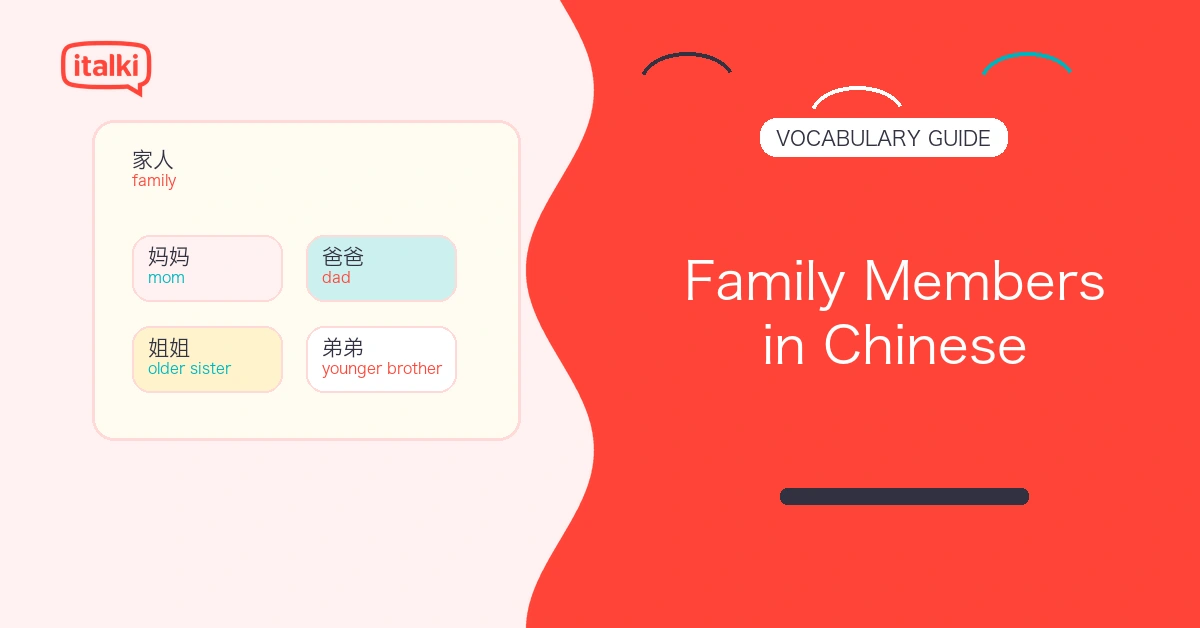
- Chinese family vocabulary is more specific than English: separate words exist for older vs. younger siblings, paternal vs. maternal grandparents, and your spouse’s parents vs. your own parents.
- 爸爸 (bàba, father) and 妈妈 (māma, mother) are informal; 父亲 (fùqīn, father) and 母亲 (mǔqīn, mother) are the formal equivalents used in writing and formal speech.
- Chinese distinguishes between 哥哥 (gēge, older brother), 弟弟 (dìdi, younger brother), 姐姐 (jiějie, older sister), and 妹妹 (mèimei, younger sister). There is no single word for sibling the way English uses brother or sister.
- Extended family vocabulary differs between paternal and maternal sides: 爷爷 (yéye, paternal grandfather) refers to your father’s father, while 外公 (wàigōng, maternal grandfather) refers to your mother’s father. These are two completely different words.
Chinese family vocabulary trips up learners for a specific reason: where English uses one word like grandfather or uncle, Chinese uses different words depending on whether the relative is on the father’s side or the mother’s side, and whether they are older or younger than your parent.
This is not complication for its own sake. It reflects how Chinese family relationships are organized and addressed in social life.
The good news is that the vocabulary follows clear patterns, and once you understand the logic of the paternal (父方 fù fāng) and maternal (母方 mǔ fāng) distinction, the extended family tree becomes much easier to navigate.
italki connects Chinese learners with native-speaking tutors who can walk you through family introductions and cultural context in a natural conversation. This guide covers immediate family, paternal grandparents and relatives, maternal grandparents and relatives, in-law vocabulary, and useful phrases for talking about your family in Chinese.
Find a Chinese language tutor and practice introducing your family members by name and relationship until the vocabulary comes naturally.

Find your perfect teacher
Build real speaking confidence with personalized lessons from a teacher who matches your goals, schedule, and learning style.
Book a trial lesson
Why chinese family terms are different from English
In English, grandfather covers both your father’s father and your mother’s father. Uncle covers all brothers of all your parents. Cousin covers all children of all aunts and uncles.
In Chinese, each of these distinctions has its own word. Your father’s father (爷爷 yéye) and your mother’s father (外公 wàigōng) are called by completely different names. Your father’s older brother (伯父 bófù) and your father’s younger brother (叔叔 shūshu) have separate titles. Your cousins on your father’s side (堂兄弟 táng xiōngdì) are called by different terms from your cousins on your mother’s side (表兄弟 biǎo xiōngdì).
This specificity exists because Chinese family structure traditionally distinguished between the patrilineal (father’s side) family line and the maternal relatives, with different social roles and obligations attached to each. Understanding this logic makes the vocabulary far easier to remember.
Work with a private Chinese tutor to practice the specific terms for your own family before trying to use them in conversation with native speakers.
Immediate family
| Chinese | Pinyin | English |
|---|---|---|
| 父亲 / 爸爸 | fùqīn / bàba | father (formal / informal) |
| 母亲 / 妈妈 | mǔqīn / māma | mother (formal / informal) |
| 父母 | fùmǔ | parents |
| 哥哥 | gēge | older brother |
| 弟弟 | dìdi | younger brother |
| 姐姐 | jiějie | older sister |
| 妹妹 | mèimei | younger sister |
| 兄弟姐妹 | xiōngdì jiěmèi | siblings (collective) |
| 丈夫 / 老公 | zhàngfu / lǎogōng | husband (formal / informal) |
| 妻子 / 老婆 | qīzi / lǎopó | wife (formal / informal) |
| 儿子 | érzi | son |
| 女儿 | nǚ’ér | daughter |
| 孩子 | háizi | child / children |
The informal terms 爸爸 (bàba) and 妈妈 (māma) are used in everyday speech and are the first words most learners encounter. The formal 父亲 (fùqīn) and 母亲 (mǔqīn) appear in writing, formal introductions, and respectful contexts.
There is no single Chinese word for sibling the way English uses it. Instead, you specify: 哥哥 (older brother), 弟弟 (younger brother), 姐姐 (older sister), 妹妹 (younger sister). The collective 兄弟姐妹 is used when referring to siblings as a group.
Find your perfect teacher
Build real speaking confidence with personalized lessons from a teacher who matches your goals, schedule, and learning style.
Book a trial lesson
Paternal grandparents and relatives
| Chinese | Pinyin | English |
|---|---|---|
| 爷爷 | yéye | paternal grandfather (father’s father) |
| 奶奶 | nǎinai | paternal grandmother (father’s mother) |
| 祖父 | zǔfù | paternal grandfather (formal) |
| 祖母 | zǔmǔ | paternal grandmother (formal) |
| 伯父 / 大伯 | bófù / dàbó | father’s older brother (uncle) |
| 叔叔 / 叔父 | shūshu / shūfù | father’s younger brother (uncle) |
| 姑姑 / 姑妈 | gūgu / gūmā | father’s sister (aunt) |
| 堂哥 | táng gē | paternal male cousin (older than you) |
| 堂弟 | táng dì | paternal male cousin (younger than you) |
| 堂姐 | táng jiě | paternal female cousin (older than you) |
| 堂妹 | táng mèi | paternal female cousin (younger than you) |
爷爷 (yéye) and 奶奶 (nǎinai) are the standard informal terms used throughout mainland China. 祖父 and 祖母 are formal equivalents used in writing and formal speech.
Paternal cousins use 堂 (táng) as a prefix plus the sibling term that indicates age: 堂哥 for a paternal male cousin older than you, 堂弟 for a paternal male cousin younger than you.
The distinction between your father’s older brother (伯父) and younger brother (叔叔) was important in traditional Chinese society and the different terms remain in use today.
Maternal grandparents and relatives
| Chinese | Pinyin | English |
|---|---|---|
| 外公 / 姥爷 | wàigōng / lǎoye | maternal grandfather (mother’s father) |
| 外婆 / 姥姥 | wàipó / lǎolao | maternal grandmother (mother’s mother) |
| 舅舅 / 舅父 | jiùjiu / jiùfù | mother’s brother (uncle) |
| 阿姨 / 姨妈 | āyí / yímā | mother’s sister (aunt) |
| 表哥 | biǎo gē | maternal male cousin (older than you) |
| 表弟 | biǎo dì | maternal male cousin (younger than you) |
| 表姐 | biǎo jiě | maternal female cousin (older than you) |
| 表妹 | biǎo mèi | maternal female cousin (younger than you) |
外公 (wàigōng) and 外婆 (wàipó) are the standard terms in mainland China for maternal grandparents. 姥爷 (lǎoye) and 姥姥 (lǎolao) are the equivalent Northern dialect terms (common in Beijing and northern China). Both sets are widely understood across China.
Maternal cousins use 表 (biǎo) as a prefix, in contrast to 堂 (táng) for paternal cousins. This 堂/表 distinction is one of the key vocabulary pairs to learn when you start talking about extended family.
阿姨 (āyí) is worth a special note: it means mother’s sister in the family vocabulary context, but it is also commonly used as a polite term of address for any adult woman of a similar age to your mother. Context makes the meaning clear.
Find your perfect teacher
Build real speaking confidence with personalized lessons from a teacher who matches your goals, schedule, and learning style.
Book a trial lesson
In-laws (spouse’s family)
| Chinese | Pinyin | English |
|---|---|---|
| 公公 | gōnggong | husband’s father (father-in-law) |
| 婆婆 | pópo | husband’s mother (mother-in-law) |
| 岳父 | yuèfù | wife’s father (father-in-law) |
| 岳母 | yuèmǔ | wife’s mother (mother-in-law) |
| 大伯子 | dàbózi | husband’s older brother (brother-in-law) |
| 小叔子 | xiǎoshūzi | husband’s younger brother (brother-in-law) |
| 大姑子 | dàgūzi | husband’s older sister (sister-in-law) |
| 小姑子 | xiǎogūzi | husband’s younger sister (sister-in-law) |
| 大舅子 | dàjiùzi | wife’s older brother (brother-in-law) |
| 小舅子 | xiǎojiùzi | wife’s younger brother (brother-in-law) |
| 大姨子 | dàyízi | wife’s older sister (sister-in-law) |
| 小姨子 | xiǎoyízi | wife’s younger sister (sister-in-law) |
公公 (gōnggong) and 婆婆 (pópo) are the woman’s terms for her husband’s parents. 岳父 (yuèfù) and 岳母 (yuèmǔ) are the man’s terms for his wife’s parents. These are two separate sets of vocabulary depending on who is speaking.
Formal vs. informal terms
For everyday family conversation, Chinese has pairs of formal and informal terms for the most common relationships. The informal terms are used in speech. The formal terms appear in writing, official documents, and respectful formal contexts.
| Relationship | Informal (spoken) | Formal (written / respectful) |
|---|---|---|
| Father | 爸爸 (bàba) | 父亲 (fùqīn) |
| Mother | 妈妈 (māma) | 母亲 (mǔqīn) |
| Paternal grandfather | 爷爷 (yéye) | 祖父 (zǔfù) |
| Paternal grandmother | 奶奶 (nǎinai) | 祖母 (zǔmǔ) |
| Husband | 老公 (lǎogōng) | 丈夫 (zhàngfu) |
| Wife | 老婆 (lǎopó) | 妻子 (qīzi) |
Find your perfect teacher
Build real speaking confidence with personalized lessons from a teacher who matches your goals, schedule, and learning style.
Book a trial lesson
How to talk about your family in chinese
Use these sentence patterns to introduce and describe family members. Substitute the relevant family term and details.
| Chinese | Pinyin | English |
|---|---|---|
| 这是我妈妈。 | Zhè shì wǒ māma. | This is my mother. |
| 这是我哥哥,他叫大明。 | Zhè shì wǒ gēge, tā jiào Dàmíng. | This is my older brother. His name is Daming. |
| 我有一个姐姐和两个弟弟。 | Wǒ yǒu yī gè jiějie hé liǎng gè dìdi. | I have one older sister and two younger brothers. |
| 我是独生子/女。 | Wǒ shì dúshēng zǐ/nǚ. | I am an only child. (male/female) |
| 我爷爷今年八十岁。 | Wǒ yéye jīnnián bāshí suì. | My paternal grandfather is eighty years old this year. |
| 我父母住在上海。 | Wǒ fùmǔ zhù zài Shànghǎi. | My parents live in Shanghai. |
| 你有兄弟姐妹吗? | Nǐ yǒu xiōngdì jiěmèi ma? | Do you have siblings? |
| 你家里有几口人? | Nǐ jiālǐ yǒu jǐ kǒu rén? | How many people are in your family? |
Note that Chinese uses the measure word 口 (kǒu) specifically when counting family members in a household: 四口人 (sì kǒu rén, four people in the family). This is one of the specialized Chinese measure words for counting family members together.
To practice talking about age in these sentences, knowing Chinese numbers is essential for saying how old your family members are.
Useful family phrases
| Chinese | Pinyin | English |
|---|---|---|
| 我来自一个大家庭。 | Wǒ láizì yī gè dà jiātíng. | I come from a large family. |
| 我们家有三代人住在一起。 | Wǒmen jiā yǒu sān dài rén zhù zài yīqǐ. | Three generations live together in our household. |
| 我和父母很亲近。 | Wǒ hé fùmǔ hěn qīnjìn. | I am very close to my parents. |
| 家人最重要。 | Jiārén zuì zhòngyào. | Family is the most important. |
| 这个周末我们要去外公外婆家。 | Zhège zhōumò wǒmen yào qù wàigōng wàipó jiā. | This weekend we are going to visit my maternal grandparents. |
Find your perfect teacher
Build real speaking confidence with personalized lessons from a teacher who matches your goals, schedule, and learning style.
Book a trial lesson
Practice family vocabulary in real conversation
Family vocabulary is one of the first things native Chinese speakers ask about in casual conversation: 你有兄弟姐妹吗? (Do you have siblings?) and 你家里有几口人? (How many people are in your family?) are standard early-conversation questions. Being able to answer these naturally, and ask them back, is a high-value skill for any Chinese learner.
A tutor can help you build a complete introduction of your own family in Chinese, check your tones on the kinship terms, and explain how Chinese family relationships work culturally. italki’s 30,000+ expert tutors include Chinese native speakers across all age groups and backgrounds who enjoy this kind of practical, personal conversation practice. Trusted by over 10 million learners worldwide, the platform makes it easy to find a tutor for regular weekly sessions. Book a trial lesson and spend the session describing your family and learning to ask about theirs.
Find your perfect teacher
Build real speaking confidence with personalized lessons from a teacher who matches your goals, schedule, and learning style.
Book a trial lesson
FAQ
Why does Chinese have different words for maternal and paternal grandparents?
The distinction reflects the traditional Chinese family structure, which organized society around the patrilineal family line. Your father’s parents (爷爷 and 奶奶) were part of your primary family unit; your mother’s parents (外公 and 外婆) were considered outside (外 wài means outside). The vocabulary encodes that social distinction, even as modern Chinese family life has become more equal between the two sides.
What is the difference between 堂 and 表 cousins?
堂 (táng) cousins are your cousins on your father’s side, meaning the children of your father’s brothers and sisters. 表 (biǎo) cousins are your cousins on your mother’s side, meaning the children of your mother’s brothers and sisters. Both sets add the specific older/younger and male/female sibling term: 堂哥 (táng gē, older male paternal cousin), 表妹 (biǎo mèi, younger female maternal cousin), etc.
Is 阿姨 always aunt?
No. 阿姨 (āyí, aunt) technically means your mother’s sister (aunt on the maternal side). But in everyday Chinese, it is commonly used as a polite address for any adult woman who is roughly your mother’s age or an older generation, such as a neighbor, a family friend, or a teacher’s spouse. Context makes the meaning clear.
How do I say my family in Chinese?
The most natural expression is 我家 (wǒ jiā, literally my home/household) or 我的家人 (wǒ de jiārén, my family members). 家庭 (jiātíng) is a slightly more formal word for family as a unit.
Do Chinese people use the same family terms to address people directly?
Yes. The kinship terms are used directly as forms of address: you would call your older brother 哥哥 directly (not by his name), your paternal grandmother 奶奶, and your uncle 叔叔. Using someone’s role in the family rather than their personal name is the norm in Chinese family address.
Want to learn a language at italki?
Here are the best resources for you!