Key takeaways
- French family vocabulary has separate words for many relationships that English collapses: grand-père (grandfather) vs. papi (grandpa), beau-père (stepfather OR father-in-law depending on context).
- Possessive adjectives in French agree with the noun they modify, not with the possessor: ma mère (my mother) but mon père (my father), and mon amie (my female friend) because amie begins with a vowel.
- The beau-/belle- prefix is used for both step-relatives and in-laws, which causes regular confusion for French learners.
- Talking about family is one of the most common conversation topics in French and one of the first contexts where learners encounter possessive adjectives, avoir constructions, and the vocabulary for numbers and ages.
Family is one of the earliest real conversation topics for French learners: introducing yourself, describing your background, asking about someone’s family, talking about where you’re from. It is also one of the first areas where grammar meets vocabulary in a practical way, because describing your family requires possessive adjectives (mon, ma, mes), and French possessive adjectives agree with the noun rather than the owner, which catches almost every English speaker.
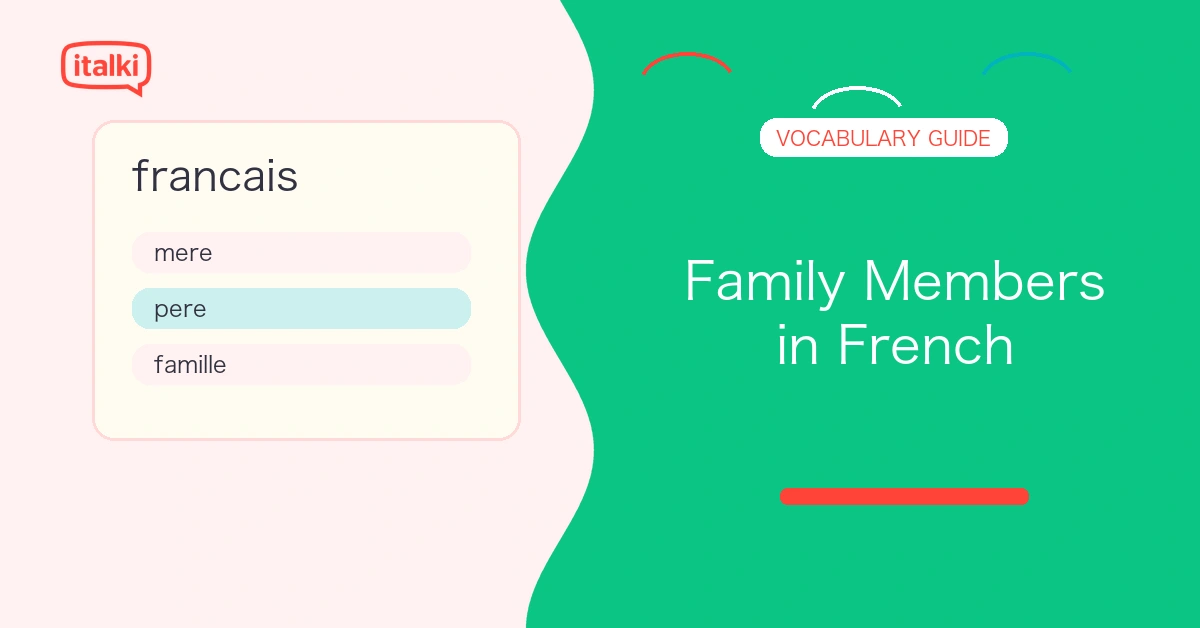
This guide covers 60+ French words for family members organised by relationship, possessive adjective rules with family vocabulary, key phrases for talking about your family, and cultural notes on French family life.
italki, which has connected 10M+ learners with teachers across 150+ languages since 2007, has French teachers who use personal topics like family as the starting point for conversation lessons, because talking about real people you know builds vocabulary and grammar at the same time. Find a French tutor and try a session where you describe your own family in French.

Find your perfect teacher
Build real French confidence with personalized lessons from a teacher who can help with speaking, exam prep, grammar, and pronunciation.

Immediate family vocabulary
| French | English | Gender note |
|---|---|---|
| la famille | family | feminine |
| les parents | parents (also: relatives) | masculine plural |
| le père | father | masculine |
| la mère | mother | feminine |
| le fils | son | masculine |
| la fille | daughter | feminine |
| le frère | brother | masculine |
| la sœur | sister | feminine |
| l’enfant | child | masculine or feminine |
| le bébé | baby | masculine (for all babies unless specifying) |
| les jumeaux / les jumelles | twins (m/f) | masculine / feminine |
| l’aîné/e | eldest child | masc./fem. |
| le cadet / la cadette | youngest child | masc./fem. |
| le mari | husband | masculine |
| la femme | wife (also: woman) | feminine |
| l’époux / l’épouse | spouse (husband/wife, formal) | masc./fem. |
| le conjoint / la conjointe | partner, spouse | masc./fem. |
| le compagnon / la compagne | partner (unmarried) | masc./fem. |
| le petit ami / la petite amie | boyfriend / girlfriend | masc./fem. |
A note on les parents: In French, les parents means “parents” in context but also means “relatives” or “family members” more broadly. Mes parents = my parents (mother and father) in everyday conversation, but un parent can also mean a relative in formal or literary use.
Extended family vocabulary
| French | English |
|---|---|
| le grand-père | grandfather |
| la grand-mère | grandmother |
| les grands-parents | grandparents |
| le petit-fils | grandson |
| la petite-fille | granddaughter |
| les petits-enfants | grandchildren |
| l’oncle | uncle |
| la tante | aunt |
| le neveu | nephew |
| la nièce | niece |
| le cousin / la cousine | cousin (m/f) |
| l’arrière-grand-père | great-grandfather |
| l’arrière-grand-mère | great-grandmother |
| l’arrière-petit-fils | great-grandson |
| l’arrière-petite-fille | great-granddaughter |
Plural note: les grands-parents (grandparents) hyphenates and both parts pluralise: grand-père → grands-pères. French compound family terms follow this hyphenation pattern: beaux-parents, petits-enfants.
Find your perfect teacher
Build real French confidence with personalized lessons from a teacher who can help with speaking, exam prep, grammar, and pronunciation.
In-laws and step-relatives
The beau-/belle- prefix causes frequent confusion because it covers both in-laws and step-relatives. Context usually clarifies which is meant.
In-laws
| French | English |
|---|---|
| le beau-père | father-in-law |
| la belle-mère | mother-in-law |
| le beau-fils | son-in-law |
| la belle-fille | daughter-in-law |
| le beau-frère | brother-in-law |
| la belle-sœur | sister-in-law |
| les beaux-parents | in-laws (parents) |
Step-relatives
| French | English |
|---|---|
| le beau-père | stepfather |
| la belle-mère | stepmother |
| le beau-fils / le fils adoptif | stepson |
| la belle-fille / la fille adoptive | stepdaughter |
| le demi-frère | half-brother / stepbrother |
| la demi-sœur | half-sister / stepsister |
Le beau-père can mean both “father-in-law” and “stepfather”; the relationship is clear from context (married partner’s father vs. mother’s new husband). For stepchildren specifically, beau-fils/belle-fille and fils/fille adoptif/adoptive are both used; demi-frère/sœur is the clearest term for half-siblings.
Working through these with a French teacher means practicing the vocabulary in the context of describing your own family tree, which is when the difference between in-laws and step-relatives becomes genuinely meaningful to the learner.
Informal and affectionate terms
These are the words French families actually use in conversation.
| Informal / affectionate | Formal equivalent | English |
|---|---|---|
| papa | le père | dad |
| maman | la mère | mum/mom |
| papi / papy | le grand-père | grandpa |
| mamie / mamy | la grand-mère | grandma |
| frérot | le frère | bro (very informal) |
| frangine | la sœur | sis (very informal) |
| tonton | l’oncle | uncle (child’s affectionate form) |
| tatie / tata | la tante | auntie (child’s affectionate form) |
| chéri/e | (none) | darling, sweetheart |
| mon amour | (none) | my love |
These informal terms are common in everyday spoken French and the forms a learner will hear in a French family environment. Knowing papi and mamie alongside grand-père and grand-mère is the difference between recognizing family references in normal speech and needing them spelled out.
Find your perfect teacher
Build real French confidence with personalized lessons from a teacher who can help with speaking, exam prep, grammar, and pronunciation.
Possessive adjectives with family vocabulary
French possessive adjectives agree with the noun they modify, not with the speaker. This is the most common grammar error with family vocabulary.
| Possessor | Masculine singular | Feminine singular | Plural |
|---|---|---|---|
| my | mon | ma | mes |
| your (tu) | ton | ta | tes |
| his/her | son | sa | ses |
| our | notre | notre | nos |
| your (vous) | votre | votre | vos |
| their | leur | leur | leurs |
Key rule for vowel-initial nouns: When a feminine noun begins with a vowel or silent h, ma/ta/sa become mon/ton/son to avoid the vowel clash.
- ma mère (my mother): normal agreement
- mon amie (my [female] friend): amie begins with a vowel, so mon not ma
The “his/her” ambiguity: French son/sa/ses means “his,” “her,” and “its”; the gender follows the noun, not the possessor.
- son père = his father / her father (depending on who the possessor is)
- sa mère = his mother / her mother
This ambiguity is resolved by context, not grammar. French speakers do not find it confusing; learners from English often do, because English distinguishes “his” from “her.”
For a complete treatment of adjective agreement patterns in French, the French adjectives guide covers the gender and number agreement rules that apply across vocabulary categories.
Phrases for talking about family
| French | English |
|---|---|
| J’ai deux frères et une sœur. | I have two brothers and one sister. |
| Je suis fils/fille unique. | I am an only child. |
| Je suis l’aîné(e) de la famille. | I’m the eldest in the family. |
| Je suis proche de ma famille. | I’m close to my family. |
| Ma famille vit en France. | My family lives in France. |
| Je vois mes grands-parents tous les dimanches. | I see my grandparents every Sunday. |
| Mes parents sont divorcés. | My parents are divorced. |
| J’ai grandi avec ma grand-mère. | I grew up with my grandmother. |
| On se réunit en famille pour Noël. | We get together as a family for Christmas. |
| Il me ressemble beaucoup. | He looks a lot like me. |
| Elle tient de sa mère. | She takes after her mother. |
| Nous sommes une famille nombreuse. | We are a large family. |
| C’est mon beau-frère. | This is my brother-in-law. |
Questions about someone’s family:
| French | English |
|---|---|
| Vous avez des enfants? | Do you have children? |
| Tu as des frères et sœurs? | Do you have siblings? |
| C’est votre famille? | Is this your family? |
| Vos parents vivent près d’ici? | Do your parents live near here? |
| Comment s’appelle ta sœur? | What is your sister’s name? |
Find your perfect teacher
Build real French confidence with personalized lessons from a teacher who can help with speaking, exam prep, grammar, and pronunciation.
Family-related verbs
| French | English |
|---|---|
| s’appeler | to be called / named |
| ressembler à | to look like, to resemble |
| tenir de | to take after |
| se marier (avec) | to get married (to) |
| divorcer | to get divorced |
| avoir des enfants | to have children |
| attendre un bébé | to be expecting a baby |
| élever ses enfants | to raise one’s children |
| grandir | to grow up |
| vieillir | to grow old |
| perdre quelqu’un | to lose someone (death) |
| se retrouver en famille | to get together as a family |
| réunir la famille | to bring the family together |
Cultural notes on French family life
Le repas familial: Shared meals are central to French family culture. Sunday lunch (le déjeuner du dimanche) brings extended family together regularly, particularly for grandparents. The phrase on va chez mes parents dimanche (we’re going to my parents’ on Sunday) implies a large shared meal.
La famille recomposée: Blended families (les familles recomposées) are common and openly discussed in French. The vocabulary for step- and half-relatives (beau-père, demi-sœur) therefore comes up frequently in everyday conversation.
Vous vs. tu: Adult family members use tu with each other. In more formal or older families, children might use vous with grandparents or much older relatives, but this is increasingly uncommon. Using tu with a French person’s family is generally expected once you know each other.
Les prénoms: French names often reflect family patterns: naming after grandparents, religious names, and regional names are all common. Knowing that Jean is the grandfather’s name when you meet someone called Jean-Baptiste is the kind of cultural reading that comes from speaking with French native speakers.
Find your perfect teacher
Build real French confidence with personalized lessons from a teacher who can help with speaking, exam prep, grammar, and pronunciation.
Building family vocabulary into real conversation
Family vocabulary is one of the first things learners can actually use in a meaningful conversation: describing their own family, asking about someone else’s, talking about how they grew up. That early conversational payoff makes it one of the most motivating vocabulary sets to work on.
italki has 30,000+ teachers across 150+ languages, including French teachers who structure early lessons around personal topics like family, precisely because the vocabulary is immediately useful and the grammar (possessives, avoir, être) supports everything else that follows.
Learn French faster with personal guidance from qualified French teachers trusted by over 10 million learners worldwide. Book a trial lesson with a online French tutor today.
Find your perfect teacher
Build real French confidence with personalized lessons from a teacher who can help with speaking, exam prep, grammar, and pronunciation.
FAQ
How do you say “brother” and “sister” in French?
Le frère (brother) and la sœur (sister). Collectively, siblings are les frères et sœurs. To say “I have a brother and a sister”: J’ai un frère et une sœur.
What is the difference between beau-père as father-in-law and stepfather?
Both meanings use the same word. Context determines which: if you are speaking about your spouse’s father, beau-père means father-in-law. If you are speaking about your mother’s husband who is not your biological father, beau-père means stepfather.
Why does ma become mon before some feminine nouns?
French avoids two vowel sounds running together. Before a feminine noun beginning with a vowel or silent h, the feminine possessives ma, ta, sa become the masculine forms mon, ton, son: mon amie (not ma amie), mon école (not ma école).
How do you say “only child” in French?
Je suis fils unique (male) or je suis fille unique (female). No article is used: not je suis un fils unique.
What is les beaux-parents in French?
Les beaux-parents means “in-laws” (specifically, the spouse’s parents) or in a blended family, “step-parents.” Which meaning applies depends on context: if speaking about your spouse’s family, it means in-laws; if describing a parent’s new partner, it means step-parents.
Want to learn a language at italki?
Here are the best resources for you!