Key takeaways:
- French family vocabulary follows gender rules that change articles and adjectives (mon père, ma mère)
- Possessive adjectives in French match the gender of the family member, not the speaker
- French culture values formal introductions and specific relationship terms that English often glosses over
- Real conversations with native speakers help you learn natural family expressions faster than textbooks alone
- What is the French family vocabulary you need to know?
- How do you talk about your family in French?
- French vocabulary for romantic relationships
- How do possessive adjectives work with family members?
- What cultural differences should you know about French families?
- How can you practice French family vocabulary effectively?
- FAQ
French for family opens doors to meaningful connections with French-speaking relatives, in-laws, or partners. Whether you’re preparing to meet your partner’s French family, reconnecting with French-speaking heritage, or planning extended time in a French-speaking country, knowing how to discuss family relationships matters.
This guide gives you practical french family vocabulary and phrases for real situations. You’ll learn the terms French people actually use, understand the grammar patterns, and pick up cultural context. Working with French tutors helps you practice these conversations before they happen in real life.

What is the French family vocabulary you need to know?
French family vocabulary starts with immediate relatives and extends to extended family, in-laws, and step-relations. The core terms appear in daily conversations.
Core family terms:
| French | Pronunciation | English |
| la famille | lah fah-mee | family |
| les parents | lay pah-rahn | parents |
| le père | luh pehr | father |
| la mère | lah mehr | mother |
| le fils | luh fees | son |
| la fille | lah fee-yuh | daughter |
| le frère | luh frehr | brother |
| la sœur | lah suhr | sister |
| le mari | luh mah-ree | husband |
| la femme | lah fahm | wife |
| l’enfant | lahn-fahn | child |
Extended family:
| French | Pronunciation | English |
| les grands-parents | lay grahn-pah-rahn | grandparents |
| le grand-père | luh grahn-pehr | grandfather |
| la grand-mère | lah grahn-mehr | grandmother |
| l’oncle | lohnkl | uncle |
| la tante | lah tahnt | aunt |
| le cousin/la cousine | luh koo-zahn/lah koo-zeen | cousin |
| le neveu | luh nuh-vuh | nephew |
| la nièce | lah nyess | niece |
| le petit-fils | luh puh-tee fees | grandson |
| la petite-fille | lah puh-teet fee-yuh | granddaughter |
| les petits-enfants | lay puh-tee zahn-fahn | grandchildren |
In-laws and step-family:
| French | Pronunciation | English |
| le beau-père | luh boh-pehr | father-in-law/stepfather |
| la belle-mère | lah behl-mehr | mother-in-law/stepmother |
| le beau-frère | luh boh-frehr | brother-in-law |
| la belle-sœur | lah behl-suhr | sister-in-law |
| le demi-frère | luh duh-mee frehr | half-brother |
| la demi-sœur | lah duh-mee suhr | half-sister |
Protip: The prefix “beau-” (beautiful) is used for both in-laws and step-relations, which can cause confusion. Context usually makes the meaning clear, but you can specify “belle-mère par alliance” (mother-in-law by marriage) or “belle-mère de remariage” (stepmother from remarriage) if needed.
Idiomatic expressions:
- Tel père, tel fils – Like father, like son
- Les chiens ne font pas des chats – The apple doesn’t fall far from the tree (literally: dogs don’t make cats)
- C’est de famille – It runs in the family
- Être comme les deux doigts de la main – To be as thick as thieves (literally: to be like two fingers of the hand)
How do you talk about your family in French?
You talk about your family in French using “ma famille” and possessive adjectives that match each family member’s gender. Start with:
- “Dans ma famille, il y a…” (In my family, there are…) or
- “J’ai…” (I have…) followed by family members.
French grammar focuses on the family member’s gender, not yours. You say “mon père” whether you’re male or female because “père” is masculine. Everyone says “ma mère” because “mère” is feminine.
Introducing your family
| French | Pronunciation | English |
| Dans ma famille, il y a… | dahn mah fah-mee, eel yah | In my family, there are… |
| J’ai deux frères et une sœur | zhay duh frehr ay oon suhr | I have two brothers and one sister |
| Je suis fils/fille unique | zhuh swee fees/fee-yuh oo-neek | I’m an only child |
| Je viens d’une famille nombreuse | zhuh vyahn doon fah-mee nohm-bruhz | I come from a large family |
| Mes parents sont mariés/divorcés | may pah-rahn sohn mah-ryay/dee-vor-say | My parents are married/divorced |
| J’ai grandi avec mes grands-parents | zhay grahn-dee ah-vehk may grahn-pah-rahn | I grew up with my grandparents |
| Je suis l’aîné(e) | zhuh swee lay-nay | I’m the oldest |
| Je suis le/la benjamin(e) | zhuh swee luh/lah behn-zhah-mehn | I’m the youngest |
| Voici ma famille | vwah-see mah fah-mee | This is my family |
| Je te présente mon frère, Thomas | zhuh tuh pray-zahnt mohn frehr, Thomas | I’d like you to meet my brother, Thomas |
| Permettez-moi de vous présenter mes parents | pehr-meh-tay mwah duh voo pray-zahn-tay may pah-rahn | Allow me to introduce my parents |
Example conversation:
- Dans ma famille, il y a cinq personnes.
- J’ai deux sœurs et un frère.
- Mes parents habitent encore à Lyon.
French speakers often include where family members live as part of standard introductions.
Describing family members
Talk about personality, appearance, and what your family members do. If you need French for Business vocabulary to describe professional occupations, that guide covers workplace terms in detail.
| French | Pronunciation | English |
| Mon père travaille comme médecin | mohn pehr trah-vah-yuh cohm mayd-sahn | My father works as a doctor |
| Ma mère enseigne l’anglais | mah mehr ahn-sehn-yuh lahn-glay | My mother teaches English |
| Mon frère est étudiant | mohn frehr ay tay-too-dyahn | My brother is a student |
| Ma sœur est très gentille | mah suhr ay treh zhahn-tee-yuh | My sister is very kind |
| Il/Elle ressemble à mon père | eel/ehl ruh-sahmbl ah mohn pehr | He/She looks like my father |
| Mon grand-père est à la retraite | mohn grahn-pehr ay tah lah ruh-treht | My grandfather is retired |
| Ma grand-mère a 75 ans | mah grahn-mehr ah swah-sahnt-kahnz ahn | My grandmother is 75 years old |
| Mon oncle habite à Paris | mohn ohnkl ah-beet ah pah-ree | My uncle lives in Paris |
| Ma tante est très drôle | mah tahnt ay treh drohl | My aunt is very funny |
| Mes cousins sont jumeaux | may koo-zahn sohn zhoo-moh | My cousins are twins |
| Il/Elle a les yeux bleus | eel/ehl ah lay zyuh bluh | He/She has blue eyes |
| Il/Elle est grand(e) et mince | eel/ehl ay grahn ay mahnss | He/She is tall and thin |
| Mon fils a 10 ans | mohn fees ah deez ahn | My son is 10 years old |
| Ma fille est en première année | mah fee-yuh ay tahn pruh-myehr ah-nay | My daughter is in first grade |
| Mes enfants vont à l’école | may zahn-fahn vohn ah lay-kohl | My children go to school |
Talking about family dynamics
Express relationships and interactions within the family.
| French | Pronunciation | English |
| Nous sommes très proches | noo sohm treh prohsh | We’re very close |
| On s’entend bien | ohn sahn-tahn byahn | We get along well |
| On se ressemble beaucoup | ohn suh ruh-sahmbl boh-koo | We look very similar |
| Il/Elle me manque | eel/ehl muh mahnk | I miss him/her |
| Nous nous voyons souvent | noo noo vwah-yohn soo-vahn | We see each other often |
| C’est mon bras droit | say mohn brah drwah | He’s/She’s my right-hand person |
| Mes parents me soutiennent | may pah-rahn muh soo-tyehn | My parents support me |
| Mon frère m’énerve parfois | mohn frehr may-nehrv pahr-fwah | My brother annoys me sometimes |
| Ma sœur et moi sommes complices | mah suhr ay mwah sohm cohm-pleess | My sister and I are close/partners in crime |
| J’ai une bonne relation avec ma belle-famille | zhay oon bohn ruh-lah-syohn ah-vehk mah behl-fah-mee | I have a good relationship with my in-laws |
| Mes grands-parents me gâtent | may grahn-pah-rahn muh gaht | My grandparents spoil me |
Common questions people ask about family
Conversation starters and how to respond naturally.
| French | Pronunciation | English |
| Parlez-moi de votre famille | pahr-lay mwah duh voh-truh fah-mee | Tell me about your family |
| Avez-vous des frères et sœurs? | ah-vay voo day frehr ay suhr | Do you have brothers and sisters? |
| Combien d’enfants avez-vous? | kohm-byahn dahn-fahn ah-vay voo | How many children do you have? |
| Où habitent vos parents? | oo ah-beet voh pah-rahn | Where do your parents live? |
| Êtes-vous proche de votre famille? | eht voo prohsh duh voh-truh fah-mee | Are you close to your family? |
| Que font vos parents? | kuh fohn voh pah-rahn | What do your parents do? |
| Vos enfants vont à quelle école? | voh zahn-fahn vohn ah kehl ay-kohl | What school do your children attend? |
| Vous ressemblez à qui dans la famille? | voo ruh-sahmb-lay ah kee dahn lah fah-mee | Who do you look like in the family? |
Talking about family events and gatherings
Discuss celebrations, traditions, visits, and special occasions. For birthday wishes in French, that guide covers all the variations you’ll need.
| French | Pronunciation | English |
| Nous fêtons Noël en famille | noo feh-tohn noh-ehl ahn fah-mee | We celebrate Christmas as a family |
| C’est l’anniversaire de ma mère | say lah-nee-vehr-sehr duh mah mehr | It’s my mother’s birthday |
| Nous allons rendre visite à mes parents | noo zah-lohn rahn-druh vee-zeet ah may pah-rahn | We’re going to visit my parents |
| Ma famille se réunit tous les dimanches | mah fah-mee suh ray-oo-nee too lay dee-mahnsh | My family gathers every Sunday |
| On organise un repas de famille | ohn ohr-gah-neez uhn ruh-pah duh fah-mee | We’re organizing a family meal |
| C’est une tradition familiale | say toon trah-dee-syohn fah-mee-lee-ahl | It’s a family tradition |
| Mes cousins viennent pour les vacances | may koo-zahn vyehn poor lay vah-kahns | My cousins are coming for the holidays |
| Nous faisons une réunion de famille | noo fuh-zohn oon ray-oo-nyohn duh fah-mee | We’re having a family reunion |
| Ma grand-mère prépare le dîner | mah grahn-mehr pray-pahr luh dee-nay | My grandmother is preparing dinner |
| Toute la famille sera là | toot lah fah-mee suh-rah lah | The whole family will be there |
| On célèbre le baptême de mon neveu | ohn say-lehbr luh bah-tehm duh mohn nuh-vuh | We’re celebrating my nephew’s baptism |
| C’est le mariage de ma sœur | say luh mah-ryahzh duh mah suhr | It’s my sister’s wedding |
Cultural context: French families treat shared meals as important social rituals. Sunday lunch often involves multiple generations and lasts several hours. Arriving on time, bringing a small gift (wine, flowers, chocolates), and staying throughout the meal shows respect.
Practice these scenarios with French tutors who can correct your mistakes and teach you the natural phrases French people use in real conversations.

Find Your Perfect Teacher
At italki, you can find your French tutor from all qualified and experienced teachers. Now experience the excellent language learning journey!
Book a trial lesson
French vocabulary for romantic relationships

French vocabulary for romantic relationships covers dating, marriage, and social connections. These phrases help you discuss everything from first dates to introducing your partner to family.
Dating and relationships
How French people call their lovers
French terms of endearment go far beyond the basics listed here, offering dozens of affectionate nicknames.
| French | Pronunciation | English |
| Mon amour | mohn nah-moor | My love |
| Mon cœur | mohn kuhr | My heart |
| Mon chéri/Ma chérie | mohn shay-ree/mah shay-ree | My dear/darling |
| Mon bébé | mohn bay-bay | My baby |
| Ma puce | mah pooss | My flea (affectionate) |
| Mon ange | mohn ahnzh | My angel |
| Doudou | doo-doo | Sweetie |
| Ma belle/Mon beau | mah behl/mohn boh | My beautiful one |
Dating phrases
| French | Pronunciation | English |
| Tu veux sortir avec moi? | too vuh sohr-teer ah-vehk mwah | Do you want to go out with me? |
| On pourrait aller prendre un verre | ohn poo-ray ah-lay prahn-druh uhn vehr | We could go for a drink |
| Tu me plais beaucoup | too muh play boh-koo | I like you a lot |
| J’aimerais mieux te connaître | zheh-muh-ray myuh tuh koh-neh-truh | I’d like to get to know you better |
| On se revoit quand? | ohn suh ruh-vwah kahn | When will we see each other again? |
| Tu es libre ce week-end? | too ay lee-bruh suh week-end | Are you free this weekend? |
| Je passe te chercher à 20h | zhuh pahss tuh shehr-shay ah vahn-tuhr | I’ll pick you up at 8pm |
| C’était une belle soirée | say-tay oon behl swah-ray | It was a nice evening |
In-a-relationship phrases
| French | Pronunciation | English |
| On sort ensemble depuis six mois | ohn sohr tahn-sahmbl duh-pwee see mwah | We’ve been dating for six months |
| C’est mon copain/ma copine | say mohn koh-pahn/mah koh-peen | He’s my boyfriend/She’s my girlfriend |
| C’est mon compagnon/ma compagne | say mohn kohm-pah-nyohn/mah kohm-pahn-yuh | He’s my partner/She’s my partner |
| Je t’aime | zhuh tehm | I love you |
| Tu me manques | too muh mahnk | I miss you |
| On habite ensemble | ohn nah-beet ahn-sahmbl | We live together |
| C’est sérieux entre nous | say say-ryuh ahn-truh noo | It’s serious between us |
| On est faits l’un pour l’autre | ohn ay fay luhn poor loh-truh | We’re made for each other |
Breakup phrases
| French | Pronunciation | English |
| On doit parler | ohn dwah pahr-lay | We need to talk |
| Je pense qu’on devrait se séparer | zhuh pahnss kohn duh-vray suh say-pah-ray | I think we should separate |
| Ce n’est plus comme avant | suh nay ploo cohm ah-vahn | It’s not like before anymore |
| On a besoin de faire une pause | ohn ah buh-zwahn duh fehr oon pohz | We need to take a break |
| C’est fini entre nous | say fee-nee ahn-truh noo | It’s over between us |
Marriage and commitment
| French | Pronunciation | English |
| Veux-tu m’épouser? | vuh too may-poo-zay | Will you marry me? |
| On va se fiancer | ohn vah suh fee-ahn-say | We’re going to get engaged |
| C’est mon fiancé/ma fiancée | say mohn fee-ahn-say/mah fee-ahn-say | He’s my fiancé/She’s my fiancée |
| Nous allons nous marier | noo zah-lohn noo mah-ryay | We’re going to get married |
| C’est mon mari/ma femme | say mohn mah-ree/mah fahm | He’s my husband/She’s my wife |
| C’est mon époux/mon épouse | say mohn nay-poo/mohn nay-pooz | He’s my spouse/She’s my spouse |
| Nous sommes mariés depuis 10 ans | noo sohm mah-ryay duh-pwee deez ahn | We’ve been married for 10 years |
| On célèbre notre anniversaire de mariage | ohn say-lehbr noh-truh ah-nee-vehr-sehr duh mah-ryahzh | We’re celebrating our wedding anniversary |
| Nous attendons un enfant | noo zah-tahn-dohn uhn ahn-fahn | We’re expecting a child |
| On fonde une famille | ohn fohnd oon fah-mee | We’re starting a family |
| C’est le père/la mère de mes enfants | say luh pehr/lah mehr duh may zahn-fahn | He’s/She’s the father/mother of my children |
| Nous renouvelons nos vœux | noo ruh-noo-vuh-lohn noh vuh | We’re renewing our vows |
Family connections in romantic contexts
Understanding in-laws and step-family terms helps you discuss complex family situations.
| French | Pronunciation | English |
| Je rencontre mes beaux-parents ce week-end | zhuh rahn-kohnt may boh-pah-rahn suh week-end | I’m meeting my in-laws this weekend |
| C’est ma belle-mère | say mah behl-mehr | She’s my mother-in-law/stepmother |
| C’est mon beau-père | say mohn boh-pehr | He’s my father-in-law/stepfather |
| Mon beau-frère habite à Lyon | mohn boh-frehr ah-beet ah lee-ohn | My brother-in-law lives in Lyon |
| J’ai une bonne relation avec ma belle-famille | zhay oon bohn ruh-lah-syohn ah-vehk mah behl-fah-mee | I have a good relationship with my in-laws |
| Je te présente à mes parents | zhuh tuh pray-zahnt ah may pah-rahn | I’m introducing you to my parents |
| Mes parents aimeraient te rencontrer | may pah-rahn ay-muh-ray tuh rahn-kohn-tray | My parents would like to meet you |
| C’est sérieux, je veux que tu rencontres ma famille | say say-ryuh, zhuh vuh kuh too rahn-kohnt mah fah-mee | It’s serious, I want you to meet my family |
Cultural context: When meeting your partner’s family, start with “vous” (formal you) and wait for them to invite you to use “tu.” This invitation might take months or even years depending on the family.
Friendship and social networks
French distinguishes between different levels of friendship more precisely than English.
| French | Pronunciation | English |
| C’est mon meilleur ami/ma meilleure amie | say mohn meh-yuhr ah-mee/mah meh-yuhr ah-mee | He’s/She’s my best friend |
| C’est un(e) ami(e) proche | say tuh(n) ah-mee prohsh | He’s/She’s a close friend |
| C’est un copain/une copine | say tuhn koh-pahn/oon koh-peen | He’s/She’s a friend |
| C’est une connaissance | say toon koh-neh-sahnss | He’s/She’s an acquaintance |
| C’est mon collègue/ma collègue | say mohn koh-lehg/mah koh-lehg | He’s/She’s my colleague |
| C’est le parrain/la marraine de mon fils | say luh pah-rahn/lah mah-rehn duh mohn fees | He’s/She’s my son’s godfather/godmother |
| C’est mon mentor | say mohn mahn-tohr | He’s/She’s my mentor |
| On se connaît depuis l’enfance | ohn suh koh-nay duh-pwee lahn-fahnss | We’ve known each other since childhood |
How do possessive adjectives work with family members?
Possessive adjectives in French match the gender and number of the family member, not the gender of the person speaking. The word “my” changes to “mon,” “ma,” or “mes” depending on what you’re talking about, not who you are.
The three forms of “my”:
- mon – before masculine singular nouns (mon père, mon frère, mon fils)
- ma – before feminine singular nouns (ma mère, ma sœur, ma fille)
- mes – before plural nouns of any gender (mes parents, mes frères, mes sœurs)
Exception: Use “mon” instead of “ma” before feminine nouns starting with a vowel. Example: “mon épouse” (my wife) in formal contexts.
Complete possessive adjective chart:
| Person | Masculine | Feminine | Plural |
| my | mon père | ma mère | mes parents |
| your (informal) | ton père | ta mère | tes parents |
| his/her/its | son père | sa mère | ses parents |
| our | notre père | notre mère | nos parents |
| your (formal/plural) | votre père | votre mère | vos parents |
| their | leur père | leur mère | leurs parents |
Key insight: “son père” means both “his father” and “her father.” French doesn’t distinguish the speaker’s gender in possessive adjectives like English does with “his” and “her.”
Practice examples:
- Mon frère et ma sœur habitent à Paris (My brother and my sister live in Paris)
- Mes grands-parents viennent dimanche (My grandparents are coming Sunday)
- Sa famille est très grande (His/Her family is very large)
- Notre père travaille à l’étranger (Our father works abroad)
What cultural differences should you know about French families?
French families maintain stronger formal boundaries than many English-speaking cultures. Understanding these differences helps you avoid social missteps.
Key cultural points:
- Vous vs. tu: Always use “vous” (formal you) with a partner’s parents or in-laws until they explicitly invite you to use “tu.” This invitation might take months or years. Wait for them to say “On peut se tutoyer” (We can use tu with each other).
- Family meals: Sunday lunch often involves multiple generations and lasts several hours. Arrive on time, bring a small gift (wine, flowers, chocolates), and stay at the table throughout the meal.
- Privacy matters: French culture values privacy more than cultures where asking about jobs, salaries, or relationship status is normal small talk. Stick to safe topics like food, wine, regional culture, or travel when first meeting a family.
- Regional variations: Southern French families (Provence, Occitanie) tend to be warmer and more demonstrative with physical affection like “faire la bise” (cheek kissing). Northern French families may be more reserved.
- Blended families: Modern French families include many step-parents, half-siblings, and complex custody arrangements. The vocabulary (beau-père, belle-mère, demi-frère) gets used frequently and discussed matter-of-factly.
- Elder care: French families often keep aging parents at home longer than is common in the US or UK. Asking about grandparents’ health is a standard conversation topic.
Find Your Perfect Teacher
At italki, you can find your French tutor from all qualified and experienced teachers. Now experience the excellent language learning journey!
Book a trial lesson
How can you practice French family vocabulary effectively?
You practice French family vocabulary effectively through repeated conversations about your actual family, not just memorizing word lists. Real practice means describing your family members, their relationships to each other, and the dynamics between them in natural French.
Create a family tree in French:
Draw your family tree and label every person with their French relationship term. Practice describing relationships: “Marie est la sœur de mon père, donc c’est ma tante” (Marie is my father’s sister, so she’s my aunt). This visual tool helps you internalize the vocabulary through spatial relationships.
Record yourself talking about your family:
Spend 2-3 minutes describing your family in French, then listen back. You’ll catch mistakes in gender agreement, possessive adjectives, and pronunciation that you miss while speaking. Do this weekly and compare recordings to track improvement.
Use your family in example sentences:
Instead of textbook examples like “My father is tall,” create real sentences: “Mon père travaille comme médecin et ma mère enseigne l’anglais” (My father works as a doctor and my mother teaches English). Personal examples stick in memory better than generic ones.
Practice with native speakers:
Conversation practice with online French tutors gives you feedback on natural phrasing that sounds right to native ears. A tutor catches mistakes like saying “ma famille se compose de” (my family is composed of) when native speakers would say “dans ma famille, il y a” (in my family, there are). These subtle differences separate textbook French from conversational French.
The best way to learn French combines structured practice with real conversations, giving you both accuracy and fluency.
Ask about their families too:
Learning works both ways. Ask your tutor or conversation partner “Parlez-moi de votre famille” (Tell me about your family) and listen for the phrases and structures they use naturally. This gives you authentic models to copy.
Use family photos as prompts:
Keep family photos on your phone and practice describing who’s who in French: “Voici ma grand-mère maternelle avec ses trois filles” (This is my maternal grandmother with her three daughters). Visual prompts make abstract vocabulary concrete.
For more structured support, explore French learning resources that complement your conversation practice.
Protip: Focus on the 20-30 family terms you’ll actually use for your specific family situation rather than memorizing every possible relationship term. If you don’t have cousins, don’t spend time on that vocabulary. If you have a large extended family, that’s where you need depth.
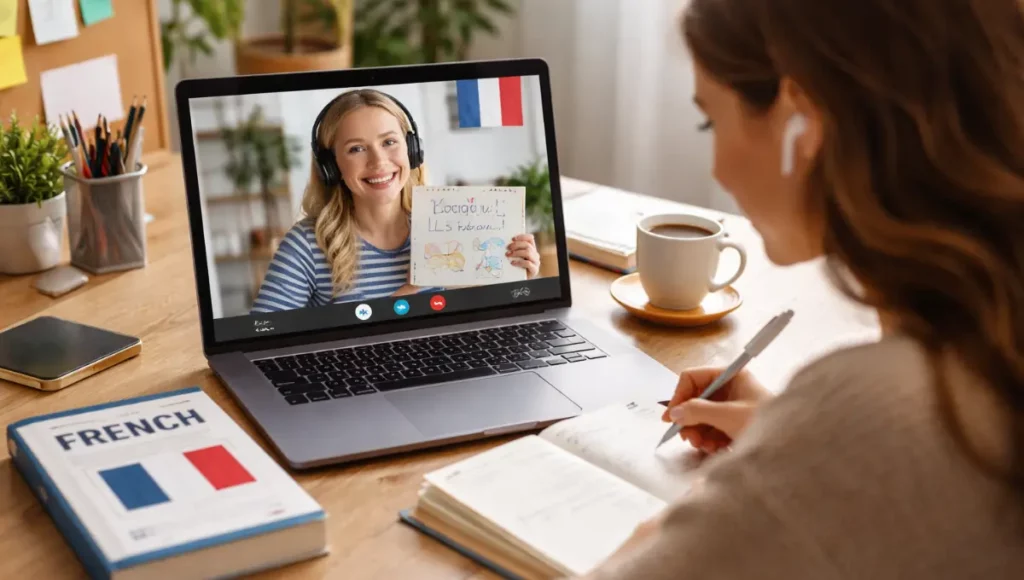
Learn French faster with personal guidance from expert French tutors trusted by over 5 million learners worldwide. Book a trial lesson today and practice talking about your family with a native speaker who can correct your possessive adjectives and teach you the phrases French people use.
FAQ
How would you say family in French?
“Family” in French is “la famille” (pronounced lah fah-mee). It’s a feminine noun, so you always use the feminine article “la.” To talk about your family, say “ma famille” (my family) or “Dans ma famille, il y a…” (In my family, there are…).
Is it le famille or la famille?
It’s “la famille” (feminine), never “le famille.” The word “famille” is always feminine in French, so it takes the feminine article “la.” This applies to all forms: “la famille,” “une famille,” “ma famille,” “ta famille.”
Are there slang terms for family in French?
Yes, French has several informal terms for family. “La fam” is youth slang for family. “Les vieux” (literally “the old ones”) informally means parents. “Frérot” and “frangine” are casual terms for brother and sister. “Mes darons” is slang for “my parents.” These terms work among friends but avoid them in formal contexts or when meeting someone’s family for the first time.
Want to learn a language at italki?
Here are the best resources for you!