Key takeaways
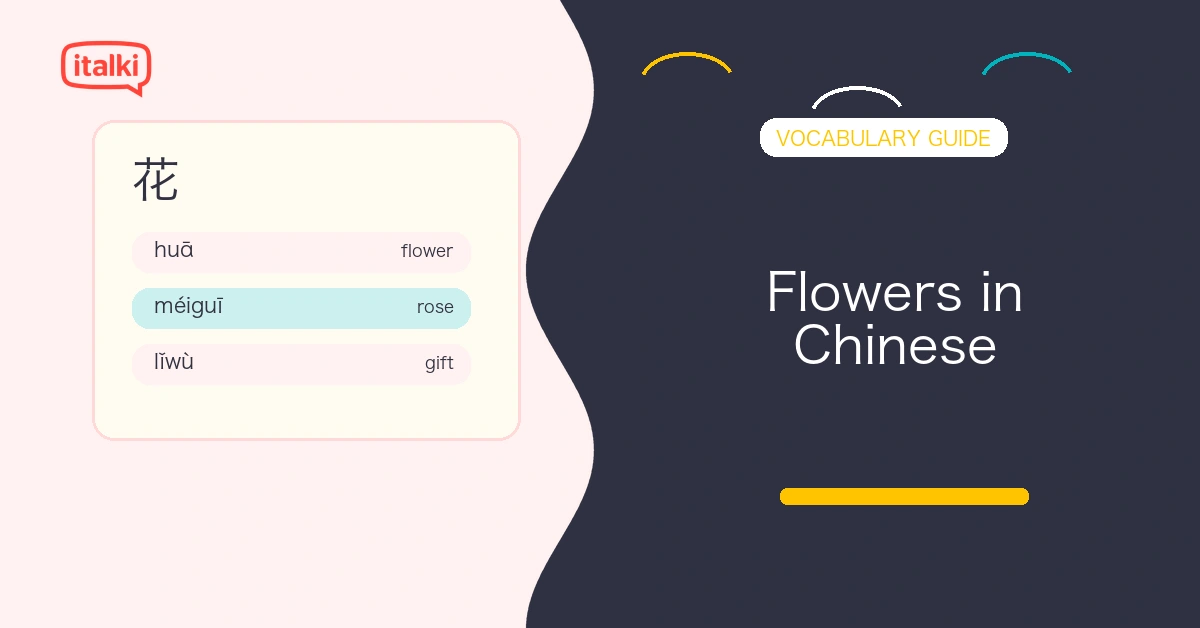
- The word for flower in Chinese is 花 (huā). It appears as a standalone word and as a component in most flower names: 玫瑰花 (méiguīhuā, rose), 菊花 (júhuā, chrysanthemum), 荷花 (héhuā, lotus flower). Recognizing this character immediately identifies a word as flower-related.
- Flowers carry strong symbolic meaning in Chinese culture. The plum blossom (梅花, méihuā) symbolizes perseverance in adversity; the lotus (莲花/荷花, liánhuā/héhuā) represents purity; the peony (牡丹, mǔdān) represents wealth and honor. Knowing these associations is as important as knowing the vocabulary for navigating Chinese cultural contexts.
- China has a national flower: the plum blossom (梅花, méihuā) holds this status in Taiwan, while the peony (牡丹, mǔdān) is widely considered China’s national flower on the mainland. Both flowers appear throughout traditional art, poetry, and festivals.
- Flowers are given as gifts in China for many occasions, but color and number matter. Red roses (红玫瑰, hóng méiguī) signal romance. Yellow flowers are associated with death and mourning in some contexts. An even number of flowers can be associated with funerals; odd numbers are typically preferred for celebratory occasions.
The Chinese character 花 (huā) appears in flower names, in phrases for spending money (花钱, huāqián, to spend money), in descriptions of patterns, and in names of places and people. Learning flower vocabulary in Chinese opens a window into cultural symbolism, poetry, and seasonal celebrations that are central to Chinese identity.
Understanding which flowers to give, when to give them, and what they mean is the kind of cultural knowledge that prevents misunderstanding and signals genuine cultural awareness. italki connects you with Chinese teachers who can explain these cultural layers alongside the vocabulary, giving you context that a word list alone cannot provide.
This guide covers flowers in Chinese across four sections: common flower names with their characters, cultural symbolism, flowers in practical phrases and gift-giving, and key vocabulary for describing flowers.
A Chinese tutor can work through seasonal flower themes with you, connecting vocabulary to poetry, festival traditions, and everyday conversations about beauty and nature in Chinese culture.

Find your perfect teacher
Build real speaking confidence with personalized lessons from a teacher who matches your goals, schedule, and learning style.

How to say flower in Chinese
The word for flower is 花 (huā). It is both a standalone noun and a component that appears in most specific flower names.
| Chinese | Pinyin | English |
|---|---|---|
| 花 | huā | flower (general) |
| 一朵花 | yī duǒ huā | one flower (量词 duǒ = measure word for flowers) |
| 一束花 | yī shù huā | a bouquet of flowers |
| 鲜花 | xiānhuā | fresh flowers |
| 野花 | yěhuā | wild flower |
| 假花 | jiǎhuā | artificial flower |
| 花瓶 | huāpíng | vase (literally flower bottle) |
| 花园 | huāyuán | garden (literally flower garden) |
| 花店 | huādiàn | flower shop |
| 开花 | kāihuā | to bloom (literally to open flowers) |
The measure word for individual flowers is 朵 (duǒ): 一朵玫瑰 (yī duǒ méiguī) = one rose. For a bunch or bouquet, use 束 (shù): 一束鲜花 (yī shù xiānhuā) = a bouquet of fresh flowers.
Common flowers in Chinese
| Chinese | Pinyin | English |
|---|---|---|
| 玫瑰 / 玫瑰花 | méiguī / méiguīhuā | rose |
| 荷花 / 莲花 | héhuā / liánhuā | lotus flower |
| 菊花 | júhuā | chrysanthemum |
| 梅花 | méihuā | plum blossom |
| 桃花 | táohuā | peach blossom |
| 樱花 | yīnghuā | cherry blossom |
| 牡丹 | mǔdān | peony |
| 兰花 | lánhuā | orchid |
| 向日葵 | xiàngrìkuí | sunflower (literally facing-sun flower) |
| 郁金香 | yùjīnxiāng | tulip |
| 百合 | bǎihé | lily |
| 薰衣草 | xūnyīcǎo | lavender |
| 茉莉 | mòlì | jasmine |
| 水仙 | shuǐxiān | narcissus / daffodil (literally water immortal) |
| 桂花 | guìhuā | osmanthus |
| 丁香 | dīngxiāng | lilac |
| 杜鹃花 | dùjuānhuā | azalea |
| 紫藤 | zǐténg | wisteria |
| 雏菊 | chújú | daisy |
| 睡莲 | shuìlián | water lily |
A Chinese teacher can introduce these flower names through poetry and seasonal context, connecting the vocabulary to the Spring Festival, Mid-Autumn Festival, and other occasions where specific flowers appear in traditional culture.
Find your perfect teacher
Build real speaking confidence with personalized lessons from a teacher who matches your goals, schedule, and learning style.
Flowers and their cultural meanings
| Flower | Chinese | Cultural meaning |
|---|---|---|
| Plum blossom | 梅花 (méihuā) | Perseverance, courage, resilience in winter; one of the Three Friends of Winter (岁寒三友) |
| Lotus | 莲花/荷花 (liánhuā/héhuā) | Purity, enlightenment, emerging clean from mud; associated with Buddhism |
| Chrysanthemum | 菊花 (júhuā) | Longevity, nobility; celebrated in the Double Ninth Festival (重阳节); also associated with mourning in some contexts |
| Peony | 牡丹 (mǔdān) | Wealth, honor, prosperity; often called the king of flowers (花中之王) |
| Orchid | 兰花 (lánhuā) | Nobility, refinement, virtue; one of the Four Gentlemen (四君子) |
| Bamboo (not a flower but often grouped) | 竹 (zhú) | Integrity, humility, resilience; also part of the Four Gentlemen |
| Osmanthus | 桂花 (guìhuā) | Romance, family reunion, autumn; associated with the Moon Festival (中秋节) and mooncakes |
| Jasmine | 茉莉 (mòlì) | Purity, grace; famously associated with the folk song 茉莉花 (Jasmine Flower) |
Gift-giving note: In Chinese culture, chrysanthemums (菊花) are typically associated with mourning and funerals and should not be given as a gift in celebratory contexts. Yellow flowers in general can carry mourning associations in some regions. Red and pink flowers are appropriate for most celebratory and romantic occasions.
Counting matters: Odd numbers of flowers are preferred for celebratory occasions; even numbers can be associated with funerals.
Like flowers, fruit is a common gift in Chinese culture with its own symbolic meanings and gifting rules. The guide to fruits in Chinese covers the vocabulary and cultural associations that determine which fruits to give and when.
Flowers in practice: gift-giving and phrases
| Chinese | Pinyin | English |
|---|---|---|
| 我想买一束花。 | wǒ xiǎng mǎi yī shù huā. | I would like to buy a bouquet. |
| 你喜欢什么花? | nǐ xǐhuān shénme huā? | What flowers do you like? |
| 这些花送给你。 | zhèxiē huā sòng gěi nǐ. | These flowers are for you. |
| 花店在哪里? | huādiàn zài nǎlǐ? | Where is the flower shop? |
| 这朵花叫什么? | zhè duǒ huā jiào shénme? | What is this flower called? |
| 玫瑰代表爱情。 | méiguī dàibiǎo àiqíng. | Roses represent love. |
| 樱花很美。 | yīnghuā hěn měi. | Cherry blossoms are beautiful. |
| 这种花在中国有什么意思? | zhè zhǒng huā zài zhōngguó yǒu shénme yìsi? | What does this flower mean in China? |
Find your perfect teacher
Build real speaking confidence with personalized lessons from a teacher who matches your goals, schedule, and learning style.
Describing flowers in Chinese
| Chinese | Pinyin | English |
|---|---|---|
| 美丽 | měilì | beautiful |
| 芬芳 / 香 | fēnfāng / xiāng | fragrant |
| 鲜艳 | xiānyàn | vivid, brightly colored |
| 盛开 | shèngkāi | in full bloom |
| 凋谢 | diāoxiè | wilted, faded |
| 含苞待放 | hán bāo dài fàng | about to bloom (bud stage) |
| 花瓣 | huābàn | petal |
| 花蕊 | huāruǐ | stamen / pistil |
| 花茎 | huājīng | stem |
| 颜色 | yánsè | color |
Common sentence patterns:
- 这朵玫瑰很香 (zhè duǒ méiguī hěn xiāng): This rose is very fragrant.
- 樱花盛开的时候真的很美 (yīnghuā shèngkāi de shíhou zhēn de hěn měi): Cherry blossoms are truly beautiful when they are in full bloom.
- 莲花出淤泥而不染 (liánhuā chū yūní ér bù rǎn): The lotus emerges from the mud without being tainted. (A famous saying about the lotus’s symbolic purity.)
Practice Chinese vocabulary with a teacher
Flower names in Chinese connect to poetry, festivals, gift-giving customs, and everyday aesthetic conversation. Understanding them fully requires cultural context, not just word lists.
With 30,000+ tutors across languages and tens of millions of learners on the platform, italki has Chinese teachers who bring cultural knowledge and language instruction together in every lesson. Book a trial lesson and ask your teacher to walk you through flower symbolism in Chinese culture, connecting each flower name to the context where it appears and the meaning it carries.
Find your perfect teacher
Build real speaking confidence with personalized lessons from a teacher who matches your goals, schedule, and learning style.
FAQ
How do you say flower in Chinese?
The word for flower in Chinese is 花 (huā). It appears as a standalone word and as a component in specific flower names. To say a flower, use 一朵花 (yī duǒ huā), where 朵 (duǒ) is the measure word for individual flowers. A bouquet is 一束花 (yī shù huā).
How do you say flower in Chinese characters?
The Chinese character for flower is 花. In Simplified Chinese (used in mainland China and Singapore), it is written 花. In Traditional Chinese (used in Taiwan and Hong Kong), it is also written 花. This is one of the characters that is the same in both systems. The character is pronounced huā in Mandarin (first tone, high and flat).
How do you say rose in Chinese?
Rose in Chinese is 玫瑰 (méiguī) or more fully 玫瑰花 (méiguīhuā). Red roses (红玫瑰, hóng méiguī) are associated with romantic love in Chinese culture. To say a rose, use 一朵玫瑰 (yī duǒ méiguī).
What flower is most associated with Chinese culture?
The plum blossom (梅花, méihuā) and the peony (牡丹, mǔdān) are both deeply associated with Chinese culture. The peony is often considered the national flower of China (mainland) and symbolizes wealth and honor. The plum blossom symbolizes perseverance through hardship and is a common subject in Chinese painting and poetry. The lotus (莲花, liánhuā) is significant in Buddhist contexts and classical Chinese literature.
Are there flowers I should avoid giving as gifts in China?
Yes. Chrysanthemums (菊花, júhuā) and yellow flowers are associated with mourning and funerals in many regions and should not be given as celebratory gifts. White flowers also carry mourning associations in some contexts. Red and pink flowers are appropriate for most positive occasions. When in doubt, ask a teacher or local contact, as regional customs can vary.
Want to learn a language at italki?
Here are the best resources for you!