Key takeaways
- French heteronyms are words with the same spelling but different pronunciations and meanings, such as fils, plus, tous, and est.
- The fastest clue is context. Look at the words before and after the spelling, especially articles, pronouns, and verb subjects.
- Some French heteronyms follow patterns, especially adjective or noun forms ending in nasal sounds and verb forms ending in silent letters.
- Practicing these pairs with a French tutor catches the tiny differences self-study misses, especially /s/ in plus and tous, nasal vowels in fils and président, and /sjɔ̃/ versus /tjɔ̃/ in words ending in -ions.
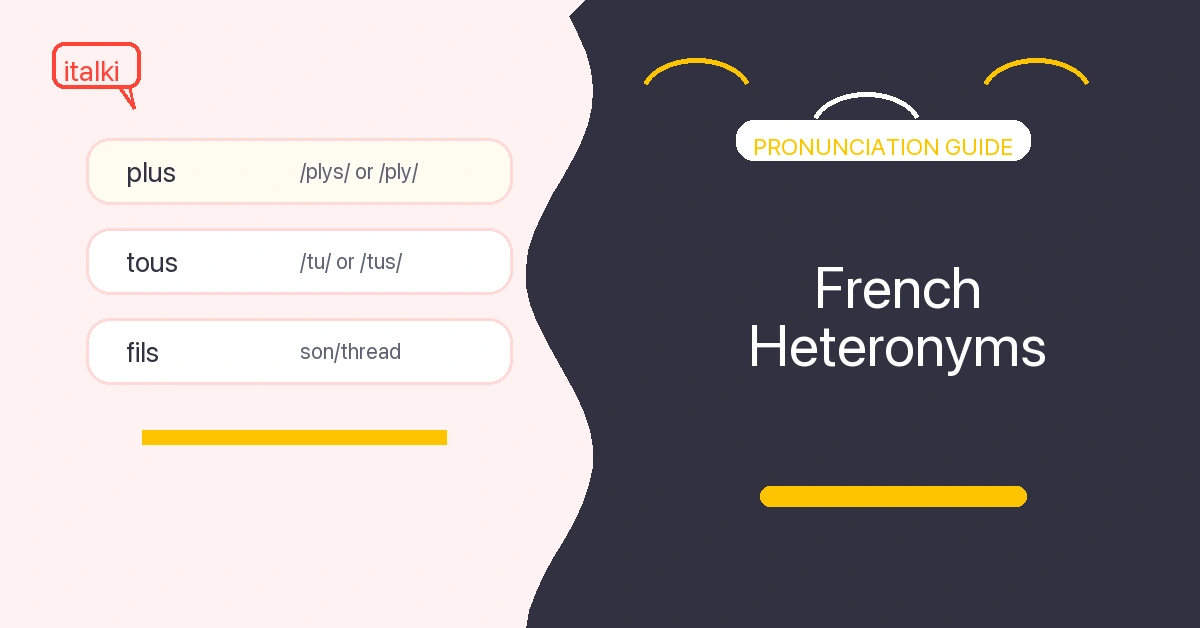
French heteronyms look harmless on the page, then cause trouble the moment someone says them out loud. A word like plus changes from /plys/ to /ply/ or /plyz/ depending on meaning and the next sound, while fils means “son” as /fis/ and “threads” as /fil/.
Because these differences reveal themselves mainly in speech, practicing with a live teacher makes a real difference. italki has helped over 10 million learners work on exactly this kind of pronunciation challenge with teachers who correct in real time, not after the fact.
Pronounce the pairs below in short dialogues, then test them with a teacher who hears which final letters, nasal vowels, and liaisons need correction.

Find Your Perfect Teacher
Build real French confidence with personalized lessons from a teacher who can help with speaking, exam prep, grammar, and pronunciation.

What are French heteronyms?
French heteronyms are same-spelling words with different pronunciations and different meanings. In French, many come from silent final letters, nasal vowels, verb endings, and liaison.
A simple pair shows the idea:
- fils /fis/ means “son,” as in mon fils (my son).
- fils /fil/ means “threads” or “wires,” as in des fils électriques (electric wires).
The spelling alone gives no full answer. The surrounding sentence tells you which word you have.
Heteronyms bring together two pronunciation topics that learners usually study separately: silent letters from the French alphabet and nasal sounds from French vowels. With heteronyms, the final letter sometimes stays silent and sometimes returns.
A practical rule helps: do not pronounce a word from spelling first. Read the sentence, identify the grammar, then say the word.
Find Your Perfect Teacher
Build real French confidence with personalized lessons from a teacher who can help with speaking, exam prep, grammar, and pronunciation.
Which everyday French heteronyms should beginners learn first?
Start with heteronyms that appear in daily speech. These words show up in greetings, directions, food orders, family talk, and simple opinions.
| French spelling | Pronunciation | Meaning | Example |
|---|---|---|---|
| fils | /fis/ | son | Mon fils arrive demain. (My son arrives tomorrow.) |
| fils | /fil/ | threads, wires | Les fils sont trop courts. (The wires are too short.) |
| est | /ɛ/ | is | Il est ici. (He is here.) |
| est | /ɛst/ | east | L’est de la France est beau. (Eastern France is beautiful.) |
| sens | /sɑ̃s/ | meaning, direction | Quel est le sens de ce mot? (What is the meaning of this word?) |
| sens | /sɑ̃/ | feel, smell, sense | Je sens le café. (I smell the coffee.) |
| vis | /vis/ | screw | Il manque une vis. (A screw is missing.) |
| vis | /vi/ | live | Je vis à Marseille. (I live in Marseille.) |
| as | /a/ | have (2nd person singular) | Tu as raison. (You are right.) |
| as | /as/ | ace, expert | C’est un as du piano. (He is a piano expert.) |
| fier | /fjɛʁ/ | proud | Elle est fière de son travail. (She is proud of her work.) |
| fier | /fje/ | to trust, in se fier à | Il faut se fier aux faits. (One has to trust the facts.) |
| couvent | /kuvɑ̃/ | convent | Le couvent est ancien. (The convent is old.) |
| couvent | /kuv/ | they brood, they hatch | Les poules couvent les œufs. (The hens brood over the eggs.) |
Notice how grammar marks the difference. Mon fils points to a person. Les fils points to plural objects. Il est is a verb phrase. L’est has an article, so it names a direction.
Reading these pairs out loud is where most self-study falls short. A French language tutor can stop you at the exact syllable where your pronunciation drifts and model the correct sound in real time.
Find Your Perfect Teacher
Build real French confidence with personalized lessons from a teacher who can help with speaking, exam prep, grammar, and pronunciation.
Which French heteronyms change because of final -ent?
A very useful group pairs adjectives or nouns ending in a nasal vowel with third-person plural verbs where -ent is silent. The spelling is identical, but the grammar changes the sound.
| French spelling | Pronunciation | Meaning | Example |
|---|---|---|---|
| content | /kɔ̃tɑ̃/ | happy | Il est content. (He is happy.) |
| content | /kɔ̃t/ | they contain | Ils contiennent une surprise. (They contain a surprise.) |
| excellent | /ɛkselɑ̃/ | excellent | C’est un excellent repas. (It is an excellent meal.) |
| excellent | /ɛksɛl/ | they excel | Elles excellent en maths. (They excel in math.) |
| violent | /vjɔlɑ̃/ | violent | C’est un geste violent. (It is a violent gesture.) |
| violent | /vjɔl/ | they violate | Ils violent la règle. (They violate the rule.) |
| négligent | /neɡliʒɑ̃/ | careless, negligent | Un travail négligent. (Careless work.) |
| négligent | /neɡliʒ/ | they neglect | Elles négligent les détails. (They neglect the details.) |
| président | /pʁezidɑ̃/ | president, chairperson | Le président parle. (The president speaks.) |
| président | /pʁezid/ | they preside over | Ils président la réunion. (They preside over the meeting.) |
The grammar gives the answer before pronunciation. If the word follows un, une, le, la, or a noun it describes, expect the nasal ending /ɑ̃/. If it follows ils or elles as a verb, the written -ent goes silent.
These pairs also explain why grammar and pronunciation belong together. How to learn French grammar is not only about verb tables; it also trains the ear to hear the difference between un président and ils président.
Find Your Perfect Teacher
Build real French confidence with personalized lessons from a teacher who can help with speaking, exam prep, grammar, and pronunciation.
Which -ions heteronyms change from /sjɔ̃/ to /tjɔ̃/?
Many words ending in -ions have two possible readings: a noun ending in /sjɔ̃/ and a verb form (the nous imperfect) ending in /tjɔ̃/. The spelling stays the same, but the sound shifts in the middle.
| French spelling | Pronunciation | Meaning | Example |
|---|---|---|---|
| portions | /pɔʁsjɔ̃/ | portions (noun) | Deux portions de soupe. (Two portions of soup.) |
| portions | /pɔʁtjɔ̃/ | we were carrying/wearing (verb) | Nous portions des manteaux. (We were wearing coats.) |
| notions | /nosjɔ̃/ | notions, ideas (noun) | Des notions de base. (Basic ideas.) |
| notions | /nɔtjɔ̃/ | we were noting down (verb) | Nous notions les réponses. (We were noting the answers.) |
| adoptions | /adɔpsjɔ̃/ | adoptions (noun) | Les adoptions sont longues. (Adoptions take time.) |
| adoptions | /adɔptjɔ̃/ | we were adopting (verb) | Nous adoptions une autre méthode. (We were adopting another method.) |
| inventions | /ɛ̃vɑ̃sjɔ̃/ | inventions (noun) | De grandes inventions. (Great inventions.) |
| inventions | /ɛ̃vɑ̃tjɔ̃/ | we were inventing (verb) | Nous inventions des histoires. (We were inventing stories.) |
| actions | /aksjɔ̃/ | actions, shares (noun) | Des actions en bourse. (Shares on the stock market.) |
| actions | /aktjɔ̃/ | we were acting (verb) | Nous actions vite en cas d’urgence. (We acted quickly in emergencies.) |
The noun pronunciation /sjɔ̃/ is the one learners expect from words like nation /nasjɔ̃/. The verb pronunciation /tjɔ̃/ comes from the imperfect nous form, where the -t- of the stem stays audible: porter gives nous portions, noter gives nous notions, inventer gives nous inventions.
A helpful reading test: if a number, article, or adjective appears before the word, it is usually a noun (deux portions, des notions, de grandes inventions). If nous appears before it, it is a verb (nous portions, nous notions, nous inventions).
Hearing yourself attempt the /sjɔ̃/ to /tjɔ̃/ switch is harder than it seems. A French teacher can ask you to read both versions back to back and tell you whether your tongue is actually making the distinction or blurring the two together.
Find Your Perfect Teacher
Build real French confidence with personalized lessons from a teacher who can help with speaking, exam prep, grammar, and pronunciation.
How do plus and tous work in real French sentences?
Plus and tous deserve special attention because they are frequent, short, and sensitive to sentence position. A final /s/ appears, disappears, or turns into /z/ through liaison.
| Word | Pronunciation | Use | Example |
|---|---|---|---|
| plus | /plys/ | more, plus sign, standalone | J’en veux plus. (I want more.) |
| plus | /ply/ | no more, no longer | Je ne veux plus de café. (I do not want coffee anymore.) |
| plus | /plyz/ | more before a vowel sound | C’est plus intéressant. (It is more interesting.) |
| tous | /tu/ | all before a plural noun | Tous les jours. (Every day.) |
| tous | /tus/ | all of them, pronoun | Ils sont tous là. (They are all there.) |
Plus creates meaning problems fast. Je veux plus de café means “I want more coffee” if plus is /plys/. Je ne veux plus de café means “I no longer want coffee” with /ply/. In casual speech, ne often drops, so pronunciation becomes even more important.
Tous also changes by role. Tous les étudiants /tu lez etydjɑ̃/ means “all the students.” Ils sont tous étudiants /il sɔ̃ tus etydjɑ̃/ means “they are all students.”
Do not treat six and dix as full heteronyms here, since their meaning stays the same. Still, they train the same ear: six /sis/ alone, six livres /si livʁ/ (six books), six amis /siz ami/ (six friends).
Because plus and tous depend on live rhythm, they are the pair that benefits most from real-time correction. An online French tutor can pause a sentence at the exact sound that shifts the meaning, something no recording or flashcard app replicates.
Find Your Perfect Teacher
Build real French confidence with personalized lessons from a teacher who can help with speaking, exam prep, grammar, and pronunciation.
How do you choose the right pronunciation from context?
Choose the pronunciation by identifying the job of the word first. A heteronym usually reveals itself through the article, subject pronoun, nearby noun, or meaning of the sentence.
Use this quick decision path:
- Look before the word. Le, la, un, une, des often signal a noun: le président /pʁezidɑ̃/, des portions /pɔʁsjɔ̃/.
- Look for a subject. Ils, elles, or nous often signal a verb: ils président /pʁezid/, nous portions /pɔʁtjɔ̃/.
- Check the meaning. A person’s child gives fils /fis/. Threads or wires give fils /fil/.
- Check the next sound. Plus before a vowel in comparisons often uses liaison: plus utile /plyz ytil/ (more useful).
- Read the whole phrase. L’est de Paris (eastern Paris) differs from il est de Paris (he is from Paris).
Here are three worked examples:
- Les fils de mon fils sont emmêlés.
Pronunciation: /le fil də mɔ̃ fis sɔ̃t‿ɑ̃mele/ Meaning: The threads of my son are tangled.
- Ils excellent, car leur méthode est excellente.
Pronunciation: /ilz ɛksɛl kaʁ lœʁ metɔd ɛ ɛkselɑ̃t/ Meaning: They excel because their method is excellent.
- Nous notions des notions importantes.
Pronunciation: /nu nɔtjɔ̃ de nosjɔ̃ ɛ̃pɔʁtɑ̃t/ Meaning: We were noting important notions.
The last sentence sounds a bit constructed, but it trains the exact contrast: notions as a verb /nɔtjɔ̃/ and notions as a noun /nosjɔ̃/. Sentences like this are exactly what a pronunciation-focused lesson would use to check whether the two sounds are truly distinct in speech.
Find Your Perfect Teacher
Build real French confidence with personalized lessons from a teacher who can help with speaking, exam prep, grammar, and pronunciation.
How should learners practice French heteronyms out loud?
Practice heteronyms in pairs, then place both meanings in one sentence. Isolated lists help recognition, but sentence drills train the pronunciation choice your mouth needs during conversation.
Use this 15-minute routine:
- Read one pair aloud: fils /fis/ and fils /fil/.
- Say one sentence for each meaning.
- Cover the pronunciation column and read the examples again.
- Record yourself saying both versions.
- Mark the sound that changed: /s/, /l/, /ɑ̃/, /t/, /sjɔ̃/, or /tjɔ̃/.
- Build a contrast sentence: Mon fils a réparé les fils. (My son repaired the wires.)
For plus and tous, add rhythm:
- Je veux plus de thé. /ʒə vø plys də te/ (I want more tea.)
- Je ne veux plus de thé. /ʒə nə vø ply də te/ (I no longer want tea.)
- Tous les amis arrivent. /tu lez ami zaʁiv/ (All the friends arrive.)
- Ils arrivent tous. /il zaʁiv tus/ (They all arrive.)
For conversation transfer, use heteronyms inside real topics from French conversation practice: family, food, work, travel, and opinions. A grocery role-play gives portions. A family chat gives fils. A work meeting gives président, excellent, and inventions.
The strongest format for heteronym practice is a short pronunciation lesson where a teacher asks you to read, repeat, and then answer unscripted questions using the same words. That kind of live correction is exactly what makes working with a teacher more effective than solo drills.
Find Your Perfect Teacher
Build real French confidence with personalized lessons from a teacher who can help with speaking, exam prep, grammar, and pronunciation.
Ready to hear French heteronyms clearly?
French heteronyms become much easier once you stop guessing from spelling and start reading the sentence as grammar plus sound. Focus first on fils, plus, tous, est, sens, vis, fier, and the -ent verb pairs, then add the -ions contrasts once your ear hears /sjɔ̃/ and /tjɔ̃/.
For live correction on final letters, nasal vowels, liaison, and verb endings, Book a trial lesson with a teacher who trains pronunciation through real French sentences.
Find Your Perfect Teacher
Build real French confidence with personalized lessons from a teacher who can help with speaking, exam prep, grammar, and pronunciation.
FAQ
What are French heteronyms?
French heteronyms are words spelled the same way but pronounced differently and used with different meanings. Fils /fis/ means “son,” while fils /fil/ means “threads” or “wires.”
Is plus always pronounced with the final s?
No. Plus is /plys/ for “more” in many positions, /ply/ for “no more” or “no longer,” and /plyz/ before a vowel sound in comparison, as in plus intéressant.
Why is tous sometimes /tu/ and sometimes /tus/?
Tous is /tu/ before a plural noun, as in tous les jours (every day). It is /tus/ as a pronoun, as in ils sont tous là (they are all there).
Are French heteronyms the same as homophones?
No. Heteronyms share spelling but differ in pronunciation, like est /ɛ/ and est /ɛst/. Homophones sound the same but differ in spelling or meaning, such as mer (sea), mère (mother), and maire (mayor).
What is the best way to remember French heteronyms?
Learn them in sentence pairs, not as single words. The article, subject pronoun, and meaning usually tell you which pronunciation to use. Recording yourself and playing it back for a teacher speeds up the process.
Want to learn a language at italki?
Here are the best resources for you!