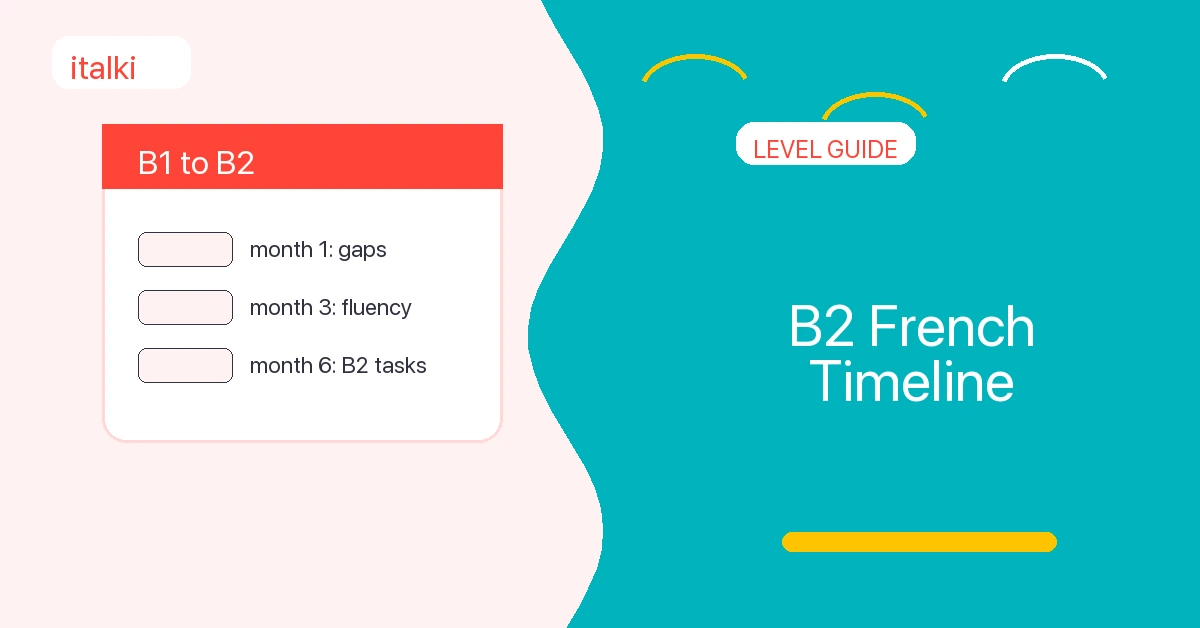
How long to learn B2 French depends on your starting level, weekly study time, and how much of your practice includes corrected speaking and writing rather than passive review.
For B2 progress, italki is useful because the B1-to-B2 jump depends on longer output, real-time correction, listening at natural speed, and repeated practice with complex topics.
This guide covers what B2 French actually means in daily use, timeline estimates for different starting points, the study habits that produce the fastest progress, and how to recognize when you have actually reached B2 rather than just studied toward it.

Find Your Perfect Teacher
B2 French requires consistent speaking practice, not just grammar study. Get personalized lessons from French tutors who can assess your current level accurately, set realistic B2 milestones, and correct the production errors that self-study misses.
Book B2 French classes
Key takeaways
- B2 French means you can handle complex topics in spoken and written French, hold conversations with native speakers without strain, and understand French media without constant dictionary use. It is the level where French becomes independently usable rather than dependent on study aids.
- For English speakers starting from zero: eighteen to twenty-four months at five hours per week reaches B2. Intensive study (20+ hours per week) can reach B2 in six to eight months.
- The B1-to-B2 gap is where most learners stall because passive study (reading, apps) no longer produces the same progress gains it did at lower levels. Speaking practice and live correction become the primary drivers of progress from B1 to B2.
- B2 French lessons are most valuable in the B1-to-B2 phase, when the skills limiting progress are speaking fluency and listening comprehension at native speed rather than vocabulary or grammar knowledge.
What does B2 French mean in practice?
B2 is the Upper Intermediate level on the Council of Europe’s CEFR scale. The official CEFR description states that a B2 user “can understand the main ideas of complex text on both concrete and abstract topics, can interact with a degree of fluency and spontaneity that makes regular interaction with native speakers quite possible without strain for either party, and can produce clear, detailed text on a wide range of subjects.”
In practical daily terms, B2 French means:
- You can watch French television, films, and YouTube content without subtitles and follow the main content, though you may miss specific vocabulary or very fast speech.
- You can read French newspapers, novels, and professional documents with reasonable fluency, using a dictionary for unfamiliar words rather than for basic comprehension.
- You can hold a spontaneous conversation with a native French speaker on a range of topics without frequent long pauses to search for vocabulary or grammar.
- You can write a coherent, detailed email, report, or essay in French that is grammatically sound and appropriately formal for the context.
- You can take French proficiency exams at the B2 level: the DELF B2 exam is the standard internationally recognized certification for B2 French.
B2 is the level at which French becomes independently usable in real professional and social contexts. Below B2, most people need to support their French with translation aids, simplified language requests, or topic restriction. At B2, French works as a functional tool.
How long does it take to reach B2 from zero?
The US Foreign Service Institute estimates 600 to 750 classroom hours for English speakers to reach professional working proficiency in French, which maps approximately to C1. B2 typically requires roughly 400 to 550 hours of effective study for English speakers.
| Starting profile | 5 hrs/week | 10 hrs/week | 20+ hrs/week |
|---|---|---|---|
| English speaker, zero French | 18–24 months | 10–14 months | 6–8 months |
| Spanish speaker, zero French | 6–9 months | 3–5 months | 2–3 months |
| English speaker at A2 | 12–18 months | 7–10 months | 4–6 months |
| English speaker at B1 | 8–12 months | 4–6 months | 2–4 months |
These estimates assume effective study time: time actively engaged with French through speaking, structured input, and correction. Passive screen time with French in the background does not count toward these hours at the same rate as active speaking practice, corrected writing, or focused listening with comprehension checks.
The variable that moves the timeline most is not total hours studied but speaking hours with correction. Learners who study twenty hours per week but spend none of it in conversation with native speakers routinely plateau below B2 regardless of total hours logged. Learners who study ten hours per week with two of those hours in corrected conversation sessions often reach B2 faster than those who study twice as many hours passively.
How long does it take to go from B1 to B2 in French?
The B1-to-B2 gap is the most commonly underestimated stage in French learning. Most learners reach B1 at a fairly predictable pace because A1-to-B1 progress is driven mainly by vocabulary and grammar accumulation, which apps and textbooks handle well. The B1-to-B2 jump requires a different kind of progress: fluency in real-time conversation, listening comprehension at natural speed, and the ability to handle complex or abstract topics spontaneously.
For an English speaker already at B1, reaching B2 typically takes eight to twelve months at five hours per week. But the distribution of those hours matters significantly at this stage:
- What still works from B1 study: Vocabulary expansion, reading authentic texts (news, books), and targeted grammar review for advanced structures (subjunctive, complex verb tenses, passives).
- What stops working at B1: App-based repetition, grammar drills in isolation, and passive listening to content you already understand. These methods produce diminishing returns once your grammatical foundation is solid.
- What drives B1-to-B2 progress: Speaking in unrehearsed conversations, processing French at native speed, writing and getting corrections on complex texts, and receiving feedback on fluency gaps that grammar knowledge alone does not fix.
The learners who stall between B1 and B2 most often are those who continue using the same methods that worked up to B1. They increase study hours without changing what they are studying. Adding one to two hours of corrected speaking practice per week at B1 level is more effective for reaching B2 than doubling total passive study hours.
What study habits produce the fastest B2 progress?
The fastest path to B2 combines high input volume with regular production correction. Neither alone is sufficient: input without production produces passive knowledge; production without input produces fluent but limited French.
Weekly habits that move the timeline:
- One to two hours of corrected speaking per week. This is the single highest-impact activity for B2 progress beyond B1. Spoken correction catches the fluency errors, vocabulary gaps, and pronunciation habits that self-study never flags.
- Daily 20 to 30 minutes of authentic listening. French radio, podcasts, and television at native speed trains the listening comprehension that B2 requires. Start with content that has French transcripts available so you can verify comprehension rather than guessing.
- Weekly corrected writing. Submit one piece of written French for correction per week. Writing forces you to construct complex sentences and reveals grammar gaps that oral improvisation hides.
- Active vocabulary expansion in topic areas. B2 vocabulary includes specialized vocabulary in areas like technology, politics, health, and business. Study vocabulary systematically by topic rather than through random word lists.
Use a French study plan to track your weekly hours across input, output, and correction, and adjust the ratio if you are plateauing. Most B1 learners who plateau need more output correction, not more input hours.
What milestones mark the path to B2 French?
Progress toward B2 is easier to track through specific observable skills than through hours studied or lessons completed. Useful practical milestones:
- A2: You can introduce yourself, handle basic service interactions (shops, restaurants), and write a simple personal email in French without needing constant translation support. Typically 2 to 3 months for English speakers.
- B1: You can follow the main points of a French news broadcast, discuss your opinions on familiar topics, and write a coherent paragraph without a dictionary for common vocabulary. Typically 6 to 9 months for English speakers.
- B1+/approaching B2: You can watch a French film with French subtitles and follow the plot without losing the thread. You can participate in a conversation about abstract or professional topics, though you notice gaps in specialized vocabulary and sometimes produce errors under time pressure.
- B2: You can watch French films without subtitles and follow most content, participate in discussions on unfamiliar topics without significant preparation, write formal correspondence accurately, and understand a range of French accents and registers without losing comprehension.
Test yourself against these benchmarks regularly. The milestones are more diagnostic than a progress chart because they reflect real performance rather than study time.
How do you know when you have reached B2 French?
The most reliable tests for B2 French are either formal certification or observable performance benchmarks. Formal certification is straightforward: passing the French proficiency exam at B2 level (typically DELF B2 or an equivalent standardized test) certifies your level with a recognized credential.
If you want a performance benchmark before committing to a formal exam, three tasks distinguish B2 from B1:
- Unscripted conversation on an unfamiliar topic. Choose a topic you have never prepared for in French (current events, an academic subject, a hypothetical scenario) and discuss it with a native speaker for ten minutes without preparation. At B2, you can sustain this without long pauses or frequent breakdowns. At B1, you will hit vocabulary walls and need to simplify your points significantly.
- French film without subtitles. Watch a French-language film without any subtitles. At B2, you follow the plot and character motivations clearly, even if you miss occasional slang or very fast dialogue. At B1, you lose the thread regularly when characters speak quickly or use informal language.
- Cold French text comprehension. Read an article from a French newspaper on a topic you have not studied (politics, science, culture) and summarize it accurately in French without a dictionary. At B2, you can do this with reasonable accuracy. At B1, you need the dictionary too often for the text to feel functional.
Use your French conversation practice sessions to test all three benchmarks before registering for a formal B2 exam. A tutor’s honest feedback on your unscripted conversation performance gives you a more accurate level assessment than a self-scored grammar test.
Make B2 progress visible
B2 French is achievable for any consistent learner. The timeline is predictable when you focus on the right skills: speaking practice with correction drives B1-to-B2 progress faster than adding more passive study hours. Grammar knowledge, vocabulary, and reading comprehension build the base; speaking and listening at native speed convert that base into functional B2 proficiency.
B2 becomes realistic when progress is visible: longer answers, clearer arguments, fewer repeated mistakes, better listening summaries, and writing that holds together without constant correction.
Find Your Perfect Teacher
Your B2 French goal does not have to stay abstract. Get personalized lessons from French tutors who can assess your current level accurately, set B2-specific milestones, and correct the production errors that close the gap between B1 and B2 faster.
B2 French tutors
FAQs
Is B2 French considered fluent?
B2 is considered upper intermediate, not fluent in the strictest sense. However, B2 French is functional and independent: you can handle most professional and social situations without assistance, understand French media, and communicate complex ideas. C1 and C2 represent advanced and near-native fluency. Many learners who describe themselves as “fluent” in French are operating at B2 level.
What exam certifies B2 French?
The DELF B2 (Diplôme d’Études en Langue Française) is the standard internationally recognized B2 French certification issued by France Education International. It does not expire, which makes it valuable for university admissions, immigration, and career purposes. TCF and TEF score ranges also indicate B2 equivalent levels for immigration purposes in Canada and France.
Can you reach B2 French in one year?
Yes, with intensive study. An English speaker studying 10 to 12 hours per week, including regular speaking practice with correction, can reach B2 in twelve to fourteen months. Spanish speakers can reach B2 in four to six months at the same intensity. The key variable is how much of the study time involves active production and correction rather than passive input.
Is B2 French good enough for a French university?
Most French universities accept students with a B2 certification or DELF B2 for degree programs conducted in French. Some programs or institutions require a higher level (C1 or DALF). Check the specific institution’s language requirements, as some accept B2 with conditions (language support courses in the first year) while others require full C1 for unconditional admission.
What is the difference between B1 and B2 French in speaking?
At B1, you can express yourself on familiar topics with occasional pauses and errors. Native speakers need to adjust their speech speed and vocabulary for you to follow comfortably. At B2, you can discuss complex and unfamiliar topics without significant pauses, understand native-speed speech in most contexts, and communicate without native speakers needing to simplify their language. The spoken difference is fluency and comprehension range, not grammar or vocabulary quantity alone.
Want to learn a language at italki?
Here are the best resources for you!