Key takeaways
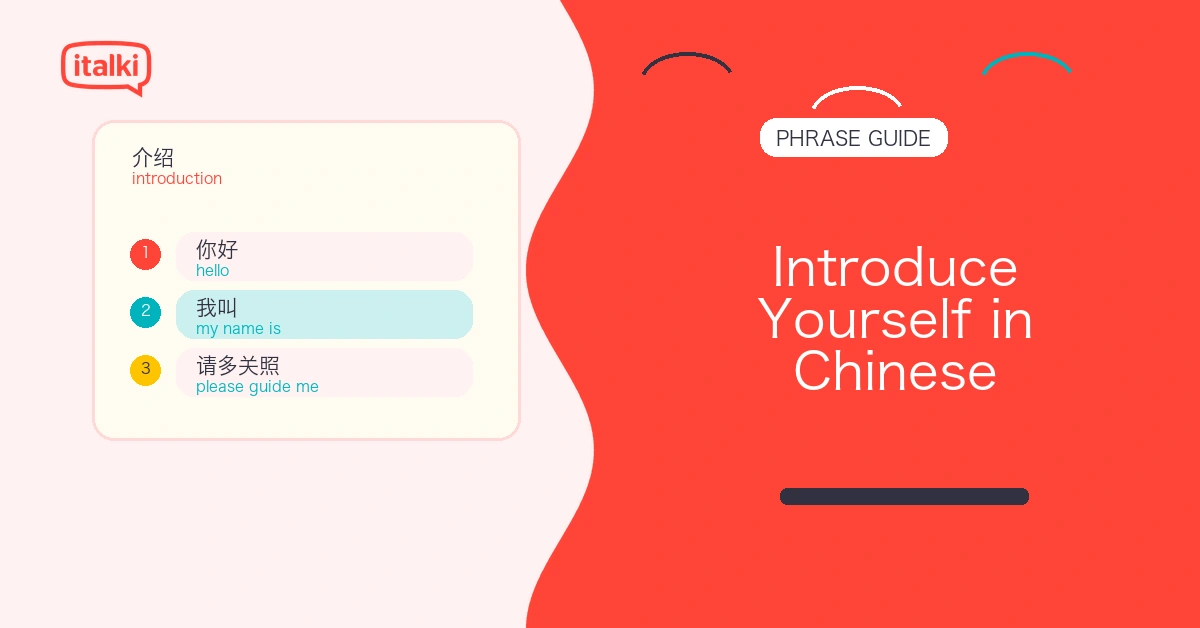
- A basic Chinese self-introduction follows a natural order: greeting, name, nationality or city, occupation or study, and a polite closing phrase. Mastering this sequence gives you a confident opening in any new encounter.
- Chinese has two levels of hello: 你好 (nǐ hǎo, hello) is the everyday form, while 您好 (nín hǎo, respectful hello) is used with elders, strangers in formal situations, and anyone whose age or status is unknown.
- Saying where you are from uses the pattern 我是…人 (Wǒ shì…rén, I am a…person): 我是美国人 (Wǒ shì Měiguórén, I am American), 我是英国人 (Wǒ shì Yīngguórén, I am British).
- The closing phrase 请多关照 (Qǐng duō guānzhào, please look after me / I am in your care) is a culturally important expression that signals respect and a desire for an ongoing relationship. It has no direct English equivalent and leaving it out sounds abrupt in formal contexts.
The first conversation you have in any language sets the tone for everything that follows. In Chinese, a well-delivered self-introduction signals not just language ability but cultural awareness, because the structure, vocabulary choices, and closing phrases all carry social meaning beyond their literal content.
italki connects language learners with Chinese tutors who can listen to your introduction, correct your tones, and help you sound natural rather than textbook-scripted.
This guide covers greeting phrases, introducing your name, saying where you are from, describing your occupation, talking about your Chinese level, a complete sample self-introduction, and common mistakes to avoid.
Work with a Chinese tutor to rehearse your introduction until it flows naturally and your tones land correctly in every sentence.

Find your perfect teacher
Build real speaking confidence with personalized lessons from a teacher who matches your goals, schedule, and learning style.
Book a trial lesson
Greeting phrases
| Chinese | Pinyin | English |
|---|---|---|
| 你好 | nǐ hǎo | hello (everyday) |
| 您好 | nín hǎo | hello (respectful / formal) |
| 大家好 | dàjiā hǎo | hello everyone (group greeting) |
| 早上好 | zǎoshang hǎo | good morning |
| 下午好 | xiàwǔ hǎo | good afternoon |
| 晚上好 | wǎnshang hǎo | good evening |
| 你好吗? | nǐ hǎo ma? | how are you? |
| 我很好,谢谢。 | wǒ hěn hǎo, xièxiè. | I am fine, thank you. |
Use 大家好 (dàjiā hǎo, hello everyone) when introducing yourself to a group, such as in a class or meeting. It is the standard opening for group self-introductions in school and workplace settings.
Introducing your name
The two most common ways to give your name in Chinese:
| Chinese | Pinyin | English |
|---|---|---|
| 我叫… | wǒ jiào… | My name is… (literally: I am called…) |
| 我的名字是… | wǒ de míngzi shì… | My name is… (more explicit) |
| 你叫什么名字? | nǐ jiào shénme míngzi? | What is your name? |
| 您贵姓? | nín guì xìng? | What is your surname? (formal, respectful) |
| 我姓… | wǒ xìng… | My surname is… |
我叫 (Wǒ jiào, I am called) is the most natural and common form. 我的名字是 (Wǒ de míngzi shì, My name is) sounds slightly more deliberate and is fine but can feel slightly formal in casual contexts.
您贵姓?(Nín guì xìng?, What is your honorable surname?) is a formal register phrase. 贵 (guì) here means honorable and elevates the question as a sign of respect. You would use this when meeting someone significantly older or in a professional context.
Find your perfect teacher
Build real speaking confidence with personalized lessons from a teacher who matches your goals, schedule, and learning style.
Book a trial lesson
Saying where you are from
The standard pattern is: 我是 + country/city + 人 (Wǒ shì…rén, I am a…person).
| Chinese | Pinyin | English |
|---|---|---|
| 我是美国人 | wǒ shì Měiguórén | I am American |
| 我是英国人 | wǒ shì Yīngguórén | I am British |
| 我是加拿大人 | wǒ shì Jiānádàrén | I am Canadian |
| 我是澳大利亚人 | wǒ shì Àodàlìyàrén | I am Australian |
| 我来自… | wǒ láizì… | I come from… |
| 我住在… | wǒ zhù zài… | I live in… |
| 你是哪里人? | nǐ shì nǎlǐ rén? | Where are you from? |
| 你从哪里来? | nǐ cóng nǎlǐ lái? | Where do you come from? |
Both 我是…人 (Wǒ shì…rén) and 我来自… (Wǒ láizì…) are correct and commonly used. The 我是…人 pattern is slightly more idiomatic in spoken Chinese.
Your age
Talking about age in Chinese requires knowing numbers. For a full breakdown of the Chinese number system, the guide to Chinese numbers covers everything from single digits to large figures.
| Chinese | Pinyin | English |
|---|---|---|
| 我今年…岁 | wǒ jīnnián…suì | I am…years old this year |
| 你多大了? | nǐ duō dà le? | How old are you? (casual) |
| 您多大年纪了? | nín duō dà niánjì le? | How old are you? (respectful, for elders) |
| 我今年二十五岁 | wǒ jīnnián èrshíwǔ suì | I am 25 years old this year |
Note that Chinese often includes 今年 (jīnnián, this year) when stating age, which gives the sentence the sense of as of this year I am X. This is grammatically normal and not redundant.
Find your perfect teacher
Build real speaking confidence with personalized lessons from a teacher who matches your goals, schedule, and learning style.
Book a trial lesson
Your occupation or study
| Chinese | Pinyin | English |
|---|---|---|
| 我是学生 | wǒ shì xuésheng | I am a student |
| 我是老师 | wǒ shì lǎoshī | I am a teacher |
| 我是工程师 | wǒ shì gōngchéngshī | I am an engineer |
| 我是医生 | wǒ shì yīshēng | I am a doctor |
| 我是设计师 | wǒ shì shèjìshī | I am a designer |
| 我在…工作 | wǒ zài…gōngzuò | I work at… |
| 我在…上学 | wǒ zài…shàngxué | I study at… |
| 你做什么工作? | nǐ zuò shénme gōngzuò? | What do you do for work? |
| 我在学习中文 | wǒ zài xuéxí Zhōngwén | I am studying Chinese |
The pattern 我是 + occupation is the simplest and most direct form. Adding 我在…工作 (I work at…) + company or city gives more specific context: 我在上海一家公司工作 (Wǒ zài Shànghǎi yī jiā gōngsī gōngzuò, I work at a company in Shanghai).
Talking about your Chinese level
Native speakers appreciate honesty about your level. These phrases let you set expectations clearly and invite patience or simpler language.
| Chinese | Pinyin | English |
|---|---|---|
| 我在学中文 | wǒ zài xué Zhōngwén | I am studying Chinese |
| 我的中文不太好 | wǒ de Zhōngwén bù tài hǎo | My Chinese is not very good |
| 我是初学者 | wǒ shì chūxuézhě | I am a beginner |
| 请说慢一点 | qǐng shuō màn yīdiǎn | Please speak more slowly |
| 请再说一遍 | qǐng zài shuō yī biàn | Please say that again |
| 你能说英文吗? | nǐ néng shuō Yīngwén ma? | Can you speak English? |
| 我听不懂 | wǒ tīng bù dǒng | I don’t understand (listening) |
| 我不明白 | wǒ bù míngbái | I don’t understand (meaning) |
Saying 我在学中文 (Wǒ zài xué Zhōngwén, I am studying Chinese) within an introduction is a natural way to explain why you are making the effort to speak Mandarin. Chinese speakers generally respond very warmly to this and will often help you with corrections.
Find your perfect teacher
Build real speaking confidence with personalized lessons from a teacher who matches your goals, schedule, and learning style.
Book a trial lesson
Talking about your family
Mentioning your family briefly is common in Chinese self-introductions, particularly in workplace or school contexts. The guide to family members in Chinese covers the full vocabulary set for family relationships.
| Chinese | Pinyin | English |
|---|---|---|
| 我家有…口人 | wǒ jiā yǒu…kǒu rén | My family has…people |
| 我有一个哥哥 | wǒ yǒu yī gè gēgē | I have one older brother |
| 我是独生子女 | wǒ shì dúshēng zǐnǚ | I am an only child |
| 我已婚 | wǒ yǐ hūn | I am married |
| 我未婚 | wǒ wèi hūn | I am unmarried |
家 (jiā, home / family) and 口人 (kǒu rén, mouths / people) together form the standard way to count family size in Chinese. 三口人 (sān kǒu rén) means a family of three.
Closing phrases
The closing of a Chinese self-introduction signals respect and openness to an ongoing relationship. These phrases matter culturally.
| Chinese | Pinyin | English |
|---|---|---|
| 请多关照 | qǐng duō guānzhào | please look after me / I am in your care |
| 很高兴认识你 | hěn gāoxìng rènshi nǐ | nice to meet you |
| 很高兴认识您 | hěn gāoxìng rènshi nín | nice to meet you (formal/respectful) |
| 希望我们相处愉快 | xīwàng wǒmen xiāngchǔ yúkuài | I hope we get along well |
| 以后请多指教 | yǐhòu qǐng duō zhǐjiào | please guide me going forward |
请多关照 (Qǐng duō guānzhào) is the most culturally important of these. It acknowledges that you are new to the relationship and are asking for the other person’s goodwill and guidance. It is expected in formal introductions and in workplace settings and sounds natural even in casual ones.
Find your perfect teacher
Build real speaking confidence with personalized lessons from a teacher who matches your goals, schedule, and learning style.
Book a trial lesson
A complete sample self-introduction
Here is a full self-introduction in natural Chinese, suitable for a class, workplace, or social setting:
大家好,我叫 [Name],我来自美国,我今年二十八岁。我在一家科技公司工作,是一名工程师。我现在在学中文,我的中文还不太好,请大家多多关照。很高兴认识大家。
(Dàjiā hǎo, wǒ jiào [Name], wǒ láizì Měiguó, wǒ jīnnián èrshíbā suì. Wǒ zài yī jiā kējì gōngsī gōngzuò, shì yī míng gōngchéngshī. Wǒ xiànzài zài xué Zhōngwén, wǒ de Zhōngwén hái bù tài hǎo, qǐng dàjiā duōduō guānzhào. Hěn gāoxìng rènshi dàjiā.)
Hello everyone, my name is [Name]. I am from the United States and I am 28 years old this year. I work at a technology company as an engineer. I am currently studying Chinese; my Chinese is not very good yet, so please take care of me. Nice to meet everyone.
This introduction is about 45 seconds when spoken at a natural pace, which is the ideal length for a first-time group introduction.
Common mistakes
Mistake 1: Using 你好 with elders or strangers in formal situations When meeting someone significantly older or in a formal business or official setting, 您好 (nín hǎo) is the appropriate greeting. Using 你好 with an elder is not rude, but 您好 signals respect and awareness of social register.
Mistake 2: Forgetting tones on 你 vs 您 你 (nǐ, you) and 您 (nín, you, respectful) are different words entirely. Dropping the tone or using the wrong one changes the meaning and the social level of the greeting.
Mistake 3: Skipping 请多关照 in formal contexts In Chinese workplace or school introductions, ending without 请多关照 (Qǐng duō guānzhào) can sound abrupt or incomplete. The phrase signals that you understand the relationship is ongoing, not just a one-time exchange.
Mistake 4: Translating My name is too literally English learners often translate My name is as 我的名字是 (Wǒ de míngzi shì), which is grammatically correct but sounds slightly stiff in speech. 我叫 (Wǒ jiào, I am called) is more natural and commonly used.
Find your perfect teacher
Build real speaking confidence with personalized lessons from a teacher who matches your goals, schedule, and learning style.
Book a trial lesson
Practice your introduction with a tutor
Reading a self-introduction from a page and delivering it confidently in a real conversation are very different skills. Tone errors that look fine in writing become obvious in speech. A Chinese tutor can hear your introduction, correct your pronunciation, and help you adapt it for different contexts.
italki’s 30,000+ expert tutors include native Mandarin speakers who specialize in spoken Chinese and conversational fluency. Trusted by over 10 million learners worldwide, the platform lets you find a tutor who can run practice introductions with you, simulate real social contexts, and build your confidence before you need it. Book a trial lesson and deliver your first full introduction in Mandarin.
Find your perfect teacher
Build real speaking confidence with personalized lessons from a teacher who matches your goals, schedule, and learning style.
Book a trial lesson
FAQ
What is the most important phrase in a Chinese self-introduction?
请多关照 (Qǐng duō guānzhào, please look after me / I am in your care) is the most culturally important closing phrase. It signals respect, humility, and openness to an ongoing relationship. In formal settings such as school or work, leaving it out makes the introduction feel incomplete.
How do you say my name is in Chinese?
The most natural form is 我叫 (Wǒ jiào…, I am called…). The more explicit form 我的名字是 (Wǒ de míngzi shì…, My name is…) is also correct but sounds slightly formal in casual conversation.
How do you say I am from in Chinese?
You can use 我来自 (Wǒ láizì…, I come from…) or 我是…人 (Wǒ shì…rén, I am a…person). Both are correct. 我是美国人 (Wǒ shì Měiguórén) and 我来自美国 (Wǒ láizì Měiguó) both mean I am from America.
What is the difference between 你好 and 您好?
你好 (nǐ hǎo) uses the standard second-person pronoun 你 (nǐ, you) and is appropriate for everyday greetings with peers, friends, and people of similar age. 您好 (nín hǎo) uses the formal/respectful second-person pronoun 您 (nín) and is used with elders, authority figures, and strangers in formal settings.
How long should a Chinese self-introduction be?
For a classroom or workplace group introduction, 30 to 60 seconds is typical. Cover your name, where you are from, your occupation or study, a brief personal detail, and a closing phrase. Longer introductions are common in more formal presentations; shorter ones suit casual social situations.
Want to learn a language at italki?
Here are the best resources for you!