Key takeaways:
- English is spoken by approximately 1.5 billion people worldwide, making it the most widely used language for international communication, travel, and business.
- Oxford Languages identifies 3,000 core words as the foundation of everyday English, and learning these high-frequency words first gives beginners the fastest path to real communication.
- The most effective approach for beginners combines daily short study sessions with regular speaking practice, not long occasional study blocks.
- A native English tutor on italki corrects pronunciation, grammar, and speaking habits from the very first lesson: the real-time feedback that prevents mistakes from becoming permanent. Lessons start from $4, with teachers available for every goal and skill level.
- Why should beginners learn English?
- How do you start learning English for beginners step by step?
- What English grammar rules do beginners need to know?
- How do you build English vocabulary as a beginner?
- How do you practice speaking English as a beginner?
- How do you improve English listening skills as a beginner?
- How do you learn American English for beginners?
- How do you learn English fast for beginners?
- What are the best resources for learning English?
- FAQ
The best way to learn English for beginners is to combine structured practice with the immersion that is uniquely available with this language, and italki is the platform that brings both together. With 30,000+ teachers across 150+ languages and over 10 million learners worldwide since 2007, it connects you with native English speakers for one-on-one lessons.
English is different from almost any other language you could study: most of the internet, global media, and international business run on it, which means listening and reading material is available to you before your very first lesson.
italki matches you with English teachers based on your specific goals, whether that is everyday conversation, exam preparation, or professional communication. This guide covers every stage of learning the English language for beginners, from grammar and vocabulary to speaking practice and daily habits that accelerate progress.
Find an English tutor and book a trial lesson today.

Find Your Perfect Teacher
Build real English confidence with personalized lessons from a teacher who matches your goals, schedule, and learning style.

Why should beginners learn English?
English is spoken by approximately 1.5 billion people worldwide, making it the most widely used language for international communication, according to Britannica. It is the official or co-official language of over 60 countries and the primary language of international business, science, technology, and aviation.
For career growth, English is often the difference between a local opportunity and a global one. Proficiency in English opens access to international companies, remote work, academic programs, and professional networks that would otherwise be out of reach.
For travel, English functions as a practical bridge language in most parts of the world. Even in countries where English is not an official language, it is the most commonly used second language for communication between people of different nationalities.
For personal growth, English gives you access to the largest body of online content, books, films, music, and research in any language. The Oxford English Dictionary contains over 600,000 words, making English the most expansive vocabulary of any language on Earth. Learning English as a beginner does not just expand your vocabulary. It expands what you have access to.
Connect with English tutors who can help you reach your specific English goals from the very first lesson.
How do you start learning English for beginners step by step?
The best way to start learning English is to focus on three areas at once: the most common everyday phrases, basic grammar structures, and speaking practice with a real person as early as possible.
Many beginners spend too much time on grammar rules before ever trying to speak. A more effective approach is to learn phrases you can use immediately, then build the grammar understanding underneath them over time. You do not need to understand every rule before you can communicate.
A practical starting sequence for absolute beginners:
- Learn the most common English greetings and introductions (week 1)
- Study basic sentence structures: subject plus verb plus object (weeks 1 to 2)
- Build a core vocabulary of 100 to 200 high-frequency words (ongoing from week 1)
- Learn the present simple tense and how to talk about daily routines (weeks 2 to 3)
- Start speaking with a tutor by week 2 to 3, before hesitation becomes a habit
- Add the past simple tense and basic question forms (weeks 3 to 6)
Knowing how to introduce yourself in English is a real milestone. Getting comfortable with a short self-introduction (your name, where you are from, and what you do) gives you a working script for every new conversation you enter as a beginner.
Book your first lesson with English teachers to start building your foundation with guidance from a native speaker.
Find Your Perfect Teacher
Build real English confidence with personalized lessons from a teacher who matches your goals, schedule, and learning style.
What English grammar rules do beginners need to know?
English has a reputation for irregular spelling and unpredictable pronunciation, but the core grammar has a genuine advantage over many other languages: it has no grammatical gender. Unlike French, Spanish, or German, English nouns are not masculine or feminine.
There is no “le” versus “la,” no need to memorize gender for every word you learn. That removes one of the most common early frustrations in language learning. What English does require is mastering a fixed word order and a small set of high-frequency grammar patterns that appear in almost every sentence. Start with these.
Basic sentence structure
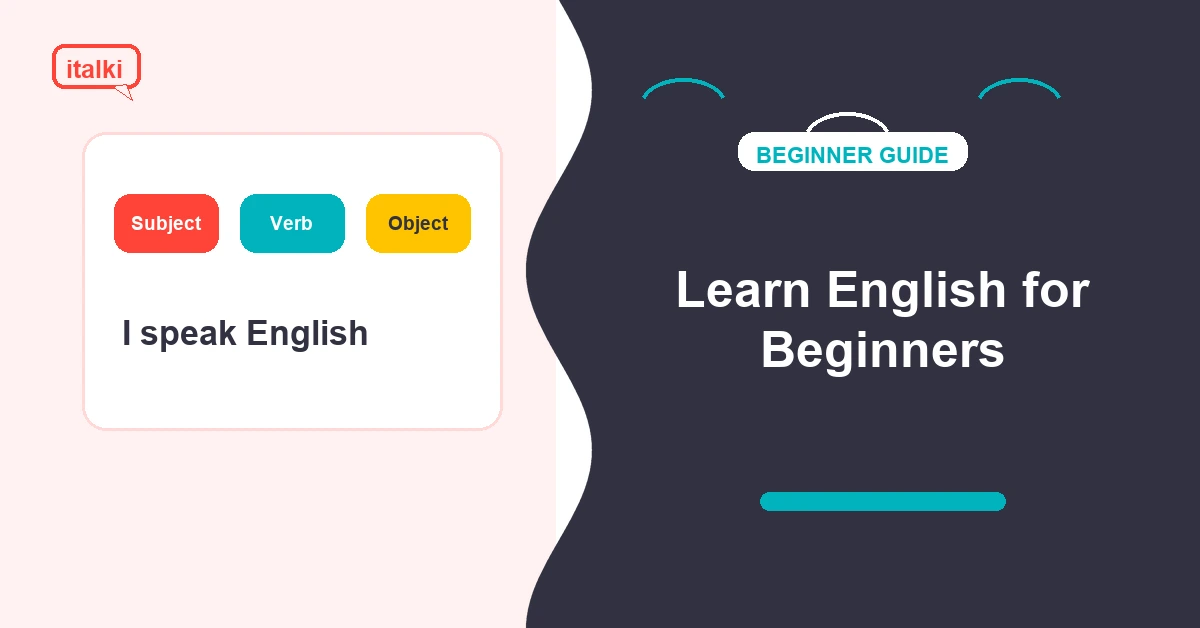
English follows a fixed subject-verb-object order. “She reads a book” cannot be rearranged to “A book she reads” in standard English. This fixed order makes sentence construction more predictable than in languages where word order is flexible.
For a clearer breakdown of how sentences are built, the English sentence structure patterns beginners use most frequently are present simple, past simple, and simple questions.
The three most important tenses
For beginners, three tenses cover most everyday communication:
- Present simple describes habits, routines, and general facts: “I work every day.” “Water boils at 100 degrees.”
- Past simple describes completed actions: “I visited Paris last year.” “She studied English for two hours.”
- Future simple describes plans and intentions: “I will call you tomorrow.” “We are going to study tonight.”
Understanding how these three English tenses work gives you the tools to talk about what you do, what you did, and what you plan to do.
Articles: a, an, and the
English uses three articles, and using them correctly is one of the most common challenges for beginners. “A” and “an” are used with singular nouns when referring to something for the first time or in general. “The” is used when referring to something specific or already known to both speaker and listener.
Subject-verb agreement
The verb must match the subject in number. “She works” (singular) versus “They work” (plural). This applies across all tenses and is one of the first grammar rules to internalize because it appears in nearly every sentence.
For structured grammar practice from the beginning, basic English grammar covers the rules most likely to affect your speaking and writing in real situations.
A tutor for English can correct grammar in real time during conversation, which builds accuracy through use far faster than studying rules in a workbook.
Find Your Perfect Teacher
Build real English confidence with personalized lessons from a teacher who matches your goals, schedule, and learning style.
How do you build English vocabulary as a beginner?
Vocabulary is the foundation of everything in language learning. Without enough words, grammar rules have nothing to work with.
Focus on high-frequency words first
Oxford Languages identifies 3,000 core words as the foundation of everyday English communication, according to the Oxford 3000 word list. These words cover the vast majority of spoken and written English you encounter daily. Learning them in order of frequency gives you the highest return on study time at the beginner stage.
Learn words in context, not in isolation
A word learned in a sentence is more useful than a word memorized from a list. Instead of learning “buy” alone, learn “I want to buy a coffee.” You get the word, the grammar structure, and a natural phrase you can use immediately. This is how language actually works in conversation.
Use spaced repetition to retain what you learn
Spaced repetition is a study method that schedules vocabulary review at increasing intervals, so you spend less time on words you already know and more time on words you are still learning. Apps like Anki use this method and are widely used by serious language learners for long-term vocabulary retention.
Build vocabulary through daily exposure
Reading simple English texts, watching English content with subtitles, and listening to English podcasts all expose you to new words in context. The more times you encounter a word across different situations, the more reliably it transfers to long-term memory and active use.
English tutoring sessions let you practice new vocabulary in real conversation, which is the fastest route to moving words from passive recognition to active use.
Recommended reading: Best Programs to Learn English
How do you practice speaking English as a beginner?
Speaking is the skill that separates learners who study English from learners who actually speak it. Most beginners delay speaking because they feel their English is not good enough yet. That delay is the problem, not the solution.
italki English tutor Jessie Goldstone puts it directly:
“Learners who use English regularly improve far faster than those who only study it. Speak, listen, and think in English daily, even with mistakes. Short, regular practice beats long study sessions every time.”
The phrase “think in English daily” is worth taking seriously. It does not require a speaking partner or a lesson. When you are making breakfast, describe what you are doing in English: “I am making coffee. The coffee is hot. I drink coffee every morning.” When you are walking outside, name what you see. When something surprises you, notice what word comes to mind in English.
This internal narration is free, takes no extra time, and does something no app replicates: it makes English the language your brain reaches for first, not the one it translates into. Over weeks, that shift is the difference between a learner who speaks and one who hesitates.
Beyond daily mental practice, here are the most effective structured speaking methods:
- One-on-one lessons with a native tutor give you a speaking environment where mistakes are corrected immediately and in context. This is the most direct route to speaking English confidently because the feedback is specific to what you actually said.
- The shadowing technique involves listening to native English audio and repeating it immediately, matching the speaker’s rhythm, stress, and intonation as closely as possible. It is highly effective for pronunciation and natural-sounding speech. If you want to add this to your daily routine, the shadowing technique works well with any audio content at your level.
- Conversation sessions focused on everyday situations build the specific vocabulary and phrases you need for real communication. Practice ordering food, giving directions, asking for help, and describing your day before those situations arise in real life.
Book a session with an online English tutor and start speaking English from your very first lesson.
Find Your Perfect Teacher
Build real English confidence with personalized lessons from a teacher who matches your goals, schedule, and learning style.
How do you improve English listening skills as a beginner?
Listening is the skill that beginners most underestimate. You can know hundreds of words and still struggle to understand a native speaker, because natural speech is faster, less formal, and full of connected sounds that look nothing like written English.
The most effective listening practice for beginners is graded input: content that is slightly above your current level but not so far above it that you understand nothing. If you understand 70 to 80% of what you hear, you are in the right zone.
Practical listening methods for beginners:
- Podcasts made for English learners use clear speech, simple vocabulary, and controlled pace. They are more useful at the beginner stage than native content, which is often too fast to follow. BBC Learning English provides free audio content specifically designed for non-native speakers at every level, from absolute beginner upward.
- English TV and film with English subtitles (not your native language subtitles) trains your ear and eye together. When you read the subtitle at the same time as you hear the sentence, you start to recognize how spoken English actually sounds versus how it is written.
- Repetition listening means playing the same short audio clip multiple times until you catch everything. Choose a 30 to 60 second clip, listen once for general meaning, then again for specific words, then again to notice pronunciation and rhythm. This focused approach builds listening accuracy faster than passive background listening.
Practicing English conversation for beginners with a tutor or language exchange partner is the most effective listening exercise because it requires you to respond in real time, not just recognize words passively.
How do you learn American English for beginners?
American English is the most widely used variety of English in global media, online content, and international business, which makes it a practical choice for beginners who want to be widely understood.
The main differences between American English and other varieties are pronunciation, vocabulary, and spelling. American English uses a pronounced “r” sound at the end of words like “car” and “water,” where British English speakers soften or drop it. American vocabulary also has distinct terms: “apartment” instead of “flat,” “elevator” instead of “lift,” “trash” instead of “rubbish.”
For pronunciation specifically, the American English accent follows consistent patterns once you understand the sounds. The most useful early focus areas are the American “r,” the short “a” in words like “cat” and “man,” and the way American English links words together in connected speech.
Practical steps for learning American English as a beginner:
- Watch American TV shows and films with English subtitles
- Listen to American English podcasts and YouTube channels designed for learners
- Work with an American English tutor who gives feedback on accent and vocabulary
- Learn American spelling conventions: “color” not “colour,” “organize” not “organise”
italki has English language tutoring options specifically for American English, with native speakers who give you direct feedback on pronunciation and help you develop natural-sounding speech faster than self-study alone.
Find Your Perfect Teacher
Build real English confidence with personalized lessons from a teacher who matches your goals, schedule, and learning style.
How do you learn English fast for beginners?
The fastest way to learn English as a beginner is to use it every day across multiple skill areas, with speaking practice at the center of your routine. Passive study produces slow results. Active use produces fast ones.
- Speak from week one. Every week you delay speaking is a week you reinforce the habit of not speaking. Book a lesson with a native English teacher in your first week, even if your English feels too basic. A good tutor meets you at your level.
- Study every day, even briefly. Daily practice of 20 to 30 minutes consistently outperforms two-hour sessions three times a week. Language learning depends on regular repetition, and gaps in practice slow retention more than most learners expect.
- Immerse yourself in English outside of lessons. Change your phone settings to English. Follow English-language social media accounts. Watch English content. Read simple English news or children’s books. The goal is to surround yourself with English so that it starts to feel like a natural part of your day rather than a separate study activity.
- Target 3,000 core words. Rather than trying to learn as many words as possible, focus on the high-frequency vocabulary that covers most everyday situations. This is a concrete, achievable goal that produces faster results than unfocused vocabulary study.
- Match your resources to your level. Using content that is too difficult wastes time and builds frustration. Use a English learning app to track your level and find content suited to where you actually are, not where you want to be.
Find English teachers online who build personalized lesson plans around your goals and pace.
What are the best resources for learning English?
No single resource produces fluency on its own. The most effective approach combines structured lessons with daily immersion across multiple formats.
For structured learning
italki tutors give you one-on-one lessons with native English speakers from $4/lesson. You can filter by specialty, teaching style, and availability to find a teacher who fits your goals, whether you need English for business communication, conversational practice, or exam preparation. If you are comparing lesson costs, see the English tutor cost breakdown across platforms before committing.
Structured textbooks such as the Oxford English series and Cambridge English courses give beginners a clear grammar and vocabulary progression. These work best alongside speaking practice, not instead of it.
For listening and immersion
BBC Learning English provides free audio and video content designed for non-native speakers across all levels. It is one of the most trusted free resources available.
English podcasts for learners give you consistent listening practice at a manageable pace. Start with beginner-level shows before moving to content made for native speakers.
For vocabulary
Anki is a free spaced repetition app that schedules vocabulary review for maximum long-term retention. Build decks from words you encounter in lessons and review daily.
Reading children’s books and graded readers in English builds vocabulary and reading comprehension at a controlled level without the overwhelm of native-level texts.
For a broader guide to what to use at each stage, see the best way to learn English broken down by skill area and learning goal.
Ready to speak English fluently?
English is the one language where study material is never the problem. Podcasts, films, social media, news in every format; it surrounds you before you ever open a textbook. What self-study cannot give you is a real person who hears exactly where you go wrong and corrects it in the moment. That is where progress accelerates fastest. italki connects you with online English teachers for live one-on-one lessons starting from $4, with 30,000+ teachers across every goal, accent, and level. Book your first lesson and start speaking, not just studying.
Find Your Perfect Teacher
Build real English confidence with personalized lessons from a teacher who matches your goals, schedule, and learning style.
FAQ
What is the best way for a complete beginner to start learning English?
italki is the best starting point for complete beginners because speaking with a real person from the first week prevents pronunciation and grammar errors from becoming habits. Start by learning basic greetings, the most common 100 words, and simple present tense sentences. Book a trial lesson within your first two weeks to practice speaking before hesitation sets in.
How long does it take to learn English as a beginner?
Reaching basic conversational ability typically takes around 180 to 200 hours of study, according to Cambridge English’s CEFR level guide. At one hour of daily practice, most learners hit this point within six to seven months. Learners who combine self-study with regular live sessions reach it faster than those using apps alone
The Foreign Service Institute estimates that reaching professional working proficiency in a language requires approximately 600 to 750 hours of study, Basic conversational ability, enough for greetings, introductions, and simple everyday requests, is a significantly lower threshold, typically around 150 to 200 hours. At 30 to 60 minutes of daily practice, most learners reach this point within five to seven months. Learners who combine self-study with regular live sessions on italki get there faster than those relying on apps alone.
Do I need to learn grammar before I can speak English?
No. You start speaking English with a handful of phrases and very basic grammar. Speaking early prevents the mindset that you need perfect grammar before you can communicate. A native English tutor on italki teaches grammar through conversation, correcting what you actually say rather than drilling rules in isolation.
How many words do I need to know to hold a basic conversation in English?
A vocabulary of around 500 to 1,000 high-frequency words is enough for basic everyday conversation. Oxford Languages identifies 3,000 core words as the foundation of everyday English, according to the Oxford 3000 word list. Reaching 1,000 to 2,000 words gives you the tools to handle most practical situations comfortably.
Is American English or British English better for beginners?
Neither is objectively better. American English is more widely used in global media, online content, and international business, which gives you more daily exposure to practice with. British English is more common in European and Commonwealth contexts. The most important thing is to pick one variety and study it consistently, then expand your exposure to other accents over time. A native English tutor on italki helps you focus on the variety that fits your goals.
Want to learn a language at italki?
Here are the best resources for you!