Key takeaways
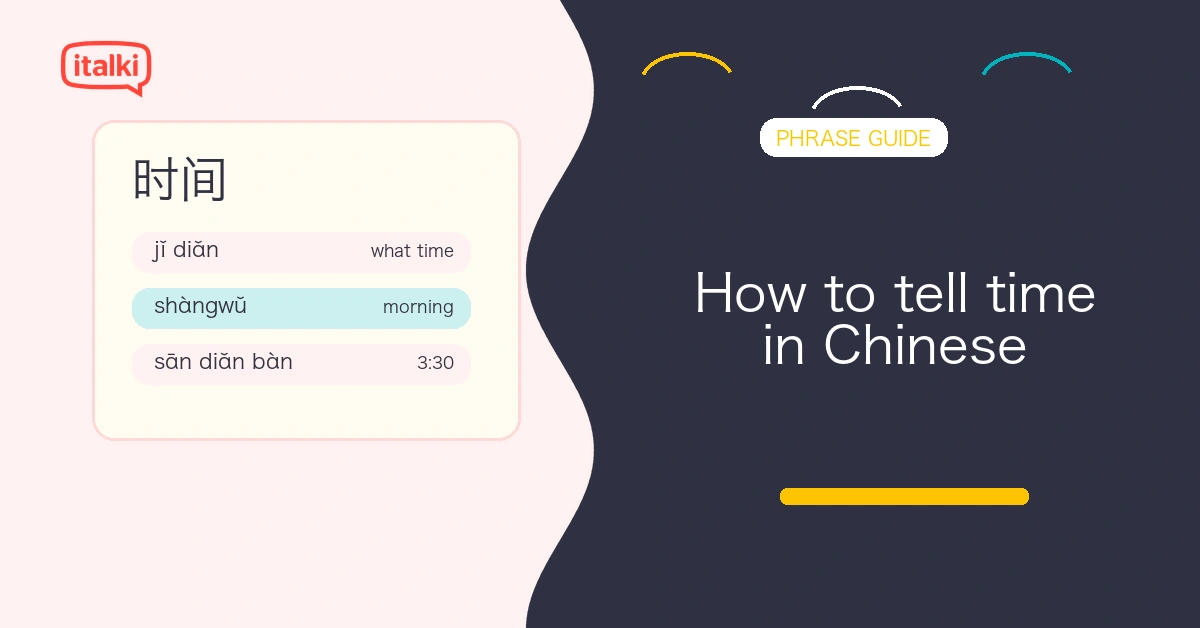
- The basic Chinese time format is: time period + hours + 点 (diǎn, o’clock) + minutes + 分 (fēn, minutes). So 3:30 PM is 下午三点三十分 (xiàwǔ sān diǎn sānshí fēn). Unlike English, the time period (AM/PM equivalent) comes before the hour, not after it.
- Chinese uses the same character system for hours and minutes in all contexts. There is no analog/digital distinction, and the format does not change between writing and speech. What you see is what you say.
- The word for o’clock is 点 (diǎn). The word for half past is 半 (bàn). A quarter hour is 一刻 (yī kè). It is 4:15 is 四点一刻 (sì diǎn yī kè). These three building blocks cover most time expressions.
- Chinese does not use a 12-hour clock in the same way English does. Instead of AM and PM, Chinese specifies the time period explicitly: 早上 (zǎoshang, morning), 上午 (shàngwǔ, late morning), 中午 (zhōngwǔ, noon), 下午 (xiàwǔ, afternoon), 傍晚 (bàngwǎn, early evening), 晚上 (wǎnshang, evening/night).
Asking for the time in Chinese takes one short sentence. Answering requires understanding the structure: time period first, then hours, then minutes. Once the structure is clear, telling the time in Chinese is more systematic than in English, because the time period always precedes the hour rather than following it.
The real challenge is fluency under normal conversational speed. Chinese time expressions in real speech are compressed and quick, and the numbers can sound unfamiliar at speed. italki connects you with Chinese teachers who can run time-telling drills in real conversation pace, building the automatic response time that drills alone cannot develop.
This guide covers how to tell time in Chinese: the question and answer structure, time periods, how to express hours and minutes, half and quarter hours, and key time-related phrases for daily conversations.
A Chinese tutor can run real-time scheduling conversations with you, asking about your day and making appointments, so time expressions become part of your active spoken Chinese rather than a structure you have to calculate before speaking.

Find your perfect teacher
Build real speaking confidence with personalized lessons from a teacher who matches your goals, schedule, and learning style.

Asking what time it is
| Chinese | Pinyin | English |
|---|---|---|
| 几点了? | jǐ diǎn le? | What time is it? |
| 现在几点? | xiànzài jǐ diǎn? | What time is it now? |
| 现在几点了? | xiànzài jǐ diǎn le? | What time is it now? (with completion marker) |
| 请问,现在几点? | qǐngwèn, xiànzài jǐ diǎn? | Excuse me, what time is it? (polite) |
| 你知道几点了吗? | nǐ zhīdào jǐ diǎn le ma? | Do you know what time it is? |
The question word 几 (jǐ) means how many and is used for numbers expected to be small (under 10). Since clock hours run 1-12, 几 is the correct question word for asking about time.
Time periods: morning through night
Chinese does not use AM/PM. Instead, the time period is stated explicitly before the hour.
| Chinese | Pinyin | Period covered |
|---|---|---|
| 早上 | zǎoshang | early morning (approximately 6-9 AM) |
| 上午 | shàngwǔ | morning / late morning (approximately 9 AM-12 PM) |
| 中午 | zhōngwǔ | noon (approximately 12 PM) |
| 下午 | xiàwǔ | afternoon (approximately 12 PM-6 PM) |
| 傍晚 | bàngwǎn | early evening / dusk (approximately 5-7 PM) |
| 晚上 | wǎnshang | evening / night (approximately 7 PM onwards) |
| 夜里 / 半夜 | yèlǐ / bànyè | late night / midnight |
| 凌晨 | língchén | hours between midnight and dawn (1-5 AM) |
Usage: The time period always comes before the hour. Good morning, it is 8 o’clock = 早上八点 (zǎoshang bā diǎn).
Find your perfect teacher
Build real speaking confidence with personalized lessons from a teacher who matches your goals, schedule, and learning style.
Hours, minutes, half, and quarter
Hours and minutes:
| Chinese | Pinyin | English |
|---|---|---|
| 点 | diǎn | o’clock / hour marker |
| 分 | fēn | minutes |
| 半 | bàn | half (half past) |
| 刻 | kè | quarter (15 minutes) |
| 差 | chà | lacking / before (used for minutes to the hour) |
| 整 | zhěng | exactly / sharp (e.g., 3 o’clock sharp) |
Numbers for hours (1-12):
| Chinese | Pinyin | Number |
|---|---|---|
| 一 | yī | 1 |
| 二 | èr | 2 |
| 三 | sān | 3 |
| 四 | sì | 4 |
| 五 | wǔ | 5 |
| 六 | liù | 6 |
| 七 | qī | 7 |
| 八 | bā | 8 |
| 九 | jiǔ | 9 |
| 十 | shí | 10 |
| 十一 | shíyī | 11 |
| 十二 | shíèr | 12 |
A Chinese teacher can run number-speed drills for time expressions, building the automatic recognition of hour numbers at conversational speed, which is faster than reading from a table.
Saying specific times
Structure: Time period + hour + 点 + minutes + 分
| Time | Chinese | Pinyin |
|---|---|---|
| 8:00 AM | 早上八点 / 早上八点整 | zǎoshang bā diǎn / bā diǎn zhěng |
| 10:30 AM | 上午十点半 | shàngwǔ shí diǎn bàn |
| 12:00 PM | 中午十二点 | zhōngwǔ shíèr diǎn |
| 3:15 PM | 下午三点一刻 | xiàwǔ sān diǎn yī kè |
| 3:45 PM | 下午三点三刻 / 差一刻四点 | xiàwǔ sān diǎn sān kè / chà yī kè sì diǎn |
| 7:20 PM | 晚上七点二十分 | wǎnshang qī diǎn èrshí fēn |
| 11:55 PM | 晚上十一点五十五分 / 差五分十二点 | wǎnshang shíyī diǎn wǔshíwǔ fēn |
| 12:00 AM | 凌晨十二点 / 午夜十二点 | língchén shíèr diǎn |
The 差 (chà, lacking) structure: Used for X minutes before the hour. 差五分三点 (chà wǔ fēn sān diǎn) = five minutes lacking three = 2:55. The missing amount comes before 差, then 分 (minutes), then the upcoming hour.
Find your perfect teacher
Build real speaking confidence with personalized lessons from a teacher who matches your goals, schedule, and learning style.
Essential time expressions and phrases
| Chinese | Pinyin | English |
|---|---|---|
| 现在 | xiànzài | now |
| 以前 | yǐqián | before / previously |
| 以后 | yǐhòu | after / later |
| 刚才 | gāngcái | just now / a moment ago |
| 马上 | mǎshàng | immediately / right away |
| 快了 | kuài le | soon / almost time |
| 还早 | hái zǎo | still early |
| 已经晚了 | yǐjīng wǎn le | already late |
| 准时 | zhǔnshí | on time |
| 提前 | tíqián | early / ahead of schedule |
| 推迟 | tuīchí | delayed / postponed |
| 什么时候 | shénme shíhou | when / what time |
| 几点钟 | jǐ diǎn zhōng | what time / at what o’clock |
Common time-related questions and answers
| Situation | Chinese | Pinyin | English |
|---|---|---|---|
| Making an appointment | 我们几点见面? | wǒmen jǐ diǎn jiànmiàn? | What time shall we meet? |
| Responding | 下午三点怎么样? | xiàwǔ sān diǎn zěnmeyàng? | How about 3 PM? |
| Confirming | 好的,三点见。 | hǎo de, sān diǎn jiàn. | OK, see you at 3. |
| Running late | 我还有二十分钟才到。 | wǒ hái yǒu èrshí fēnzhōng cái dào. | I will arrive in 20 minutes. |
| Asking when | 你几点下班? | nǐ jǐ diǎn xià bān? | What time do you get off work? |
| Not this time | 这次不行,下次吧。 | zhè cì bù xíng, xià cì ba. | Not this time, let’s do it next time. |
| Declining politely | 这次不太方便。 | zhè cì bù tài fāngbiàn. | This time is not very convenient. |
For how date and time structures appear in social contexts such as asking when someone was born, what date their birthday falls on, or how old they are, the guide to happy birthday in Chinese covers the date and age vocabulary that draws directly on the time patterns in this guide.
Find your perfect teacher
Build real speaking confidence with personalized lessons from a teacher who matches your goals, schedule, and learning style.
Practice time expressions with a teacher
Time expressions appear in almost every practical conversation: making appointments, describing your schedule, asking when something will happen. Building fluency with them requires using them in real exchanges, not just recognizing them in tables.
Millions of learners have found their Chinese teachers on italki, including teachers who build practical daily life fluency through scheduling, storytelling, and appointment-making scenarios. Book a trial lesson and ask your teacher to run a scheduling conversation in Chinese: plan a week together, discuss your daily routine, and practice every time expression until it comes out automatically.
Find your perfect teacher
Build real speaking confidence with personalized lessons from a teacher who matches your goals, schedule, and learning style.
FAQ
How do you say what time is it in Chinese?
The most common way is 几点了? (jǐ diǎn le?) or 现在几点?(xiànzài jǐ diǎn?). For a more polite version when asking a stranger, use 请问,现在几点?(qǐngwèn, xiànzài jǐ diǎn?), meaning Excuse me, what time is it?
How do you say not this time in Chinese?
The natural way to say not this time in Chinese is 这次不行 (zhè cì bù xíng), meaning this time it does not work. To soften it, add 下次吧 (xià cì ba, let’s do it next time): 这次不行,下次吧 (zhè cì bù xíng, xià cì ba). A polite alternative is 这次不太方便 (zhè cì bù tài fāngbiàn, this time is not very convenient).
Does Chinese use AM and PM?
Not in the same way as English. Instead of AM/PM, Mandarin Chinese specifies the time of day explicitly before the hour: 早上 (zǎoshang, morning), 下午 (xiàwǔ, afternoon), 晚上 (wǎnshang, evening). The time period always comes before the hour number, not after it.
How do you say half past in Chinese?
Use 半 (bàn) after the hour marker 点 (diǎn): 三点半 (sān diǎn bàn) = half past three / 3:30. For quarter past, use 一刻 (yī kè): 三点一刻 (sān diǎn yī kè) = 3:15. For quarter to, use 三刻 (sān kè) or the 差 structure: 差一刻四点 (chà yī kè sì diǎn) = a quarter to four / 3:45.
What is the difference between 点 (diǎn) and 点钟 (diǎn zhōng)?
Both mean o’clock. 点钟 (diǎn zhōng) is the full form; 点 (diǎn) is the shortened form used in everyday speech. When giving a specific time with minutes (三点半, 三点二十分), the 钟 is always dropped. 点钟 is used when stating a pure hour without minutes: 三点钟 (three o’clock). In practice, 点 is used far more frequently.
Want to learn a language at italki?
Here are the best resources for you!