Key takeaways
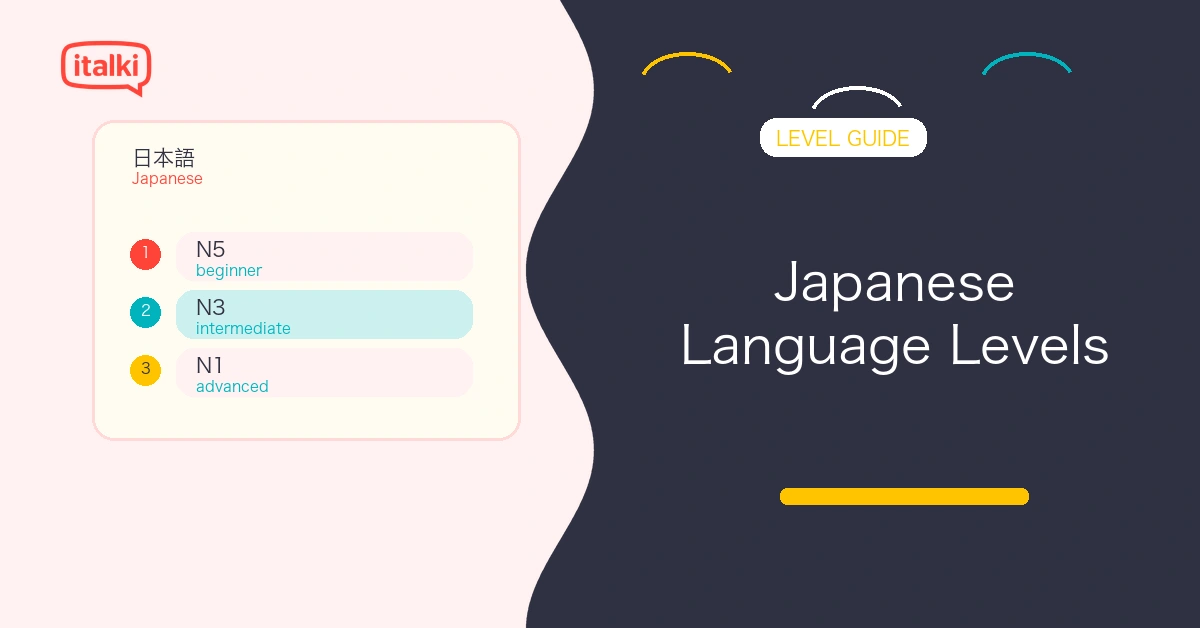
- The JLPT (Japanese Language Proficiency Test) is the most widely recognized Japanese proficiency certification worldwide. It has five levels from N5 (most basic) to N1 (most advanced). N2 is the minimum level required for most professional jobs in Japan; N1 is expected for positions in law, medicine, academic research, and high-level business communication.
- JLPT levels do not include a speaking or writing component: the exam tests only reading and listening. For a comprehensive proficiency benchmark including speaking and writing, the CEFR (Common European Framework of Reference) provides a mapped equivalent: N5 corresponds roughly to A1, N4 to A2, N3 to B1, N2 to B2, and N1 to C1-C2.
- The kanji requirements increase steeply across JLPT levels: N5 requires approximately 100 kanji, N4 approximately 300, N3 approximately 650, N2 approximately 1,000, and N1 approximately 2,000. The Japanese government’s standard for literate adults (常用漢字, jōyō kanji) is 2,136 characters, making N1 the approximate threshold for functional literacy.
- The Kanken (漢字検定, Japanese Kanji Aptitude Test) is a separate certification specifically for kanji knowledge, used primarily within Japan for native speakers and advanced learners. Unlike the JLPT, Kanken tests kanji writing as well as recognition.
Understanding how Japanese proficiency is measured helps you set realistic goals, communicate your level to employers or schools, and plan your study path effectively. italki connects learners with Japanese tutors who can assess your current level, help you prepare for the JLPT or other examinations, and build the specific skills each level requires.
This guide covers the JLPT level system in detail, the CEFR mapping, other Japanese proficiency tests, what each level requires in practical terms, and strategies for moving between levels.
Work with a Japanese tutor online to get an accurate assessment of your current level, build targeted skills for your next exam, and accelerate your progress through structured practice.

Find your perfect teacher
Build real speaking confidence with personalized lessons from a teacher who matches your goals, schedule, and learning style.
Book a trial lesson
The jlpt: Japan’s main proficiency test
The 日本語能力試験 (Nihongo Nōryoku Shiken, JLPT) is administered twice a year (July and December) at test sites in Japan and in over 70 countries worldwide. It is organized by the Japan Foundation and Japan Educational Exchanges and Services.
Key facts about the JLPT:
- Five levels: N5 (easiest) to N1 (hardest)
- Tests only reading and listening (no speaking or writing component)
- Results are scored by section; each section must meet a minimum score in addition to the total
- Certificate is valid indefinitely (does not expire)
- Accepted by Japanese universities, employers, and immigration authorities as proof of proficiency
JLPT test sections:
| Level | Test sections | Total time (approx.) |
|---|---|---|
| N5, N4 | Language Knowledge (vocabulary/grammar) + Reading, Listening | ~110 minutes |
| N3 | Language Knowledge (vocabulary), Language Knowledge (grammar) + Reading, Listening | ~140 minutes |
| N1, N2 | Language Knowledge (vocabulary/grammar) + Reading, Listening | ~170 minutes |
Scoring: Each level uses a scaled scoring system. The total score is 180 for N1 and N2, 180 for N3, and 180 for N4 and N5. Each section also has a minimum pass threshold. You must meet both the total minimum AND each section minimum to pass.
Jlpt n5: beginner
| Metric | N5 requirement |
|---|---|
| Vocabulary | Approximately 800 words |
| Kanji | Approximately 100 characters |
| Grammar | Basic sentence patterns |
| Study hours (approx.) | 150-300 hours from zero |
What N5 covers:
N5 tests knowledge of basic Japanese needed for simple, everyday situations. At this level, learners can:
- Read hiragana, katakana, and approximately 100 kanji
- Understand basic vocabulary related to daily life (numbers, time, greetings, common objects)
- Parse short, simple sentences
Representative N5 grammar:
- Topic marker は (wa), object marker を (o), direction marker へ/に (e/ni)
- Verb te-form for sequential actions
- Basic adjective conjugation (い-adjectives and な-adjectives)
- Simple question formation with か (ka)
- 〜たいです (I want to ~), 〜ないでください (please don’t ~)
N5 is the starting goal for most new learners and typically takes 6-12 months of consistent study to reach. For beginners, building a foundation in the writing systems first is essential. The guide to Japanese alphabets covers hiragana, katakana, and the basics of kanji that underpin all further study.
Find your perfect teacher
Build real speaking confidence with personalized lessons from a teacher who matches your goals, schedule, and learning style.
Book a trial lesson
Jlpt n4: elementary
| Metric | N4 requirement |
|---|---|
| Vocabulary | Approximately 1,500 words |
| Kanji | Approximately 300 characters |
| Grammar | Expanded sentence patterns and conjunctions |
| Study hours (approx.) | 300-600 hours from zero |
What N4 covers:
N4 extends the basic competency of N5 into more varied situations. At this level, learners can:
- Read texts on familiar topics at a slow pace
- Understand conversations in everyday situations when spoken slowly
- Express opinions and reasons with basic grammar structures
Representative N4 grammar:
- て-form connections, 〜てから (after doing ~), 〜ても (even if ~)
- Conditional 〜たら, 〜ば
- て-form for permission (〜てもいい), prohibition (〜てはいけない)
- 〜そうだ (looks like / I heard that), 〜らしい (apparently)
- Passive form, causative form
- 〜ために (in order to ~), 〜ながら (while doing ~)
N4 is typically reached after 1-2 years of study. At this point, learners have enough grammar and vocabulary to manage many travel situations and basic conversations.
Jlpt n3: lower intermediate
| Metric | N3 requirement |
|---|---|
| Vocabulary | Approximately 3,750 words |
| Kanji | Approximately 650 characters |
| Grammar | Full range of intermediate patterns |
| Study hours (approx.) | 450-900 hours from zero |
What N3 covers:
N3 represents the intermediate threshold. It is often described as the level at which learners begin to engage meaningfully with authentic Japanese content with significant effort. At this level, learners can:
- Read texts on a variety of everyday topics with some difficulty
- Follow conversations at natural speed on familiar topics
- Express ideas in connected sentences
Representative N3 grammar:
- 〜ようだ, 〜みたいだ (seems like), 〜はずだ (should be / expected to be)
- 〜てしまう (unfortunately ~, completely ~)
- 〜ことにする / 〜ことになる (decided to / it has been decided that)
- 〜ばかり (only, just), 〜だけ (only, just)
- 〜ので (because of, reason), 〜のに (despite, although)
- Honorific and humble forms beginning (〜ます patterns)
N3 is the level at which kanji knowledge becomes a serious focus. The relationship between on’yomi and kun’yomi readings is central to N3 study. The guide to on’yomi vs kun’yomi covers the two reading systems and strategies for learning multiple readings of the same kanji.
Find your perfect teacher
Build real speaking confidence with personalized lessons from a teacher who matches your goals, schedule, and learning style.
Book a trial lesson
Jlpt n2: upper intermediate
| Metric | N2 requirement |
|---|---|
| Vocabulary | Approximately 6,000 words |
| Kanji | Approximately 1,000 characters |
| Grammar | Advanced functional grammar including formal registers |
| Study hours (approx.) | 600-1,200 hours from zero |
What N2 covers:
N2 is the practical threshold for living and working in Japan. Most companies in Japan require at minimum N2 for positions where Japanese communication is essential. At this level, learners can:
- Read newspaper and magazine articles with moderate difficulty
- Follow TV news and standard-pace conversation on most topics
- Participate in most workplace and social conversations
Representative N2 grammar:
- 〜に対して (toward, in relation to), 〜に関して (regarding)
- 〜わけだ, 〜わけがない (that’s why / there’s no way ~)
- 〜を通じて / 〜を通して (through, via)
- 〜に比べて (compared to)
- 〜に伴って (as ~ happens / accompanying)
- 〜どころか (far from ~, let alone ~)
- Formal written grammar patterns
N2 involves significant engagement with formal Japanese and keigo (honorific language). At this level, learners need to understand both written and spoken registers.
Jlpt n1: advanced
| Metric | N1 requirement |
|---|---|
| Vocabulary | Approximately 10,000 words |
| Kanji | Approximately 2,000 characters |
| Grammar | Full range of formal, literary, and colloquial patterns |
| Study hours (approx.) | 900-2,000+ hours from zero |
What N1 covers:
N1 is the highest JLPT level and represents near-native functional literacy. At this level, learners can:
- Read newspapers, novels, academic papers, and legal documents with good comprehension
- Follow TV news, lectures, and discussions at natural speed
- Participate in complex discussions on abstract topics
- Use a full range of formal, informal, and written registers
Representative N1 grammar:
- Literary and classical patterns (〜べき, 〜をもって, 〜にほかならない)
- Advanced connective patterns (〜にもかかわらず, 〜にしろ)
- Subtle nuance patterns (〜かねる, 〜兼ねない)
- Full keigo (sonkeigo / kenjōgo / teineigo distinctions)
- 文語 (bungo, written/classical language) elements
N1 requires extensive reading of authentic Japanese material, broad vocabulary, and deep grammar knowledge. The study period from N2 to N1 often takes as long as the journey from zero to N2.
Find your perfect teacher
Build real speaking confidence with personalized lessons from a teacher who matches your goals, schedule, and learning style.
Book a trial lesson
Jlpt vs cefr: how the levels map
| JLPT level | Approximate CEFR equivalent | Description |
|---|---|---|
| N5 | A1 | Beginner: handles basic isolated phrases |
| N4 | A2 | Elementary: handles simple familiar situations |
| N3 | B1 | Lower intermediate: handles everyday topics |
| N2 | B2 | Upper intermediate: handles most situations |
| N1 | C1-C2 | Advanced to mastery |
Important caveat: This mapping is approximate. The JLPT does not test speaking or writing, which means a high JLPT score does not guarantee equivalent spoken or written production ability. Someone with N2 reading and listening ability may have significantly weaker speaking ability if they have not practiced production. CEFR assessments measure all four skills; JLPT measures only two.
Practical implication for learners: If your goal is academic study or employment in Japan, the JLPT is the recognized credential. If your goal is comprehensive communicative competence, supplement JLPT study with regular speaking practice.
Other Japanese proficiency tests
Kanken (漢字検定, Japanese Kanji Aptitude Test): The Kanken tests kanji knowledge including reading, writing, meaning, and word formation. It has 12 levels, with Level 2 corresponding roughly to the standard of 2,136 jōyō kanji and Level 1 including an additional 3,000+ kanji used in names and classical texts. Unlike the JLPT, Kanken tests writing (you must write kanji by hand). It is primarily a test for native speakers and is used in Japan for educational and employment purposes.
J-CAT (Japanese Computerized Adaptive Test): An online adaptive proficiency test that adjusts question difficulty based on performance. It covers vocabulary, listening, grammar, and reading. J-CAT provides a numerical score that can be mapped to JLPT and CEFR equivalents. It is used by Japanese language schools for placement and by learners for self-assessment.
BJT (Business Japanese Test): A test specifically designed to assess Japanese proficiency in business contexts. It evaluates listening and reading ability in workplace situations: business meetings, customer service, email comprehension. It is used primarily by companies recruiting Japanese-speaking staff.
EJU (Examination for Japanese University Admission for International Students): Required for international students applying to Japanese universities. It covers Japanese language alongside subject-matter tests. The Japanese component tests reading, listening-reading, and listening.
Find your perfect teacher
Build real speaking confidence with personalized lessons from a teacher who matches your goals, schedule, and learning style.
Book a trial lesson
What you can do at each level
| JLPT level | Real-world capability |
|---|---|
| N5 | Order from a menu; read basic signs and hiragana/katakana; count and tell time; simple greetings |
| N4 | Navigate travel situations; have basic conversations on familiar topics; read simple texts slowly |
| N3 | Follow daily conversation with some gaps; read most everyday texts with occasional lookups; watch anime/TV with subtitles |
| N2 | Work in Japan in most professional roles; read news articles; watch most TV without subtitles; write business emails |
| N1 | Follow lectures and complex discussions; read academic papers and literature; operate fully in formal and professional contexts |
Preparation strategies by level
For N5 and N4:
- Master hiragana and katakana before studying vocabulary
- Use spaced repetition flashcard apps (Anki, Wanikani for kanji) for vocabulary and kanji
- Focus on core grammar patterns from a structured textbook (Genki I and II cover roughly N5-N4 range)
- Practice listening with graded materials at your level
For N3:
- Expand reading to simple authentic texts: manga, graded readers, children’s books
- Begin active kanji study with compound words, not just single characters
- Listen to standard-speed Japanese audio with transcripts
- Start noticing formal vs informal speech differences
For N2:
- Read Japanese newspapers and magazine articles regularly
- Study keigo (honorific language) systematically
- Practice grammar in written form: write short essays and have them corrected
- Use practice test books specifically designed for N2 (the grammar and reading density increases significantly)
For N1:
- Read novels, opinion pieces, and technical articles in your field
- Listen to fast-paced content: news, talk shows, debates, lectures
- Study literary grammar patterns and formal written style
- Work through N1 practice tests under timed conditions
For building the verb conjugation skills that underpin grammar at all JLPT levels, the guide to Japanese conjugation practice covers the full conjugation system with practice examples.
Find your perfect teacher
Build real speaking confidence with personalized lessons from a teacher who matches your goals, schedule, and learning style.
Book a trial lesson
Prepare for the jlpt with a tutor
The JLPT requires systematic preparation: learning specific vocabulary lists, mastering grammar patterns, and building test-taking strategies for each section. A tutor can assess your current level accurately, identify which vocabulary and grammar gaps are most important to close, and provide practice with the types of questions that appear on the actual exam.
italki’s 30,000+ expert tutors include native Japanese speakers and certified JLPT preparation specialists who have helped thousands of learners reach their target levels. Trusted by over 10 million learners worldwide, the platform lets you find a tutor who specializes in the specific level you are targeting. Book a trial lesson and get a roadmap for reaching your JLPT target.
Find your perfect teacher
Build real speaking confidence with personalized lessons from a teacher who matches your goals, schedule, and learning style.
Book a trial lesson
FAQ
What is the difference between JLPT N1 and N2?
N2 is the practical threshold for professional life in Japan: most companies require at minimum N2 for Japanese-language roles. N1 is the highest level and represents near-native functional literacy. N1 requires approximately 2,000 kanji and 10,000 vocabulary items, compared to N2’s approximately 1,000 kanji and 6,000 vocabulary items. The gap between N2 and N1 is often described as one of the largest jumps in the series.
Is the JLPT a speaking test?
No. The JLPT tests only reading and listening comprehension. There is no speaking or writing production component. This means a high JLPT score demonstrates strong reading and listening ability but does not directly assess spoken fluency or writing ability. For a comprehensive proficiency assessment, JLPT should be supplemented with speaking practice and separate assessment.
How many hours does it take to pass JLPT N1?
Estimates vary significantly based on the learner’s first language, study methods, and immersion opportunities. For English speakers starting from zero, estimates range from approximately 2,200 to 4,800 hours, with 2,200 representing highly efficient study and immersion. Japanese shares linguistic features with Korean that give Korean speakers a significant advantage. The JLPT official guidelines suggest approximately 900 hours from zero to reach N1 level, which most learners and researchers consider a conservative estimate.
What is the Kanken?
漢字検定 (Kanji Kentei, commonly called Kanken) is the Japanese Kanji Aptitude Test, administered by the Japan Kanji Aptitude Testing Foundation. It tests kanji knowledge including reading, writing, stroke order, and meaning, and uniquely tests handwritten production. It has 12 levels: Level 10 for beginning elementary school students through Level 1 for mastery beyond standard literacy. Level 2 covers the 2,136 jōyō kanji used in everyday Japanese life.
How long is the JLPT certificate valid?
JLPT certificates do not expire. Once you pass a level, the certification is valid indefinitely. However, some employers and universities may prefer recent results. The test is administered twice per year (typically in July and December) at test sites across Japan and in over 70 countries.
Want to learn a language at italki?
Here are the best resources for you!