Key takeaways
- 今日 (kyou: today) and 昨日 (kinou: yesterday) are high-frequency anchor words that appear in almost every daily conversation.
- The particle に (ni) marks specific, clock-anchored times but is not used with relative words like today and tomorrow.
- Japanese expresses AM and PM using 午前 (gozen: AM) and 午後 (gogo: PM), placed before the hour.
- Relative time words follow a consistent pattern: 先 (sen: last/previous), 今 (kon/ko: this), and 来 (rai: next/coming).
- Clock time uses 時 (ji: o’clock) for hours and 分 (fun/pun: minutes); knowing Japanese numbers is essential for reading times accurately.
You are checking the departure board at Shinjuku Station. The platform screen shows times in Japanese, the announcement is fast, and you need to know whether your train left five minutes ago or arrives in ten. Japanese time vocabulary is the specific gap between understanding nothing and getting where you need to go.
With 30,000+ tutors across 150+ languages, italki connects you with Japanese tutors who can run real scheduling conversations with you until reading and hearing time information in Japanese becomes automatic rather than effortful.
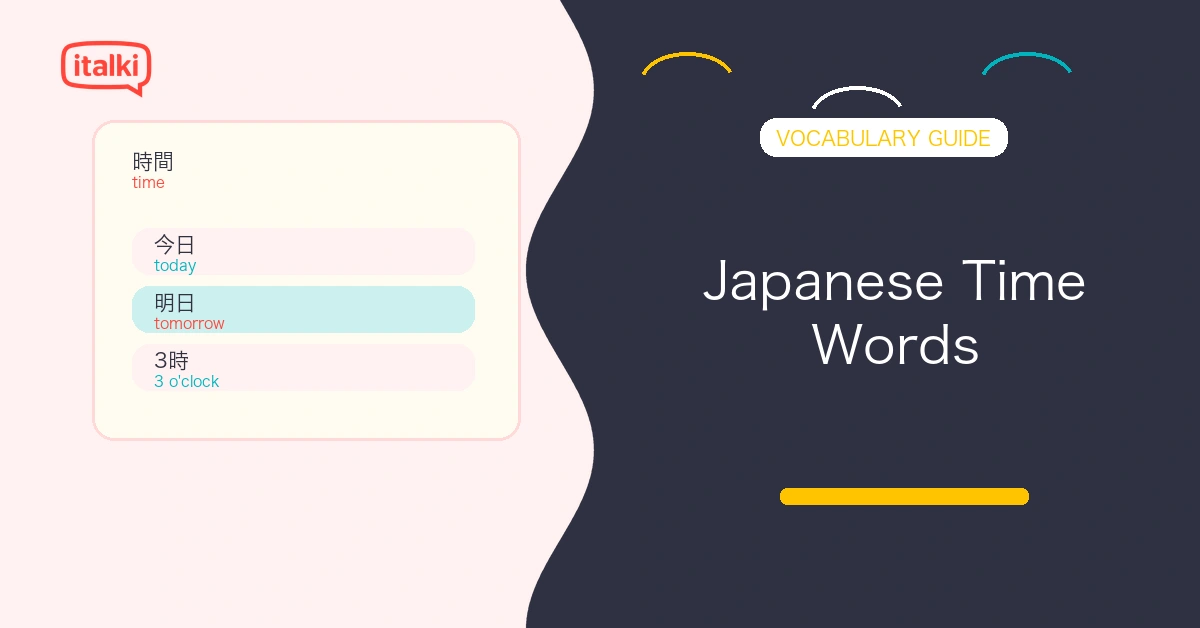
Now, today, yesterday, tomorrow These four anchor words cover most of what you need for daily time references:
| Japanese | Romaji | English |
|---|---|---|
| 今 | ima | now |
| 今日 | kyou | today |
| 昨日 | kinou | yesterday |
| 明日 | ashita / asu | tomorrow |
| 今夜 | kon’ya | tonight |
| 明後日 | asatte | the day after tomorrow |
| 一昨日 | ototoi | the day before yesterday |
| 毎日 | mainichi | every day |
Note: 明日 is read ashita in conversational speech and asu in formal or written contexts. Both are correct; the reading changes with the register.
Recognize these distinctions through dialogue practice with a Japanese instructor.

Find your perfect teacher
Build real speaking confidence with personalized lessons from a teacher who matches your goals, schedule, and learning style.
Book a trial lesson
Times of day
| Japanese | Romaji | English |
|---|---|---|
| 朝 | asa | morning |
| 午前 | gozen | AM (before noon) |
| 昼 | hiru | noon / midday |
| 午後 | gogo | PM (after noon) |
| 夕方 | yuugata | late afternoon / early evening |
| 夜 | yoru | evening / night |
| 深夜 | shinya | late night |
| 夜中 | yonaka | middle of the night |
In formal contexts such as train schedules and appointments, 午前 (gozen) and 午後 (gogo) appear before the hour: 午前9時 (gozen ku-ji: 9 AM), 午後3時 (gogo san-ji: 3 PM). In everyday conversation, 朝 (asa: morning) and 夜 (yoru: evening) are more natural.
Book private Japanese lessons with a native speaker to practice these time-of-day phrases in scheduling contexts.
Clock times: hours and minutes
Japanese clock time follows the pattern: hour + 時 (ji: o’clock) + minutes + 分 (fun/pun: minutes).
| Japanese | Romaji | English |
|---|---|---|
| 1時 | ichi-ji | 1 o’clock |
| 3時 | san-ji | 3 o’clock |
| 6時 | roku-ji | 6 o’clock |
| 12時 | juuni-ji | 12 o’clock |
| 15分 | juugo-fun | 15 minutes |
| 30分 | sanjup-pun | 30 minutes |
| 45分 | yonjuugo-fun | 45 minutes |
| 半 | han | half past (used after the hour: 3時半 = half past 3) |
Reading clock times requires understanding Japanese numbers, especially the irregular hour readings and the fun/pun pronunciation shift for minutes.
Start your Japanese lesson online and work on these time-telling patterns with a native Japanese speaker in a realistic conversation.
Find your perfect teacher
Build real speaking confidence with personalized lessons from a teacher who matches your goals, schedule, and learning style.
Book a trial lesson
The time particle に (ni)
に (ni) marks a specific point in time. The rule is clear: use に for clock-anchored or calendar-anchored times, not for relative expressions like today, yesterday, or tomorrow.
Use に: 3時に (san-ji ni: at 3 o’clock), 月曜日に (getsuyoubi ni: on Monday), 来年に (rainen ni: next year).
Do not use に: 今日 (kyou: today), 昨日 (kinou: yesterday), 毎朝 (mai-asa: every morning).
Solidify this particle distinction with a Japanese teacher through targeted sentence practice.
Relative time: weeks, months, years
| Japanese | Romaji | English |
|---|---|---|
| 今週 | konshuu | this week |
| 先週 | senshuu | last week |
| 来週 | raishuu | next week |
| 今月 | kongetsu | this month |
| 先月 | sengetsu | last month |
| 来月 | raigetsu | next month |
| 今年 | kotoshi | this year |
| 去年 | kyonen | last year |
| 来年 | rainen | next year |
Connect relative time to conversation with a Japanese private tutor in real dialogue.
Find your perfect teacher
Build real speaking confidence with personalized lessons from a teacher who matches your goals, schedule, and learning style.
Book a trial lesson
Frequency and duration words
| Japanese | Romaji | English |
|---|---|---|
| 毎週 | maishuu | every week |
| 毎月 | maitsuki | every month |
| いつも | itsumo | always |
| 時々 | tokidoki | sometimes |
| たまに | tama ni | occasionally |
| もうすぐ | mousugu | very soon |
| さっき | sakki | a little while ago |
| あとで | ato de | later |
| まだ | mada | not yet / still |
| もう | mou | already / anymore |
もう (mou) and まだ (mada) are a pair to memorize together. もう means something has already happened or is now done; まだ means something has not happened yet or is still ongoing.
Build these frequency words with a Japanese tutor on italki through contextual use.
Common sentence patterns with time words
- 今、東京にいます。(Ima, Tokyo ni imasu: I am in Tokyo now.)
- 昨日、映画を見ました。(Kinou, eiga wo mimashita: I watched a film yesterday.)
- 明日の3時に会いましょう。(Ashita no san-ji ni aimashou: Let’s meet tomorrow at 3 o’clock.)
- 先週、京都に行きました。(Senshuu, Kyoto ni ikimashita: I went to Kyoto last week.)
- 毎朝、コーヒーを飲みます。(Mai-asa, koohii wo nomimasu: I drink coffee every morning.)
- もう行きました。(Mou ikimashita: I already went.)
- まだ食べていません。(Mada tabete imasen: I have not eaten yet.)
Time vocabulary is simple to learn from a table and surprisingly hard to use correctly under pressure. With 30,000+ expert tutors on italki trusted by over 10 million learners worldwide, a Japanese teacher can run scheduling, travel, and daily routine roleplays with you until time expressions stop being words you translate and start being words you just reach for. Book a trial lesson today.
FAQ Do 今日 (kyou) and 本日 (honjitsu) both mean today?
Yes, both mean today, but 本日 (honjitsu) is formal and used in announcements, business communications, and official contexts. 今日 (kyou) is the everyday word for conversation.
How do you say two hours vs two o’clock in Japanese?
Two o’clock is 2時 (ni-ji: two o’clock). Two hours as a duration is 2時間 (ni-jikan: two hours). The addition of 間 (kan: interval/period) changes a point in time into a duration.
Which comes first in a Japanese sentence: the time or the topic?
Time words are highly flexible in Japanese sentence position, but the most natural placement is at the very beginning of the sentence before the topic marker は (wa). The order is: time + topic + object + verb.
Find your perfect teacher
Build real speaking confidence with personalized lessons from a teacher who matches your goals, schedule, and learning style.
Book a trial lesson
Want to learn a language at italki?
Here are the best resources for you!