Key takeaways
- Japanese has many words that overlap in meaning but differ in formality, intensity, or the type of situation they belong in.
- Casual words like でかい (dekai, huge) are natural with close friends but can sound blunt or even rude in formal settings.
- Some words that learners treat as synonyms are not fully interchangeable: 面白い (omoshiroi) can mean interesting or funny, while 楽しい (tanoshii) only means fun or enjoyable.
- Knowing which word fits which situation is one of the fastest ways to sound genuinely natural in Japanese.
Choosing the right word in Japanese is not just about getting the meaning across. It is about matching the word to the social context, the relationship between you and your listener, and the level of formality the moment calls for.
Many learners get the core meaning right but pick a word that sounds too blunt, too stiff, or too childish for the situation. Working with a tutor through italki gives you a chance to practice these choices in real conversations and get honest feedback on how natural you actually sound.
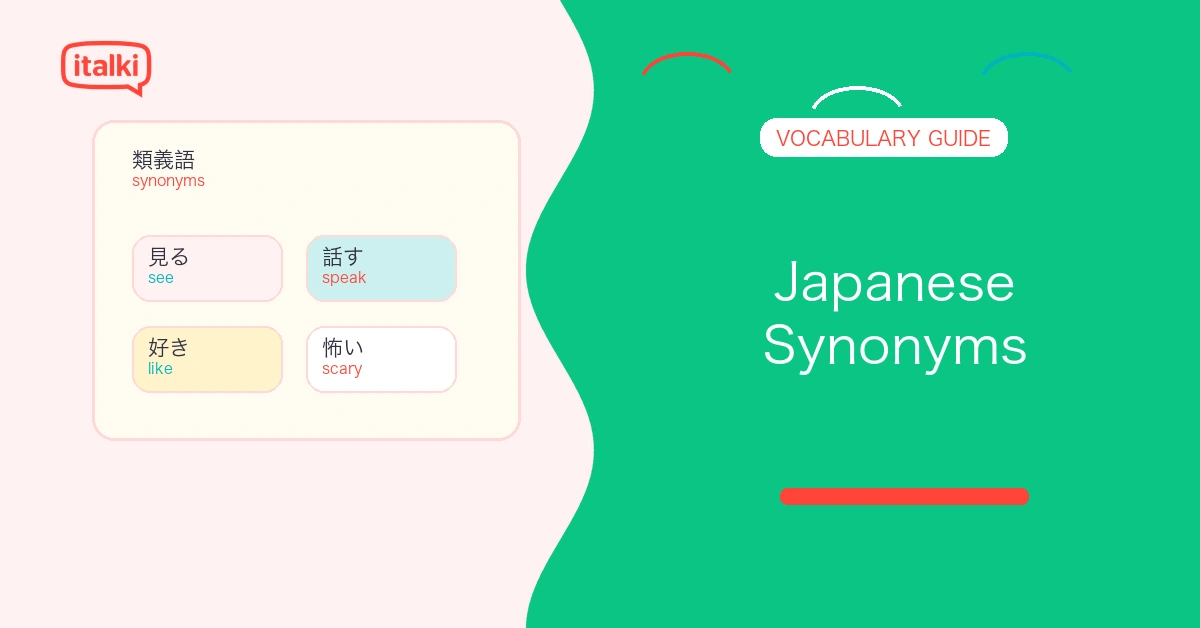
This guide covers eight synonym groups: see/be visible/watch (見る, 見える, 観る), say/speak/chat (言う, 話す, しゃべる), like/love (好き, 大好き, 愛している), big (大きい, でかい, 巨大な), scary (怖い, 恐ろしい, ゾッとする), tired (疲れた, くたびれた, 疲弊した), pretty/beautiful/cute (きれい, 美しい, かわいい), and interesting vs fun (面白い, 楽しい). italki tutors can help you practice these word groups in context until the right choice becomes instinctive.
Find an experienced Japanese language tutor and practice choosing the right word in real-time conversations.

Find your perfect teacher
Build real speaking confidence with personalized lessons from a teacher who matches your goals, schedule, and learning style.
Book a trial lesson
Why Japanese synonyms matter
In English, you can often swap big for large without anyone noticing. Japanese is less flexible. でかい (dekai, big/huge) and 大きい (ookii, big) both translate to big in English, but でかい is blunt and casual. Use it in the wrong setting and you sound rude rather than expressive.
Register is the main driver of these differences. Japanese has distinct layers of language for formal settings, everyday conversations, and close-friend speech. A word that sounds warm and natural among friends can sound jarring or disrespectful in a professional context. Learners who ignore register can come across as immature or impolite even when they mean nothing of the sort.
Building your vocabulary by studying synonym groups alongside Japanese nouns gives you a much richer mental map of the language. Rather than knowing one word for each meaning, you learn the full range and when to reach for each option.
見る、見える、観る: to look, to be visible, to watch
These three words all relate to seeing, but they each describe a different relationship between you and what you see.
| Japanese | Romaji | English |
|---|---|---|
| 見る | miru | to look at, to see (active and intentional) |
| 見える | mieru | to be visible, to be able to see (passive or natural) |
| 観る | miru | to watch entertainment: films, plays, performances |
Note that 見る and 観る have exactly the same romaji (miru) but different kanji. This distinction shows up in writing and signals how you are engaging with what you see.
見る (miru) is the general, active verb for looking at something or seeing something. テレビを見る (terebi o miru) means to watch TV. この書類を見る (kono shorui o miru) means to look at these documents. It covers most everyday acts of looking.
見える (mieru) describes something appearing in your visual field passively. You are not actively trying to see it; it is just there. 富士山が見える (fujisan ga mieru) means Mount Fuji can be seen from here or Mount Fuji is visible. If you wear glasses and suddenly see clearly, you would say よく見える (yoku mieru, I can see well now), not 見る.
観る (miru) is used specifically for engaging with creative or performance content. 映画を観る (eiga o miru) means to watch a film. 舞台を観る (butai o miru) means to watch a stage performance. Using the standard 見る kanji is not wrong here, but 観る carries a nuance of appreciative, attentive viewing.
Find your perfect teacher
Build real speaking confidence with personalized lessons from a teacher who matches your goals, schedule, and learning style.
Book a trial lesson
言う、話す、しゃべる: to say, to speak, to chat
| Japanese | Romaji | English |
|---|---|---|
| 言う | iu | to say, to tell (often quotes specific words or content) |
| 話す | hanasu | to speak, to talk (conversation or extended exchange) |
| しゃべる | shaberu | to chat, to talk freely (informal, casual) |
言う (iu) focuses on what was said. It often introduces or reports specific words or statements. 彼はそう言った (kare wa sou itta) means he said so or he said that. 何と言いましたか (nani to iimashita ka) means what did you say? It is about the content of speech more than the act of speaking.
話す (hanasu) emphasizes the act of having a conversation or speaking at length with someone. 先生と話した (sensei to hanashita) means I talked with the teacher. 日本語を話す (nihongo o hanasu) means to speak Japanese. It is the standard word for describing conversations and language ability.
しゃべる (shaberu) is casual and suggests talking freely, chatting, or talking a lot. 友達としゃべった (tomodachi to shabetta) means I chatted with a friend. It can also carry the nuance of talking too much or gossiping. Avoid it in formal or professional contexts, where 話す is the right choice.
好き、大好き、愛している: to like, to love
| Japanese | Romaji | English |
|---|---|---|
| 好き | suki | to like, to be fond of |
| 大好き | daisuki | to really like, to love (versatile, enthusiastic) |
| 愛している | aishite iru | to love deeply (serious, romantic or profound) |
好き (suki) covers liking in a broad and neutral sense. 猫が好き (neko ga suki) means I like cats. コーヒーが好き (koohii ga suki) means I like coffee. It is versatile and works for people, food, hobbies, and places.
大好き (daisuki) intensifies the feeling. The 大 (dai) prefix means great or big, so 大好き expresses strong fondness or love. ラーメンが大好き (ramen ga daisuki) means I love ramen. You can also use it affectionately with people: 君が大好き (kimi ga daisuki) means I really love you in a warm, approachable way.
愛している (aishite iru) is a serious and weighty expression. It is used for profound romantic love or deep devotion. In Japanese culture, saying 愛している is a significant declaration. It is much heavier than its English equivalent I love you and is far less common in everyday speech. Between casual partners or in everyday affection, 大好き is much more natural.
Find your perfect teacher
Build real speaking confidence with personalized lessons from a teacher who matches your goals, schedule, and learning style.
Book a trial lesson
大きい、でかい、巨大な: big, huge, enormous
| Japanese | Romaji | English |
|---|---|---|
| 大きい | ookii | big, large (neutral and standard) |
| でかい | dekai | huge, massive (casual, blunt) |
| 巨大な | kyodai na | enormous, gigantic (formal, written or academic) |
大きい (ookii) is the standard, neutral word for big. Use it in any context and it will be appropriate: 大きい犬 (ookii inu, a big dog), 大きい問題 (ookii mondai, a big problem). There is no risk of sounding too casual or too stiff with this word.
でかい (dekai) is a casual, blunt word for big or massive. It is common among male friends and in informal conversation, and carries a raw, unfiltered energy. Say でかい at a work meeting and people will notice the register clash. Use it freely with close friends.
巨大な (kyodai na) is formal and used for things that are genuinely enormous in scale. It appears in news reporting, academic writing, and formal descriptions. 巨大な企業 (kyodai na kigyou, a giant corporation), 巨大な建物 (kyodai na tatemono, an enormous building). It is rarely used in everyday casual conversation.
怖い、恐ろしい、ゾッとする: scary, terrifying, chilling
| Japanese | Romaji | English |
|---|---|---|
| 怖い | kowai | scary, frightening (common, everyday) |
| 恐ろしい | osoroshii | terrifying, dreadful (stronger, literary or serious) |
| ゾッとする | zotto suru | to feel chilled, to get goosebumps (sensory, vivid) |
怖い (kowai) is the most common word for scary. It works in both casual and semi-formal contexts. 怖い映画 (kowai eiga, a scary movie), 怖い夢 (kowai yume, a scary dream), 怖い人 (kowai hito, a scary person). It is your safe default whenever something frightens you.
恐ろしい (osoroshii) carries significantly more weight. It describes something deeply disturbing, terrible, or dreadful. 恐ろしい事件 (osoroshii jiken, a terrible incident) is the kind of phrase you would see in a news headline. It has a more literary and formal tone than 怖い.
ゾッとする (zotto suru) describes the physical sensation of being creeped out or getting goosebumps. それを聞いてゾッとした (sore o kiite zotto shita) means Hearing that gave me the chills. It focuses on your body’s reaction rather than a general judgment of something being scary. It is more vivid and expressive than the other two options.
Find your perfect teacher
Build real speaking confidence with personalized lessons from a teacher who matches your goals, schedule, and learning style.
Book a trial lesson
疲れた、くたびれた、疲弊した: tired, worn out, depleted
| Japanese | Romaji | English |
|---|---|---|
| 疲れた | tsukareta | tired (standard, neutral, everyday) |
| くたびれた | kutabireta | worn out, physically exhausted (casual, vivid) |
| 疲弊した | hiheishita | depleted, burned out (formal, often systemic) |
疲れた (tsukareta) is the most common and neutral way to say you are tired. Use it after a long workday, after exercise, or whenever you feel run down. 疲れた (tsukareta) fits both casual and semi-formal contexts equally well and is the form beginners should learn first.
くたびれた (kutabireta) is more vivid and physical. It suggests feeling completely used up, like a worn-out pair of shoes. It can also describe objects: a worn, shabby coat or bag might be called くたびれた. When used about a person, it implies genuine physical exhaustion rather than mild tiredness.
疲弊した (hiheishita) is formal and carries the sense of being systematically drained over time. It often appears in formal reports, medical or organizational contexts, and serious writing: 社員が疲弊した (shain ga hiheishita, the employees are burned out/depleted). You would not use this word in casual everyday conversation.
きれい、美しい、かわいい: pretty, beautiful, cute
| Japanese | Romaji | English |
|---|---|---|
| きれい | kirei | pretty, clean, tidy (versatile and everyday) |
| 美しい | utsukushii | beautiful (elevated, poetic, or formal) |
| かわいい | kawaii | cute, adorable, endearing |
きれい (kirei) covers both pretty and clean or tidy, which surprises many learners. きれいな花 (kirei na hana) means a pretty flower. 部屋がきれい (heya ga kirei) means the room is clean. This word is extremely versatile and works in almost any context, from complimenting someone’s appearance to describing a tidy space, and it also shows why learning Japanese adjectives by usage pattern is more useful than memorizing one English translation.
美しい (utsukushii) is more elevated and often carries a poetic quality. Use it when the beauty is striking, profound, or deserving of a more formal register. 美しい音楽 (utsukushii ongaku, beautiful music), 美しい景色 (utsukushii keshiki, beautiful scenery), 美しい言葉 (utsukushii kotoba, beautiful words). It would feel overwrought or out of place in casual everyday conversation.
かわいい (kawaii) means cute, adorable, or endearing. It is one of the most frequently used words in everyday Japanese and covers a wide range: babies, puppies, small accessories, fashion styles, and even certain behaviors can all be かわいい. It carries warmth and is used freely across age groups.
Find your perfect teacher
Build real speaking confidence with personalized lessons from a teacher who matches your goals, schedule, and learning style.
Book a trial lesson
面白い、楽しい: interesting/funny vs fun
These two words are frequently confused by learners because both describe positive experiences, but they are not interchangeable.
| Japanese | Romaji | English |
|---|---|---|
| 面白い | omoshiroi | interesting, funny, or amusing (about content or a situation) |
| 楽しい | tanoshii | fun, enjoyable (about an experience or activity you participate in) |
面白い (omoshiroi) describes content or situations that capture your attention, make you curious, or make you laugh. この映画は面白い (kono eiga wa omoshiroi) means this movie is interesting or this movie is funny, depending on context. The quality is in the thing itself, not in your participation.
楽しい (tanoshii) describes the feeling of enjoying something you are actively doing or participating in. パーティーは楽しかった (paatii wa tanoshikatta) means the party was fun. 日本語の勉強は楽しい (nihongo no benkyou wa tanoshii) means studying Japanese is fun. It is about your experience of engagement, not the intellectual content of the thing.
Saying 面白い about a party implies you found it intellectually interesting rather than genuinely fun. Saying 楽しい about a book sounds slightly odd because you typically use 楽しい for active, participatory experiences. Getting this distinction right will make your Japanese sound noticeably more natural.
Understanding the suffixes that attach to these adjectives also helps you build vocabulary. 面白さ (omoshirosa, the quality of being interesting) and 楽しさ (tanoshisa, the quality of being fun) are forms you will encounter as your reading level grows.
Tips for choosing the right synonym
Match the word to the register of the situation. Casual words like でかい and しゃべる belong in conversations with close friends. Formal words like 巨大な and 疲弊した belong in writing or serious discussions. Using the wrong register is one of the most common errors intermediate learners make.
Pay attention to what the word describes. Some words describe an action (言う is about what was said). Others describe a state (見える is about what is visible). Some describe a feeling in your body (ゾッとする is a physical sensation). Getting that level right makes your meaning much more precise.
Listen for these words in Japanese media. Drama series, variety shows, and podcasts expose you to these synonyms in natural context. Pay attention to who says which word and in what kind of situation. You will start to feel the difference before you can explain it.
Practice synonym choices with a live tutor. It is very hard to know if your choice sounds natural until someone who knows the language well gives you feedback. Find a Japanese language specialist on italki and use synonym groups as a conversation practice tool.
Practicing word choices with a tutor accelerates your feel for the language in a way that studying lists alone cannot. A good tutor will notice when you use 愛している in a context where 大好き would sound more natural, or when でかい slips into a formal sentence, and explain exactly why the swap matters in that moment.
italki’s 30,000+ expert tutors include Japanese specialists at every level, from beginner to advanced. Trusted by over 10 million learners worldwide, italki helps you find a tutor who fits your goals, schedule, and learning style. Book a trial lesson and start choosing Japanese synonyms with confidence and precision.
Find your perfect teacher
Build real speaking confidence with personalized lessons from a teacher who matches your goals, schedule, and learning style.
Book a trial lesson
FAQ
What is the difference between 見る (miru) and 観る (miru) in Japanese?
Both are pronounced miru but use different kanji. 見る is the general, active verb for looking at or seeing something. 観る is used specifically for watching entertainment or performance content, such as films, plays, or sports events. The kanji carries a nuance of attentive, appreciative watching.
When should I use 愛している (aishite iru) instead of 大好き (daisuki)?
愛している is a serious, weighty declaration of deep romantic love or profound devotion. 大好き is enthusiastic affection that works for people, food, hobbies, and much more. In everyday Japanese, 大好き is far more common and sounds natural in most affectionate contexts. Reserve 愛している for truly significant romantic declarations.
Why does きれい (kirei) mean both pretty and clean?
きれい covers both visual beauty and physical neatness under the same umbrella word. The meaning is always clear from context. きれいな部屋 (kirei na heya) refers to a clean, tidy room, while きれいな人 (kirei na hito) describes an attractive person. Japanese often uses one word where English uses two distinct ones.
Is でかい (dekai) considered rude in Japanese?
でかい is not rude in itself, but it is blunt and casual. Using it in formal settings or with people you do not know well sounds like a register mismatch and can come across as impolite. In relaxed conversation with close friends, it is completely natural and often used for emphasis.
What is the difference between 面白い (omoshiroi) and 楽しい (tanoshii)?
面白い describes content or situations that are interesting, amusing, or funny. 楽しい describes the feeling of enjoying an activity or experience you are participating in. A book or movie is typically 面白い. A party or outing is typically 楽しい. Mixing these up is a very common learner mistake that can make sentences sound slightly off to a native speaker.
Want to learn a language at italki?
Here are the best resources for you!