Key takeaways
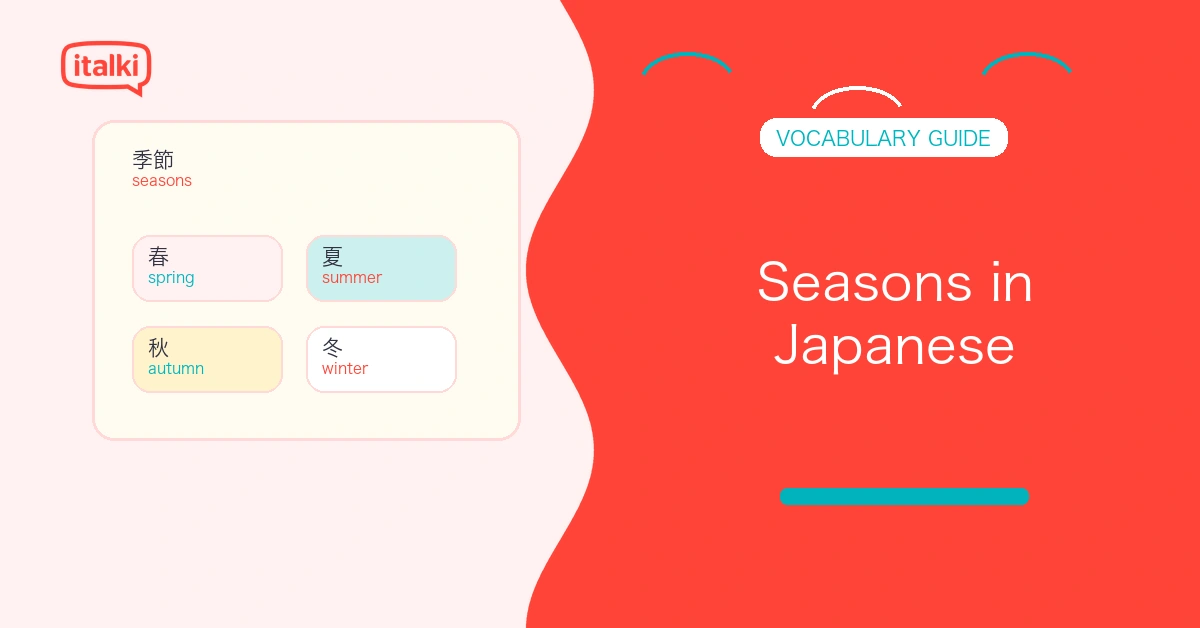
- Japanese has four seasons with distinct names: 春 (haru, spring), 夏 (natsu, summer), 秋 (aki, autumn), and 冬 (fuyu, winter). The word for the four seasons as a concept is 四季 (shiki, literally four seasons), which is also used to describe Japan’s celebrated seasonal variety.
- Seasons in Japan are deeply embedded in culture, art, food, and daily life in ways that go beyond weather vocabulary. Each season has associated customs (花見 hanami in spring, 花火 hanabi in summer, 紅葉 kōyō in autumn, こたつ kotatsu in winter), foods, and even a poetic tradition (kigo) of seasonal reference words used in haiku.
- Japanese weather vocabulary follows predictable patterns: adjectives ending in –い (samui, cold; atsui, hot; suzushii, cool; atatakai, warm) describe the feeling of the air. Adding です (desu) makes them polite statements: 今日は寒いです (kyō wa samui desu, it is cold today).
- Japan has a rainy season called 梅雨 (tsuyu or baiu), which typically falls in June and early July across most of the country. Understanding this season is essential for travel planning and appears frequently in both weather conversations and cultural references.
The seasons are one of the most frequently discussed topics in Japanese daily conversation, and seasonal vocabulary appears in everything from weather small talk to invitations for seasonal activities. Understanding the seasons also opens the door to Japanese cultural practices that are central to daily life.
italki connects learners with Japanese tutors who can help you use seasonal vocabulary naturally in real conversation and explain the cultural context that makes these expressions meaningful. This guide covers vocabulary for all four seasons, weather words, seasonal customs, seasonal foods, and calendar language.
Work with a Japanese tutor online to practice seasonal vocabulary in real conversation and learn the cultural knowledge that makes Japanese seasonal expressions come alive.

Find your perfect teacher
Build real speaking confidence with personalized lessons from a teacher who matches your goals, schedule, and learning style.
Book a trial lesson
The four seasons in Japanese
| Characters | Romaji | English |
|---|---|---|
| 四季 | shiki | the four seasons |
| 春 | haru | spring |
| 夏 | natsu | summer |
| 秋 | aki | autumn / fall |
| 冬 | fuyu | winter |
| 季節 | kisetsu | season (general word) |
| 季節の変わり目 | kisetsu no kawarime | seasonal transition |
Approximate seasonal dates in Japan:
- Spring: March to May
- Summer: June to August (with a distinct rainy season in June-July)
- Autumn: September to November
- Winter: December to February
Japan’s island geography and north-south extent create significant regional variation: while Okinawa barely has a winter, Hokkaido has heavy snowfall from November through April. The seasonal dates above apply broadly to the central Honshu region.
Spring vocabulary and customs
| Characters | Romaji | English |
|---|---|---|
| 桜 | sakura | cherry blossoms |
| 花見 | hanami | cherry blossom viewing |
| 花 | hana | flower / blossom |
| 梅 | ume | plum blossom |
| 春風 | harukaze | spring breeze |
| 暖かい | atatakai | warm |
| 春雨 | harusame | spring rain |
| 卒業式 | sotsugyōshiki | graduation ceremony |
| 入学式 | nyūgakushiki | school entrance ceremony |
| 新学期 | shingakki | new school term |
| 花粉症 | kafunshō | hay fever (pollen allergy) |
| 春分 | shunbun | spring equinox |
| ゴールデンウィーク | gōruden wīku | Golden Week (late April-early May holiday period) |
| 新緑 | shinryoku | fresh green leaves (early spring foliage) |
花見 (hanami) is one of the most celebrated Japanese customs. It involves gathering outdoors under cherry blossom trees to eat, drink, and enjoy the blossoms. The season is brief, typically just one to two weeks in late March or early April, and forecasts for when blossoms will peak are followed nationwide.
Spring in Japan coincides with the start of the school and fiscal year (April 1), making it a time of new beginnings. This cultural framing makes spring vocabulary particularly common in conversations about change, new starts, and hopes.
Find your perfect teacher
Build real speaking confidence with personalized lessons from a teacher who matches your goals, schedule, and learning style.
Book a trial lesson
Summer vocabulary and customs
| Characters | Romaji | English |
|---|---|---|
| 夏休み | natsuyasumi | summer vacation |
| 暑い | atsui | hot (weather or object) |
| 蒸し暑い | mushiatsui | hot and humid |
| 梅雨 | tsuyu | rainy season (June-July) |
| 台風 | taifū | typhoon |
| 花火 | hanabi | fireworks |
| 花火大会 | hanabi taikai | fireworks festival |
| 盆踊り | bon odori | Obon dance festival |
| お盆 | obon | Obon festival (August, ancestral commemoration) |
| 浴衣 | yukata | lightweight summer kimono |
| 夏祭り | natsumatsuri | summer festival |
| セミ | semi | cicada (whose sound is iconic of Japanese summer) |
| 蚊 | ka | mosquito |
| プール | pūru | swimming pool |
| 海 | umi | sea / ocean |
| 冷房 | reibō | air conditioning |
| ひまわり | himawari | sunflower |
お盆 (obon) is the summer festival in mid-August during which Japanese people return to their hometowns to honor their ancestors. It is one of the three major holiday periods when travel is heaviest (along with Golden Week and New Year). Understanding obon is essential for making sense of the rhythms of Japanese social and professional life in August.
梅雨 (tsuyu) is the rainy season that affects most of Japan from June to mid-July (Okinawa from May; Hokkaido does not have a true tsuyu). During this period, rain falls for days at a stretch, and humidity is extremely high. Vocabulary related to tsuyu appears constantly in weather conversations during this season.
Autumn vocabulary and customs
| Characters | Romaji | English |
|---|---|---|
| 紅葉 | kōyō | autumn foliage / changing leaves |
| 紅葉狩り | momijigari | autumn leaf viewing (literally maple hunting) |
| 秋風 | akikaze | autumn wind |
| 涼しい | suzushii | cool (pleasantly) |
| お月見 | otsukimi | moon viewing (mid-autumn tradition) |
| 十五夜 | jūgoya | the full moon of mid-autumn |
| 運動会 | undōkai | school sports festival |
| 収穫 | shūkaku | harvest |
| 稲刈り | inekari | rice harvesting |
| 文化の日 | bunka no hi | Culture Day (November 3rd national holiday) |
| 七五三 | shichi-go-san | Shichi-Go-San celebration (Nov. 15, for children aged 3, 5, 7) |
| 秋晴れ | akibare | clear autumn sky |
| 落ち葉 | ochiba | fallen leaves |
| 紅葉 | momiji | maple leaf / red autumn leaf |
紅葉 (kōyō) viewing is the autumn equivalent of hanami: people travel to parks, mountain areas, and temples to see the changing leaves. The vocabulary here has a character shared with 紅葉狩り (momijigari), using the reading momiji for the maple leaf itself and kōyō for the general foliage phenomenon.
お月見 (otsukimi), moon viewing, is celebrated on the fifteenth day of the eighth lunar month (typically September in the Western calendar). Traditional offerings include tsukimi dango (rice dumplings) and susuki grass.
Find your perfect teacher
Build real speaking confidence with personalized lessons from a teacher who matches your goals, schedule, and learning style.
Book a trial lesson
Winter vocabulary and customs
| Characters | Romaji | English |
|---|---|---|
| 寒い | samui | cold |
| 雪 | yuki | snow |
| 雪だるま | yukidaruma | snowman (literally snow Dharuma doll) |
| お正月 | oshōgatsu | New Year’s (the most important holiday in Japan) |
| 年末年始 | nenmatsu nenshi | year-end and New Year period |
| 大掃除 | ōsōji | year-end big cleaning |
| 年賀状 | nengajō | New Year’s cards (postcards sent to arrive on Jan. 1st) |
| 初詣 | hatsumōde | first shrine visit of the new year |
| こたつ | kotatsu | low heated table with blanket |
| 鍋 | nabe | hot pot dish (shared pot meal) |
| クリスマス | kurisumasu | Christmas (celebrated as a commercial/romantic event) |
| 冬至 | tōji | winter solstice |
| 温泉 | onsen | hot spring bath |
| 除夜の鐘 | joya no kane | New Year’s Eve temple bell (rung 108 times at midnight) |
| 初日の出 | hatsuhinode | first sunrise of the new year |
お正月 (oshōgatsu) is the most important holiday in Japan, roughly equivalent in cultural weight to Christmas in Western countries. The period from December 28 to January 3 sees most businesses closed, and families gather for traditional foods (おせち料理 osechi ryōri), shrine visits (初詣 hatsumōde), and ritual activities.
こたつ (kotatsu) is a low table with a heating element underneath, covered with a blanket. Sitting around the kotatsu eating tangerines (みかん mikan) is an iconic winter image in Japan.
Weather vocabulary across seasons
| Characters | Romaji | English |
|---|---|---|
| 天気 | tenki | weather |
| 天気予報 | tenkiyohō | weather forecast |
| 晴れ | hare | sunny / clear |
| 曇り | kumori | cloudy |
| 雨 | ame | rain |
| 大雨 | ōame | heavy rain |
| 雪 | yuki | snow |
| 嵐 | arashi | storm |
| 風 | kaze | wind |
| 霧 | kiri | fog |
| 雷 | kaminari | thunder |
| 稲妻 | inazuma | lightning |
| 虹 | niji | rainbow |
| 湿度 | shitsudo | humidity |
| 気温 | kion | air temperature |
| 最高気温 | saikō kion | high temperature (daily max) |
| 最低気温 | saitei kion | low temperature (daily min) |
Using weather adjectives in sentences:
- 今日は暑いですね。(Kyō wa atsui desu ne.) It’s hot today, isn’t it.
- 最近、寒くなりましたね。(Saikin, samuku narimashita ne.) It’s gotten cold recently, hasn’t it.
- 明日は雨が降るそうです。(Ashita wa ame ga furu sō desu.) It seems like it’s going to rain tomorrow.
The sentence-final particle ね (ne) is extremely common in weather conversation, seeking agreement and creating a sense of shared observation.
Find your perfect teacher
Build real speaking confidence with personalized lessons from a teacher who matches your goals, schedule, and learning style.
Book a trial lesson
Seasonal foods
Spring:
| Characters | Romaji | English |
|---|---|---|
| 桜餅 | sakuramochi | cherry blossom rice cake |
| たけのこ | takenoko | bamboo shoots |
| 春キャベツ | haru kyabetsu | spring cabbage |
| いちご | ichigo | strawberry |
Summer:
| Characters | Romaji | English |
|---|---|---|
| かき氷 | kakigōri | shaved ice dessert |
| スイカ | suika | watermelon |
| 素麺 | sōmen | cold thin noodles |
| うなぎ | unagi | eel (eaten on 土用の丑の日 doyo no ushi no hi for stamina in summer heat) |
Autumn:
| Characters | Romaji | English |
|---|---|---|
| 栗 | kuri | chestnut |
| 松茸 | matsutake | matsutake mushroom |
| さんま | sanma | Pacific saury (seasonal fish) |
| 芋 | imo | sweet potato / taro |
Winter:
| Characters | Romaji | English |
|---|---|---|
| 鍋料理 | nabe ryōri | hot pot dishes |
| みかん | mikan | mandarin orange |
| 年越しそば | toshikoshi soba | New Year’s Eve soba noodles |
| おせち料理 | osechi ryōri | traditional New Year’s foods |
Calendar and seasonal time words
| Characters | Romaji | English |
|---|---|---|
| 今年 | kotoshi | this year |
| 来年 | rainen | next year |
| 去年 | kyonen | last year |
| 今月 | kongetsu | this month |
| 来月 | raigetsu | next month |
| 先月 | sengetsu | last month |
| 今週 | konshū | this week |
| 来週 | raishū | next week |
| 先週 | senshū | last week |
| 季節の変わり目 | kisetsu no kawarime | seasonal transition period |
| 旬 | shun | the peak season (for food, flowers, or activities) |
| 〜の季節 | ~no kisetsu | the season of ~ |
For the complete Japanese calendar system including months and dates, the guide to months in Japanese covers the 12 months, era year system, date format, and Japanese holidays in full.
Find your perfect teacher
Build real speaking confidence with personalized lessons from a teacher who matches your goals, schedule, and learning style.
Book a trial lesson
Seasonal expressions in Japanese conversation
Seasonal greetings and references are a common feature of Japanese communication, from casual conversation to formal letters.
Seasonal conversation openers:
- 今年の夏は本当に暑いですね。(Kotoshi no natsu wa hontō ni atsui desu ne.) This summer is really hot, isn’t it.
- そろそろ桜の季節ですね。(Sorosoro sakura no kisetsu desu ne.) It’s almost cherry blossom season.
- 秋になりましたね。(Aki ni narimashita ne.) Autumn has come.
- 寒くなってきましたね。(Samuku natte kimashita ne.) It’s been getting cold.
Formal seasonal greetings (used in letters and emails): Japanese correspondence often begins with a seasonal greeting phrase (時候の挨拶 jikō no aisatsu):
- 春暖の候 (shundan no kō) – In this warmth of spring…
- 盛夏の候 (seika no kō) – In the height of summer…
- 秋冷の候 (shūrei no kō) – In the cool of autumn…
- 厳寒の候 (genkan no kō) – In the severe cold of winter…
These formal seasonal phrases appear in business letters, formal invitations, and traditional correspondence. Learning to recognize them helps with reading formal Japanese text.
Practice seasonal vocabulary with a tutor
Seasonal vocabulary in Japanese connects to cultural knowledge, customs, and social practices that cannot be fully understood from a vocabulary list alone. A tutor can help you use seasonal expressions naturally in context, explain the cultural significance behind customs like hanami or obon, and help you participate in seasonal conversation with the cultural awareness that makes it meaningful.
italki’s 30,000+ expert tutors include native Japanese speakers who can bring seasonal culture to life in your lessons with stories, photos, and firsthand accounts of seasonal traditions. Trusted by over 10 million learners worldwide, the platform lets you find a tutor whose teaching style matches your learning goals. Book a trial lesson and start learning Japanese seasonal vocabulary in the cultural context that makes it stick.
Find your perfect teacher
Build real speaking confidence with personalized lessons from a teacher who matches your goals, schedule, and learning style.
Book a trial lesson
FAQ
What are the four seasons in Japanese?
Spring is 春 (haru), summer is 夏 (natsu), autumn is 秋 (aki), and winter is 冬 (fuyu). The collective concept of the four seasons is 四季 (shiki). The general word for season is 季節 (kisetsu).
What is hanami in Japanese?
花見 (hanami) is the Japanese custom of gathering outdoors to view cherry blossoms (桜, sakura) in spring. The word literally means flower viewing. It is one of the most celebrated seasonal traditions in Japan, typically occurring in late March and early April. People gather in parks under cherry trees to picnic, drink, and enjoy the brief bloom.
Does Japan have a rainy season?
Yes. Japan’s rainy season is called 梅雨 (tsuyu), typically occurring from early June to mid-July across most of Honshu. During this period, the country experiences extended periods of rain and high humidity. Okinawa enters tsuyu earlier (May), and Hokkaido does not experience a traditional rainy season.
How do you say it’s cold in Japanese?
寒い (samui) means cold in terms of weather or temperature felt by the body. To make a polite statement: 寒いです (samui desu), It is cold. To describe an object being cold to the touch, 冷たい (tsumetai) is used instead: 水が冷たい (mizu ga tsumetai), The water is cold.
What is kotatsu?
こたつ (kotatsu) is a traditional Japanese heated table consisting of a low wooden table frame with a heat source underneath, covered by a heavy blanket or duvet (kotatsu futon). Family members sit around it with their legs under the blanket to stay warm in winter. It is an iconic symbol of Japanese winter domesticity and appears frequently in winter-themed vocabulary and cultural references.
Want to learn a language at italki?
Here are the best resources for you!