Key takeaways
- Japanese restaurant interactions follow a clear sequence: entry and seating, ordering, receiving food, eating, and paying. Each stage has its own set of phrases.
- Staff will call out いらっしゃいませ (irasshaimase) when you enter. This is a formal welcome and does not require a response, though a nod or smile is normal.
- To order, the most reliable phrase is: [item] を ください (o kudasai: please give me [item]). It works for food, drinks, and extra items.
- Paying at a Japanese restaurant almost always happens at the register (レジ, reji) on the way out, not at the table.
You are at a Japanese restaurant. The server bows and speaks quickly, the menu has items you half-recognize, and the interaction moves at a pace that leaves no time to search your notes.
Japanese restaurants have a defined set of phrases that staff use at each stage of the meal, and knowing them in advance turns an awkward guessing experience into a smooth one. italki connects learners with Japanese teachers who can roleplay restaurant scenarios at realistic speed so the vocabulary works when it matters.
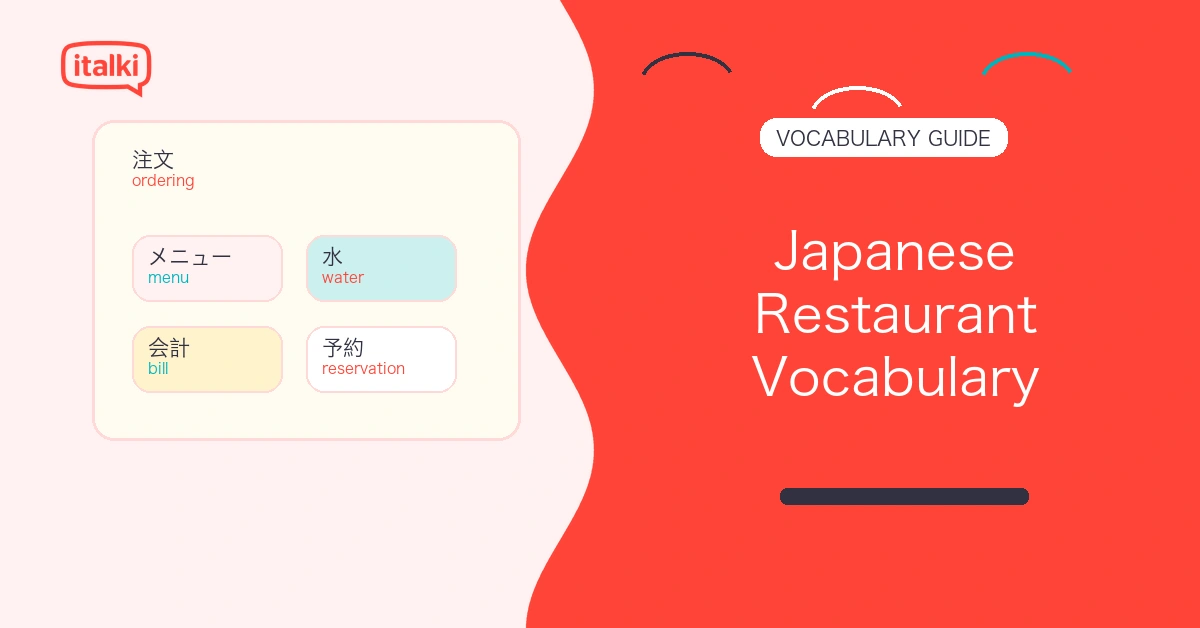
This guide covers Japanese restaurant vocabulary across five stages: arrival and seating, menu and ordering vocabulary, eating and requests during the meal, payment, and dietary restriction phrases.

Find your perfect teacher
Build real speaking confidence with personalized lessons from a teacher who matches your goals, schedule, and learning style.
Book a trial lesson
Arrival and seating phrases
| Japanese | Romaji | English |
|---|---|---|
| いらっしゃいませ | irasshaimase | Welcome (staff greeting; no response needed) |
| 何名様ですか? | nan-mei-sama desu ka | How many people in your party? |
| 二人です | futari desu | Two people |
| 一人です | hitori desu | One person |
| 三人です | sannin desu | Three people |
| 禁煙席をお願いします | kin’enseki o onegaishimasu | A non-smoking seat, please |
| 席はありますか? | seki wa arimasu ka | Is there a table available? |
| 予約しています | yoyaku shite imasu | I have a reservation |
| どうぞ | dōzo | Please (go ahead / this way) |
| こちらへどうぞ | kochira e dōzo | This way, please |
When staff ask 何名様ですか? (nan-mei-sama desu ka), answer with the number + 人です (nin desu) or use the special counters for small numbers: 一人 (hitori: one person), 二人 (futari: two people). From three people onward, use the regular counter: 三人 (sannin), 四人 (yonin), 五人 (gonin).
Work through a seating arrival scenario with a Japanese tutor who can play the restaurant host and practice at realistic conversational speed.
Menu vocabulary
Food categories
| Japanese | Romaji | English |
|---|---|---|
| 定食 | teishoku | set meal (main + sides + rice + soup) |
| ランチセット | ranchi setto | lunch set |
| 前菜 | zensai | starter/appetizer |
| メイン / 主菜 | mein / shusai | main course |
| デザート | dezāto | dessert |
| 飲み物 | nomimono | drinks |
| おすすめ | osusume | recommendation / today’s special |
| 本日のおすすめ | honjitsu no osusume | today’s special |
Common menu items
| Japanese | Romaji | English |
|---|---|---|
| ラーメン | rāmen | ramen |
| 寿司 | sushi | sushi |
| 天ぷら | tenpura | tempura |
| 焼き鳥 | yakitori | grilled chicken skewers |
| 刺身 | sashimi | sashimi (raw fish) |
| 唐揚げ | karaage | Japanese fried chicken |
| そば | soba | buckwheat noodles |
| うどん | udon | thick wheat noodles |
| カレーライス | karē raisu | Japanese curry rice |
| 餃子 | gyōza | pan-fried dumplings |
| 焼き魚 | yakizakana | grilled fish |
| 味噌汁 | misoshiru | miso soup |
| ご飯 | gohan | rice / cooked rice |
Drinks
| Japanese | Romaji | English |
|---|---|---|
| お水 | omizu | water |
| お茶 | ocha | tea (usually green tea in Japanese restaurants) |
| ビール | bīru | beer |
| 日本酒 | nihonshu | sake |
| ジュース | jūsu | juice |
| コーヒー | kōhī | coffee |
Ordering quantities depends on Japanese numbers, including both the native Japanese counting system and the Sino-Japanese system used in restaurant contexts.
Find your perfect teacher
Build real speaking confidence with personalized lessons from a teacher who matches your goals, schedule, and learning style.
Book a trial lesson
Ordering phrases
| Japanese | Romaji | English |
|---|---|---|
| [item] をください | [item] o kudasai | Please give me [item] |
| [item] をひとつください | [item] o hitotsu kudasai | One [item] please |
| [item] をふたつください | [item] o futatsu kudasai | Two [item] please |
| 注文してもいいですか? | chūmon shite mo ii desu ka | May I order? |
| まだ決めていません | mada kimete imasen | I have not decided yet |
| おすすめは何ですか? | osusume wa nan desu ka | What do you recommend? |
| これは何ですか? | kore wa nan desu ka | What is this? |
| 同じものをください | onaji mono o kudasai | The same as that, please |
| セットにしてください | setto ni shite kudasai | Please make it a set meal |
| お持ち帰りで | omochikaeri de | To take away / takeout |
The phrase [item] をください (o kudasai) is the most reliable structure for ordering anything. Point to the menu item, say its name, and add をください. It works for food, drinks, extra napkins, and more.
During the meal: requests and responses
| Japanese | Romaji | English |
|---|---|---|
| すみません | sumimasen | Excuse me (to call a server) |
| お水をください | omizu o kudasai | Could I have some water, please? |
| おかわりをください | okawari o kudasai | Refill, please |
| [item] はまだですか? | [item] wa mada desu ka | Is the [item] still coming? |
| とても美味しいです | totemo oishii desu | This is very delicious |
| お箸をください | ohashi o kudasai | Could I have chopsticks, please? |
| フォークをください | fōku o kudasai | Could I have a fork, please? |
| ナプキンをください | napukin o kudasai | Could I have a napkin, please? |
| 量が多すぎます | ryō ga ōsugimasu | The portion is too large |
| 辛すぎました | karashigimashita | It was too spicy |
Calling a server in Japan is done by saying すみません (sumimasen) at a normal volume, sometimes raising a hand. In some modern restaurants there is a call button at the table (呼び出しボタン, yobidashi botan). Shouting or waving aggressively is not the norm.
An online Japanese teacher can practice table-side requests with you, including how to ask about your order politely when it has not arrived.
Find your perfect teacher
Build real speaking confidence with personalized lessons from a teacher who matches your goals, schedule, and learning style.
Book a trial lesson
Payment phrases
| Japanese | Romaji | English |
|---|---|---|
| お会計をお願いします | okaikei o onegaishimasu | The bill, please |
| いくらですか? | ikura desu ka | How much is it? |
| カードで払えますか? | kādo de haraemasu ka | Can I pay by card? |
| 現金で払います | genkin de haraimasu | I will pay in cash |
| 別々に払えますか? | betsubetsu ni haraemasu ka | Can we pay separately? |
| 一緒に払います | issho ni haraimasu | We will pay together |
| 領収書をください | ryōshūsho o kudasai | Could I have a receipt, please? |
| ごちそうさまでした | gochisōsama deshita | Thank you for the meal (said after eating / when leaving) |
In most Japanese restaurants, payment is made at the register (レジ, reji) at the entrance on the way out, not at the table. If a cashier tray (お盆, obon) is present, place your money on it rather than handing it directly.
ごちそうさまでした (gochisōsama deshita) is said to the staff or host when leaving. It is the standard post-meal expression and is always well received.
Dietary restriction phrases
| Japanese | Romaji | English |
|---|---|---|
| ベジタリアンです | bejitarian desu | I am vegetarian |
| ビーガンです | bīgan desu | I am vegan |
| アレルギーがあります | arerugī ga arimasu | I have an allergy |
| [item] アレルギーです | [item] arerugī desu | I am allergic to [item] |
| 卵アレルギーです | tamago arerugī desu | I am allergic to eggs |
| 乳製品アレルギーです | nyūseihin arerugī desu | I am allergic to dairy |
| 小麦アレルギーです | komugi arerugī desu | I am allergic to wheat/gluten |
| [item] は入っていますか? | [item] wa haitte imasu ka | Does this contain [item]? |
| だしは何ですか? | dashi wa nan desu ka | What is the broth/stock made from? |
| ハラールですか? | harāru desu ka | Is this halal? |
Dashi (だし) is a stock used as the base of many Japanese soups, sauces, and dishes. It is often made from fish (katsuobushi: dried bonito flakes) or kelp (kombu). For vegetarians or those with fish allergies, asking 「だしは何ですか?」 is an important question in Japanese restaurants.
Find your perfect teacher
Build real speaking confidence with personalized lessons from a teacher who matches your goals, schedule, and learning style.
Book a trial lesson
Ready to order confidently in Japanese?
The vocabulary and phrases in this guide cover every stage of a typical Japanese restaurant experience. Most Japanese restaurant staff are patient and accustomed to helping non-native speakers, but knowing the right phrases means you can communicate your needs clearly rather than relying on pointing and guessing.
Practicing these phrases at real conversational speed, including handling the quick-fire welcoming sequence and the payment process, is what makes them usable rather than just recognizable. italki has 30,000+ expert tutors trusted by over 10 million learners worldwide, with Japanese tutors who can run full restaurant simulations in your lessons. Book a trial lesson and practice from entry to お会計 (the bill) in one session.
Find your perfect teacher
Build real speaking confidence with personalized lessons from a teacher who matches your goals, schedule, and learning style.
Book a trial lesson
FAQ
Is tipping expected in Japanese restaurants?
No. Tipping is not practiced in Japan and can cause confusion or discomfort if offered. The service is included in the price by default, and the concept of leaving extra money on the table is unfamiliar in most Japanese restaurant contexts. The best way to show appreciation is ごちそうさまでした (gochisōsama deshita: thank you for the meal) as you leave.
What should I do if there is no English menu and I cannot read the Japanese?
Point to what other diners are eating and say 同じものをください (onaji mono o kudasai: the same as that, please). Alternatively, ask おすすめは何ですか? (osusume wa nan desu ka: what do you recommend?). Many Japanese restaurants also display plastic food models outside – pointing to one and saying これをください (kore o kudasai: I would like this one) works reliably.
How do I politely send food back or raise a problem with my order in Japanese?
すみません (sumimasen: excuse me) to get the server’s attention, then describe the issue simply. For a wrong dish: 注文と違います (chūmon to chigaimasu: this is different from what I ordered). For something missing: [item] がまだ来ていません ([item] ga mada kite imasen: the [item] has not come yet). Japanese restaurant staff handle these situations calmly and professionally.
Want to learn a language at italki?
Here are the best resources for you!