Key takeaways
- Japanese months follow a simple, logical pattern: number + 月 (gatsu, month-suffix). January is 一月 (ichigatsu, one-month), February is 二月 (nigatsu, two-month), and so on through December (十二月, jūnigatsu). There are no separate month names to memorize.
- The kanji 月 has two readings depending on context: 月 (tsuki, the moon / a month as a period of time) and 月 (gatsu/gatu, the month-number suffix used in dates). Both come from the same source: the lunar calendar that once governed Japanese timekeeping.
- Japanese date format goes from largest to smallest: Year 年 (nen) + Month 月 (gatsu) + Day 日 (nichi/ka). So July 2, 2026 is written and said as 2026年7月2日 (nisen nijūroku nen shichigatsu futsuka).
- Day numbers in Japanese use special readings for the 1st through the 10th, the 14th, 20th, and 24th. These irregular readings are a distinct learning point because they do not follow the standard number-plus-nichi pattern.
Months and dates are among the most immediately practical vocabulary in any language. They appear on calendars, in appointments, in greetings, in business correspondence, and in everyday plans. Japanese month names are notable for their simplicity: unlike English, Japanese does not use separate Latin-derived month names.
Instead, months are numbered, making the system fast to learn and logical to remember. italki connects learners with Japanese tutors who can help you practice date vocabulary in real calendar conversations, appointment settings, and cultural discussions about Japanese seasons.
This guide covers the 12 months with pronunciation, the Japanese date format, irregular day readings, seasonal vocabulary, and key phrases for talking about time and the calendar.
Work with a Japanese language tutor to practice dates and calendar vocabulary in real conversation, including how to read and say Japanese dates in different contexts.

Find your perfect teacher
Build real speaking confidence with personalized lessons from a teacher who matches your goals, schedule, and learning style.
Book a trial lesson
The 12 months in Japanese
Japanese months are formed by combining the number with 月 (gatsu, month-suffix). The number readings use the standard Japanese number readings with a few phonetic adjustments.
| 漢字 | Romaji | English |
|---|---|---|
| 一月 | ichigatsu | January |
| 二月 | nigatsu | February |
| 三月 | sangatsu | March |
| 四月 | shigatsu | April |
| 五月 | gogatsu | May |
| 六月 | rokugatsu | June |
| 七月 | shichigatsu | July |
| 八月 | hachigatsu | August |
| 九月 | kugatsu | September |
| 十月 | jūgatsu | October |
| 十一月 | jūichigatsu | November |
| 十二月 | jūnigatsu | December |
The month names use the reading 月 (gatsu), not 月 (tsuki). 七月 (shichigatsu, July) uses the shichi reading for 7, not the alternative nana reading, so it is important to know: months always use the shichi/roku/hachi forms, not nana/mutsu/yatsu.
For a full breakdown of Japanese number readings, including the regular and irregular forms, the guide to Japanese numbers covers everything you need for counting, dates, and beyond.
How to say the year in Japanese
Years in Japanese are expressed in two ways: the Western year system (西暦, seireki) and the traditional Japanese era system (元号, gengō).
Western year (西暦, seireki): Years are said by reading the full number + 年 (nen, year-suffix).
- 2026年: にせんにじゅうろくねん (nisen nijūroku nen)
- 1990年: せんきゅうひゃくきゅうじゅうねん (sen kyūhyaku kyūjū nen)
Japanese era system (元号, gengō): Japan also uses a traditional era counting system based on the reigning emperor. The current era is 令和 (Reiwa), which began in May 2019. Year 1 of Reiwa = 2019 CE.
- 令和7年 (Reiwa 7): corresponds to 2025
- 令和8年 (Reiwa 8): corresponds to 2026
Government documents, official paperwork, and some everyday contexts in Japan still use the era system. Both systems are in common use and learners benefit from recognizing both.
Find your perfect teacher
Build real speaking confidence with personalized lessons from a teacher who matches your goals, schedule, and learning style.
Book a trial lesson
How to say the date in Japanese
Japanese date format goes from largest unit to smallest: Year – Month – Day. This is the opposite of the American order (month/day/year) and different from the European order (day/month/year).
Written format: 2026年7月2日 Spoken format: にせんにじゅうろくねん しちがつ ふつか (nisen nijūroku nen, shichigatsu futsuka)
General pattern: [Year]年 + [Month]月 + [Day]日
Examples:
- March 15, 2025 = 2025年3月15日 (nisen nijūgo nen sangatsu jūgonichi)
- December 1, 2026 = 2026年12月1日 (nisen nijūroku nen jūnigatsu tsuitachi)
For just month and day (no year):
- April 5th = 4月5日 (shigatsu itsuka)
- November 20th = 11月20日 (jūichigatsu hatsuka)
Day readings: the irregular forms
Day numbers in Japanese do not simply use the number + 日 (nichi). The first ten days, and several others, use special traditional readings that must be memorized separately.
| Day | Kanji | Romaji | Notes |
|---|---|---|---|
| 1st | 一日 | tsuitachi | completely irregular |
| 2nd | 二日 | futsuka | |
| 3rd | 三日 | mikka | |
| 4th | 四日 | yokka | |
| 5th | 五日 | itsuka | |
| 6th | 六日 | muika | |
| 7th | 七日 | nanoka | |
| 8th | 八日 | yōka | |
| 9th | 九日 | kokonoka | |
| 10th | 十日 | tōka | |
| 11th | 十一日 | jūichinichi | regular from here |
| 14th | 十四日 | jūyokka | exception |
| 17th | 十七日 | jūshichinichi | regular |
| 20th | 二十日 | hatsuka | exception |
| 24th | 二十四日 | nijūyokka | exception |
The irregular forms for the 1st through 10th come from old Japanese counting words (hitotsu, futatsu, mittsu…) applied to the calendar. The 14th (jūyokka), 20th (hatsuka), and 24th (nijūyokka) are the main exceptions beyond the first 10.
In practice, the days you will use most often in conversation are the 1st (tsuitachi), 2nd (futsuka), 3rd (mikka), 10th (tōka), and 20th (hatsuka). Mastering these first covers most common date situations.
Find your perfect teacher
Build real speaking confidence with personalized lessons from a teacher who matches your goals, schedule, and learning style.
Book a trial lesson
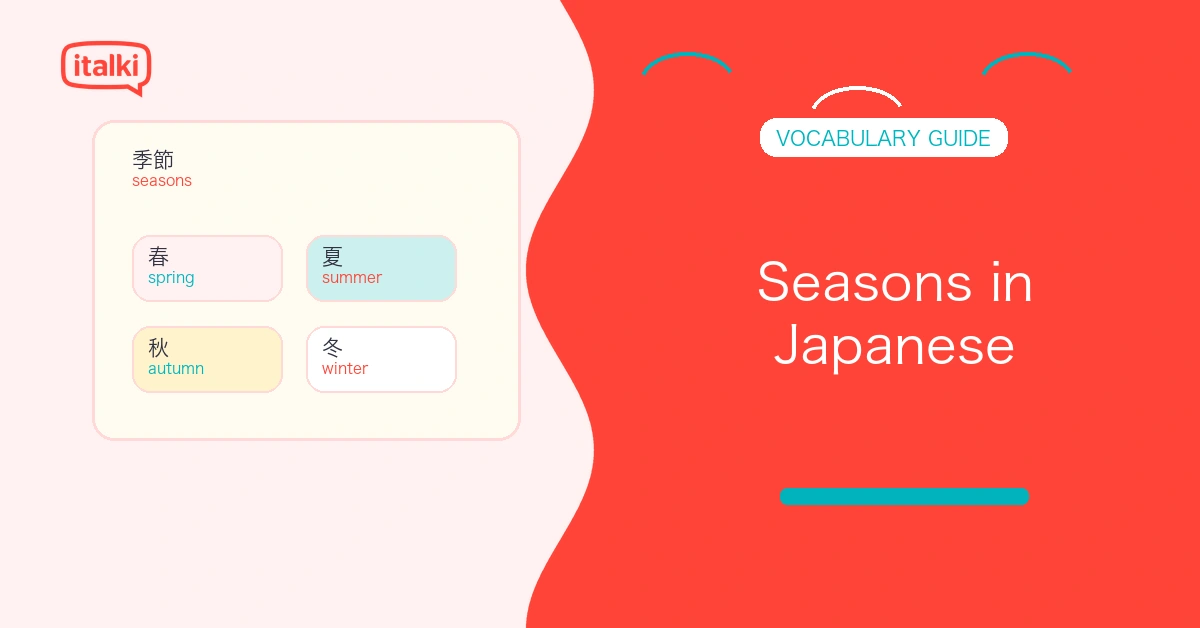
Seasons in Japanese
Japan has four clearly defined seasons, and seasonal language is deeply embedded in Japanese culture, food, literature, and everyday conversation.
| 漢字 | Romaji | English | Months |
|---|---|---|---|
| 春 | haru | spring | March, April, May |
| 夏 | natsu | summer | June, July, August |
| 秋 | aki | autumn / fall | September, October, November |
| 冬 | fuyu | winter | December, January, February |
Seasonal references appear throughout Japanese food culture, traditional arts, and daily conversation:
- 春めく (harumeku, to take on the feeling of spring)
- 夏バテ (natsubate, summer fatigue / exhaustion from the heat)
- 秋の味覚 (aki no mikaku, the tastes of autumn)
- 冬将軍 (fuyu shōgun, General Winter, the personification of the cold season)
Japanese also has a rich vocabulary of seasonal reference words called 季語 (kigo), used in the traditional haiku poetry form. Each season has its own associated words, images, and feelings.
Time words for the calendar
These words for navigating the calendar are used constantly in everyday Japanese conversation.
| 漢字 | Romaji | English |
|---|---|---|
| 今月 | kongetsu | this month |
| 先月 | sengetsu | last month |
| 来月 | raigetsu | next month |
| 今年 | kotoshi | this year |
| 去年 | kyonen | last year |
| 来年 | rainen | next year |
| 今日 | kyō | today |
| 明日 | ashita | tomorrow |
| 昨日 | kinō | yesterday |
| 先週 | senshū | last week |
| 今週 | konshū | this week |
| 来週 | raishū | next week |
| 毎月 | maitsuki | every month |
| 毎年 | maitoshi / mainen | every year |
Notice the pattern for last / this / next: 先 (sen, previous), 今 (kon/ko, current), 来 (rai, coming). This pattern applies to weeks (週 shū), months (月 gatsu/tsuki), and years (年 nen/toshi), making the three-way system systematic once you recognize it.
Find your perfect teacher
Build real speaking confidence with personalized lessons from a teacher who matches your goals, schedule, and learning style.
Book a trial lesson
Useful phrases for talking about dates
| Japanese | Romaji | English |
|---|---|---|
| 今日は何日ですか? | Kyō wa nannichi desu ka? | What is today’s date? |
| 今日は七月二日です。 | Kyō wa shichigatsu futsuka desu. | Today is July 2nd. |
| 誕生日はいつですか? | Tanjōbi wa itsu desu ka? | When is your birthday? |
| 私の誕生日は三月十五日です。 | Watashi no tanjōbi wa sangatsu jūgonichi desu. | My birthday is March 15th. |
| いつ日本に来ましたか? | Itsu Nihon ni kimashita ka? | When did you come to Japan? |
| 予定はいつですか? | Yotei wa itsu desu ka? | When is the plan / appointment? |
| 来月また会いましょう。 | Raigetsu mata aimashō. | Let’s meet again next month. |
| 締め切りは何日ですか? | Shimekiri wa nannichi desu ka? | What date is the deadline? |
| ゴールデンウィークはいつですか? | Gōruden Wīku wa itsu desu ka? | When is Golden Week? |
Japanese holidays by month
Knowing the major Japanese public holidays in each month gives context to dates and is useful for travel planning and cultural conversations.
| Month | Holiday | Japanese | Notes |
|---|---|---|---|
| January 1 | New Year’s Day | 元日 (ganjitsu) | Most important holiday in Japan |
| January (2nd Mon) | Coming of Age Day | 成人の日 (seijin no hi) | Celebrates those turning 20 |
| February 11 | National Foundation Day | 建国記念の日 | |
| March 20/21 | Spring Equinox | 春分の日 (shunbun no hi) | Date varies |
| April 29 | Shōwa Day | 昭和の日 | Start of Golden Week |
| May 3 | Constitution Day | 憲法記念日 (kenpō kinenbi) | Golden Week |
| May 4 | Greenery Day | みどりの日 (midori no hi) | Golden Week |
| May 5 | Children’s Day | こどもの日 (kodomo no hi) | Golden Week |
| July (3rd Mon) | Marine Day | 海の日 (umi no hi) | |
| August 11 | Mountain Day | 山の日 (yama no hi) | |
| September (3rd Mon) | Respect for the Aged Day | 敬老の日 (keirō no hi) | |
| September 22/23 | Autumn Equinox | 秋分の日 (shūbun no hi) | Date varies |
| October (2nd Mon) | Sports Day | スポーツの日 | |
| November 3 | Culture Day | 文化の日 (bunka no hi) | |
| November 23 | Labor Thanksgiving Day | 勤労感謝の日 | |
| December 23 | Emperor’s Birthday | 天皇誕生日 |
ゴールデンウィーク (Gōruden Wīku, Golden Week) is the period from late April to early May containing four public holidays. It is one of the busiest travel periods in Japan, when most businesses close for several days.
Find your perfect teacher
Build real speaking confidence with personalized lessons from a teacher who matches your goals, schedule, and learning style.
Book a trial lesson
Practice calendar and date vocabulary with a tutor
Reading about months, dates, and seasons builds recognition. Practicing them in real scheduling conversations, birthday discussions, and appointment settings builds the instinctive fluency you need for daily Japanese life. A tutor can set up real calendar scenarios, correct your day-number readings, and help you understand how Japanese people talk about time, seasons, and upcoming events.
italki’s 30,000+ expert tutors include native Japanese speakers who can practice real-life scheduling, travel planning, and seasonal conversations with you at the right level for your current ability. Trusted by over 10 million learners worldwide, the platform lets you find a tutor who matches your schedule and learning goals. Book a trial lesson and practice saying today’s date, your birthday, and your next plans in Japanese.
Find your perfect teacher
Build real speaking confidence with personalized lessons from a teacher who matches your goals, schedule, and learning style.
Book a trial lesson
FAQ
How do you say the months in Japanese?
Japanese months use a number + 月 (gatsu) pattern. January = 一月 (ichigatsu), February = 二月 (nigatsu), March = 三月 (sangatsu), April = 四月 (shigatsu), May = 五月 (gogatsu), June = 六月 (rokugatsu), July = 七月 (shichigatsu), August = 八月 (hachigatsu), September = 九月 (kugatsu), October = 十月 (jūgatsu), November = 十一月 (jūichigatsu), December = 十二月 (jūnigatsu).
What is the Japanese date format?
Japanese dates go from largest to smallest: Year 年 (nen) + Month 月 (gatsu) + Day 日 (nichi/ka). July 2, 2026 = 2026年7月2日 (nisen nijūroku nen shichigatsu futsuka). This is the order used in writing, on calendars, in official documents, and in everyday speech.
What are the irregular day readings in Japanese?
The first ten days of the month (plus the 14th, 20th, and 24th) use special old Japanese readings that must be memorized: 1st = tsuitachi, 2nd = futsuka, 3rd = mikka, 4th = yokka, 5th = itsuka, 6th = muika, 7th = nanoka, 8th = yōka, 9th = kokonoka, 10th = tōka, 14th = jūyokka, 20th = hatsuka, 24th = nijūyokka. From the 11th onward, regular readings (number + nichi) are used except for those four exceptions.
What is the difference between 月 (tsuki) and 月 (gatsu)?
Both are readings of the same kanji 月, but they are used in different contexts. 月 (tsuki) means the moon or a month as a duration of time (三ヶ月, sankagetsu, three months). 月 (gatsu) is the suffix attached to a number to form a specific month name: 七月 (shichigatsu, July). The two readings come from the same origin in the lunar calendar.
How do Japanese seasons connect to language?
Japan has four clearly defined seasons and an extremely rich vocabulary for describing seasonal change. Seasonal reference words (季語 kigo) are used in the traditional haiku poetry form, and references to seasonal foods, weather, and natural phenomena appear constantly in Japanese writing, conversation, and cultural practice. Knowing that 春 (haru) is spring, 夏 (natsu) is summer, 秋 (aki) is autumn, and 冬 (fuyu) is winter opens up a significant amount of cultural and conversational context in Japanese.
Want to learn a language at italki?
Here are the best resources for you!