Key takeaways
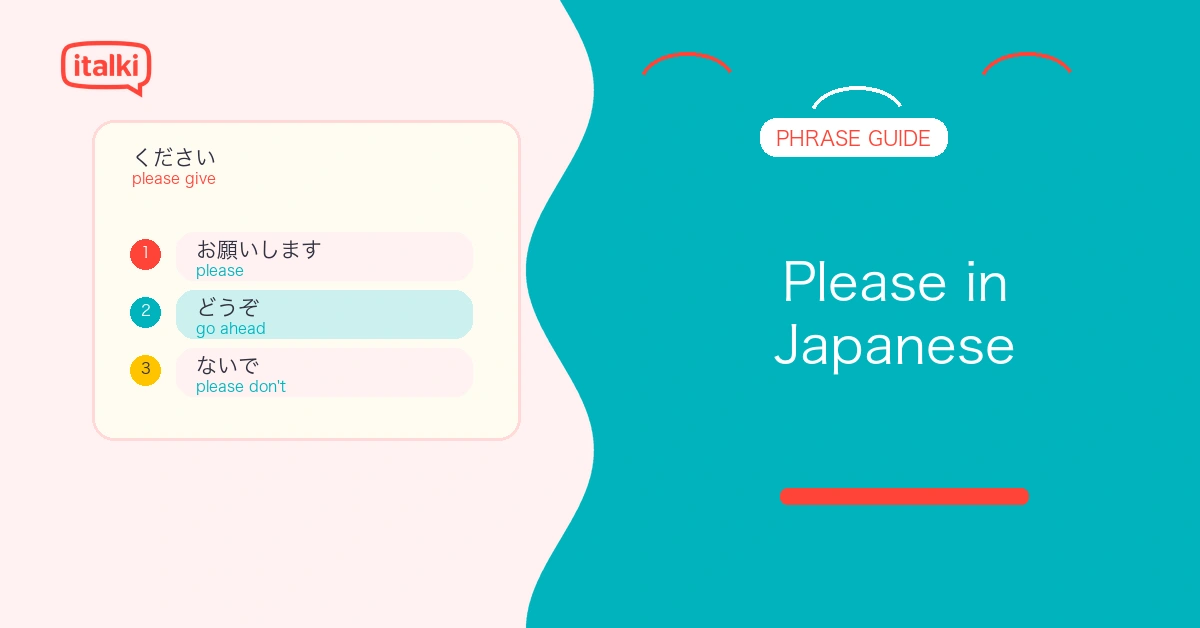
- Japanese does not have one single word for please. The right expression depends on what you are requesting: an object, an action, a favor, or permission.
- ください (kudasai) is used with the te-form of a verb to request an action (please do X) or directly after a noun to request an item (please give me X).
- お願いします (onegaishimasu) is a versatile polite request phrase closer to I ask you kindly or please take care of this and works in a wider range of situations.
- どうぞ (dōzo) means please in the sense of offering or giving permission: please go ahead, please help yourself, please come in.
Learners often reach for one please word in Japanese and discover quickly that the wrong one in the wrong context sounds either unnatural or overly casual. A customer asking for the check with just ください (kudasai) is correct but abrupt; adding お願いします (onegaishimasu) rounds it out significantly.
Getting the right phrase in the right situation matters for politeness and clarity. italki connects learners with Japanese teachers who can correct your polite phrasing in real conversational scenarios before the wrong form becomes a habit.
This guide covers ください (kudasai), お願いします (onegaishimasu), よろしくお願いします (yoroshiku onegaishimasu), どうぞ (dōzo), negative request forms, and the register differences between them, with examples for ordering food, making requests at work, and everyday situations.

Find your perfect teacher
Build real speaking confidence with personalized lessons from a teacher who matches your goals, schedule, and learning style.
Book a trial lesson
Kudasai: requesting actions and items
ください (kudasai) comes from the verb くださる (kudasaru), an honorific form of to give. It functions in two main ways:
Requesting an item: Place ください directly after a noun or noun phrase to ask for something.
| Japanese | Romaji | English |
|---|---|---|
| 水をください | mizu o kudasai | Please give me water / Water, please |
| メニューをください | menyū o kudasai | May I have the menu, please? |
| レシートをください | reshīto o kudasai | Please give me a receipt |
| もう一つください | mō hitotsu kudasai | One more, please |
| 領収書をください | ryōshūsho o kudasai | Please give me an official receipt |
Requesting an action: Attach ください to the te-form of a verb to ask someone to do something.
| Japanese | Romaji | English |
|---|---|---|
| 座ってください | suwatte kudasai | Please sit down |
| 待ってください | matte kudasai | Please wait |
| 見てください | mite kudasai | Please look / Please check |
| ゆっくり話してください | yukkuri hanashite kudasai | Please speak slowly |
| ここに書いてください | koko ni kaite kudasai | Please write it here |
| もう一度言ってください | mō ichido itte kudasai | Please say it again |
Work through te-form request structures with an online Japanese teacher in real-time conversation drills; the Japanese verb forms article explains how te-form is built from each verb group.
Onegaishimasu: general polite request
お願いします (onegaishimasu) comes from お願い (onegai: request, wish) and します (shimasu: to do). It does not attach to nouns or verbs in the same way as ください. Instead, it works as a standalone polite request phrase or is placed after a noun to express please (handle/bring/do) this.
| Japanese | Romaji | English |
|---|---|---|
| お願いします | onegaishimasu | Please / I ask you kindly |
| コーヒーをお願いします | kōhī o onegaishimasu | Coffee, please (ordering) |
| これをお願いします | kore o onegaishimasu | This one, please (ordering by pointing) |
| お会計をお願いします | okaikei o onegaishimasu | Check, please |
| タクシーをお願いします | takushī o onegaishimasu | A taxi, please |
お願いします works at a restaurant when ordering, checking out of a hotel, asking a driver to take you somewhere, or closing a business meeting with a polite request for continued cooperation. It is softer and more broadly applicable than ください in most service contexts.
Find your perfect teacher
Build real speaking confidence with personalized lessons from a teacher who matches your goals, schedule, and learning style.
Japanese tutor
Kudasai vs onegaishimasu: when each fits
Both mean please but they are not always interchangeable.
| Situation | Better choice | Reason |
|---|---|---|
| Asking staff to bring water | 水をください or 水をお願いします | Both work; お願いします slightly softer |
| Asking someone to do an action (verb request) | Te-form + ください | お願いします does not attach to verb te-form |
| Ordering at a restaurant | Noun + お願いします | Slightly more natural in service contexts |
| Asking a colleague to review a document | お願いします or お願いできますか | More appropriate register |
| Emergency: please call an ambulance | 救急車を呼んでください | ください with action verb is direct and clear |
A useful rule of thumb: ください is more direct and specific. お願いします is more deferential and general. In formal or service contexts, お願いします is often the safer choice.
Yoroshiku onegaishimasu: broader courtesy
よろしくお願いします (yoroshiku onegaishimasu) and its more formal version よろしくお願いいたします (yoroshiku onegai itashimasu) are among the most frequently used Japanese politeness phrases. They do not translate directly to please in English.
よろしく (yoroshiku) expresses the hope that things will go well and that the other person will treat you favorably. Combined with お願いします, the phrase functions as:
- I look forward to working with you (at the start of a professional relationship)
- I am counting on you / I leave it in your hands (delegating a task)
- Thank you for your continued support (closing an email or meeting)
- Nice to meet you (after an introduction, in combination with はじめまして)
| Context | Example |
|---|---|
| Meeting someone new | はじめまして、よろしくお願いします (Hajimemashite, yoroshiku onegaishimasu) |
| Closing a business email | よろしくお願いいたします (Yoroshiku onegai itashimasu) |
| Asking a colleague for a favor | よろしくお願いします (Yoroshiku onegaishimasu) |
Writing an email in Japanese shows how よろしくお願いいたします works as a standard formal closing phrase.
Find your perfect teacher
Build real speaking confidence with personalized lessons from a teacher who matches your goals, schedule, and learning style.
Find a Japanese tutor
Dozo: offering and giving permission
どうぞ (dōzo) is the please of invitations, offers, and permission. It means please, go ahead or please, help yourself and is used when you are giving something to someone or granting them permission to do something.
| Japanese | Romaji | English |
|---|---|---|
| どうぞ | dōzo | Please, go ahead / Here you are |
| どうぞ座ってください | dōzo suwatte kudasai | Please, have a seat |
| どうぞお入りください | dōzo o-hairi kudasai | Please come in |
| どうぞ召し上がってください | dōzo meshiagatte kudasai | Please help yourself (to food, formal) |
| どうぞご自由に | dōzo go-jiyū ni | Please feel free / Help yourself |
どうぞ can stand alone as a single-word response when handing something to someone (similar to here you are in English) or when waving someone through a door. It is always the speaker offering or permitting, never requesting.
A Japanese language tutor can practice role-play scenarios with you: one person as host offering food and space, the other as guest responding, so the timing and natural usage of どうぞ becomes instinctive.
Negative request forms: please do not
To ask someone not to do something, Japanese uses the te-form with はいけません (wa ikemasen) or ないでください (naide kudasai).
| Japanese | Romaji | English |
|---|---|---|
| 写真を撮らないでください | shashin o toranaide kudasai | Please do not take photos |
| ここに入らないでください | koko ni hairanaide kudasai | Please do not enter here |
| 触らないでください | sawaranaide kudasai | Please do not touch |
| 遅れないでください | okurenaide kudasai | Please do not be late |
| 心配しないでください | shinpai shinaide kudasai | Please do not worry |
The structure is: verb negative plain form (nai-form) + でください. This is slightly softer than the prohibitive ~てはいけません (te wa ikemasen) and is more natural in everyday polite requests.
Find your perfect teacher
Build real speaking confidence with personalized lessons from a teacher who matches your goals, schedule, and learning style.
Japanese tutors online
Please in casual speech
In casual speech between friends or family, the politeness level drops considerably.
| Formal | Casual equivalent | English |
|---|---|---|
| ~てください | ~て or ~てよ | Please do X (casual) |
| お願いします | お願い (onegai) | Please / I’m asking you |
| ~ないでください | ~ないで (naide) | Please don’t (casual) |
For example, 待ってください (matte kudasai) in formal speech becomes 待って (matte) or 待ってよ (matte yo) with a close friend. Using formal please phrases with close friends sounds stiff; using casual forms in professional or service settings sounds rude.
Common situations and example phrases
| Situation | Phrase | Romaji |
|---|---|---|
| Ordering food | ラーメンをお願いします | Rāmen o onegaishimasu |
| Asking for the bill | お会計をお願いします | Okaikei o onegaishimasu |
| Asking server to repeat | もう一度お願いします | Mō ichido onegaishimasu |
| Requesting a slower pace | ゆっくり話してください | Yukkuri hanashite kudasai |
| Entering an office | 失礼します、よろしくお願いします | Shitsurei shimasu, yoroshiku onegaishimasu |
| Holding a seat | ここに座らないでください | Koko ni suwaranaide kudasai |
| Accepting an offer | どうぞ、ありがとうございます | Dōzo, arigatou gozaimasu |
| Asking someone in | どうぞお入りください | Dōzo o-hairi kudasai |
Find your perfect teacher
Build real speaking confidence with personalized lessons from a teacher who matches your goals, schedule, and learning style.
Japanese teacher
Ready to practice polite Japanese?
Using please correctly in Japanese is less about memorizing a single word and more about matching the right phrase to the social situation. The difference between ください and お願いします, between casual お願い and formal よろしくお願いいたします, becomes clear through exposure and correction in real conversation rather than grammar lists. italki has 30,000+ expert tutors trusted by over 10 million learners worldwide, including Japanese tutors who can put all these please expressions in real conversational scenarios and correct your usage as it happens. private Japanese tutor and practice making requests, giving permission, and politely declining in Japanese.
Find your perfect teacher
Build real speaking confidence with personalized lessons from a teacher who matches your goals, schedule, and learning style.
Japanese lessons online
FAQ
Can I use お願いします to make a te-form verb request?
Not directly. お願いします does not attach to verb te-forms. For action requests, use the te-form plus ください: 送ってください (okutte kudasai: please send it). お願いします works best after nouns or as a standalone courtesy phrase. You can combine both: 確認してください、お願いします adds extra politeness but is slightly unusual. The standard is to choose one or the other depending on the context.
Is よろしくお願いします too formal for casual situations?
It depends on the degree. よろしくお願いします is standard in most professional and semi-formal situations. With close friends or in very casual settings, just よろしく (yoroshiku) is used. Using the full form with a close friend is not wrong; it just sounds slightly formal, which can also function as light humor or deliberate politeness in some contexts.
What is the difference between どうぞよろしく and よろしくお願いします?
どうぞよろしく (dōzo yoroshiku) is a slightly older or more emphatic way of saying the same thing as よろしくお願いします. Adding どうぞ emphasizes the sincerity of the request. In modern usage, よろしくお願いします (and its more formal variant よろしくお願いいたします) is more common in both spoken and written contexts.
Want to learn a language at italki?
Here are the best resources for you!