Key takeaways
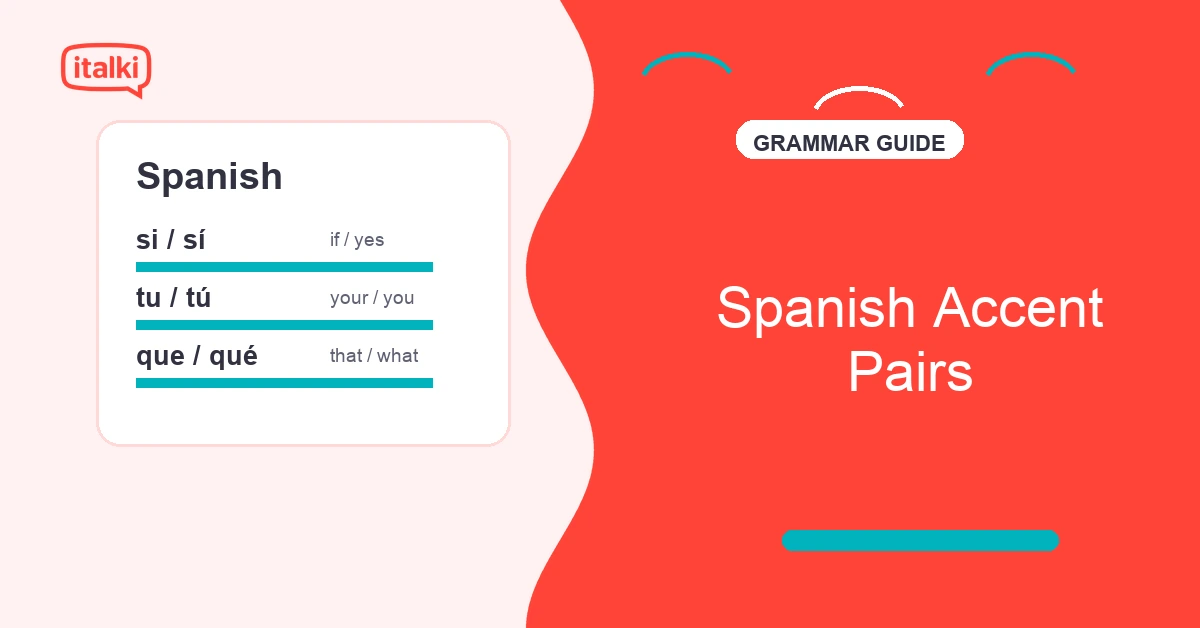
- Spanish accent pairs are words that look almost identical, but the accent mark (tilde) changes meaning, grammar role, or stress: si means “if,” sí means “yes.”
- The most common pairs include el/él, tu/tú, mi/mí, si/sí, de/dé, se/sé, te/té, mas/más, and aun/aún.
- Question words like que/qué and como/cómo need accents in direct questions, indirect questions, and exclamations.
- Working through your own accent-pair sentences with a Spanish tutor is the fastest way to stop confusing tu and tú in your writing.
Spanish accent pairs are words such as si and sí, el and él, and que and qué where one small mark changes the meaning entirely. The mark is called a tilde diacrítica, and in most pairs it signals stress and a different grammar role rather than a new vowel sound.
Learners tend to skip accents because native speakers “understand from context,” but dropping the wrong tilde in a formal email or exam answer changes “you” to “your” or “yes” to “if.” italki has helped 10M+ learners fix exactly this kind of mistake through live correction with qualified teachers.
This guide covers every major pair with meanings, pronunciation notes, and example sentences you can bring straight into a lesson.
Get real-time feedback on your accent marks from a private Spanish tutor.

Find Your Perfect Teacher
Build real speaking confidence with personalized lessons from a teacher who matches your goals, schedule, and learning style.

What are Spanish accent pairs?
Spanish accent pairs are word pairs sharing the same letters but differing by an accent mark, where the accent changes meaning or grammatical function. In most cases the accent separates a short, unstressed grammar word from a stressed content word.
The tilde diacrítica separates certain words written alike but with different meanings, especially common short words such as el and él or tu and tú.
| Pair | Without accent | With accent | Quick example |
|---|---|---|---|
| el, él | the | he, him | El libro es de él. (The book is his.) |
| tu, tú | your | you | Tu casa y tú. (Your house and you.) |
| mi, mí | my | me | Mi regalo es para mí. (My gift is for me.) |
| si, sí | if | yes, oneself | Si dices que sí, voy. (If you say yes, I’ll go.) |
| de, dé | of, from | give (subjunctive) | Quiero que me dé agua. (I want him to give me water.) |
| se, sé | himself, herself | I know / be (imperative) | Sé que se fue. (I know he left.) |
This topic connects to the broader rules in Spanish accents, because written accent marks often signal the stressed syllable. With accent pairs, the mark also protects meaning.
A teacher who reads your sentences can spot which pairs you consistently confuse and correct them on the spot. Find a Spanish teacher online who focuses on written accuracy to build this habit early.
Find Your Perfect Teacher
Build real speaking confidence with personalized lessons from a teacher who matches your goals, schedule, and learning style.
Which one-syllable Spanish accent pairs matter most?
The most important one-syllable pairs are el/él, tu/tú, mi/mí, si/sí, de/dé, se/sé, te/té, and mas/más. They appear in texts, emails, song lyrics, and exam answers constantly.
Spanish usually skips accent marks on one-syllable words, but these pairs are exceptions because the accent separates two distinct meanings.
| No accent | With accent | Example sentence |
|---|---|---|
| el (the) | él (he, him) | El perro es de él. (The dog is his.) |
| tu (your) | tú (you) | Tu hermana y tú vienen. (Your sister and you are coming.) |
| mi (my) | mí (me) | Mi madre habla de mí. (My mother talks about me.) |
| si (if) | sí (yes, oneself) | Si quieres, sí. (If you want, yes.) |
| de (of, from) | dé (give) | Espero que me dé tiempo. (I hope it gives me time.) |
| se (himself, herself) | sé (I know, be) | Sé que se llama Ana. (I know her name is Ana.) |
| te (you, to you) | té (tea) | Te preparo té. (I’ll make you tea.) |
| mas (but, literary) | más (more) | Quiero más, mas no tengo dinero. (I want more, but I have no money.) |
A few pairs deserve extra attention.
el and él. El is the masculine article “the.” Él is the pronoun “he” or “him” after a preposition. Voy con él. (I’m going with him.) Writing “Voy con el” reads as “I’m going with the,” which is incomplete.
tu and tú. Tu means “your.” Tú means “you.” Both sound nearly identical in fast speech, but the difference matters in writing. Tú tienes razón. (You are right.) Tu razón es clara. (Your reason is clear.)
mi and mí. Mi means “my.” Mí means “me” after prepositions like para, de, a, or sin. Este café es para mí. (This coffee is for me.) Confusing these is one of the most frequent accent mistakes in beginner writing.
Since tú, él, and mí all function as Spanish subject pronouns learners drill early, accent pairs are worth reviewing alongside pronoun charts.
Find Your Perfect Teacher
Build real speaking confidence with personalized lessons from a teacher who matches your goals, schedule, and learning style.
How do question word accent pairs work?
Question word accent pairs need an accent when the word asks a direct or indirect question, or appears in an exclamation. Que means “that” or “which” as a connector, but qué means “what” inside a question or exclamation. The same pattern applies to como/cómo, cuando/cuándo, donde/dónde, quien/quién, cual/cuál, and cuanto/cuánto.
| No accent | With accent | Examples |
|---|---|---|
| que (that, which) | qué (what) | Sé que vienes. / ¿Qué quieres? |
| como (as, like) | cómo (how) | Lo hago como tú. / ¿Cómo estás? |
| cuando (when, connector) | cuándo (when, question) | Voy cuando pueda. / ¿Cuándo sales? |
| donde (where, connector) | dónde (where, question) | Vivo donde trabajo. / ¿Dónde vives? |
| quien (who, connector) | quién (who, question) | La persona quien llamó. / ¿Quién llamó? |
| cual (which) | cuál (which one) | Elige el cual prefieras. / ¿Cuál prefieres? |
| cuanto (how much) | cuánto (how much, question) | Come cuanto quiera. / ¿Cuánto cuesta? |
Indirect questions hide inside statements but still need accents. This is the part learners most often get wrong.
- No sé qué hacer. (I don’t know what to do.)
- Dime cuándo llegas. (Tell me when you arrive.)
- Quiero saber dónde vives. (I want to know where you live.)
The test: if you can replace the word with an English question word and the sentence still works as a hidden question, write the accent. “Dime cuándo llegas” = “Tell me when you arrive” (hidden question = accent). “Voy cuando pueda” = “I’ll go when I can” (no question = no accent).
Exclamations also use accents: ¡Qué bonito. (How beautiful.) ¡Cómo llueve. (How it’s raining.) ¡Cuánto tiempo. (Long time no see.)
Spanish punctuation makes questions easier to spot in writing. The opening ¿ signals a question is coming, something covered in the guide to the Spanish question mark.
If indirect questions confuse you, write five sentences beginning with “No sé…” or “Dime…” and bring them to a lesson with an online Spanish tutor for correction.
Find Your Perfect Teacher
Build real speaking confidence with personalized lessons from a teacher who matches your goals, schedule, and learning style.
What is the difference between aun and aún?
Aun means “even,” while aún means “still” or “yet.” This pair trips up learners because both words sound similar and often appear before verbs.
Use aun when the meaning is “even” (synonym of incluso).
- Aun los niños lo saben. (Even the children know it.)
- Aun cansado, fue al trabajo. (Even tired, he went to work.)
Use aún when the meaning is “still” or “yet” (synonym of todavía).
- Aún vivo aquí. (I still live here.)
- No ha llegado aún. (He has not arrived yet.)
Substitution test: if todavía fits, write aún. If incluso fits, write aun.
Compare: Aun así, quiero ir. (Even so, I want to go.) vs. Aún quiero ir. (I still want to go.) Same letters, but the accent flips the meaning.
Unlike el/él and tu/tú, aun and aún have two syllables, and the accent affects stress more noticeably. Aun in “aun así” flows quickly (“own ah-SEE”), while aún stands alone with stress on the second syllable (“ah-OON”).
The shortcuts for typing accented characters on phones and laptops are covered in how to type Spanish accents.
Bring a paragraph mixing both forms to your next lesson. A Spanish language tutor can confirm whether you chose correctly and adjust your instinct in real time.
Find Your Perfect Teacher
Build real speaking confidence with personalized lessons from a teacher who matches your goals, schedule, and learning style.
Which accent pairs appear in everyday messages?
The pairs sí/si, qué/que, tú/tu, mí/mi, and sé/se appear constantly in texts and social messages. One missing accent can change the tone or clarity of a short reply.
| Message | Meaning |
|---|---|
| Sí, voy. | Yes, I’m going. |
| Si voy, te aviso. | If I go, I’ll let you know. |
| ¿Qué tal? | How’s it going? |
| Creo que bien. | I think it’s fine. |
| Tú dime. | You tell me. |
| Tu idea me gusta. | I like your idea. |
| Para mí, no. | For me, no. |
| Mi plan cambió. | My plan changed. |
| Sé la respuesta. | I know the answer. |
| Se fue temprano. | He/she left early. |
A natural mini-chat shows how many accent pairs crowd into a short exchange.
- A: ¿Qué haces? (What are you doing?)
- B: Nada. ¿Y tú? (Nothing. And you?)
- A: Tomo té. ¿Quieres? (I’m drinking tea. Want some?)
- B: Sí, pero si no tienes más, no pasa nada. (Yes, but if you don’t have more, no problem.)
That four-line exchange contains sí next to si, plus tú, té, and más. Missing one accent rarely ruins the message, but getting them right marks your writing as precise. Native speakers notice.
Many of these pairs sit inside phrases learners already study, such as ¿Qué tal?, Sí claro, and Para mí, un café. Building accent awareness on top of common Spanish phrases reinforces both skills at once.
Try writing your own four-line text conversation using at least three different accent pairs, then ask a Spanish tutor online to check whether every tilde landed correctly.
Find Your Perfect Teacher
Build real speaking confidence with personalized lessons from a teacher who matches your goals, schedule, and learning style.
How does pronunciation change in Spanish accent pairs?
The vowel sound stays the same in most Spanish accent pairs, but the accented word receives more stress within the sentence. In el and él, both use the same “e” vowel, yet él carries more weight when spoken.
This is why accent pairs are hard to hear at first. The difference is not like English “ship” vs. “sheep,” where the vowel changes. It is more like a weak grammar word versus a word the speaker lands on.
| Pair | Read it aloud |
|---|---|
| El libro es de él. | el LEE-bro es de EL (stress on final él) |
| Tu casa y tú. | too CA-sa ee TOO (stress on final tú) |
| Mi foto es para mí. | mee FO-to es PA-ra MEE (stress on final mí) |
| Si dices que sí. | see DEE-ses ke SEE (stress on final sí) |
| Te doy té. | te doy TEH (stress on final té) |
| Se fue, lo sé. | se fweh, lo SEH (stress on final sé) |
For question words, stress is easier to hear. Como arroz (I eat rice) sounds like “KO-mo ah-RROS” with como sliding past quickly. ¿Cómo estás? puts clear stress on “KO-mo” because the question word carries the sentence.
A workbook shows the accent, but it cannot tell you whether your voice stressed the right word. Record yourself reading the sentences above, then compare with a native speaker in your next lesson.
Find Your Perfect Teacher
Build real speaking confidence with personalized lessons from a teacher who matches your goals, schedule, and learning style.
How should learners practice Spanish accent pairs?
Practice Spanish accent pairs inside short sentence groups, not isolated word lists. The meaning becomes clearer when each pair sits inside a sentence forcing a choice between both forms.
Use this three-step routine.
- Sort by meaning. Write pairs in two columns: grammar word and content word. Example: tu = “your,” tú = “you.”
- Build contrast sentences. Put both words in one sentence. Example: Tu hermano y tú viven aquí. (Your brother and you live here.) This forces your brain to assign each spelling to a different job.
- Read aloud and mark stress. Circle the accented word and give it more voice. Record yourself and listen back.
| Pair | Sentence pattern to fill in |
|---|---|
| el, él | El ___ es de él. (The ___ is his.) |
| tu, tú | Tu ___ y tú ___. (Your ___ and you ___.) |
| mi, mí | Mi ___ es para mí. (My ___ is for me.) |
| si, sí | Si ___, sí ___. (If ___, yes ___.) |
| de, dé | Quiero que me dé ___. (I want him/her to give me ___.) |
| se, sé | Sé que se ___. (I know that he/she ___.) |
| que, qué | Sé que ___. ¿Qué ___? (I know that ___. What ___?) |
| aun, aún | Aun ___, aún ___. (Even ___, still ___.) |
Fill in the blanks with your own vocabulary. The more personal the sentences, the better they stick. Broader Spanish grammar rules around accent placement follow the same logic of matching the mark to the word’s role.
Once your fill-in sentences feel solid, bring the full set to a lesson. A best online Spanish tutor can spot the pairs you still confuse and give you targeted drills on those specific ones.
Find Your Perfect Teacher
Build real speaking confidence with personalized lessons from a teacher who matches your goals, schedule, and learning style.
Write Spanish accents with fewer mistakes
Spanish accent pairs stop feeling random once you link each mark to a specific meaning: sí means “yes,” si means “if,” tú means “you,” tu means “your,” qué asks “what.” The goal is recognizing the job each word has in the sentence and writing the accent that matches.
The fastest way to build that habit is writing your own sentences and getting them corrected by someone who catches every missing tilde. A teacher who sees your writing pinpoints which pairs trip you up, whether de/dé in subjunctive clauses or qué in indirect questions, and fixes the pattern before it hardens.
Book a trial lesson and bring ten sentences using si/sí, tu/tú, que/qué, and aun/aún for correction in your first session.
Find Your Perfect Teacher
Build real speaking confidence with personalized lessons from a teacher who matches your goals, schedule, and learning style.
FAQ
What are Spanish accent pairs?
Spanish accent pairs are words sharing the same letters but differing by an accent mark. The accent changes meaning or grammar role: el means “the,” él means “he.”
Is si the same as sí in Spanish?
No. Si means “if” and introduces a condition. Sí means “yes” or sometimes “oneself,” as in sí mismo (himself, herself, itself).
Do el and él sound different?
They use the same vowel sound, but él receives more stress in the sentence because it is a pronoun carrying meaning. El is lighter because it functions as the article “the.”
When does que need an accent?
Qué needs an accent in direct questions (¿Qué quieres?), indirect questions (No sé qué hacer), and exclamations (¡Qué bonito.). When que means “that” or “which” as a connector, no accent.
Should solo have an accent in Spanish?
Under current Real Academia Española guidelines, solo does not need an accent in either meaning (“alone” or “only”). Older texts sometimes write sólo for “only,” so learners may encounter it in books and subtitles.
Want to learn a language at italki?
Here are the best resources for you!