Key takeaways
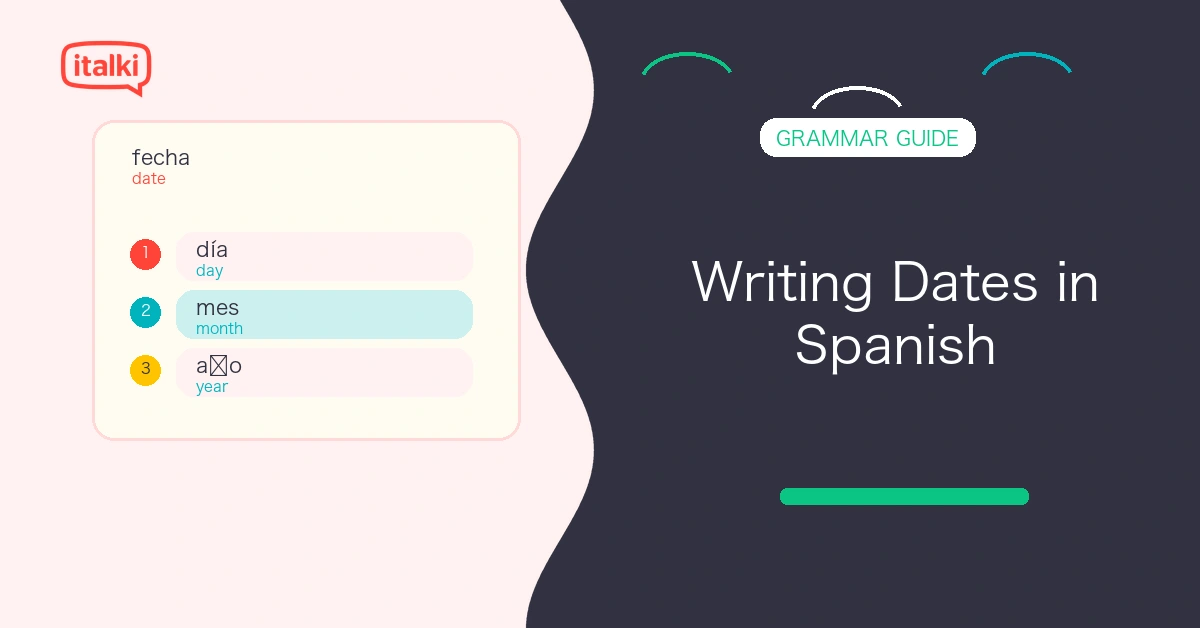
- Spanish uses day-month-year order, not month-day-year. Written out: el 6 de julio de 2026. Written numerically: 6/7/2026.
- Days of the week and months are not capitalized in Spanish, unlike in English.
- For the 1st of any month, use primero (ordinal). For all other dates, use cardinal numbers: el dos, el tres, el catorce.
- To ask the date informally, say ¿A cuántos estamos? In formal letters, the header reads: [City], [day] de [month] de [year].
Spanish date format trips up English speakers at almost every step: the order is reversed, neither days nor months get capital letters, and there are two natural ways to say what’s the date today. italki connects you with Spanish tutors who give real-time corrections when you write dates in emails, letters, or forms, catching the exact pattern of mistakes you repeat without noticing.
This guide covers the standard Spanish date format, how to say and write specific dates, the days and months every learner needs, formal letter conventions, and the most common errors English speakers make.

Find your perfect teacher
Build real speaking confidence with personalized lessons from a teacher who matches your goals, schedule, and learning style.

The standard Spanish date format
Spanish uses day/month/year order. This is the reverse of American English (month/day/year) and matches how British English writes dates.
| Format | Example |
|---|---|
| Written out, full | el 6 de julio de 2026 |
| Written out, short | 6 de julio de 2026 |
| Numeric | 6/7/2026 |
| With day of week | el lunes, 6 de julio de 2026 |
The structure for writing a full date is: [el] + [day number] + de + [month] + de + [year]
The word el before the day is standard in speech and informal writing. Formal documents often omit it.
Asking for the date:
| Spanish | English |
|---|---|
| ¿Cuál es la fecha de hoy? | What is today’s date? (formal) |
| ¿A cuántos estamos? | What’s the date? (informal) |
| ¿Qué día es hoy? | What day is today? |
Answering:
| Spanish | English |
|---|---|
| Hoy es el 6 de julio. | Today is July 6th. |
| Hoy estamos a 6 de julio. | Today is the 6th of July. (informal) |
| Hoy es lunes, 6 de julio. | Today is Monday, July 6th. |
Work with a Spanish teacher online to practice writing dates in the real contexts where you need them: filling out official forms, writing formal emails, or confirming appointments.
Days of the week in Spanish
| Spanish | English |
|---|---|
| lunes | Monday |
| martes | Tuesday |
| miércoles | Wednesday |
| jueves | Thursday |
| viernes | Friday |
| sábado | Saturday |
| domingo | Sunday |
Three rules to remember:
- Days of the week are never capitalized in Spanish.
- The calendar week starts on Monday, not Sunday, across Spanish-speaking countries.
- El lunes means on Monday (a specific date). Los lunes means every Monday.
Find your perfect teacher
Build real speaking confidence with personalized lessons from a teacher who matches your goals, schedule, and learning style.
Months in Spanish
| Spanish | English | Spanish | English |
|---|---|---|---|
| enero | January | julio | July |
| febrero | February | agosto | August |
| marzo | March | septiembre | September |
| abril | April | octubre | October |
| mayo | May | noviembre | November |
| junio | June | diciembre | December |
All months are masculine and lowercase in Spanish. Common abbreviations for informal writing: ene., feb., mar., abr., may., jun., jul., ago., sep., oct., nov., dic.
How to say and write specific dates
Cardinal vs. ordinal for the day number:
Spanish uses cardinal numbers for dates (dos, tres, quince). The only exception is the first of the month, which uses primero.
| Date | Correct Spanish | Common error |
|---|---|---|
| January 1st | el primero de enero | el uno de enero |
| January 2nd | el dos de enero | el segundo de enero |
| March 15th | el quince de marzo | el décimo quinto de marzo |
| December 31st | el treinta y uno de diciembre | el trigésimo primero |
Writing years:
Years are read as a single number, not split the way some informal English does (twenty twenty-six).
| Year | Spanish |
|---|---|
| 2026 | dos mil veintiséis |
| 1999 | mil novecientos noventa y nueve |
| 1492 | mil cuatrocientos noventa y dos |
Decades:
| Spanish | English |
|---|---|
| los años ochenta | the eighties |
| los años noventa | the nineties |
| los años dos mil | the 2000s |
| los años veinte | the twenties (2020s) |
For scheduling contexts, the guide to telling time in Spanish covers the hours, minutes, and appointment phrases that often appear beside dates.
Find your perfect teacher
Build real speaking confidence with personalized lessons from a teacher who matches your goals, schedule, and learning style.
Writing dates in formal contexts
In letters and official correspondence:
Formal Spanish letters use this header format: [City], [day] de [month] de [year]
Examples:
- Madrid, 6 de julio de 2026
- Ciudad de México, 15 de enero de 2025
- Buenos Aires, 31 de agosto de 2024
On forms and official paperwork:
Spanish-language forms label date fields as Fecha and typically request: DD/MM/AAAA (where AAAA stands for año, year). The day comes first. A date written 06/07/2026 means July 6 in Spanish, which is the same as 6/7/2026.
In business emails:
For formal emails, the date appears in the header in written-out form. If you are using the date in correspondence, the guide to writing an email in Spanish covers the salutation, closing, and register choices too:
Barcelona, 6 de julio de 2026
A private Spanish tutor can review your formal correspondence and fix formatting details that automated checkers miss, including date placement, punctuation, and regional conventions in letters.
Common mistakes English speakers make
Mistake 1: Month before day English speakers instinctively write the month first. In Spanish, 7/6/2026 means June 7, not July 6.
Mistake 2: Capitalizing months and days julio, not Julio. lunes, not Lunes.
Mistake 3: Using uno for the first of the month The correct form is el primero de enero, not el uno de enero.
Mistake 4: Reading years with a split Say dos mil veintiséis, not veinte veintiséis.
Mistake 5: Adding ordinal suffixes Spanish does not add ordinal endings after day numbers (no el 6to or el 6.a). Just el 6.
Find your perfect teacher
Build real speaking confidence with personalized lessons from a teacher who matches your goals, schedule, and learning style.
Practice with a Spanish teacher
Dates appear constantly in real-life Spanish: booking appointments, writing emails, filling out immigration forms, making travel plans. Knowing the rules in theory is different from applying them confidently under pressure.
Working with a Spanish teacher gives you a space to practice dates in context: writing formal letters, responding to scheduling messages, and reading dates correctly on Spanish documents.
Learn Spanish faster with personal guidance from 2500+ expert Spanish teachers online, trusted by over 10 million learners worldwide. Book a trial lesson and experience the difference personalized tutoring makes. Book a trial lesson and make the day-month-year order automatic.
Find your perfect teacher
Build real speaking confidence with personalized lessons from a teacher who matches your goals, schedule, and learning style.
FAQ
Does Spanish ever use month-day-year order?
No. All Spanish-speaking countries use day-month-year. The format is consistent, though abbreviation styles vary slightly by country.
How do I write the 1st of May in Spanish?
El primero de mayo. Only the first of the month uses an ordinal form. Every other date uses a cardinal number: el dos de mayo, el quince de mayo.
Is there a difference in date writing between Spain and Latin America?
The format (day-month-year) is the same everywhere. Minor differences exist in abbreviation conventions and whether a comma follows the city name in letter headers.
Can I use a fully numeric date, like 6/7/2026?
Yes in informal writing and on forms. Always put the day first. For formal documents and correspondence, the written-out form (6 de julio de 2026) is standard.
Want to learn a language at italki?
Here are the best resources for you!