Key takeaways
- English sentence structure follows Subject-Verb-Object order almost always: She reads books (S-V-O). Changing this order changes the meaning or makes the sentence wrong.
- English has 8 parts of speech: nouns, pronouns, verbs, adjectives, adverbs, prepositions, conjunctions, and articles. Understanding what each one does makes grammar rules much easier to apply.
- Present simple, past simple, and present continuous are the three verb tenses beginners need first. Together, they cover most of what beginners want to say.
- Articles (a, an, the) are one of the most common sources of errors for beginners. The rule is simpler than it looks: the for specific things, a/an for non-specific things.
Grammar rules are not what most beginners expect. Many learners assume English grammar is either very simple (it looks like it does not have verb endings or gender) or impossibly complicated (there must be hundreds of rules).
The reality is in between: English has a clear core of about 15 to 20 rules that cover most everyday communication, and each one is learnable with the right explanation and a little practice.
italki connects beginners with English teachers who can explain the rules that confuse you most and correct your errors in real time, which is far more effective than studying grammar tables alone.
This guide covers the essential basic English grammar rules for beginners: sentence structure, parts of speech, the three most important verb tenses, articles, plurals, pronouns, prepositions, and the most common grammar mistakes beginners make in real speech.

Find your perfect teacher
Build real English confidence with personalized lessons from a teacher who matches your goals, schedule, and learning style.
Book a trial lesson
English sentence structure
English follows Subject-Verb-Object (S-V-O) order in almost all sentences. This is the most important rule in the language because changing the order changes the meaning or makes the sentence ungrammatical.
| Subject | Verb | Object |
|---|---|---|
| She | reads | books. |
| The dog | chased | the cat. |
| My brother | speaks | Spanish. |
Questions change the word order by moving the auxiliary verb before the subject:
- Statement: She is a teacher.
- Question: Is she a teacher?
- Statement: They are working.
- Question: Are they working?
- Statement: He likes coffee.
- Question: Does he like coffee? (Add does for simple present with he/she/it)
Negatives add not after the auxiliary verb:
- She is not a teacher.
- They are not working.
- He does not like coffee.
In informal speech, contractions are standard: is not becomes isn’t, does not becomes doesn’t, are not becomes aren’t.
Work through question formation with an English tutor who can prompt you with statements and have you flip them into questions and negatives in real time. This kind of drill builds speed that grammar tables alone cannot.
Parts of speech: what each word does
Every English word belongs to one or more categories called parts of speech. Understanding the role of each word helps you build correct sentences.
| Part of speech | What it does | Examples |
|---|---|---|
| Noun | Names a person, place, thing, or idea | cat, city, happiness, teacher |
| Pronoun | Replaces a noun | he, she, it, they, we |
| Verb | Describes an action or state | run, is, think, have |
| Adjective | Describes a noun | big, cold, happy, new |
| Adverb | Modifies a verb, adjective, or other adverb | quickly, very, never, often |
| Preposition | Shows relationship (time, place, direction) | in, on, at, under, before |
| Conjunction | Joins words or sentences | and, but, because, although |
| Article | Specifies a noun | a, an, the |
Adverbs of manner are one category worth studying in detail because words like quickly, slowly, and carefully modify verbs and change where information sits in a sentence.
Find your perfect teacher
Build real English confidence with personalized lessons from a teacher who matches your goals, schedule, and learning style.
Book a trial lesson
The three essential verb tenses for beginners
English has twelve tenses, but beginners only need three to handle most daily conversations.
1. Present simple
Used for: habits, routines, facts, and general truths.
Form: subject + base verb. For he/she/it: add -s or -es.
| Subject | Verb | Example |
|---|---|---|
| I / You / We / They | work | I work every day. |
| He / She / It | works | She works in an office. |
Negative: subject + do/does + not + base verb.
- I do not like coffee. / She does not work on Sundays.
Question: do/does + subject + base verb?
- Do you live here? / Does he speak French?
Key time words: always, usually, often, sometimes, rarely, never, every day, on Mondays.
2. Past simple
Used for: completed actions in the past.
Regular verbs: add -ed to the base form.
- Work – worked, play – played, watch – watched
Irregular verbs: the past form changes completely. These must be memorized.
| Base form | Past simple | Example |
|---|---|---|
| go | went | She went to the store. |
| have | had | I had a great day. |
| see | saw | We saw a movie last night. |
| come | came | They came home late. |
| buy | bought | He bought a new phone. |
| eat | ate | I ate breakfast at 7am. |
| say | said | She said she was tired. |
| get | got | We got the tickets. |
Negative: subject + did not + base verb.
- I did not go to school. / She did not see the email.
Question: did + subject + base verb?
- Did you call him? / Did they arrive on time?
Key time words: yesterday, last week, last year, in 2020, ago (two days ago, a month ago).
3. Present continuous
Used for: actions happening right now, or plans in the near future.
Form: subject + is/am/are + verb-ing.
| Subject | Form | Example |
|---|---|---|
| I | am working | I am working now. |
| He / She / It | is working | She is working from home. |
| We / You / They | are working | They are studying for the exam. |
Negative: subject + is/am/are + not + verb-ing.
- I am not watching TV. / He is not coming to the meeting.
Question: is/am/are + subject + verb-ing?
- Are you listening? / Is she coming tomorrow?
Present continuous for plans:
- I am meeting a friend tonight.
- We are flying to Tokyo next week.
These tense choices also shape workplace tone, so business English conversation shows how present simple and present continuous appear in professional contexts.
Articles: a, an, and the
Articles are small words but they cause many errors. The rule is simpler than most learners think.
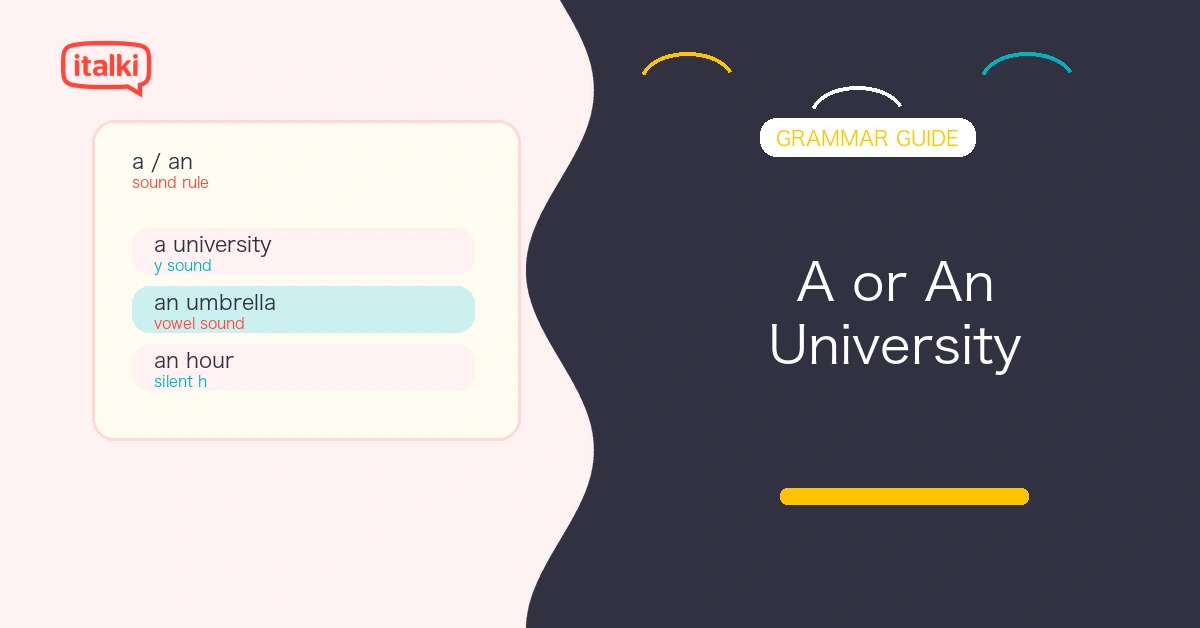
a and an: used before singular nouns that are not specific. Use an before vowel sounds (a, e, i, o, u).
- I saw a dog. (any dog, not a specific one)
- She is a teacher. (her job, not a specific identity)
- He ate an apple. (any apple)
- It is an interesting book.
the: used before nouns that are specific, known to both speaker and listener, or unique.
- The dog in our garden is friendly. (a specific dog we both know about)
- Pass me the salt, please. (the salt on this specific table)
- The sun rises in the east. (the only sun)
- Did you finish the report? (a specific report we both know about)
No article: used with plural nouns in a general sense, and with uncountable nouns in a general sense.
- Dogs are friendly animals. (dogs in general, not specific ones)
- Water is important for health. (water in general)
- I love music.
| Rule | Example |
|---|---|
| First mention, singular: a/an | I saw a cat outside. |
| Second mention, now specific: the | The cat was black. |
| Unique, only one exists: the | The president spoke today. |
| General plural: no article | Cats are independent animals. |
| Uncountable, general: no article | I drink coffee every morning. |
Find your perfect teacher
Build real English confidence with personalized lessons from a teacher who matches your goals, schedule, and learning style.
Book a trial lesson
Plurals and possessives
Making plurals
Most English nouns form the plural by adding -s or -es.
| Rule | Example |
|---|---|
| Most nouns: add -s | book – books, chair – chairs |
| Nouns ending in -s, -sh, -ch, -x, -z: add -es | bus – buses, watch – watches |
| Nouns ending in consonant + y: change y to -ies | city – cities, baby – babies |
| Nouns ending in -f or -fe: change to -ves | leaf – leaves, knife – knives |
| Irregular plurals (must memorize) | man – men, woman – women, child – children, tooth – teeth, foot – feet, mouse – mice |
Possessives
To show that something belongs to a person or thing, add ‘s or use of.
- The dog’s bowl is empty. (the bowl belongs to the dog)
- My sister’s car is blue. (the car belongs to my sister)
- The end of the road (use of for objects, not ‘s)
- The children’s books are on the shelf. (children is already plural)
For irregular plurals that already end in -s, just add an apostrophe: the teachers’ lounge.
Pronouns
Pronouns replace nouns so you do not repeat the same noun.
| Person | Subject pronoun | Object pronoun | Possessive adjective | Possessive pronoun |
|---|---|---|---|---|
| I (singular, speaker) | I | me | my | mine |
| You (singular) | you | you | your | yours |
| He (singular, male) | he | him | his | his |
| She (singular, female) | she | her | her | hers |
| It (singular, thing/animal) | it | it | its | its |
| We (plural, including speaker) | we | us | our | ours |
| You (plural) | you | you | your | yours |
| They (plural) | they | them | their | theirs |
Subject pronouns go before the verb: I like coffee. She is my friend. Object pronouns go after the verb or preposition: Call me. I gave it to him. She is talking to us.
Common error: Me and my friend went to the store. The correct form is My friend and I went to the store because I is the subject pronoun.
Choose vs. chose is a useful example of how small word changes affect tense and meaning, the same principle behind many beginner grammar mistakes.
Find your perfect teacher
Build real English confidence with personalized lessons from a teacher who matches your goals, schedule, and learning style.
Book a trial lesson
Prepositions of time and place
Prepositions are short words that show relationships. The three most important for beginners are at, on, and in.
Prepositions of time
| Preposition | Used with | Examples |
|---|---|---|
| at | specific times, holidays, parts of the day | at 7am, at noon, at night, at Christmas |
| on | days and dates | on Monday, on March 7th, on my birthday |
| in | months, years, seasons, longer periods | in January, in 2020, in summer, in the morning |
Memory shortcut: Think big to small for place (in the country, on the street, at the door) and time (in the year, on the day, at the hour).
Prepositions of place
| Preposition | Meaning | Example |
|---|---|---|
| in | inside an enclosed space | in the room, in the box, in London |
| on | on a surface | on the table, on the wall, on the bus |
| at | at a specific point or location | at the door, at school, at work |
| under | below something | under the chair |
| above | higher than something | above the window |
| next to | beside | next to the bank |
| between | in the middle of two things | between the chairs |
| behind | at the back of | behind the building |
Common grammar mistakes beginners make
| Mistake | Correct form | Explanation |
|---|---|---|
| I am agree with you. | I agree with you. | Agree is a verb; you cannot use am before it |
| She don’t like it. | She doesn’t like it. | He/she/it needs does in present simple |
| Yesterday I go to school. | Yesterday I went to school. | Yesterday signals past simple; use went |
| I am here since Monday. | I have been here since Monday. | Since requires present perfect, not present continuous |
| I have 20 years. | I am 20 years old. | English uses be for age, not have |
| She is very interest in music. | She is very interested in music. | The adjective is interested, not interest |
| He make me laugh. | He makes me laugh. | He/she/it adds -s in present simple |
| Please explain me this. | Please explain this to me. | Explain takes to before the indirect object |
Find your perfect teacher
Build real English confidence with personalized lessons from a teacher who matches your goals, schedule, and learning style.
Book a trial lesson
How to practice English grammar effectively
One tense at a time. Do not jump between tenses before the first one is automatic. Spend a week on present simple, then past simple, then present continuous. Moving too quickly creates confusion that is hard to unlearn.
Speak, do not just study. Grammar learned from a book but never spoken stays passive. Use new rules in full sentences out loud. Make mistakes in a safe context with a teacher rather than in your next important meeting.
Keep a personal error log. Write down the specific mistakes you make when speaking or writing. Review them before each practice session. Knowing your own patterns is more efficient than reviewing all grammar rules every time.
Use grammar in context. Practicing tenses in sentences about your real life is more memorable than abstract exercises. I visited my grandmother last Sunday sticks better than Subject + visited + object.
Working with an English language teacher who gives you live error correction on the specific rules in this guide turns passive knowledge into real spoken accuracy.
Find your perfect teacher
Build real English confidence with personalized lessons from a teacher who matches your goals, schedule, and learning style.
Book a trial lesson
FAQ
Why does English have irregular verbs?
Irregular verbs come from the historical merging of several older languages. Old English, Old Norse, and Norman French all contributed vocabulary to English, each with different verb patterns. Words like go/went and buy/bought were shaped by this mixing over centuries. There is no single rule that covers all irregular verbs – the most efficient approach is to learn the most common ones (go, have, see, come, get, say, take) as a priority set.
How long does it take to learn basic English grammar?
Most beginners can understand and apply the core rules in 2-3 months of consistent practice. Consistency matters more than intensity: 30 minutes daily produces faster results than three hours once a week. The transfer from knowing a rule to using it automatically in speech takes longer and is where regular conversation practice makes the clearest difference.
Is it possible to speak English well without mastering all the grammar rules?
Yes. Native speakers routinely break grammar rules in casual speech, and communication is still effective. The goal for beginners is not perfect grammar but grammar that is good enough to be understood clearly. Starting with the highest-frequency rules (present and past tense, basic questions, articles) and building from there is more practical than trying to learn every rule before speaking.
Want to learn a language at italki?
Here are the best resources for you!