Key takeaways
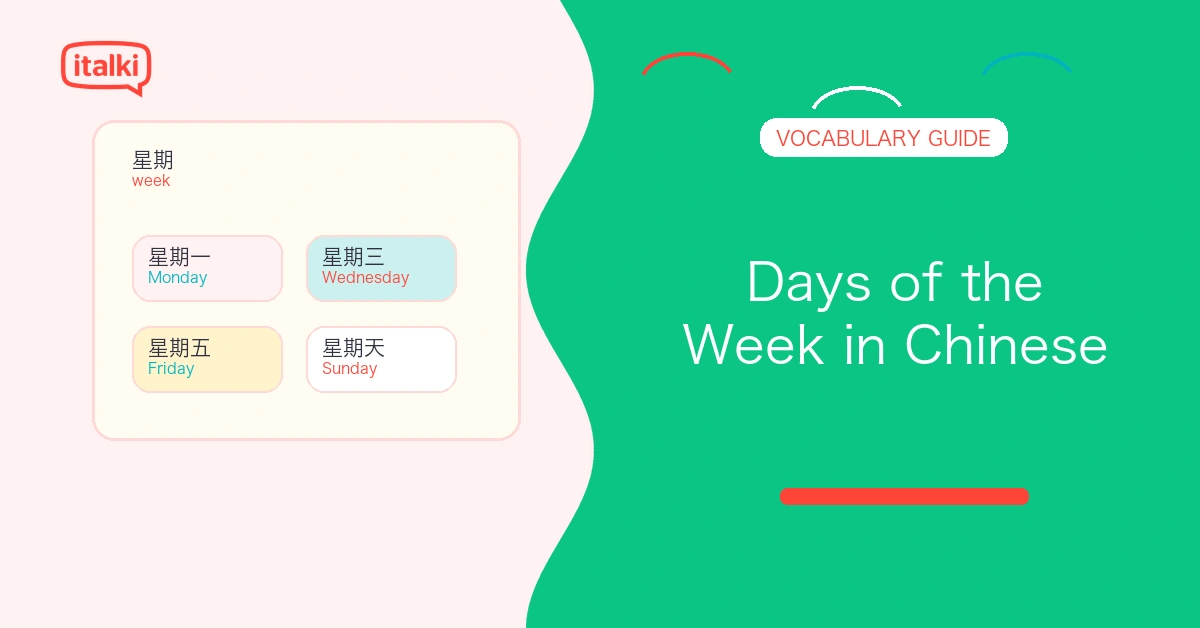
- Chinese days of the week follow a numbered pattern: 星期一 (Monday) through 星期六 (Saturday). Sunday is the exception: it uses 天 (tiān: sky/day) or 日 (rì: sun/day), not a number.
- Two systems exist: 星期 (xīngqī: week) for everyday speech and 周 (zhōu: week) for more formal and written Chinese. Both are correct and both are worth recognizing.
- To ask what day it is: 今天星期几? (jīntiān xīngqī jǐ: what day is today?). To answer: 今天是星期X. The structure is the same every time.
- In Chinese sentences, the day comes before the time, and time comes before the verb.
Here is something that makes Chinese days of the week easier than most learners expect: they follow a logical, numbered system. Once you know the numbers 1 through 6 and the word for week (星期), you know Monday through Saturday automatically. There is no memorizing Monday, Tuesday, Wednesday as unrelated words.
italki connects you with Chinese teachers who can practice scheduling conversations and weekly plans with you so the days become automatic in natural speech.
This guide covers the full Chinese days of the week vocabulary, the two parallel systems (星期 and 周), how to use days in sentences, how to ask and answer questions about the day, and the most common patterns for talking about weekly schedules.

Find your perfect teacher
Build real speaking confidence with personalized lessons from a teacher who matches your goals, schedule, and learning style.

The days of the week: full table
| Chinese | Pinyin | English | Notes |
|---|---|---|---|
| 星期一 | Xīngqī yī | Monday | Literally: Week + One |
| 星期二 | Xīngqī èr | Tuesday | Literally: Week + Two |
| 星期三 | Xīngqī sān | Wednesday | Literally: Week + Three |
| 星期四 | Xīngqī sì | Thursday | Literally: Week + Four |
| 星期五 | Xīngqī wǔ | Friday | Literally: Week + Five |
| 星期六 | Xīngqī liù | Saturday | Literally: Week + Six |
| 星期天 / 星期日 | Xīngqī tiān / Xīngqī rì | Sunday | 天 = sky/day; 日 = sun/day; both are correct |
The pattern breaks only at Sunday. There is no 星期七 (Week Seven). Sunday uses either 天 (tiān: sky, day) or 日 (rì: sun, day), both meaning day in a different sense. 星期天 is more common in speech; 星期日 appears more in formal written contexts such as calendars and official documents.
The two systems: 星期 and 周
Chinese has two ways to say the days of the week. Both are correct; they differ slightly in register.
| English | 星期 (xīngqī) system | 周 (zhōu) system |
|---|---|---|
| Monday | 星期一 | 周一 |
| Tuesday | 星期二 | 周二 |
| Wednesday | 星期三 | 周三 |
| Thursday | 星期四 | 周四 |
| Friday | 星期五 | 周五 |
| Saturday | 星期六 | 周六 |
| Sunday | 星期天 / 星期日 | 周日 / 周天 |
When to use which:
- 星期 (xīngqī): common in everyday spoken Chinese across all regions. More widely used in Taiwan and with older speakers.
- 周 (zhōu): slightly more concise and formal. Common in Mandarin-speaking mainland China, especially in writing, apps, calendars, and office communication. Many business emails and meeting invitations use 周一 rather than 星期一.
Both forms are understood everywhere. If you are unsure, 星期 is the safer default for learners.
Work with a Chinese tutor to practice both forms in conversation so you can switch naturally between them depending on the context.
Find your perfect teacher
Build real speaking confidence with personalized lessons from a teacher who matches your goals, schedule, and learning style.
How to ask what day it is
The standard question:
| Chinese | Pinyin | English |
|---|---|---|
| 今天星期几? | Jīntiān xīngqī jǐ? | What day is today? |
| 今天是几号? | Jīntiān shì jǐ hào? | What is the date today? (day of the month) |
| 今天是哪天? | Jīntiān shì nǎ tiān? | What day is today? (slightly informal) |
Note: 星期几 literally asks Week number how-many using the question word 几 (jǐ). This is the same 几 used when asking how many for small quantities.
Answering:
| Chinese | Pinyin | English |
|---|---|---|
| 今天是星期三。 | Jīntiān shì xīngqī sān. | Today is Wednesday. |
| 今天星期五。 | Jīntiān xīngqī wǔ. | Today is Friday. (informal, dropping 是) |
| 今天是周一。 | Jīntiān shì zhōu yī. | Today is Monday. (周 form) |
Days of the week become more useful once you can add Chinese numbers for dates and time expressions in Chinese for scheduling.
Using days in sentences
In Chinese, time expressions come before the verb, and within a time expression, the order goes from largest to smallest: year – month – date – day – time of day – hour.
Basic sentence structure with days:
Subject + [time expression] + verb + object
| Chinese | Pinyin | English |
|---|---|---|
| 我星期一有课。 | Wǒ xīngqī yī yǒu kè. | I have class on Monday. |
| 她星期五不工作。 | Tā xīngqī wǔ bù gōngzuò. | She does not work on Friday. |
| 我们星期三开会。 | Wǒmen xīngqī sān kāi huì. | We have a meeting on Wednesday. |
| 他每个星期六都去健身房。 | Tā měi gè xīngqī liù dōu qù jiànshēnfáng. | He goes to the gym every Saturday. |
Adding time of day:
| Chinese | Pinyin | English |
|---|---|---|
| 我星期二上午有预约。 | Wǒ xīngqī èr shàngwǔ yǒu yùyuē. | I have an appointment Tuesday morning. |
| 我们星期四下午两点开会。 | Wǒmen xīngqī sì xiàwǔ liǎng diǎn kāi huì. | We have a meeting Thursday afternoon at 2pm. |
Days with 每 (měi / every):
| Chinese | Pinyin | English |
|---|---|---|
| 每个星期一 | měi gè xīngqī yī | every Monday |
| 每周三 | měi zhōu sān | every Wednesday |
| 每个周末 | měi gè zhōumò | every weekend |
Find your perfect teacher
Build real speaking confidence with personalized lessons from a teacher who matches your goals, schedule, and learning style.
Talking about last, this, and next week
| Chinese | Pinyin | English |
|---|---|---|
| 上个星期 / 上周 | shàng gè xīngqī / shàng zhōu | last week |
| 这个星期 / 本周 | zhège xīngqī / běn zhōu | this week |
| 下个星期 / 下周 | xià gè xīngqī / xià zhōu | next week |
| 上个星期一 | shàng gè xīngqī yī | last Monday |
| 下个星期五 | xià gè xīngqī wǔ | next Friday |
Example sentences:
| Chinese | Pinyin | English |
|---|---|---|
| 我上周三去了北京。 | Wǒ shàng zhōu sān qùle Běijīng. | I went to Beijing last Wednesday. |
| 下个星期一我们有考试。 | Xià gè xīngqī yī wǒmen yǒu kǎoshì. | We have an exam next Monday. |
| 这个周末你有空吗? | Zhège zhōumò nǐ yǒu kòng ma? | Are you free this weekend? |
Useful weekly time words:
| Chinese | Pinyin | English |
|---|---|---|
| 周末 | zhōumò | weekend |
| 工作日 | gōngzuòrì | weekday / working day |
| 假日 | jiàrì | holiday / day off |
| 平时 | píngshí | usually / on regular days |
Days in daily scheduling conversations
Here are the most common scheduling exchanges you will have in Chinese:
Making a plan:
| Chinese | Pinyin | English |
|---|---|---|
| 你星期几有空? | Nǐ xīngqī jǐ yǒu kòng? | Which day are you free? |
| 我星期三下午有空。 | Wǒ xīngqī sān xiàwǔ yǒu kòng. | I am free Wednesday afternoon. |
| 星期五可以吗? | Xīngqī wǔ kěyǐ ma? | Is Friday okay? |
| 星期五不行,星期六怎么样? | Xīngqī wǔ bù xíng, xīngqī liù zěnmeyàng? | Friday does not work, what about Saturday? |
Talking about weekly routines:
| Chinese | Pinyin | English |
|---|---|---|
| 我每周一都有英语课。 | Wǒ měi zhōu yī dōu yǒu Yīngyǔ kè. | I have English class every Monday. |
| 我们公司周六不上班。 | Wǒmen gōngsī zhōu liù bù shàngbān. | Our company does not work on Saturdays. |
| 周末我喜欢待在家。 | Zhōumò wǒ xǐhuān dāi zài jiā. | I like to stay home on weekends. |
For travel-related scheduling phrases including asking about transport and departure times, the guide to Chinese travel phrases covers the day and time vocabulary used in real travel situations.
Find your perfect teacher
Build real speaking confidence with personalized lessons from a teacher who matches your goals, schedule, and learning style.
Practice these days in real conversations
The days of the week are among the first things that come up in any real Chinese conversation about plans, schedules, and daily life. Knowing the vocabulary in isolation is easy; producing it naturally mid-conversation, when someone asks you a quick scheduling question, takes practice.
A Chinese teacher can run daily scheduling dialogues with you, help you practice the time-before-verb sentence structure that trips up many learners, and correct your pronunciation of the trickier days (星期四 / xīngqī sì in particular, where the tones are easy to confuse). Find one on italki: 30,000+ expert tutors, trusted by over 10 million learners worldwide, across every schedule and time zone. Book a trial lesson and practise your weekly schedule in Chinese in your very first session.
Find your perfect teacher
Build real speaking confidence with personalized lessons from a teacher who matches your goals, schedule, and learning style.
FAQ
Why is Sunday 星期天 and not 星期七?
The numbering system (一 through 六) maps onto the six workdays. Sunday falls outside the numbered sequence and uses 天 (sky/day) or 日 (sun) instead of a number. This reflects traditional Chinese calendar thinking, where Sunday was not simply day seven but had its own distinct character as a rest day. Both 星期天 and 星期日 are correct; the distinction is mainly register, not meaning.
What is the difference between 周末 and 星期六和星期天?
周末 (zhōumò) specifically means the weekend as a combined concept: Saturday and Sunday together. 星期六和星期天 means Saturday and Sunday as two separate days. In casual speech, 周末 is far more natural when you mean the weekend as a unit of free time.
Do Chinese calendars start the week on Monday or Sunday?
Chinese calendars start the week on Monday, with Sunday at the end. This is the standard in mainland China, Taiwan, Hong Kong, and most of Asia. If you see a Chinese calendar, the columns run 一 (Mon) through 日 (Sun), left to right.
Is Tuesday in Chinese 星期二 or 礼拜二?
Both. 礼拜 (lǐbài) is a third system, less formal and more colloquial, used mainly in spoken Shanghainese-influenced Mandarin and some regional speech patterns: 礼拜一 (Monday), 礼拜二 (Tuesday), etc. You may hear it, but 星期 and 周 are the standard forms to learn and use.
Want to learn a language at italki?
Here are the best resources for you!