Key takeaways
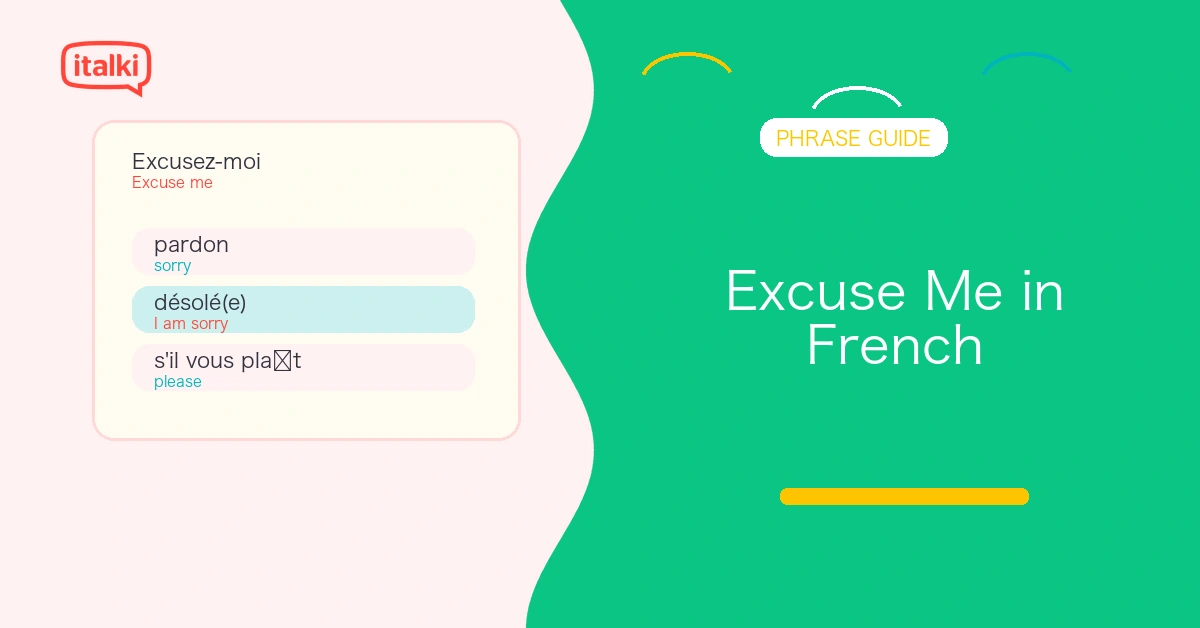
- The two most common French phrases for “excuse me” are Excusez-moi (to get attention or pass by someone) and Pardon (to apologise for a minor collision or interruption).
- Excusez-moi is the more versatile and slightly more formal phrase; it works in almost any “excuse me” situation.
- Pardon is quicker and is often used reflexively when bumping into someone or interrupting briefly.
- Je suis désolé(e) (I am sorry) is used for genuine apologies, not for polite “excuse me” situations.
- The formal Je vous demande pardon (I beg your pardon) and Pardonnez-moi are used in more serious or formal contexts.
“Excuse me” in English does several different jobs: getting someone’s attention, apologising for a minor bump, asking someone to repeat something, and politely pushing past in a crowd. French uses different phrases for each of those situations, and using the wrong one sounds odd even if everyone understands you.
This guide gives you the right phrase for each situation. With 30,000+ expert tutors trusted by 10M+ learners worldwide, italki connects you with French teachers who can walk you through polite phrases in context, including the social register cues that make French daily interactions feel natural rather than mechanical.

Find Your Perfect Teacher
Build real French confidence with personalized lessons from a teacher who can help with speaking, exam prep, grammar, and pronunciation.
Book a trial lesson
The main phrases and when to use each
| French | English equivalent | Best used when |
|---|---|---|
| Excusez-moi | Excuse me | Getting attention, asking to pass, formal “excuse me” |
| Pardon | Sorry / Excuse me | Brief bumps, quick interruptions, asking to repeat |
| Pardonnez-moi | Pardon me / Excuse me | Slightly more formal than Pardon |
| Je suis désolé(e) | I am sorry | Genuine apology for something with impact |
| Je vous demande pardon | I beg your pardon | Formal, serious apology or formal request to repeat |
| Permettez-moi | Allow me / Excuse me | Asking permission to pass or do something |
Excusez-moi: the all-purpose phrase
Excusez-moi (eks-kyoo-zay-MWAH) is the phrase you will use most. It translates as “excuse me” and works across the widest range of situations:
- To get a stranger’s attention: Excusez-moi, vous savez où est la gare? (Excuse me, do you know where the station is?)
- To interrupt a conversation: Excusez-moi de vous déranger… (Excuse me for interrupting…)
- To ask to pass in a crowd: Excusez-moi, je peux passer? (Excuse me, can I get through?)
- To get a server’s attention in a restaurant: Excusez-moi, s’il vous plaît… (Excuse me, please…)
- To signal you are about to ask something formal: Excusez-moi, j’aurais une question. (Excuse me, I have a question.)
The vous form (Excusez-moi) is formal. The tu form (Excuse-moi) is used with people you know well, children, and peers in casual settings. Practice your command of Excusez-moi with an online French tutor through realistic daily scenarios.
Find Your Perfect Teacher
Build real French confidence with personalized lessons from a teacher who can help with speaking, exam prep, grammar, and pronunciation.
Book a trial lesson
Pardon: the collision reflex
Pardon (par-DOHN) is the instinctive phrase for minor, immediate situations: bumping into someone in a corridor, talking over someone briefly, or asking someone to repeat what they said.
- Bumping into someone: Pardon! (almost reflexive, like “sorry!”)
- Asking for repetition: Pardon? (said with rising intonation, meaning “sorry, could you say that again?”)
- Briefly interrupting: Pardon, je ne voulais pas vous couper. (Sorry, I did not mean to interrupt you.)
Pardon said with rising intonation functions as “I beg your pardon?” in the sense of “could you repeat that?” This is the same as the English usage of “pardon?” as a polite request for repetition. Build the Pardon reflex with an online French teacher for spontaneous, natural-sounding reactions.
Je suis désolé(e): the real apology
Je suis désolé(e) (zhuh swee day-zo-LAY) means “I am sorry” and is for situations that go beyond the social pleasantry:
- When you are significantly late: Je suis vraiment désolé(e) d’être en retard. (I am truly sorry to be late.)
- When you have caused someone an inconvenience: Je suis désolé(e) pour ce désagrément. (I am sorry for this inconvenience.)
- When something has gone wrong: Je suis désolé(e), ce n’était pas mon intention. (I am sorry, that was not my intention.)
The -e at the end of désolée is added when the speaker is female. Désolé (no extra e) is used by male speakers. Using Je suis désolé(e) when you just walked past someone in a supermarket aisle would sound disproportionate in French; Pardon or Excusez-moi is the right fit for brief moments.
Find Your Perfect Teacher
Build real French confidence with personalized lessons from a teacher who can help with speaking, exam prep, grammar, and pronunciation.
Book a trial lesson
Pronunciation guide
| French | Phonetic guide | Notes |
|---|---|---|
| Excusez-moi | eks-kyoo-zay MWAH | Stress on the final syllable |
| Pardon | par-DOHN | The “on” is a nasal vowel |
| Je suis désolé | zhuh swee day-zo-LAY | The “é” has a crisp “ay” sound |
| Pardonnez-moi | par-don-ay MWAH | Similar structure to excusez-moi |
| Permettez-moi | pair-met-ay MWAH | Three syllables in permettez |
Asking to repeat in French
When you did not catch what someone said, several phrases work depending on formality:
| French | English | Register |
|---|---|---|
| Pardon? | Sorry? | Informal / neutral |
| Comment? | What? / Pardon? | Informal (can sound abrupt) |
| Vous pouvez répéter, s’il vous plaît? | Could you repeat that, please? | Polite |
| Je n’ai pas bien compris. | I did not understand it well. | Neutral, explanatory |
| Pouvez-vous parler plus lentement? | Could you speak more slowly? | Polite request |
| Je suis désolé(e), je ne comprends pas le français très bien. | I’m sorry, I don’t speak French very well. | Honest, disarming |
Pardon? with rising intonation is the most natural quick response when you miss something. Adding s’il vous plaît after any request makes it significantly more polite and appreciated in French culture. Build confidence asking for repetition with French tutoring on italki. Using polite phrases in French daily life French culture places high value on polite register in interactions with strangers, shopkeepers, and colleagues. A few patterns to know:
| Situation | What to say |
|---|---|
| Entering a shop | Bonjour! (before any request) |
| Getting the attention of a server | Excusez-moi, s’il vous plaît |
| Asking to pass in a crowd | Excusez-moi, pardon |
| Bumping into someone | Pardon! |
| Asking for help on the street | Excusez-moi, je cherche… |
| Apologising for being late | Je suis vraiment désolé(e) |
| Leaving a conversation | Excusez-moi de vous quitter, mais… |
Learn faster with personal guidancefrom 30,000+ expert tutors trusted by over 10 million learners worldwide.Book a trial lesson today.
Find Your Perfect Teacher
Build real French confidence with personalized lessons from a teacher who can help with speaking, exam prep, grammar, and pronunciation.
Book a trial lesson
FAQ
Is it rude to say “Comment?” when I do not understand something in French?
Comment? (What? / Pardon?) is technically acceptable but is considered slightly blunt in formal settings. Among friends, it is natural and common. In more formal or professional situations, Pardon? or Vous pouvez répéter, s’il vous plaît? sounds more polished. French speakers will not be offended by Comment? but they will notice that you used the less formal option. When should I use “Permettez-moi” vs “Excusez-moi”? Permettez-moi (allow me) is used when you are asking permission to act: to enter a room first, to take something, to help someone (“Permettez-moi de vous aider” – allow me to help you). Excusez-moi is used when you want to excuse yourself for interrupting or disturbing. In practice, Excusez-moi works in most situations where either might apply, and Permettez-moi adds a layer of formal courtesy when you want to be particularly respectful. Can I just say “Pardon” for everything to keep it simple? Pardon works for most minor “excuse me” situations and is unlikely to cause offence in any of them. The distinctions matter most in professional or formal contexts where the right phrase shows social awareness. For everyday use while learning, Pardon and Excusez-moi together cover the vast majority of situations you will encounter. As your French improves, adding the other forms makes your politeness feel more native and contextually appropriate.
Want to learn a language at italki?
Here are the best resources for you!