Key takeaways
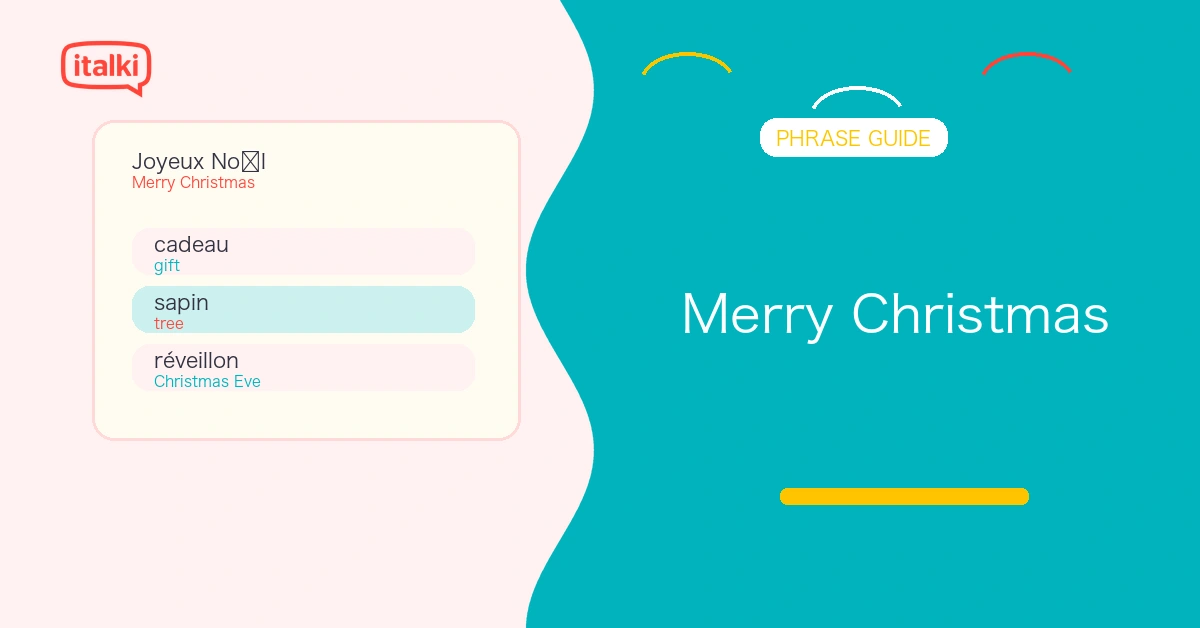
- “Merry Christmas” in French is Joyeux Noël, pronounced “zhwah-yuh no-el.”
- The combined greeting Joyeux Noël et Bonne Année (Merry Christmas and Happy New Year) is the most common form in both written and spoken use.
- Noël can be used alone as a festive exclamation, similar to “Happy Christmas” in informal British English.
- In Quebec and some African Francophone countries, Bon Noël is an alternative to Joyeux Noël.
- French Christmas greetings tend to be slightly more restrained in written form than their English equivalents.
You have studied enough French to have a conversation, but when December comes and you want to write a card or send a message to a French contact, the right phrasing escapes you.
French Christmas greetings have a specific feel: warm but measured, and there are differences between what you say to a close friend vs. a professional contact that matter in French culture.
With 150+ languages across 190+ countries, italki connects you with French teachers who can help you practice seasonal greetings and the conversational French that fills the space around them.

Find Your Perfect Teacher
Build real French confidence with personalized lessons from a teacher who can help with speaking, exam prep, grammar, and pronunciation.
Book a trial lesson
The core greeting: Joyeux Noël
| French | English | Register |
|---|---|---|
| Joyeux Noël! | Merry Christmas! | Standard, universal |
| Joyeux Noël et Bonne Année! | Merry Christmas and Happy New Year! | Full seasonal greeting |
| Bon Noël! | Good Christmas! | Informal, regional (Quebec) |
| Joyeuses Fêtes! | Happy Holidays! | Inclusive, used when unsure of the person’s traditions |
| Bonnes Fêtes de fin d’année! | Happy end-of-year celebrations! | Formal, inclusive |
Joyeux Noël is the standard phrase across France, Belgium, Switzerland, and most of the French-speaking world. Joyeux Noël et Bonne Année is the extended form used in cards, professional emails, and messages sent in the days around Christmas that will carry into the new year. Joyeuses Fêtes (Happy Holidays) is used in professional contexts where you want to be inclusive of people who do not celebrate Christmas, or when writing to a diverse group.
Written examples for different relationships
For a close friend (text or social media):
- Joyeux Noël! J’espère que tu passes de bonnes fêtes avec ta famille. (Merry Christmas! I hope you are having a good holiday with your family.)
- Gros bisous et joyeux Noël! (Big kisses and Merry Christmas!)
- Joyeux Noël! On se voit bientôt en janvier? (Merry Christmas! See you in January?)
For family:
- Joyeux Noël à toute la famille, avec tout notre amour. (Merry Christmas to all the family, with all our love.)
- Je vous souhaite un joyeux Noël et de très belles fêtes. (I wish you a Merry Christmas and wonderful celebrations.)
- Que le bonheur soit avec toi en cette belle période. (May happiness be with you during this beautiful period.)
For a colleague or professional contact:
- Je vous souhaite un joyeux Noël et une excellente Nouvelle Année. (I wish you a Merry Christmas and an excellent New Year.)
- Toute l’équipe vous souhaite de bonnes fêtes de fin d’année. (The whole team wishes you happy end-of-year celebrations.)
- Meilleurs voeux pour les fêtes et la Nouvelle Année. (Best wishes for the holidays and the New Year.)
Learn to adjust formality with a French tutor for your specific relationships. Book your trial lesson on italki.
Find Your Perfect Teacher
Build real French confidence with personalized lessons from a teacher who can help with speaking, exam prep, grammar, and pronunciation.
Book a trial lesson
Pronunciation guide
| French | Phonetic guide |
|---|---|
| Joyeux | zhwah-yuh |
| Noël | no-el (the “ë” marks that both vowels are pronounced separately) |
| Joyeuses | zhwah-yuhz |
| Fêtes | feht (circumflex lengthens the vowel slightly) |
| Bonnes | bun |
| Souhaitons | soo-ay-ton (h is silent) |
The umlaut on Noël (ë) is called a tréma in French. It appears to indicate that the two vowels in “oë” are each pronounced separately: “no” + “el” rather than a merged vowel. Saying “noel” as one sound is a common error; the correct pronunciation keeps the two syllables distinct. Practice saying these greetings correctly with a French tutor online through focused pronunciation practice on italki.
Christmas vocabulary in French
| French | English |
|---|---|
| Noël | Christmas |
| le sapin de Noël | the Christmas tree |
| le Père Noël | Father Christmas / Santa Claus |
| les cadeaux | the gifts |
| la crèche | the nativity scene |
| le réveillon de Noël | Christmas Eve dinner |
| la messe de minuit | midnight mass |
| les décorations | the decorations |
| la bûche de Noël | the Yule log cake (a French Christmas dessert) |
| les fêtes | the holidays / the celebrations |
| les lumières | the lights |
| la neige | the snow |
La bûche de Noël is a key cultural detail: a traditional French Christmas dessert shaped and decorated to look like a log. It is closely associated with the holiday and worth knowing as a cultural reference. Learn festive vocabulary with French tutors online to enrich your holiday conversations.
Find Your Perfect Teacher
Build real French confidence with personalized lessons from a teacher who can help with speaking, exam prep, grammar, and pronunciation.
Book a trial lesson
French Christmas customs
Christmas in France (Noël) centres on le réveillon de Noël, the Christmas Eve dinner. This is typically the main family celebration of the season, often lasting late into the night. Traditional foods include oysters, foie gras, smoked salmon, and la bûche de Noël for dessert. Gift-giving in France happens primarily on Christmas Day (December 25). In Alsace and some regions, Saint Nicolas Day (December 6) also involves small gifts for children. In terms of greetings, the French Christmas card tradition exists but is slightly less prominent than in English-speaking countries. Professional messages are often digital and sent in the last week of December. For New Year greetings that naturally follow Christmas exchanges, the guide on how to say happy New Year in French covers Bonne Année, Meilleurs Voeux, and the cultural customs around French New Year. With 30,000+ expert tutors across 150+ languages on italki, find a French tutor and practice seasonal conversations.Book a trial lesson today and roleplay a brief seasonal exchange
Find Your Perfect Teacher
Build real French confidence with personalized lessons from a teacher who can help with speaking, exam prep, grammar, and pronunciation.
Book a trial lesson
FAQ
Is it “Joyeux Noël” or “Joyeuses Noël”?
Joyeux Noël is correct. Noël is masculine in French (le Noël), so the masculine form joyeux is used. Joyeuses is the feminine plural form, which appears in Joyeuses Fêtes (happy celebrations) because fêtes (celebrations) is a feminine plural noun. For Noël specifically, always use joyeux (masculine). Can I wish someone “Joyeux Noël” if they do not celebrate Christmas? In a professional or mixed-audience context, Joyeuses Fêtes (Happy Holidays) or Bonnes Fêtes de fin d’année (Happy end-of-year celebrations) is more inclusive. These phrases cover the holiday season without specifically referencing Christmas. In personal contexts where you know the person celebrates Christmas, Joyeux Noël is appropriate. When in doubt, Joyeuses Fêtes avoids any sensitivity. When should I send a French Christmas greeting? The most natural timing for sending Joyeux Noël greetings is December 23-25. Cards and emails are typically sent in the last week of December. Sending on December 26 or 27 is late but still understandable. The Joyeux Noël et Bonne Année combination works for messages sent from around December 20 through January 1, covering both events at once. After January 1, switch to Bonne Année alone.
Want to learn a language at italki?
Here are the best resources for you!