Key takeaways
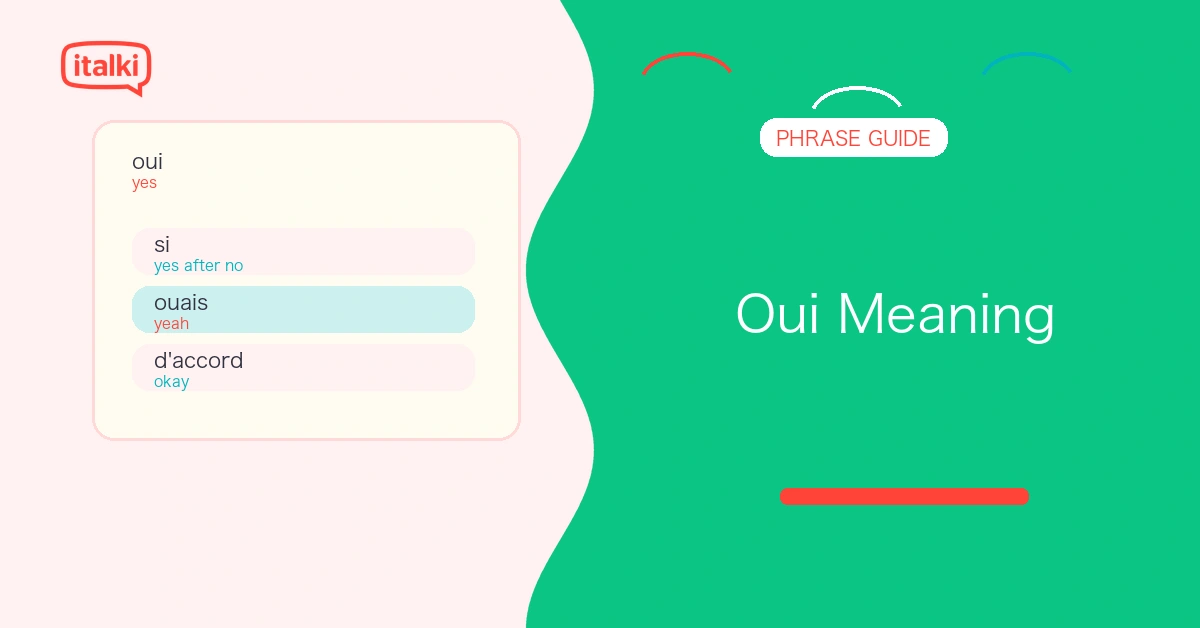
- Oui (pronounced wee) is the standard French word for yes and is used in most affirmative responses.
- Si (not oui) is used to say yes when contradicting a negative statement or question: Tu n’aimes pas le café ? – Si, j’aime le café.
- Casual alternatives to oui include ouais (yeah), mouais (a reluctant yes), and ben oui (well, yes).
- In very formal or professional contexts, oui can be doubled for emphasis: Oui, oui, absolument.
- Oui appears in a large number of fixed expressions and response patterns that go beyond simple affirmation.
Yes in French is rarely just oui. The choice between oui, si, and their informal variants carries information about whether you are agreeing, contradicting a negative, or expressing enthusiasm or reluctance. Getting this right is one of the smaller but consistently noticeable markers of natural French.
italki’s network of 30,000+ expert tutors includes native French teachers who can help you develop these instinctive, automatic responses.
This guide covers the pronunciation of oui, the oui vs. si distinction, casual and formal alternatives, how oui is used in fixed expressions, and examples of oui in real conversation contexts.
Pronunciation of oui
| French | IPA | Pronunciation guide |
|---|---|---|
| oui | /wi/ | Like the English word wee |
Oui is a single syllable. The ou combination in oui is not pronounced like the ou in soup; it is a glide sound. The whole word sounds like wee in English. Many learners mispronounce it as oh-wee (two syllables) or oo-ee, both of which are incorrect.
Oui vs. si: the most important distinction The key rule: use si (not oui) when saying yes to contradict a negative statement or question.
| Situation | French | English |
|---|---|---|
| Affirmative question, affirmative answer | Tu aimes le café ? – Oui, j’aime le café. | Do you like coffee? – Yes, I like coffee. |
| Negative question, contradicting answer | Tu n’aimes pas le café ? – Si, j’aime le café. | You don’t like coffee? – Yes, I do like coffee. |
| Negative statement, contradiction | Il ne viendra pas. – Si, il viendra. | He will not come. – Yes, he will. |
Learn the distinction between oui vs. si through rapid-fire questions with an online French tutor until your response becomes reflexive.

Find your perfect teacher
Build real French confidence with personalized lessons from a teacher who can help with speaking, exam prep, grammar, and pronunciation.
Book a trial lesson
Informal alternatives to oui
| French | Pronunciation | Register | Meaning/feeling |
|---|---|---|---|
| ouais | /wɛ/ (like weh) | Casual | Yeah |
| mouais | /mwɛ/ | Casual | Yeah, sort of / not really enthusiastic |
| ben oui | /bɛ̃ wi/ | Casual | Well, yes / of course |
| bah oui | /ba wi/ | Casual | Well obviously / yes, come on |
| tout à fait | /too ta fε/ | Formal | Absolutely / quite right |
| exactement | /ɛɡzaktəmɑ̃/ | Semi-formal | Exactly / precisely |
| bien sûr | /bjɛ̃ syʁ/ | Semi-formal | Of course |
| absolument | /apsɔlymɑ̃/ | Semi-formal | Absolutely |
For other common words and expressions in everyday French conversation, the guide to most common French words covers the high-frequency vocabulary that makes up the core of spoken French.
Develop register awareness by practicing formal and informal yes responses with French tutors online.
Find your perfect teacher
Build real French confidence with personalized lessons from a teacher who can help with speaking, exam prep, grammar, and pronunciation.
Book a trial lesson
Oui in fixed expressions and response patterns
| French | English |
|---|---|
| Mais oui ! | But of course! / Why yes! |
| Ah oui ? | Oh really? (surprise) |
| Ah oui, c’est vrai. | Oh yes, that’s true. |
| Oui, c’est ça. | Yes, that’s it. / Yes, exactly. |
| Oui, je crois. | Yes, I think so. |
| Oui, je veux bien. | Yes, I’d like that. / Yes, I’m happy to. |
| Oui et non. | Yes and no. |
| Oui ? (rising intonation) | Yes? (answering a phone or a knock at the door) |
Recognise fixed expression patterns in French dialogue and practice responding naturally without translation with a French teacher on italki.
Find your perfect teacher
Build real French confidence with personalized lessons from a teacher who can help with speaking, exam prep, grammar, and pronunciation.
Book a trial lesson
Answering the phone and the door in French
When answering the phone or responding to a knock, French speakers often use oui with a questioning tone:
- Phone: Allô ? or Oui, allô ?
- Door knock: Oui ? or Entrez !
- Calling out to someone: Oui, j’arrive ! (Yes, I’m coming!)
The difference between oui and si seems small but it matters every time you answer a French question. One-on-one conversation practice with a native speaker on italki solidifies this distinction faster than any explanation. Browse French tutors on italki and book your trial lesson today.
Find your perfect teacher
Build real French confidence with personalized lessons from a teacher who can help with speaking, exam prep, grammar, and pronunciation.
Book a trial lesson
FAQ
Why is si used for yes in French when contradicting a negative, but not in Spanish?
Spanish uses sí universally. French is unusual among Romance languages in having a dedicated word si for contradicting negatives. It comes from Latin sic (thus / so it is). German and Swedish have similar systems (doch in German, jo in Swedish).
Is ouais considered rude?
Ouais is not rude; it is simply informal. Using it with close friends, peers, or in casual situations is entirely normal. Using it with a boss, a professor, or in a formal interview would be seen as too casual, similar to saying yeah in an English job interview when yes is expected.
What does mouais signal and when do French speakers use it?
Mouais signals reluctant, unenthusiastic agreement. The speaker is technically saying yes but conveying reservations or lack of enthusiasm. It is similar to meh or I suppose in English. French speakers use it when they want to agree without pretending enthusiasm they do not feel.
Want to learn a language at italki?
Here are the best resources for you!